
Prince Edward & Kwun Tong clinics · Home-visit enquiries elsewhere

TCM Lab

TCM Lab · Outdoor learning & coastal life / Courses and booking

PADI certification costs: turn your questions into a usable booking brief

Content updated

Ask for the course you actually want, read the price label carefully, then request a written total for your learning plan. A short booking brief can keep those separate decisions clear without turning your first enquiry into a commitment.

Illustrative scuba learning preparation objects
AI-generated illustrative concept; not an actual DiveHarbour class, student or dive-site record.

The short answer

For a useful PADI cost enquiry, name the certification level, explain your starting point and state whether you already own eLearning. Ask for an itemised quotation covering training, equipment, logistics and certification processing, followed by dates and written payment terms. A published price, an enquiry reply and a confirmed booking are not the same thing.

DiveHarbour is a separate diving school under the same ownership as TCM Lab. Diving courses and activities are separate from Chinese medicine care; reading this collection or visiting TCM Lab does not replace medical fitness-to-dive assessment or clearance.

Name the certification before asking what it costs

Start with a sentence about the outcome you want, rather than asking only for a diving price. For example: ‘I am a beginner interested in PADI Open Water Diver certification, not a one-off introduction.’ That names both the agency and the course level. It also helps separate your enquiry from a refresher, continuing education or a recreational outing. A supervised introduction is not the same product as a full certification course, even if both involve spending time in the water. [1] [3]

The PADI Open Water course Hong Kong information gives you a starting point for that product conversation. Read it to identify what you still need explained about knowledge development, confined-water practice and open-water training. Then ask the provider which current arrangement fits your experience and availability. The course name establishes the intended route; it does not establish a particular group, location, price or completion date. [1]

Describe your starting point honestly: no previous scuba experience, an introductory session, or learning already begun elsewhere. Mention your preferred teaching language and how comfortable you feel swimming. These details help make the reply relevant without requiring you to understand every course term first. If you are enquiring with a friend, give separate experience summaries rather than assuming the same package and pace will suit both of you.

Separate eLearning from the complete training quotation

An online course price can be easy to mistake for the cost of becoming certified. PADI's education guidance separates knowledge development or eLearning from in-water training and directs learners to their chosen dive shop for local training prices. It also says to notify the shop if you have already purchased eLearning. An overseas online learning amount therefore should not be converted into Hong Kong dollars and presented as a complete local certification budget. [2]

If you have not bought materials, ask whether the proposed quotation includes the appropriate PADI learning access and how it will be supplied. If you have bought them, say which course you purchased and whether you have started or finished it. Ask what records the provider needs to review and what remains to be arranged. Do not assume that owning online materials automatically produces a discount or that practical sessions can be booked without discussing the rest of the course.

Keep this part of the enquiry specific: ‘Please distinguish the learning-material component from the instructor-led practical training and administration.’ That is more useful than asking whether everything is included, because everything means different things to different people. It also lets you compare a materials-only offer with a complete quotation without treating them as competing versions of the same purchase. Study progress is relevant booking information, not evidence that the whole certification has been completed. [2]

Read published prices by agency and activity

Use a public price list to orient your questions, not to fill in missing details. DiveHarbour's scuba diving course price Hong Kong overview lists different activities and course routes, with published amounts described as per person in Hong Kong dollars. The label beside the amount matters as much as the amount itself. An introductory activity, an entry-level course and an advanced course describe different purchases. [3]

In particular, do not take a published NAUI course figure and rename it a PADI fee. The current shared list identifies its adult Open Water group-course entry as NAUI; it is not a personal PADI quotation. Different certification agencies have their own learning and administrative arrangements. If the precise PADI course you want has no clearly labelled amount, write ‘current PADI quotation requested’ in your notes rather than borrowing a nearby price. [3] [4]

Save the page date and course label with any price reference you use. When a reply arrives, check whether it describes the same agency, level and teaching format. A group-course headline and a quotation for a different arrangement may not be directly comparable. Ask what changed instead of assuming a mismatch is either a hidden charge or a better deal. The aim is to understand the offer well enough to decide, not to find a number that seems to validate an earlier guess.

Ask for a total attached to a defined learning plan

The PADI scuba certification price Hong Kong page points readers towards a current, course-specific quotation and an inclusion check. Use that enquiry to ask for a total attached to your proposed format, not simply a repeated headline amount. Request that included items, separately payable necessities and optional purchases be identified. The page highlights materials, practical training, equipment, certification processing and venue or boat costs as matters to clarify. [4]

Ask whether equipment rental covers each planned practical session and what personal items you must supply. Ask how fitting is arranged and whether something you already own can be used. Keep transport questions distinct: getting yourself to a meeting point is not necessarily the same as boat transport during the course. Likewise, ask whether certification processing is part of the quote rather than assuming that the word certification settles every administrative charge.

For anything not yet decided, request the basis of the cost rather than demanding an invented all-inclusive figure. A useful question is: ‘If additional supervised practice is needed, how would its scope and fee be agreed before it is booked?’ Keep optional purchases outside your core comparison until you decide you want them. Your working budget should distinguish the quoted course payment from your own travel or personal purchases, and it should leave unresolved items visibly unresolved instead of silently counting them as free.

Put date constraints and change terms beside the cost

A quotation is useful only if the learning plan can fit your calendar. Tell the provider which dates you can attend, which are merely preferences and whether a holiday or work commitment creates a deadline. Ask when independent study needs to be completed and how practical sessions would be arranged. PADI describes its certification courses as flexible and performance-based; a general completion estimate is not a promise of your provider's timetable or your own progress. [2]

The current DiveHarbour booking page states that all fees are non-refundable and make-up sessions are subject to written terms. Read those conditions before payment. Ask how the applicable terms address a missed session, weather disruption or a request for more practice, and whether any permitted make-up has separate costs or availability conditions. Do not assume that a cancelled outdoor session creates a refund entitlement, a free replacement or a guaranteed new date. [5]

If your availability is narrow, say so before accepting the proposal. A plan that relies on you attending another day may be unsuitable even if its initial fee fits your budget. Ask which practical arrangements are confirmed and which remain provisional. Also explain any need for a slower learning pace. Paying for a course does not guarantee certification, and protecting a travel deadline is not a reason to conceal difficulty or continue when you feel unwell. [1]

Know when the enquiry becomes a confirmed booking

When you are ready to book a scuba diving course in Hong Kong, send the course name and participant details together with your date options. The booking information describes a discussion of fit, arrangements, documents, payment and written terms before confirmation. An enquiry is not a held place. A helpful reply can move the conversation forward without proving that the requested dates or proposed practical arrangements are secured. [5]

Before paying, bring the final version into one written record: agency and course level, participants, proposed learning format, total and inclusions, agreed dates or unresolved arrangements, payment instructions and applicable terms. If a later message changes the format or price, ask for the updated version and which earlier details it replaces. This is especially useful when you have compared several options and could otherwise accept a fee while remembering the inclusions from a different proposal.

Complete the requested course documents yourself and answer health questions honestly. If the screening process requires medical review, allow time for an appropriate doctor to assess you; ask privately how to submit the required form. TCM Lab's lifestyle reading and a TCM consultation do not provide fitness-to-dive clearance. Keep payment evidence with the final agreement, then obtain explicit written confirmation of the booking and any remaining preparation. A receipt records a payment; you still need to understand the agreed arrangements. [5]

Turn your notes into a message the provider can answer

Use this adaptable opening: ‘I am enquiring about PADI Open Water Diver certification. My previous scuba experience is [describe it], and my swimming comfort is [describe it]. I prefer learning in [language]. My available dates are [date windows], with [any firm deadline]. I [have or have not] purchased eLearning. I expect to need [equipment arrangement to discuss]. Please advise whether this course and proposed format are suitable.’ Replace the brackets with your own details; this is an enquiry format, not a recommended answer about eligibility.

Follow with the decision-making request: ‘Please provide the current per-person total and state the currency, included learning materials, practical training, equipment, certification processing and venue or boat arrangements. Please identify compulsory separate charges and optional purchases. What preparation is required before practical sessions? How would extra practice or a changed session be handled under the written terms? What needs to be agreed and paid before the booking is confirmed?’ This gives the provider concrete questions to answer rather than a broad request for the best deal.

When the response arrives, compare it with your original notes. Mark each unresolved point as a question, not as an assumed inclusion. If the course fits, accept the final written proposal and follow its confirmed next steps. If it does not, explain whether the obstacle is price, availability, course choice or learning support. A usable booking brief helps you make that decision before spending, while preserving the distinction between a course enquiry, a published reference price and the arrangement you actually agree to buy.

Take it into everyday life

A practical checklist

  • Name PADI and the exact certification level; distinguish certification from an introductory activity.
  • Describe each participant's experience, swimming comfort, teaching-language preference and practical needs separately.
  • State whether eLearning is already purchased or completed, and ask what records need review.
  • Supply genuine date windows and identify any firm deadline without expecting guaranteed completion.
  • Request a current total with currency, inclusions, compulsory separate charges and optional items distinguished.
  • Clarify equipment fitting, personal kit, meeting-point travel and any venue or boat arrangements.
  • Read the non-refundable-fee policy and applicable written make-up terms before payment.
  • Resolve contradictions, complete required documents and retain the final agreement, payment record and booking confirmation.

Questions & answers

Can I use the online PADI eLearning price as my full Hong Kong certification budget?

No. PADI distinguishes knowledge development or eLearning from in-water training and directs learners to their chosen dive shop for local costs. Ask which components are covered in your provider's quotation. An overseas materials-only amount is not a complete Hong Kong training fee. [2]

Why does the published Open Water amount not answer my PADI enquiry?

Read the agency and format beside the price. DiveHarbour's current shared list labels its adult Open Water group-course entry as NAUI. That figure should not be re-labelled as PADI. Ask for the current quotation for the PADI level and arrangement you actually want. [3] [4]

What should I say if I have already bought PADI learning materials?

Identify the course purchased and your study progress, then ask which records the provider needs and what training remains to be arranged. PADI advises notifying the chosen dive shop about an existing eLearning purchase. Do not assume an automatic reduction or guaranteed practical-session booking. [2]

Does receiving a quote mean my place is reserved?

No. A quotation sets out a proposed purchase; an enquiry does not guarantee availability. Clarify course fit, participants, dates, arrangements, payment requirements and written terms, then obtain explicit booking confirmation. Keep the final version rather than relying on an earlier message about a different option. [5]

Can I receive a refund or automatically move a session if my plans change?

DiveHarbour's current published policy states that all fees are non-refundable. Make-up sessions depend on the written terms and are not an automatic replacement or guaranteed free change. Ask how the applicable policy addresses your circumstances before paying, and do not build your budget around an assumed refund. [5]

Will paying the whole fee guarantee that I am certified before my holiday?

No. PADI describes certification courses as performance-based, and certification depends on completing the relevant learning requirements. State your holiday deadline during the enquiry and ask what happens if practice or practical arrangements need more time. Neither payment nor a preferred schedule guarantees completion. [1] [2]

Should I include medical details in the first pricing message?

Ask how the required screening documents are handled and raise relevant questions privately. Complete your own answers honestly, with appropriate medical review when the process requires it. TCM Lab reading or consultation cannot provide fitness-to-dive clearance; a price quotation does not settle medical suitability. [5]

Sources & further context

Numbered references follow the source order below. Course websites describe their own programmes; health and coastal sources have separate purposes and do not endorse commercial course quality.

  1. [1] DiveHarbour: PADI Open Water Course in Hong Kong
  2. [2] PADI: Scuba Diving Training and Education Courses
  3. [3] DiveHarbour: Scuba Diving Course Prices in Hong Kong
  4. [4] DiveHarbour: PADI Scuba Course Fees in Hong Kong
  5. [5] DiveHarbour: Book a Scuba Diving Course in Hong Kong

Match each quoted component to a learning stage

Give your quotation notes separate spaces for knowledge preparation, confined-water practice and open-water training. Beside each, record the proposed arrangement, what the quote covers and what still needs an answer. If a reply names practical training without explaining its scope, ask the provider to connect that wording to the proposed sessions. This makes it easier to spot an unanswered question without assuming that a missing detail means an excluded service.

Keep an existing eLearning purchase in its own line, with the course name and study progress. Do not count the same materials twice in your working budget or subtract an imagined credit. Ask for clarification if the new quotation includes materials you believe you already own. The stage record is a comparison aid, not a substitute for the provider's course requirements or final agreement.

Conceptual arrangement of a closed book, an empty miniature pool and a separate abstract open-water cove.
Separate learning contexts help organise quotation questions; this concept illustration is not a course timetable or an actual training venue.Generated illustrative image

Ask for an equipment list rather than a package label

Use an equipment illustration to start a question list, not to infer what your package supplies. Ask which rental items are provided for each practical stage and whether the quoted arrangement covers all the sessions currently proposed. Keep the provider's answer beside the equipment line in your quotation notes. A picture of a buoyancy compensator, regulator, mask and fins cannot establish the contents, condition or suitability of anyone's rental kit.

If the reply says you need to supply an item, ask whether it must be purchased or whether another arrangement can be agreed. Request clarification before adding a purchase to the budget. Record unresolved equipment questions separately from confirmed rental inclusions so that an appealing package description does not become an assumed shopping list.
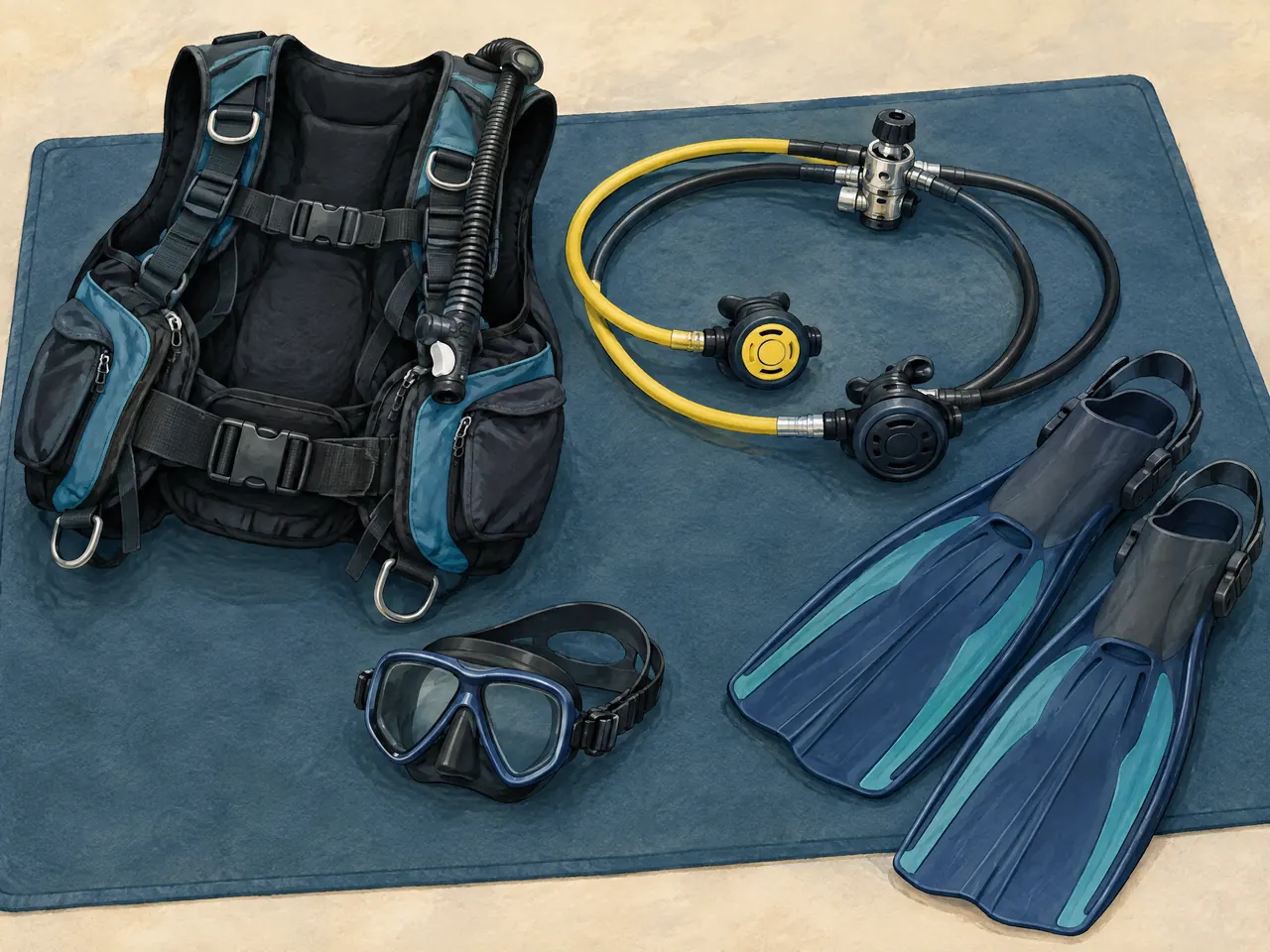
Unbranded buoyancy compensator, regulator assembly, mask and fins arranged separately on a dry preparation mat.
Illustrative equipment objects for an inclusion checklist, not a record of equipment supplied by DiveHarbour.Generated illustrative image

Put fitting questions before personal purchases

A rental inclusion and an equipment-fitting arrangement are different details to confirm. Ask when you can discuss mask and fin fit, who will help you with that discussion and how to raise a comfort concern before a practical session. If you own equipment, describe the specific items rather than writing only 'own kit'. Ask whether the provider can review them for the proposed course; do not treat ownership as approval to use them.

Keep any suggested personal purchase provisional until you understand why it is needed and whether it is compulsory or optional. The two masks and fins in the illustration represent questions to discuss, not recommended models, sizes or a self-fitting method.
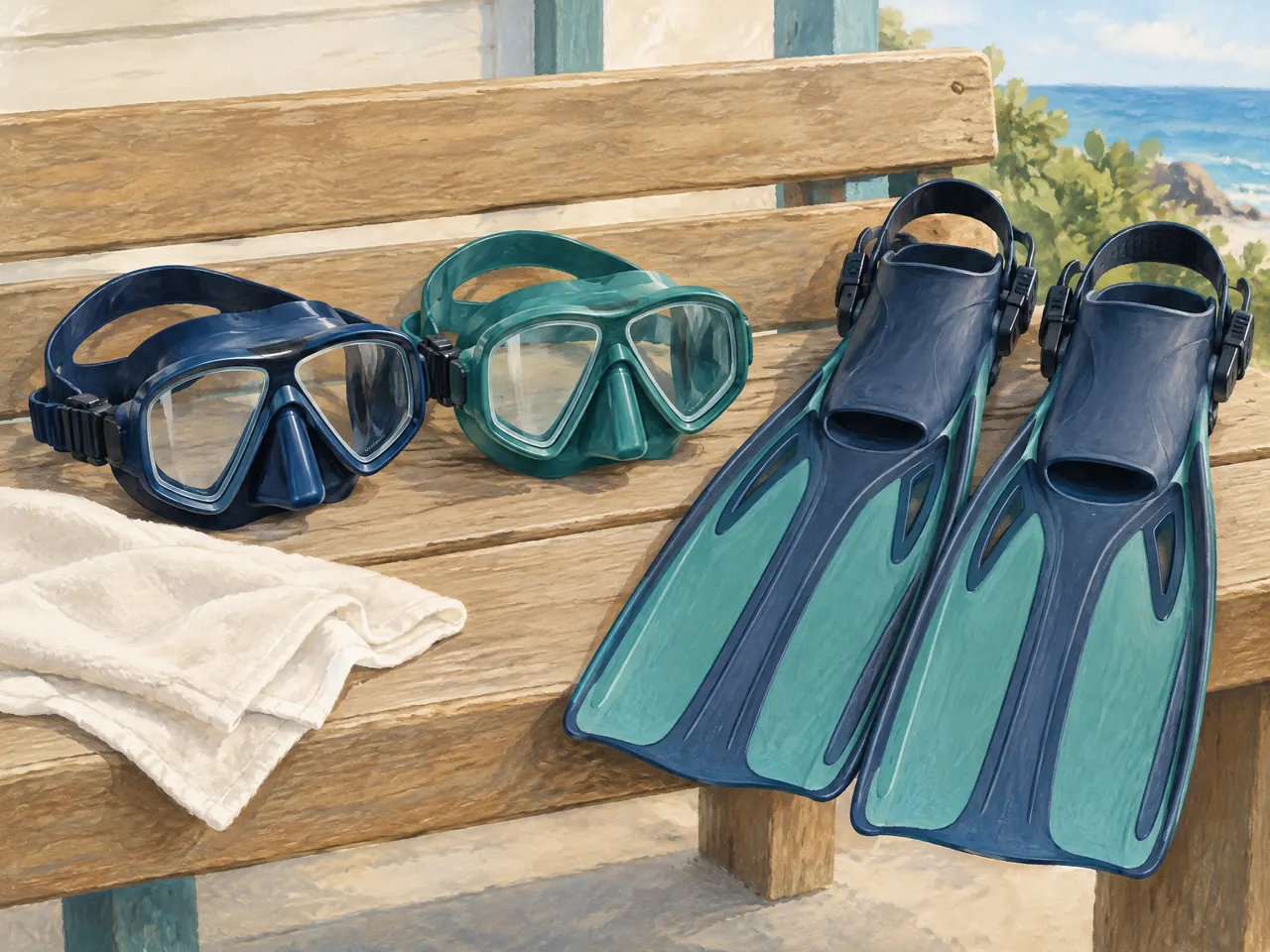
Two generic scuba masks and separate adjustable fins on a bench beside a clean cloth.
Generic masks and fins illustrate a fitting conversation, not a product recommendation or an actual learner's equipment.Generated illustrative image

Keep an unresolved session change visibly unresolved

For an outdoor session that remains provisional, write down the proposed date and ask how any change would be communicated. Request the relevant written terms and ask what would need to be agreed about a replacement arrangement and any cost. Until the provider answers, keep the date and cost questions open rather than assigning a free replacement or assuming that your alternative date is available.

If a later message proposes a different venue or session, compare it with the previous written plan. Ask which arrangements it replaces and whether equipment, transport or payment details also change. Weather information can prompt that conversation; it is not a basis for you to set a safe-diving threshold or override the provider's decisions.
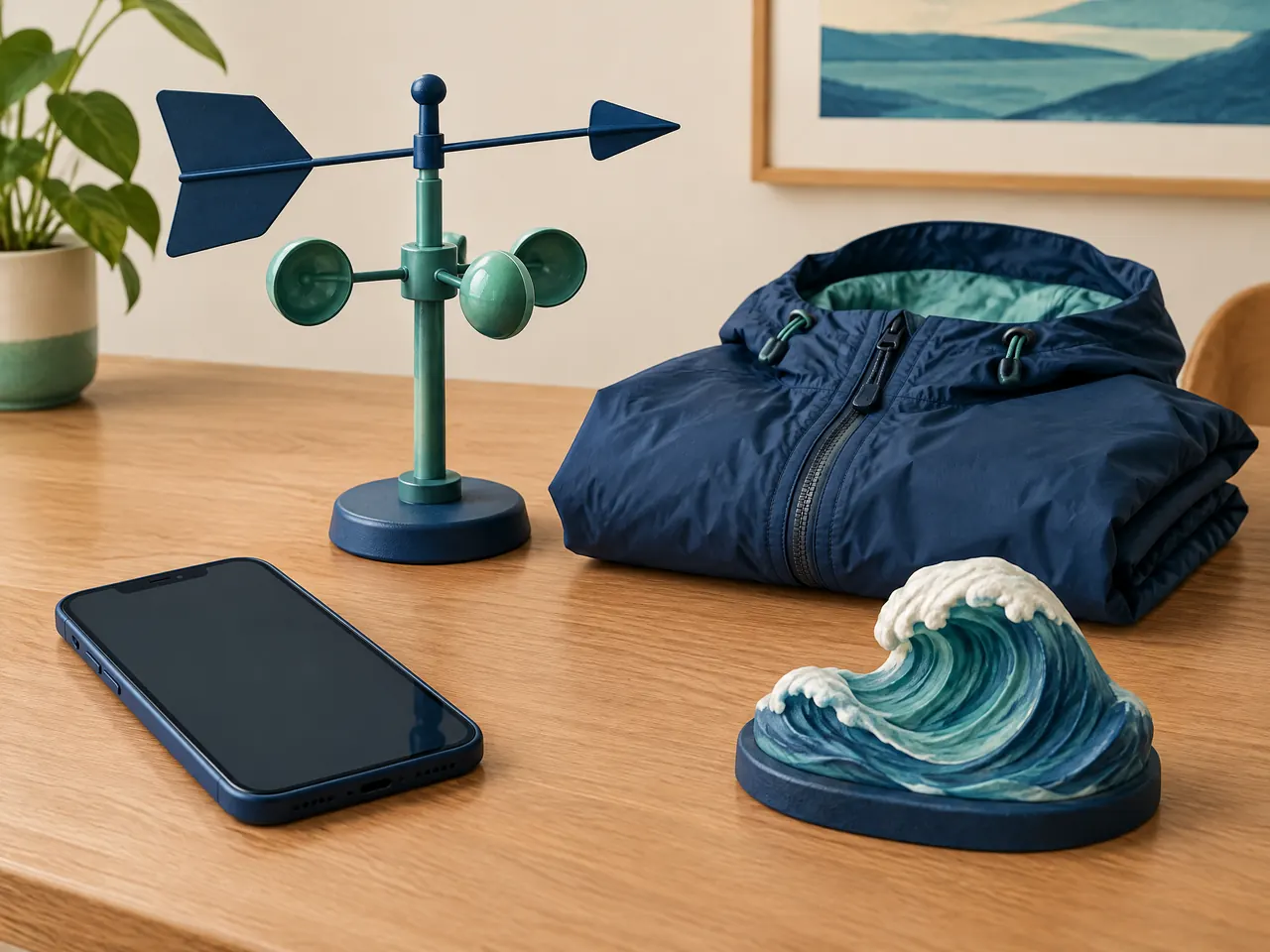
Unbranded phone with a blank screen beside a wind vane model, rain shell and miniature wave sculpture.
Concept objects prompt weather and change-term questions; the blank phone is not a forecast, safety assessment or confirmed session notice.Generated illustrative image

Separate your packing budget from the course quotation

Once the practical arrangements are explained, make a small personal-preparation list alongside the course total. Ask what to bring, what facilities are available and whether the session involves a boat journey. A towel, water bottle, hat or bag may belong in your own preparation notes, but do not assume that anything pictured is supplied, required or appropriate for every session.

Mark what you already own before budgeting for new purchases. Keep personal travel and packing costs separate from charges payable to the provider, and identify any question that still depends on the venue. This lets you estimate your own spending without changing the quoted course amount or mistaking personal outing items for specialist diving equipment.

Open dry bag with a towel, water bottle and sun hat beside deck-shoe silhouettes on an abstract empty timber surface.
Personal packing objects illustrate a separate preparation list, not a course inclusion, required kit list or actual boat-day record.Generated illustrative image

Clinic enquiries

Contact and appointment arrangements

Clinics
Prince Edward and Kwun Tong
Opening hours
11:00–21:00
WhatsApp and telephone
+852 6940 5663

Appointments, practitioner availability and service arrangements are confirmed via WhatsApp.

Please mention any consultation language needs in your WhatsApp enquiry so that arrangements can be confirmed.

Enquire via WhatsApp
Food, gifts and floral lifeWhatsApp enquiry