
TCM Lab · Health reading
lumbar spondylosis symptoms and lumbar radiculopathy symptoms: What are the symptoms of lumbar spondylosis?
Published Updated
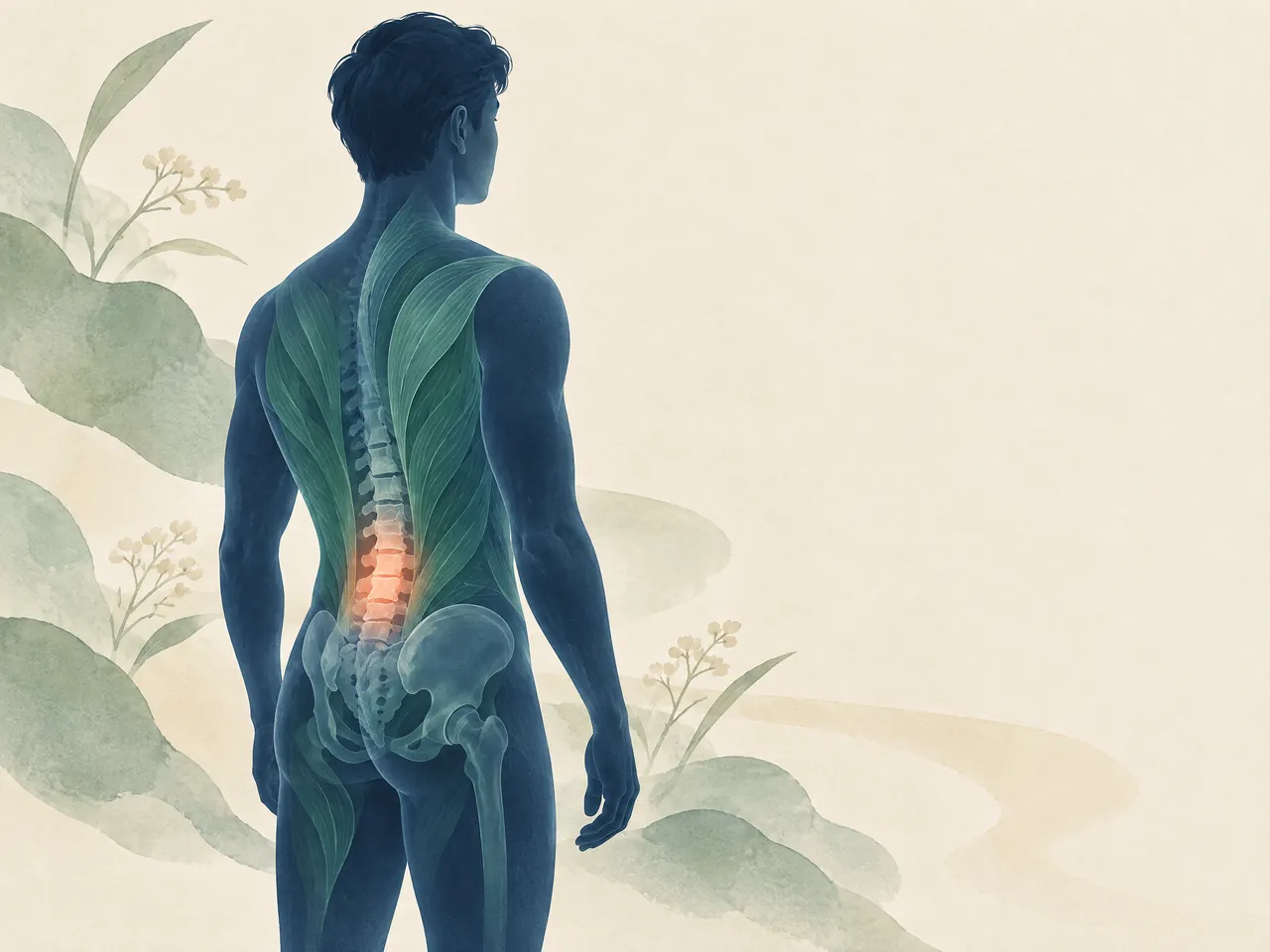
Low-back wear-and-tear changes are common, but a scan label alone does not tell you how much pain or limitation you will have. Lumbar spondylosis symptoms often centre on aching low-back pain, stiffness after stillness and a reduced ability to bend or turn. When a nerve root is irritated, the picture can include pain, tingling, numbness or weakness travelling through the buttock and leg. The useful question is not simply whether a scan shows degeneration, but which symptoms are present, how they behave, and whether any warning sign needs medical care first.
Appointments are confirmed through WhatsApp. If you have language requirements, please mention them in your enquiry.
The short answer
Lumbar spondylosis symptoms can include low-back pain, stiffness and limited movement; some people have no symptoms at all. Lumbar radiculopathy symptoms occur when a lumbar nerve root is irritated and may include pain, tingling, numbness or weakness extending into a leg. Walking-related leg heaviness or pain can also occur with spinal narrowing. New bladder or bowel problems, progressive weakness, fever, unexplained weight loss or severe worsening pain need prompt medical assessment rather than acupuncture first.
Transparent pricing
See the fees.
Choose your care.
Explore our complete official price list, including first-trial prices, regular prices, packages and branch-specific options.
Opening WhatsApp prepares an enquiry; it does not send a message, take payment or confirm an appointment. Suitability and individual arrangements are confirmed during consultation.
Pain care
All prices in HKDExtracorporeal shockwave treatment
Shockwave treatment for deep-tissue and fascial care. The Kwun Tong clinic offers the multi-area options shown below.
Priced by branch
Branch-specific pricing
Prince Edward: HK$250 per area
Kwun Tong: HK$250 for 1 area / HK$450 for 2 areas / HK$600 for 3 areas
Pain care (manual therapy)
Includes Chinese medicine musculoskeletal assessment, manual joint techniques and tui na.
HK$580 (single session)
Chinese medicine musculoskeletal assessment
Pain care (acupuncture and manual therapy)
Combines acupuncture and manual therapy.
HK$680 (single session)
Combined care
Hair and scalp
All prices in HKDScalp health and hair-loss management
Includes AI scalp analysis, deep scalp and follicle cleansing, and scalp oil-control care.
HK$380 (first trial)
Regular price: HK$680
- 6 sessions: HK$3,480 (HK$580 per session)
- 12 sessions: HK$5,760 (HK$480 per session)
- 20 sessions: HK$8,600 (HK$430 per session)
- 30 sessions: HK$11,400 (HK$380 per session)
Hair acupuncture and Chinese herbal medicine package
Includes scalp acupuncture and 3 days of Chinese herbal medicine that does not require decoction.
HK$580 (single session)
Registered Chinese Medicine Practitioner consultation
- 6 sessions: HK$3,180 (HK$530 per session)
- 12 sessions: HK$5,760 (HK$480 per session)
- 20 sessions: HK$8,600 (HK$430 per session)
- 30 sessions: HK$11,400 (HK$380 per session)
Combined hair and scalp treatment
Combines acupuncture and Chinese herbal medicine with salon-level scalp and follicle care. Packages include complimentary hair-care shampoo and serum.
HK$1,260 (single session)
Combined treatment
- 8 sessions: HK$8,640 (HK$1,080 per session)
- 16 sessions: HK$15,680 (HK$980 per session)
- 20 sessions: HK$18,600 (HK$930 per session)
- 30 sessions: HK$26,400 (HK$880 per session)
Weight management
All prices in HKDFull-body acupoint embedding for weight management
Includes full-body acupoint embedding. Packages include complimentary Chinese herbal medicine for weight management, with the number of included days scaled to the package. Embedding material and the individual treatment arrangement are confirmed during consultation; this is not a cosmetic thread lift.
HK$980 (single session)
No trial session
- 10 sessions: HK$7,800 (HK$780 per session)
- 20 sessions: HK$14,600 (HK$730 per session)
- 30 sessions: HK$20,400 (HK$680 per session)
Facial acupuncture
All prices in HKDFacial acupuncture (basic)
Includes facial acupuncture and meridian-based facial care, including care for facial puffiness.
HK$480 (first trial)
Regular price: HK$680
- 10 sessions: HK$5,200 (HK$520 per session)
- 20 sessions: HK$9,600 (HK$480 per session)
- 30 sessions: HK$13,500 (HK$450 per session)
Facial acupuncture (advanced)
Includes enhanced facial acupuncture with a specially formulated moisturising mask and serum.
HK$780 (first trial)
Regular price: HK$1,180
- 10 sessions: HK$9,000 (HK$900 per session)
- 20 sessions: HK$16,600 (HK$830 per session)
- 30 sessions: HK$23,400 (HK$780 per session)
Chinese medicine
All prices in HKDAcupuncture and Chinese herbal medicine package
Includes a Chinese medicine consultation with pulse assessment, body acupuncture and 3 days of Chinese herbal granules that do not require decoction.
HK$580 (single session)
Chinese medicine consultation with pulse assessment
lumbar spondylosis symptoms, lumbar radiculopathy symptoms — What are the symptoms of lumbar spondylosis? A practical overview
Lumbar spondylosis is a broad term for age-related degenerative changes in the lower spine. Discs can lose height, facet joints can become arthritic, and ligaments or surrounding structures can change over time. These findings are not a pain score. One person may have visible changes and stay active with few symptoms, while another has a flare of back pain or a leg symptom that deserves assessment. Hospital for Special Surgery notes that pain, limited movement and nerve-compression symptoms depend on the structures affected, and that some people have no symptoms at all [1].
For a day-to-day description, notice the location, quality and pattern of discomfort. An ache after sitting through a long meeting is different from sharp, electric pain running below the knee. Stiffness after a car ride, difficulty putting on shoes, or pain when bending may all matter. Note what eases the symptom: changing position, sitting, gentle movement or none of these.
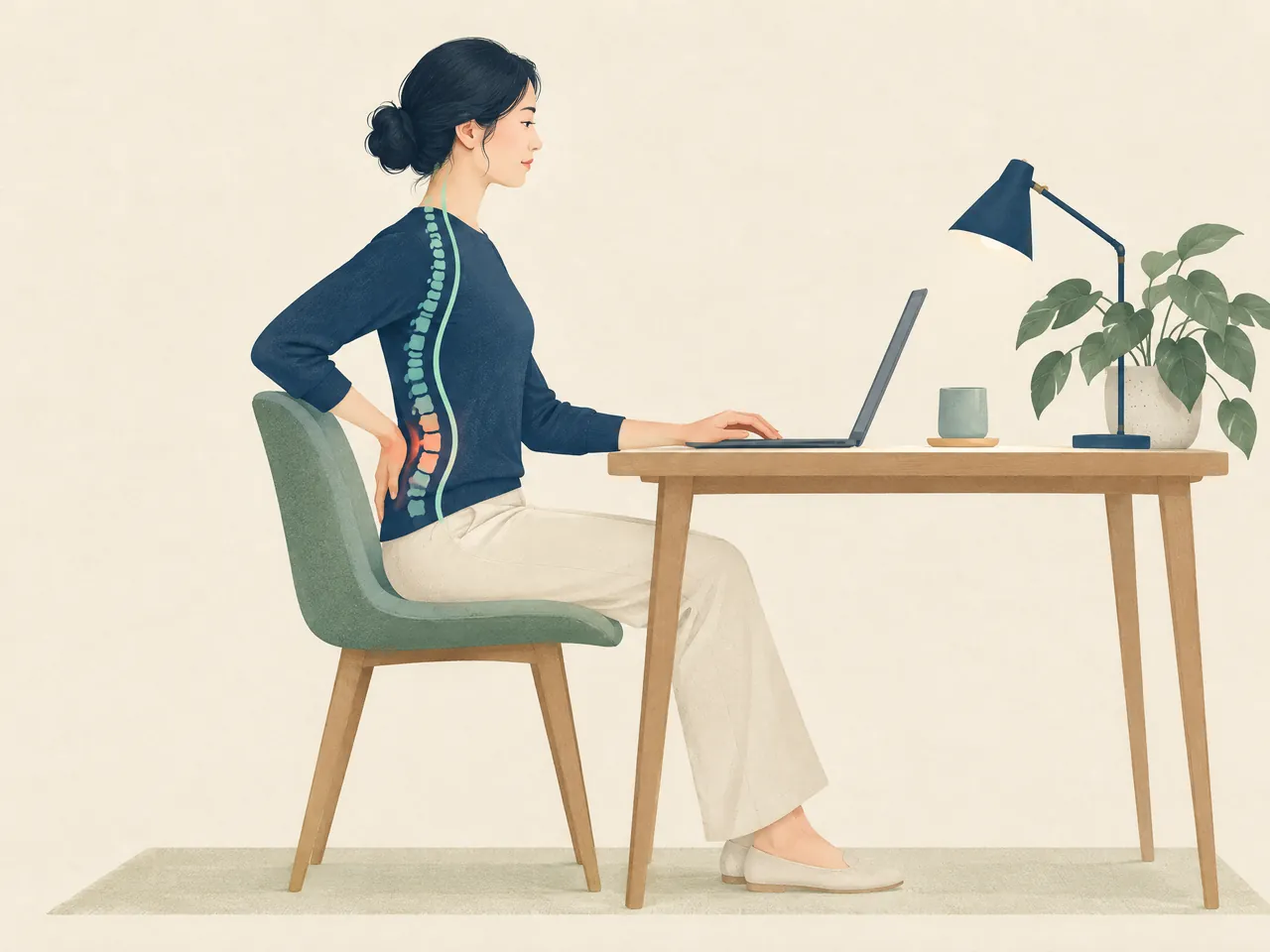
Separate a familiar, stable symptom from a new change. A recurring ache that settles with activity calls for a different discussion from sudden walking change, new foot weakness, altered sensation around the groin, or severe pain after an injury. low back stiffness and limited movement is a useful description, not a diagnosis. History and examination help consider whether symptoms are mechanical, nerve-related, inflammatory or from another condition.
The comparison below helps organise observations before a consultation; it cannot confirm which structure is responsible. Symptoms overlap with hip, vascular, neurological and other problems. Report what you feel, where you feel it and what changes it.

lumbar spondylosis symptoms and lumbar radiculopathy symptoms: What are the symptoms of lumbar spondylosis? — Back pain and stiffness
Back symptoms may stay around the belt line or to either side of the spine. They can feel dull, tight or sore, especially after one position is held too long. Bending, twisting, standing from a low chair or carrying a bag may make limitation clearer. A crunching feeling alone does not establish nerve damage; the key detail is whether movement is restricted or triggers leg symptoms.
Lumbar radiculopathy symptoms differ in distribution. Nerve-root irritation or compression can cause pain, tingling, numbness or weakness into the buttock, thigh, lower leg or foot. It may be called sciatica when the sciatic-nerve pattern is involved, but not every leg pain is sciatica. Explain the side, whether it is constant, and whether coughing, sitting or posture provokes it. HSS describes these radiating sensory and motor symptoms as possible effects of lumbar nerve compression or inflammation [1].
lumbar spondylosis symptoms and lumbar radiculopathy symptoms: What are the symptoms of lumbar spondylosis? — Movement and walking changes
Movement changes can be subtle. You may turn your whole body rather than rotate through the waist, take longer to stand upright, or avoid lifting from the floor. Explain how symptoms affect a typical activity, such as walking from the MTR, dressing, driving, stairs, a work shift or lifting a child. That functional detail is often more useful than a pain score alone.
Leg symptoms after standing or walking deserve attention. With spinal-canal narrowing, some people experience heaviness, tingling, pain or weakness in one or both legs that improves when sitting or bending forward. This is called neurogenic claudication. It is not the same as every calf ache, and should not be assumed from symptoms alone. Seek medical assessment if the walking distance is shrinking or the leg gives way. HSS also identifies this standing- or walking-related pattern in lumbar spinal stenosis [1].
Compare your options
| What you notice | Details worth recording | Why it may change the next step |
|---|---|---|
| Local low-back ache or stiffness | Position, time of day, bending or turning limitation, and effect on work or sleep | Helps distinguish a local functional problem from a new or spreading symptom pattern. |
| Pain, tingling or numbness into one leg | Exact route, side, whether it reaches the foot, and triggers such as sitting or coughing | May prompt assessment for lumbar radiculopathy symptoms rather than back pain alone. |
| Heaviness or pain when standing or walking | Approximate activity that brings it on and whether sitting or leaning forward relieves it | Can help a clinician consider a claudication-type pattern and other possible causes. |
| Weakness or altered balance | Newness, progression, foot catching, falls, and tasks that have become unsafe | Progressive or marked weakness needs prompt medical assessment. |
| Bladder or bowel change, fever, major trauma or unexplained weight loss | When it began and any associated saddle numbness or severe worsening pain | These are warning signs for urgent medical review, not a routine acupuncture-first visit. |
On smaller screens, scroll the table sideways to compare all columns.
lumbar spondylosis symptoms, lumbar radiculopathy symptoms — What are the symptoms of lumbar spondylosis? Assessment before acupuncture
Assessment starts with the story, not an assumption that every low-back problem is lumbar spondylosis. Say when it began, whether it followed an incident, where symptoms travel and how sleep, work or walking are affected. Mention previous episodes, treatments and relevant history such as a fall, injury, infection, cancer or osteoporosis. How is lumbar spondylosis assessed? explains why history, examination and existing records are considered together.
A practitioner may observe standing and movement, ask you to bend or walk, and check tenderness, tension, sensation, strength or reflexes as appropriate. These findings can indicate whether the symptom seems local, nerve-related or needs referral. A scan is not automatic, and an old X-ray or MRI does not explain every current symptom. Its timing, report and relation to the present pattern matter.

For acupuncture, safety screening is part of the appointment. A Hong Kong low-back-pain guideline covers Western diagnosis, traditional syndrome differentiation, rehabilitation and follow-up; it says unsuitable conditions and severe spinal or systemic pathology should be excluded before treatment is considered [2]. The Chinese Medicine Hospital of Hong Kong also describes history assessment and integrated Chinese-Western care in its low-back-pain programme [3]. Clear symptom and treatment information is more useful than a self-selected treatment request.
lumbar spondylosis symptoms and lumbar radiculopathy symptoms: What are the symptoms of lumbar spondylosis? — History, medicines and imaging
Bring or photograph relevant reports if you have them: recent X-ray, MRI or CT reports, referral letters and a list of diagnoses. It is equally important to list all current medicines, including pain medicines, anti-inflammatory medicines, blood thinners, supplements and Chinese medicines. Tell the practitioner about allergies, pregnancy, bleeding problems, implanted devices, surgery, diabetes and major chronic conditions when applicable. Do not stop or change prescribed treatment because you are exploring acupuncture; discuss any concern with the clinician who prescribed it.
Useful history is specific but brief. Note whether pain wakes you at night, whether there is fever or a general unwell feeling, and whether the leg changes are sensory, strength-related or both. State if the symptom has become rapidly worse, if a foot catches on the ground, or if you are avoiding tasks that were previously easy. If imaging has been done, the report may guide the conversation, but it should be interpreted alongside your examination and current symptoms rather than used as a stand-alone forecast of recovery.

lumbar spondylosis symptoms and lumbar radiculopathy symptoms: What are the symptoms of lumbar spondylosis? — Traditional Chinese medicine assessment
A Traditional Chinese medicine consultation may include observation, questions about the symptom and general health, and pulse or tongue assessment, alongside a local examination of movement, tension and tender areas. In traditional terminology, a practitioner may discuss patterns such as cold-damp obstruction, qi and blood stagnation, or liver-kidney deficiency. These are traditional clinical approaches for planning care; they do not replace a medical diagnosis of nerve compression, fracture, infection or another structural condition.
If acupuncture is considered suitable, ask what the proposed goal is for your situation: easing a particular pain pattern, helping movement, or supporting a broader care plan. Ask what information would change that plan and when other assessment should take priority. The Hong Kong guideline notes that traditional syndrome differentiation rests on traditional theory and clinical experience and has relatively low-level evidence in its grading [2]. A careful explanation of limits is therefore more useful than a promise that one treatment will fix a degenerative finding.
lumbar spondylosis symptoms, lumbar radiculopathy symptoms — What are the symptoms of lumbar spondylosis? Management and safety
Management follows the symptom pattern and impact on life, not an effort to erase imaging language. Depending on assessment, it may involve medical review, physiotherapy or exercise guidance, pain management, activity modification, acupuncture or more than one of these. Identify positions and loads that aggravate symptoms, maintain essential movement within tolerable limits, and seek review if the pattern worsens or does not make sense.
Use observations rather than rigid rules. Break up prolonged sitting or standing when feasible; vary work, travel and lifting; and avoid repeatedly testing a painful movement. A short symptom note can show whether sitting, extension, walking, bending, lifting or poor sleep is the main trigger. Take it to physiotherapy, medical or Chinese medicine appointments so the plan addresses a real functional problem.

After symptoms ease, avoid both returning to every heavy task at once and permanent avoidance. Discuss a paced return to activities that matter. If leg pain, numbness or weakness is present, review whether the distribution or strength is changing rather than focusing only on low-back soreness. For a fuller discussion, see acupuncture for lumbar spondylosis.
lumbar spondylosis symptoms and lumbar radiculopathy symptoms: What are the symptoms of lumbar spondylosis? — Acupuncture's role and limits
Acupuncture may be discussed as a symptom-management option after an appropriate assessment. A session commonly uses fine, sterile single-use needles at selected points; the choice of points and any accompanying approach should follow the individual assessment. It may sit alongside other care rather than replace it. The fact that acupuncture is being considered does not mean that a person has one fixed diagnosis, nor does it mean that every back or leg symptom should be treated with needling first. For context on this option in the broader low-back-pain discussion, read acupuncture for low back pain.
Set expectations around function and safety, not structural repair. Acupuncture cannot remove bone spurs, restore disc thickness or guarantee a set number of treatments will work. Tell the practitioner about changes in medicines, new symptoms and any reason you may be at higher risk of bleeding or infection. If the assessment raises concern about marked nerve compression, instability or another serious cause, medical or specialist evaluation may be the priority. The guideline source describes acupuncture practice within a pathway that includes diagnosis, rehabilitation and follow-up, not as a substitute for those steps [2].

lumbar spondylosis symptoms and lumbar radiculopathy symptoms: What are the symptoms of lumbar spondylosis? — Red flags and daily habits
Seek urgent medical care rather than trying acupuncture first if you develop new bladder or bowel incontinence, difficulty passing urine, numbness around the saddle area, rapidly progressive leg weakness, or a new foot drop. Fever, unexplained weight loss, a history of cancer, severe pain that is escalating or pain after significant trauma also need timely medical attention. These signs do not prove one diagnosis, but they can point to conditions that need urgent assessment. HSS advises more immediate care for weakness including foot drop and bladder or bowel dysfunction [1]; NIH MedlinePlus also lists fever, unintentional weight loss, severe trauma and worsening neurological symptoms among reasons to contact a provider promptly [4].
For non-urgent symptoms, daily habits can support a steadier pattern without becoming a cure claim. Choose frequent position changes over long unbroken periods in one posture. Use a bag, workstation and lifting method that let you keep a comfortable, controlled position. Build activity gradually with advice appropriate to your condition, and allow sleep, stress and workload to be part of the conversation because they can influence how manageable pain feels. If a habit reliably makes leg symptoms spread, weakness increase or walking less safe, stop and seek advice rather than forcing repetition.
Care and health guide
Health service information
This directory brings together services, reading, and visit information related to health services, to help you prepare questions for a consultation.
If you are organising health questions, Chinese medicine clinic Hong Kong is a starting point for learning about related services and preparing for a consultation.
People have different needs; acupuncture Hong Kong provides further reading to help you understand options in your own context.


Your questions, answered
Frequently asked questions
Can lumbar spondylosis symptoms come and go?
They can vary with posture, activity, sleep, workload and the particular structures involved. A fluctuating pattern does not rule out a problem, but a clear new worsening, spreading leg symptoms or loss of function should be assessed rather than assumed to be a routine flare.
Does leg tingling always mean lumbar radiculopathy?
No. Tingling can have several causes. Lumbar radiculopathy is one possibility when symptoms follow a nerve-related pattern from the lower back or buttock into the leg, but history and examination are needed to consider other explanations.
Should I bring an old MRI report to a Chinese medicine consultation?
Yes, bring it if available, together with other recent reports and your current medicine list. The report is useful context, but the practitioner also needs to know how your symptoms have changed and whether medical or physiotherapy assessment should come first.
Can acupuncture replace medical assessment for suspected nerve compression?
No. Acupuncture should not replace a needed medical assessment, especially with progressive weakness, bladder or bowel symptoms, severe or rapidly worsening pain, fever, unexplained weight loss or other red flags. Its role, if any, should be discussed after safety screening.
Sources and further information
- [1] Hospital for Special Surgery — Lumbar and Cervical Spondylosis: Symptoms and Treatments
Referenced for: Hospital clinical overview used for symptom patterns, lumbar radiculopathy, neurogenic claudication and urgent nerve-related warning signs.
- [2] PubMed Central — Acupuncture for low back pain: a clinical practice guideline from the Hong Kong taskforce of standardized acupuncture practice
Referenced for: Hong Kong taskforce guideline used for the scope of low-back-pain assessment, acupuncture pathways, exclusions and limits of traditional syndrome differentiation.
- [3] Chinese Medicine Hospital of Hong Kong — Low Back Pain Care Programme
Referenced for: Hong Kong public hospital service information used for its integrated Chinese-Western assessment and medical-history context; not evidence that TCM Lab offers the same programme.
- [4] NIH MedlinePlus — Low back pain, acute
Referenced for: U.S. National Library of Medicine public-health reference used for urgent low-back-pain warning signs including fever, unintentional weight loss, severe trauma and neurological or bladder/bowel changes.