
TCM Lab · Health reading
Lateral Epicondylitis Acupuncture: Acupuncture Assessment for Elbow Pain and Elbow Pain Range of Motion Assessment
Published Updated
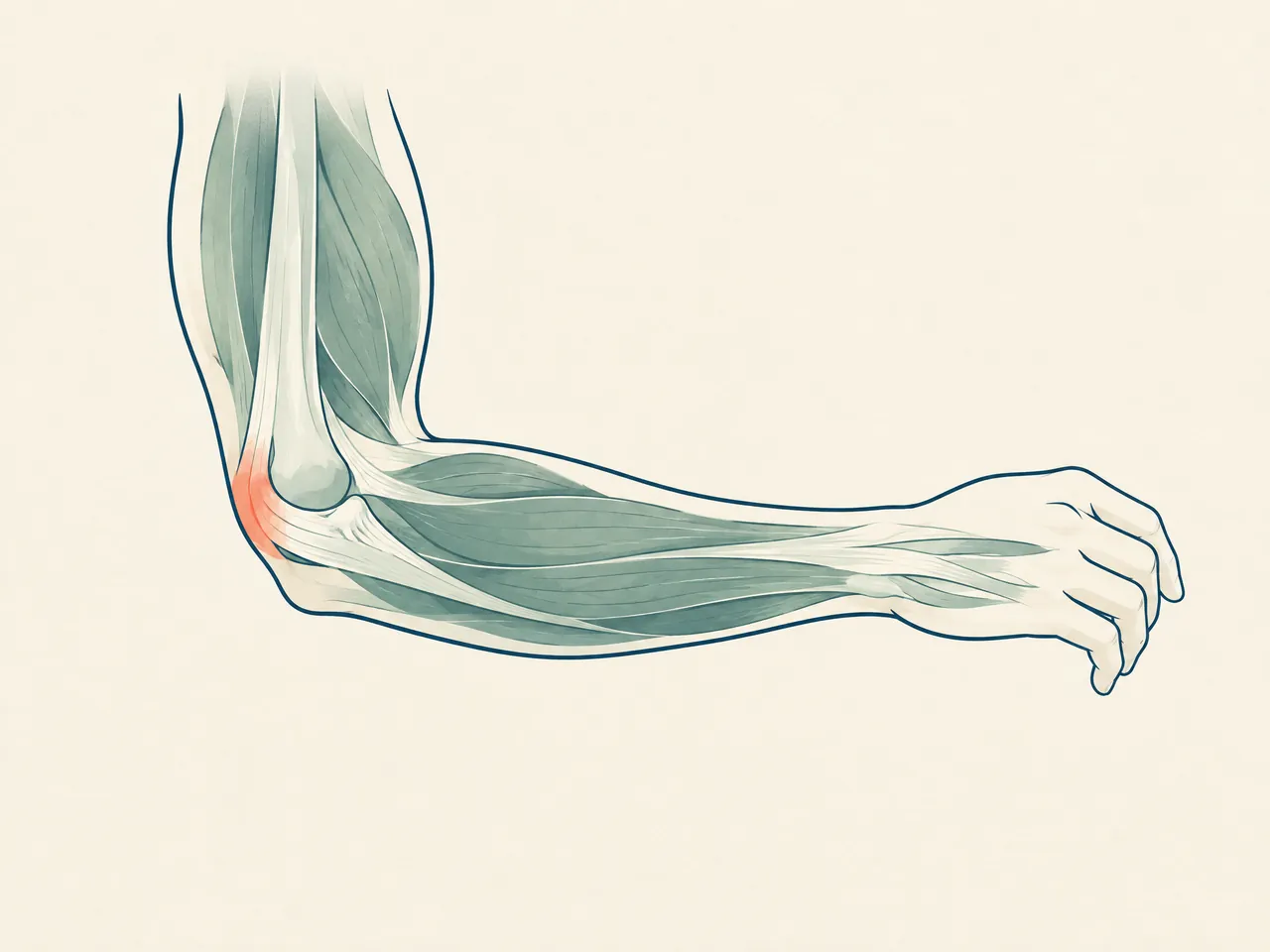
Pain on the outside of an elbow can make a coffee cup, a laptop bag, a screwdriver or a backhand feel unexpectedly difficult. It is tempting to call every such problem tennis elbow and search for a quick fix, but the useful first question is whether the pattern is actually lateral epicondylitis. Acupuncture may be discussed as one part of care for diagnosed lateral elbow pain; it is not a way to identify a fracture, infection, nerve problem or other source of pain. An assessment that connects the exact pain site, provoking tasks, movement and day-to-day function gives a safer basis for deciding whether acupuncture belongs alongside load adjustment and rehabilitation.
Appointments are confirmed through WhatsApp. If you have language requirements, please mention them in your enquiry.
The short answer
Lateral epicondylitis acupuncture may be worth discussing after an assessment supports outer-elbow tendon pain and urgent causes have been excluded. Research does not show a guaranteed cure or reliable long-term benefit, so it should not replace diagnosis, appropriate rehabilitation or activity changes. An acupuncture assessment for elbow pain should map symptoms and function, while an elbow pain range of motion assessment checks bending, straightening and forearm rotation before treatment goals are set.
Transparent pricing
See the fees.
Choose your care.
Explore our complete official price list, including first-trial prices, regular prices, packages and branch-specific options.
Opening WhatsApp prepares an enquiry; it does not send a message, take payment or confirm an appointment. Suitability and individual arrangements are confirmed during consultation.
Pain care
All prices in HKDExtracorporeal shockwave treatment
Shockwave treatment for deep-tissue and fascial care. The Kwun Tong clinic offers the multi-area options shown below.
Priced by branch
Branch-specific pricing
Prince Edward: HK$250 per area
Kwun Tong: HK$250 for 1 area / HK$450 for 2 areas / HK$600 for 3 areas
Pain care (manual therapy)
Includes Chinese medicine musculoskeletal assessment, manual joint techniques and tui na.
HK$580 (single session)
Chinese medicine musculoskeletal assessment
Pain care (acupuncture and manual therapy)
Combines acupuncture and manual therapy.
HK$680 (single session)
Combined care
Hair and scalp
All prices in HKDScalp health and hair-loss management
Includes AI scalp analysis, deep scalp and follicle cleansing, and scalp oil-control care.
HK$380 (first trial)
Regular price: HK$680
- 6 sessions: HK$3,480 (HK$580 per session)
- 12 sessions: HK$5,760 (HK$480 per session)
- 20 sessions: HK$8,600 (HK$430 per session)
- 30 sessions: HK$11,400 (HK$380 per session)
Hair acupuncture and Chinese herbal medicine package
Includes scalp acupuncture and 3 days of Chinese herbal medicine that does not require decoction.
HK$580 (single session)
Registered Chinese Medicine Practitioner consultation
- 6 sessions: HK$3,180 (HK$530 per session)
- 12 sessions: HK$5,760 (HK$480 per session)
- 20 sessions: HK$8,600 (HK$430 per session)
- 30 sessions: HK$11,400 (HK$380 per session)
Combined hair and scalp treatment
Combines acupuncture and Chinese herbal medicine with salon-level scalp and follicle care. Packages include complimentary hair-care shampoo and serum.
HK$1,260 (single session)
Combined treatment
- 8 sessions: HK$8,640 (HK$1,080 per session)
- 16 sessions: HK$15,680 (HK$980 per session)
- 20 sessions: HK$18,600 (HK$930 per session)
- 30 sessions: HK$26,400 (HK$880 per session)
Weight management
All prices in HKDFull-body acupoint embedding for weight management
Includes full-body acupoint embedding. Packages include complimentary Chinese herbal medicine for weight management, with the number of included days scaled to the package. Embedding material and the individual treatment arrangement are confirmed during consultation; this is not a cosmetic thread lift.
HK$980 (single session)
No trial session
- 10 sessions: HK$7,800 (HK$780 per session)
- 20 sessions: HK$14,600 (HK$730 per session)
- 30 sessions: HK$20,400 (HK$680 per session)
Facial acupuncture
All prices in HKDFacial acupuncture (basic)
Includes facial acupuncture and meridian-based facial care, including care for facial puffiness.
HK$480 (first trial)
Regular price: HK$680
- 10 sessions: HK$5,200 (HK$520 per session)
- 20 sessions: HK$9,600 (HK$480 per session)
- 30 sessions: HK$13,500 (HK$450 per session)
Facial acupuncture (advanced)
Includes enhanced facial acupuncture with a specially formulated moisturising mask and serum.
HK$780 (first trial)
Regular price: HK$1,180
- 10 sessions: HK$9,000 (HK$900 per session)
- 20 sessions: HK$16,600 (HK$830 per session)
- 30 sessions: HK$23,400 (HK$780 per session)
Chinese medicine
All prices in HKDAcupuncture and Chinese herbal medicine package
Includes a Chinese medicine consultation with pulse assessment, body acupuncture and 3 days of Chinese herbal granules that do not require decoction.
HK$580 (single session)
Chinese medicine consultation with pulse assessment
Lateral Epicondylitis Acupuncture: What the Research Actually Examines — acupuncture assessment for elbow pain | elbow pain range of motion assessment
The phrase lateral epicondylitis is commonly used for tennis elbow: pain around the outer bony part of the elbow, often aggravated when gripping, lifting, using tools or extending the wrist. It can occur without playing tennis. That description is a starting pattern, not a diagnosis made from a web search. The research question is narrower still: it asks about acupuncture in people selected for lateral epicondylitis, rather than everyone with an aching elbow. Before considering acupuncture for tennis elbow, establish whether the history and examination support that specific pattern.
The evidence is worth reading with its comparison groups in view. A 2020 systematic review included ten randomised trials of acupuncture for lateral epicondylitis. Its sham-acupuncture analyses had substantial variation between the underlying studies, and there were too few studies to analyse follow-up or adverse reactions. The authors called for larger, lower-risk-of-bias trials. That does not mean nobody can experience symptom relief; it means the evidence does not justify promising that acupuncture will cure the tendon problem, work for every elbow pain, or provide a known lasting result [1].

Lateral Epicondylitis Acupuncture and the Difference Between Outer and Inner Elbow Pain — acupuncture assessment for elbow pain | elbow pain range of motion assessment
A location check changes the conversation. Lateral epicondylitis describes pain on the outer side of the elbow, often noticed when the wrist and fingers work against load. Inner-elbow pain may follow a different pattern, including pain with other gripping or throwing actions. Pain at the tip of the elbow, deep joint pain, swelling, a sudden post-injury pain or a tingling hand should not be folded into the same label. The NHS lists several possible causes of elbow and arm pain, including tendonitis, bursitis, sprains and strains, arthritis and joint infection, and advises against self-diagnosis [2].
In practice, describe the pain with a map rather than a name. Is one fingertip able to find the sore outer area? Does the discomfort travel into the forearm or hand? Did it begin after a new gym routine, prolonged mouse use, repeated lifting, a fall, or without a clear trigger? Note what happens when turning a key, opening a jar, carrying a pan or shaking hands. That record gives an acupuncture assessment for elbow pain more useful information than a pain score taken in isolation. It also helps distinguish a familiar load-related pattern from a presentation that deserves medical investigation before any adjunctive treatment.
Lateral Epicondylitis Acupuncture Evidence: Short-Term Symptoms Are Not a Cure — acupuncture assessment for elbow pain | elbow pain range of motion assessment
It is reasonable to ask whether an intervention helps pain, but pain relief and tissue healing are not interchangeable outcomes. The lateral-epicondylitis trials reviewed in 2020 used different comparators, including sham acupuncture, medication and injection-type blocking therapy. In the pooled sham comparisons, the review reported wide inconsistency between studies; long-term follow-up and safety data could not be analysed because reporting was insufficient [1]. A moment of easier gripping after a session therefore cannot, by itself, show that the tendon has healed or that future flare-ups have been prevented.
A useful discussion separates an immediate goal from the wider plan. If the goal is to make a necessary work task more manageable, track that task before and after treatment. If the goal is returning to racket sport or manual work, also discuss graded loading, technique, rest breaks and rehabilitation with the appropriate professional. UCLA Health similarly frames acupuncture as one of several modalities for tennis-elbow pain and notes the difficulty of separating its contribution from physical therapy and time [3]. This is why an honest plan has review points based on function, not a pre-promised number of sessions.
Compare your options
| What to notice | Why it matters in assessment | A useful next question |
|---|---|---|
| Pain is precisely on the outer elbow and appears during gripping or lifting | This may fit a lateral-elbow pattern, but it still needs a history and examination rather than a label from location alone. | Which grip, lift or wrist movement reliably brings it on? |
| Pain is inner, at the tip, diffuse, or travels with tingling | The pattern may not match lateral epicondylitis and can change the priority for further evaluation. | Are there hand symptoms, neck symptoms, swelling or a recent injury? |
| The elbow is stiff or painful during bending, straightening or palm-up/palm-down rotation | A range-of-motion assessment shows how movement and function are affected and may reveal a reason to alter the plan. | Which daily movement is limited, and does it feel painful, blocked or weak? |
| Symptoms are worsening, there is deformity, severe movement difficulty, numbness, feverish swelling, or chest pressure with arm pain | These are not routine treatment goals; prompt medical or emergency assessment may be needed [2]. | What urgent service or medical assessment is appropriate now? |
On smaller screens, scroll the table sideways to compare all columns.
Acupuncture Assessment for Elbow Pain: Finding the Likely Pain Source — lateral epicondylitis acupuncture | elbow pain range of motion assessment
An acupuncture assessment for elbow pain should begin before needles are considered. It normally brings together the onset, the exact location, the activities that reproduce symptoms, previous injury, work and sport demands, and any prior assessment or imaging. It should also cover medicines, bleeding concerns, relevant health conditions and previous reactions to treatment. The purpose is not to turn a questionnaire into a diagnosis; it is to decide whether the presentation is appropriate for conservative symptom support, needs a different clinical opinion, or needs urgent care first.
Bring a short symptom record if possible. Record which hand is affected, whether the pain is constant or task-specific, whether it wakes you, and what has changed at work or training. List the functions that matter to you: holding chopsticks, carrying shopping, typing, moving a patient, lifting a child, climbing, cooking or playing an instrument. A practitioner can use those examples to establish a baseline and to check whether the plan is helping the activities that prompted the consultation. For a broader explanation of what may be checked, see elbow pain physical examination.

Acupuncture Assessment for Elbow Pain Through Symptoms, History and Daily Function — lateral epicondylitis acupuncture | elbow pain range of motion assessment
History places the symptom in context. A gradual ache after repeated gripping suggests a different line of inquiry from sharp pain after a fall. So does a new weakness when lifting a kettle, compared with a stable ache that occurs only after a long day of computer work. Mention neck and shoulder symptoms as well as elbow symptoms, because discomfort can be felt away from its source. The assessment may include looking for visible swelling or bruising, gently locating tenderness and observing how the arm moves during simple tasks. These observations guide questions; they do not make online self-testing a substitute for examination.
Daily function is the outcome people often care about most. Instead of asking only, “How much does it hurt?”, choose two or three repeatable tasks and describe the dose: a brief mouse session, a particular shopping bag, a set of kitchen tongs, or a sport drill. Note whether the task is painful during, after, or the following morning. This makes a change in symptoms interpretable. It also reveals when a person is repeatedly exceeding a tolerable load despite a temporary reduction in pain. TCM approaches can be discussed in that wider setting; our overview of TCM for elbow pain explains why the diagnosis and the intended role of care should be clear first.

Acupuncture Assessment for Elbow Pain: When Referral or Further Evaluation Matters — lateral epicondylitis acupuncture | elbow pain range of motion assessment
Do not wait for an acupuncture appointment if the arm has severe pain and is difficult to move, if an injury was followed by a snapping sound or an altered shape, or if the arm is tingling or numb. The NHS identifies those as reasons for urgent assessment. Swelling together with a very high temperature or feeling hot, cold or shivery also needs prompt medical attention. Sudden arm pain with pressure, heaviness or squeezing across the chest is an emergency situation, not an elbow-treatment decision [2].
Other presentations may be non-urgent but still need an earlier medical or musculoskeletal review: pain that does not settle over a few weeks, a steadily worsening loss of use, recurring locking, marked redness, unexplained weakness or symptoms that do not fit a local load-related pattern. Referral is not a failure of conservative care. It is the sensible next step when the likely source remains unclear or when a structural, inflammatory, neurological or systemic problem needs to be considered. If a diagnosis has already been made, bring that information so acupuncture can be discussed as a coordinated adjunct rather than as a disconnected alternative.
Elbow Pain Range of Motion Assessment: Discussing Acupuncture in Rehabilitation — lateral epicondylitis acupuncture | acupuncture assessment for elbow pain
An elbow pain range of motion assessment observes more than whether the arm can move at all. It compares comfortable bending and straightening with the other side when appropriate, and considers forearm rotation: turning the palm up and down for tasks such as using a key, pouring from a jug or carrying a plate. The assessor notes where pain begins, whether movement is blocked or simply guarded, and whether wrist, shoulder or neck movement changes the symptoms. Measurements may be useful in a clinic, but the pattern and functional impact are often more useful to a person than chasing a perfect number.

Movement findings help set sensible expectations for acupuncture in rehabilitation. For a suitable lateral-elbow presentation, acupuncture may be considered to support symptom management while activity is adjusted and a wider rehabilitation plan is followed. It is not a replacement for urgent assessment after trauma, and it should not be used to push through worsening pain. People looking for self-management ideas can read tennis elbow stretches, but exercises and loading should be selected or modified for the individual problem rather than copied into a painful routine.

Elbow Pain Range of Motion Assessment for Bending, Straightening and Rotation — lateral epicondylitis acupuncture | acupuncture assessment for elbow pain
For bending and straightening, the practical questions are whether the elbow reaches the position needed for daily life, when pain occurs and whether the end of the motion feels stiff, weak, unstable or mechanically blocked. Compare the familiar movements that reveal the problem: reaching a shelf, washing hair, pushing up from a chair or fully straightening the arm while carrying something. If a movement is sharply painful or the elbow cannot be moved normally after an injury, do not repeatedly test it at home. The result should guide timely assessment rather than become a challenge to overcome.
Rotation can be easy to overlook because the elbow may look calm while twisting is the troublesome action. Turning the palm upward and downward coordinates the forearm with the elbow and wrist. A clinician may observe this in relaxed positions and in a light everyday task, then ask where symptoms appear. In an acupuncture assessment for elbow pain, this helps link the reported pain to a real movement pattern. It can also identify a mismatch: a person who reports “tennis elbow” but has prominent numbness, locking or widespread arm symptoms needs a different conversation before treatment goals are set.

Elbow Pain Range of Motion Assessment, Load Management and Realistic Expectations — lateral epicondylitis acupuncture | acupuncture assessment for elbow pain
Load management does not automatically mean stopping all activity. It means identifying the part of a task that keeps provoking symptoms and adjusting one variable at a time: grip force, repetition, duration, weight, wrist position, tool size, break pattern or recovery between sessions. Someone who types may experiment with shorter blocks and a neutral setup; someone who carries stock may discuss technique or temporary task changes. Track the response later that day and the next morning. This gives the rehabilitation plan evidence from your own routine without treating pain as something to ignore.
Set review questions before starting any adjunctive treatment. Can you turn a doorknob with less discomfort? Can you complete the same work block without symptoms escalating? Is elbow extension easier, or has it become more restricted? If the answer is no, reassess the diagnosis, load and care plan rather than simply increasing treatment. For readers deciding where to ask questions in person, TCM Lab has a Kwun Tong Chinese medicine clinic and a Chinese medicine clinic Prince Edward; contact the clinic to explain the symptoms and confirm a suitable appointment arrangement.
Care and health guide
Pain-care information
This directory brings together services, reading, and visit information related to pain care, to help you prepare questions for a consultation.
When pain care affects your day, noting when it occurs, its relation to activity, and what you have already tried can help prepare a consultation; Chinese medicine pain management Hong Kong is a relevant service or reading entry point.
Individual circumstances differ, and acupuncture Hong Kong offers related information to help you understand options and prepare questions.


Your questions, answered
Frequently asked questions
Who does research on lateral epicondylitis acupuncture mainly apply to?
It mainly concerns people selected for lateral epicondylitis, or tennis elbow, rather than every form of elbow pain. Findings should not automatically be transferred to inner-elbow pain, fracture, infection, bursitis, nerve symptoms or an unexplained painful elbow.
Does acupuncture clearly beat sham acupuncture or all other care for tennis elbow?
No broad conclusion is justified. A systematic review found substantial variation in its sham-acupuncture comparisons and said the available trial quality was low. Its results do not prove superiority over all rehabilitation, every medicine or every other approach, nor do they establish a durable benefit [1].
Why is an elbow pain range of motion assessment useful before acupuncture?
It checks how bending, straightening and forearm rotation behave in a practical way. Pain, stiffness, a blocked sensation or an unexpected loss of motion can affect whether symptom-focused care is appropriate, what should be monitored, or whether a further evaluation should come first.
When should I seek medical help instead of waiting to discuss acupuncture?
Seek urgent assessment for severe pain with difficulty moving, injury with a snapping sound or changed shape, or tingling or numbness. Swelling with severe systemic symptoms also needs prompt care. Sudden arm pain with chest pressure, heaviness or squeezing is an emergency [2].
Sources and further information
- [1] Zhou et al., Effectiveness of Acupuncture for Lateral Epicondylitis: Systematic Review and Meta-Analysis
Referenced for: Evidence scope, comparisons, study limitations, follow-up and adverse-reaction reporting limitations for acupuncture in lateral epicondylitis.
- [2] NHS: Elbow and arm pain
Referenced for: Possible elbow and arm pain causes and urgent or emergency escalation guidance.
- [3] UCLA Health: Can acupuncture ease the pain of tennis elbow?
Referenced for: Context that acupuncture may be one modality among broader tennis-elbow care, with persistence of benefit uncertain.