
TCM Lab · Health reading
Can acupuncture help rounded shoulders? What does an acupuncture assessment for rounded shoulders involve? Can acupuncture improve postural kyphosis?
Published Updated
Rounded shoulders can describe a familiar screen-work posture: the shoulders sit forward, the upper back looks more curved, and the neck, chest or shoulder-blade area may feel tight by the end of the day. Acupuncture may be worth discussing for posture-related muscle tension or discomfort after an individual assessment. It is not a way to rebuild a structural spinal curve, and it cannot promise a visible posture correction. The useful question is whether symptoms, movement habits and examination findings suggest a conservative symptom-management plan—or whether a medical or physiotherapy assessment should come first.
Appointments are confirmed through WhatsApp. If you have language requirements, please mention them in your enquiry.
The short answer
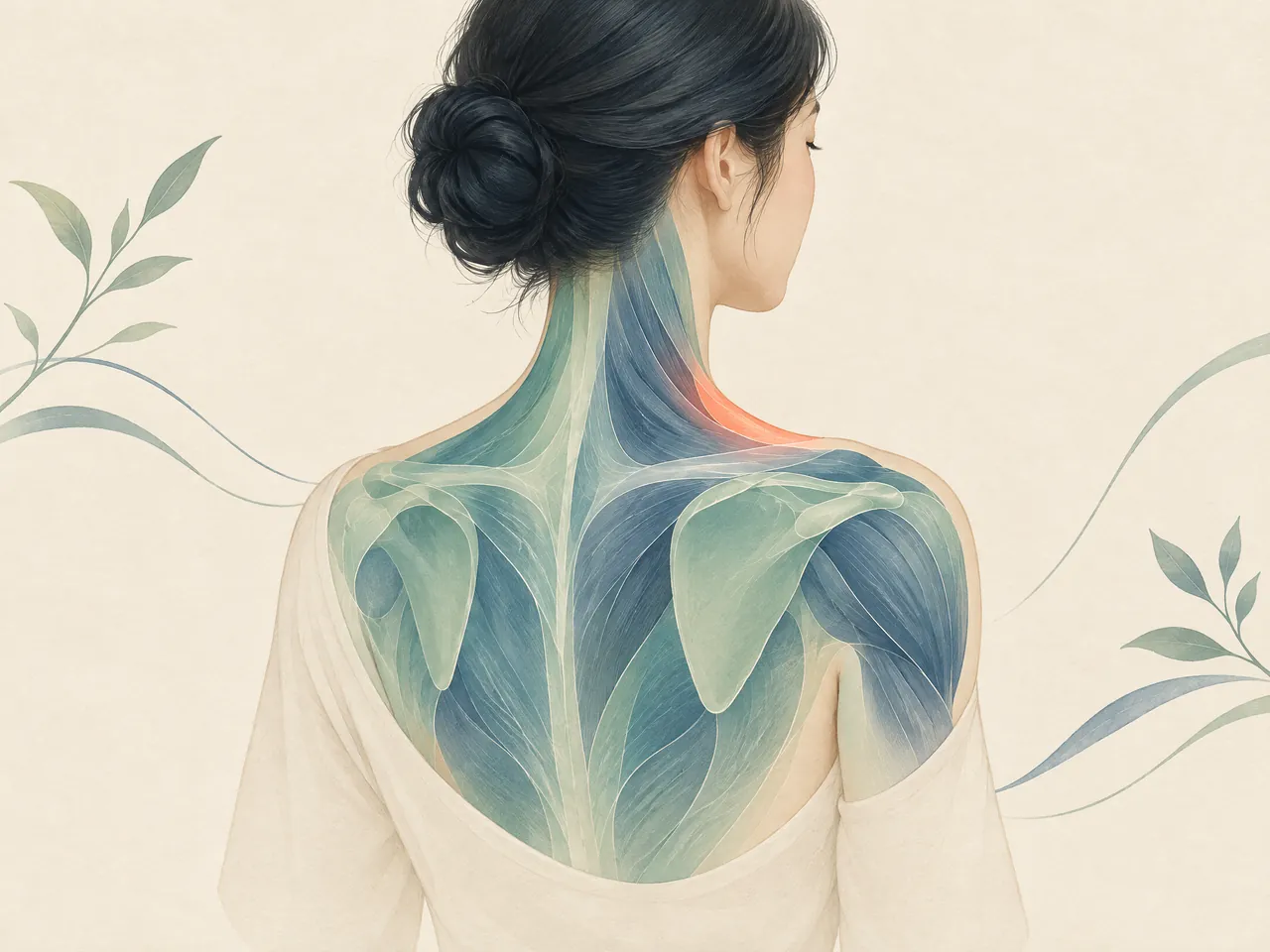
Acupuncture may be considered for tight, sore or stiff muscles around rounded shoulders, but it does not repair bones or guarantee that a hunched upper back will straighten. A TCM assessment commonly reviews sitting and standing posture, symptom pattern, neck-shoulder-back tension, tender areas and daily loading habits. If the curve is marked, worsening, follows injury, or comes with weakness, numbness, breathing difficulty or chest pain, seek medical assessment before acupuncture.
Transparent pricing
See the fees.
Choose your care.
Explore our complete official price list, including first-trial prices, regular prices, packages and branch-specific options.
Opening WhatsApp prepares an enquiry; it does not send a message, take payment or confirm an appointment. Suitability and individual arrangements are confirmed during consultation.
Pain care
All prices in HKDExtracorporeal shockwave treatment
Shockwave treatment for deep-tissue and fascial care. The Kwun Tong clinic offers the multi-area options shown below.
Priced by branch
Branch-specific pricing
Prince Edward: HK$250 per area
Kwun Tong: HK$250 for 1 area / HK$450 for 2 areas / HK$600 for 3 areas
Pain care (manual therapy)
Includes Chinese medicine musculoskeletal assessment, manual joint techniques and tui na.
HK$580 (single session)
Chinese medicine musculoskeletal assessment
Pain care (acupuncture and manual therapy)
Combines acupuncture and manual therapy.
HK$680 (single session)
Combined care
Hair and scalp
All prices in HKDScalp health and hair-loss management
Includes AI scalp analysis, deep scalp and follicle cleansing, and scalp oil-control care.
HK$380 (first trial)
Regular price: HK$680
- 6 sessions: HK$3,480 (HK$580 per session)
- 12 sessions: HK$5,760 (HK$480 per session)
- 20 sessions: HK$8,600 (HK$430 per session)
- 30 sessions: HK$11,400 (HK$380 per session)
Hair acupuncture and Chinese herbal medicine package
Includes scalp acupuncture and 3 days of Chinese herbal medicine that does not require decoction.
HK$580 (single session)
Registered Chinese Medicine Practitioner consultation
- 6 sessions: HK$3,180 (HK$530 per session)
- 12 sessions: HK$5,760 (HK$480 per session)
- 20 sessions: HK$8,600 (HK$430 per session)
- 30 sessions: HK$11,400 (HK$380 per session)
Combined hair and scalp treatment
Combines acupuncture and Chinese herbal medicine with salon-level scalp and follicle care. Packages include complimentary hair-care shampoo and serum.
HK$1,260 (single session)
Combined treatment
- 8 sessions: HK$8,640 (HK$1,080 per session)
- 16 sessions: HK$15,680 (HK$980 per session)
- 20 sessions: HK$18,600 (HK$930 per session)
- 30 sessions: HK$26,400 (HK$880 per session)
Weight management
All prices in HKDFull-body acupoint embedding for weight management
Includes full-body acupoint embedding. Packages include complimentary Chinese herbal medicine for weight management, with the number of included days scaled to the package. Embedding material and the individual treatment arrangement are confirmed during consultation; this is not a cosmetic thread lift.
HK$980 (single session)
No trial session
- 10 sessions: HK$7,800 (HK$780 per session)
- 20 sessions: HK$14,600 (HK$730 per session)
- 30 sessions: HK$20,400 (HK$680 per session)
Facial acupuncture
All prices in HKDFacial acupuncture (basic)
Includes facial acupuncture and meridian-based facial care, including care for facial puffiness.
HK$480 (first trial)
Regular price: HK$680
- 10 sessions: HK$5,200 (HK$520 per session)
- 20 sessions: HK$9,600 (HK$480 per session)
- 30 sessions: HK$13,500 (HK$450 per session)
Facial acupuncture (advanced)
Includes enhanced facial acupuncture with a specially formulated moisturising mask and serum.
HK$780 (first trial)
Regular price: HK$1,180
- 10 sessions: HK$9,000 (HK$900 per session)
- 20 sessions: HK$16,600 (HK$830 per session)
- 30 sessions: HK$23,400 (HK$780 per session)
Chinese medicine
All prices in HKDAcupuncture and Chinese herbal medicine package
Includes a Chinese medicine consultation with pulse assessment, body acupuncture and 3 days of Chinese herbal granules that do not require decoction.
HK$580 (single session)
Chinese medicine consultation with pulse assessment
Can acupuncture help rounded shoulders? What does an acupuncture assessment for rounded shoulders involve? Can acupuncture improve postural kyphosis? — Understanding the posture concern
People often use “rounded shoulders,” “hunched upper back” and “kyphosis” as if they mean exactly the same thing. They do not. Rounded shoulders describe how the shoulder girdle appears or rests. Kyphosis describes a curve of the upper spine. The NHS notes that kyphosis can make the upper back look rounded or hunched and that the shoulders can look rounded too [1]. A person may have a habit-related forward posture without a fixed structural problem, while another person may have a more pronounced spinal curve that needs separate clinical assessment. That distinction matters before choosing any treatment.
The immediate concern is often not appearance but what happens after a normal day: a pulling feeling across the front of the chest, ache between the shoulder blades, neck fatigue during laptop work, or stiffness on standing after a long commute. Those symptoms can be influenced by sustained positions, workload, sleep, stress, previous injury and how much the body is moved between tasks. They are not proof that one tight muscle or one acupuncture point explains the problem. A helpful plan starts by describing the pattern clearly rather than assuming all forward posture is “bad posture.”

Can acupuncture help rounded shoulders? What does an acupuncture assessment for rounded shoulders involve? Can acupuncture improve postural kyphosis? — Rounded shoulders and upper-back posture
Postural kyphosis is commonly linked with posture, but other forms of kyphosis have different causes. The NHS advises against self-diagnosis and explains that a clinician may assess the back while a person bends forward, as well as examine the arms and legs; imaging can be used when more detail is needed [1]. That is why a visible curve, an adolescent whose posture is changing, or an adult who notices progression should not be treated as a simple desk-work issue without appropriate evaluation.
A practical self-observation is to notice variability, not to force a military posture. Does the upper back look different after a walk, when lying down, or after a break from a screen? Can the shoulders move comfortably overhead? Does a supported sitting position change symptoms? These observations can help explain the day-to-day picture, but they do not measure the spinal curve. If you are mainly looking for care for aching and stiffness, see our overview of acupuncture for upper back pain and stiffness for the related symptom conversation.

Can acupuncture help rounded shoulders? What does an acupuncture assessment for rounded shoulders involve? Can acupuncture improve postural kyphosis? — Muscle tension, stiffness and daily habits
Forward-head screen work can encourage a low-movement routine in which the chest, upper trapezius, neck and upper-back region all feel overloaded. It is tempting to label the front as “too tight” and the back as “too weak,” but a real person may also have shoulder irritation, a rotator-cuff problem, headache, jaw tension or simply insufficient recovery between demanding days. The location of discomfort, what reproduces it and what makes it settle are more useful than a one-line posture label.
Small changes are often easier to sustain than an ambitious correction routine. Alternate sitting and standing where possible, bring a screen closer to eye level, avoid holding a phone low for long stretches, and take brief movement breaks before symptoms build. NIAMS advises people with back pain to get up, move around and change position frequently during prolonged sitting, while adding exercise gradually and seeking suitable advice on the types of exercise [3]. For shoulder pain that is triggered by reaching, lifting or sleeping on one side, it is sensible to consider whether acupuncture for rotator cuff injury is the more relevant topic—not to assume it is caused by rounded shoulders.
Compare your options
| What you notice | Most useful next focus | Why that route fits |
|---|---|---|
| Tightness or mild ache that builds after desk, phone or driving time, with no warning signs | Discuss symptom management and practical activity changes | An assessment can relate symptoms to daily loading and consider whether acupuncture is suitable alongside movement breaks. |
| A visible upper-back curve, uncertainty about its cause, or a curve that appears to progress | Medical or physiotherapy assessment | The concern may be postural or structural; examination helps separate appearance from a diagnosis. |
| Pain with arm lifting, night discomfort, weakness or a specific shoulder injury history | Shoulder-focused clinical assessment | The shoulder itself may need attention rather than treating the problem as general posture tension. |
| Severe pain, trauma, numbness, weakness, chest pain or breathing difficulty | Urgent medical assessment | These features should not be attributed to rounded shoulders without prompt clinical evaluation. |
On smaller screens, scroll the table sideways to compare all columns.
Can acupuncture help rounded shoulders? What does an acupuncture assessment for rounded shoulders involve? Can acupuncture improve postural kyphosis? — What a TCM assessment considers
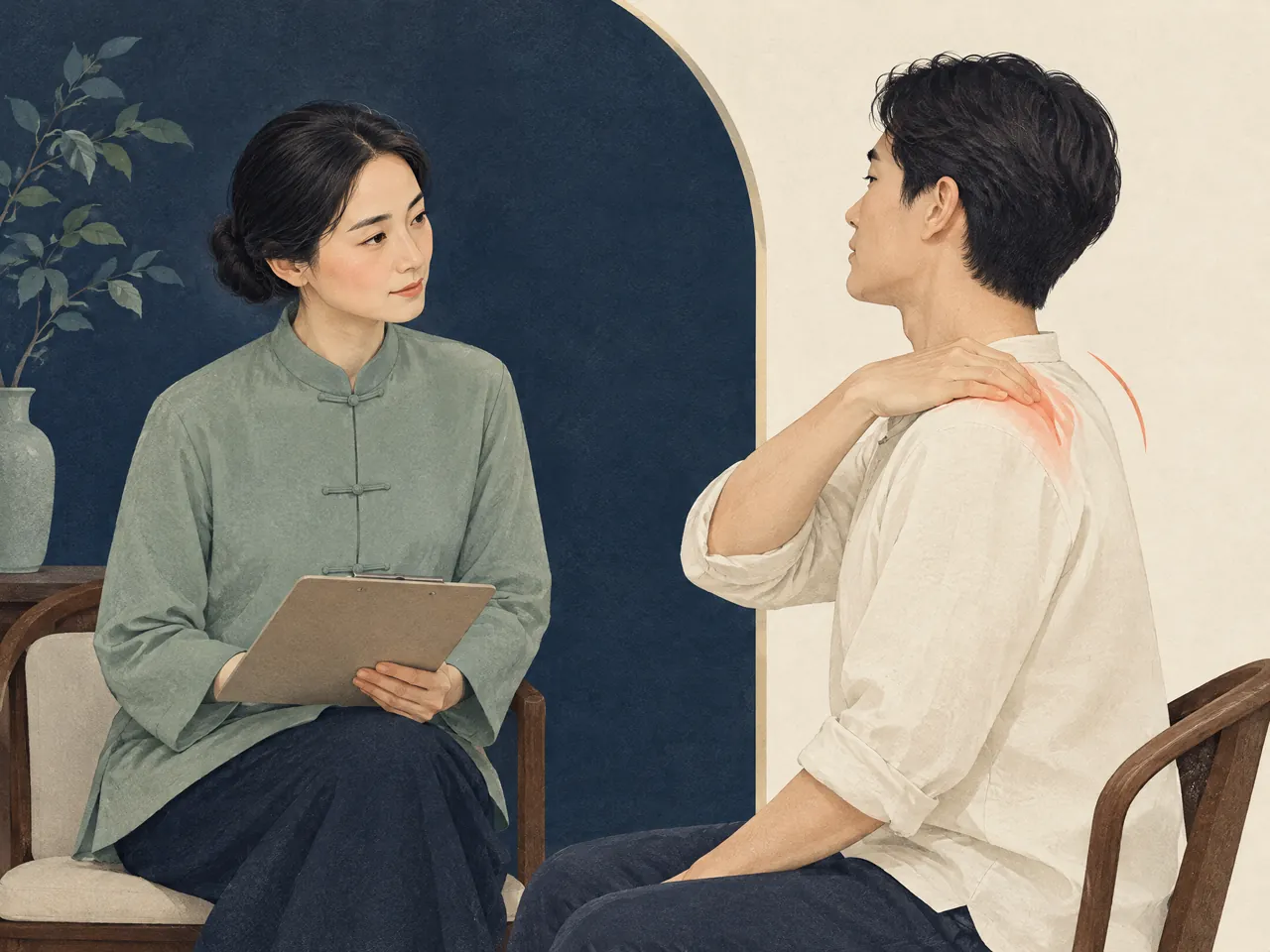
An acupuncture consultation for rounded-shoulder discomfort should begin with a conversation, not a preset needling map. Useful details include when the problem began; the area, quality and timing of symptoms; work, study, driving and exercise demands; past shoulder, neck or spinal injuries; and any previous diagnoses or scans. Medication, pregnancy, bleeding concerns, implanted devices where relevant, allergies and prior reactions to needling should also be raised. This information helps determine whether acupuncture is appropriate to discuss and whether another clinician should assess first.
TCM may describe findings through concepts such as channels, Qi and Blood, while contemporary examination also pays attention to observation, movement and local tissue response. These are different ways of organising a consultation. A traditional pattern description should not be presented as proof of a structural diagnosis, and an area of tenderness should not be assumed to identify a damaged tissue. The purpose is to make a safe, individual plan for the complaint in front of the practitioner.
Can acupuncture help rounded shoulders? What does an acupuncture assessment for rounded shoulders involve? Can acupuncture improve postural kyphosis? — Posture, movement and palpation
Observation may include how the head, ribcage, shoulder blades and pelvis appear in relaxed sitting and standing, as well as whether one side is more guarded. Movement checks can explore comfortable neck rotation, arm elevation and upper-back extension without chasing pain. Palpation may identify areas that feel tense, sensitive or protective around the neck, shoulders and upper back. None of these observations alone diagnoses kyphosis, a disc problem or a tendon injury; they help build a working picture and identify whether referral is sensible.
The consultation should also make room for a person’s goal. One person wants fewer evening aches so they can keep exercising; another wants to tolerate a workstation change; another is concerned about a visible curve. Those goals call for different conversations. For broader non-surgical approaches, compare the options in upper back pain treatment options. A clinician may recommend physiotherapy or medical review if the priority is assessing a curve, nerve signs, trauma history, persistent functional loss or a symptom pattern that does not fit straightforward muscular tension.

Can acupuncture help rounded shoulders? What does an acupuncture assessment for rounded shoulders involve? Can acupuncture improve postural kyphosis? — Acupuncture as symptom management
If acupuncture is considered appropriate, fine needles are placed at selected body points, usually with the person positioned comfortably. The point selection and whether treatment focuses more on the neck, shoulder girdle, upper back or a wider TCM presentation depend on the assessment. During needling, people may notice local heaviness, dullness, tingling or an ache, but sensations vary. Speak up immediately about sharp pain, dizziness, anxiety or any sensation that feels wrong; comfort and communication matter more than enduring a sensation.
The evidence base is broader for pain than for changing postural shape. NCCIH says research suggests acupuncture may be helpful for several pain conditions, including back or neck pain, while the way it works is not fully understood [2]. That does not establish that acupuncture corrects rounded shoulders or improves a structural kyphosis. It supports a narrower, honest discussion: can a time-limited course be considered for the person’s pain or stiffness, alongside the measures that address their movement and loading? Acupuncture needles should be sterile and single-use; NCCIH notes that complications can occur with nonsterile needles or improper treatment [2].
Can acupuncture help rounded shoulders? What does an acupuncture assessment for rounded shoulders involve? Can acupuncture improve postural kyphosis? — Limits, activity and when to seek assessment
The limitation is straightforward: a treatment aimed at symptoms cannot be sold as a structural correction. The NHS states that physiotherapy can help posture and relieve pain and stiffness, but specific exercises given in physiotherapy will not improve the spinal curve or stop it worsening [1]. That is an important reality check for anyone comparing options. Acupuncture may be one part of comfort management for posture-related tension; it is not a substitute for assessing why the curve is present or whether it is changing.
A useful decision is less about choosing “acupuncture versus exercise” and more about matching the tool to the goal. If pain makes it hard to begin a movement plan, symptom support may be discussed. If the main goal is movement control, progressive strengthening or work-task modification, physiotherapy or an exercise professional may be central. If there is a possible structural issue, medical evaluation provides the diagnostic route. You can read a focused introduction to acupuncture for rounded shoulders before deciding which question you need answered first.

Can acupuncture help rounded shoulders? What does an acupuncture assessment for rounded shoulders involve? Can acupuncture improve postural kyphosis? — Posture practice, stretching and strengthening
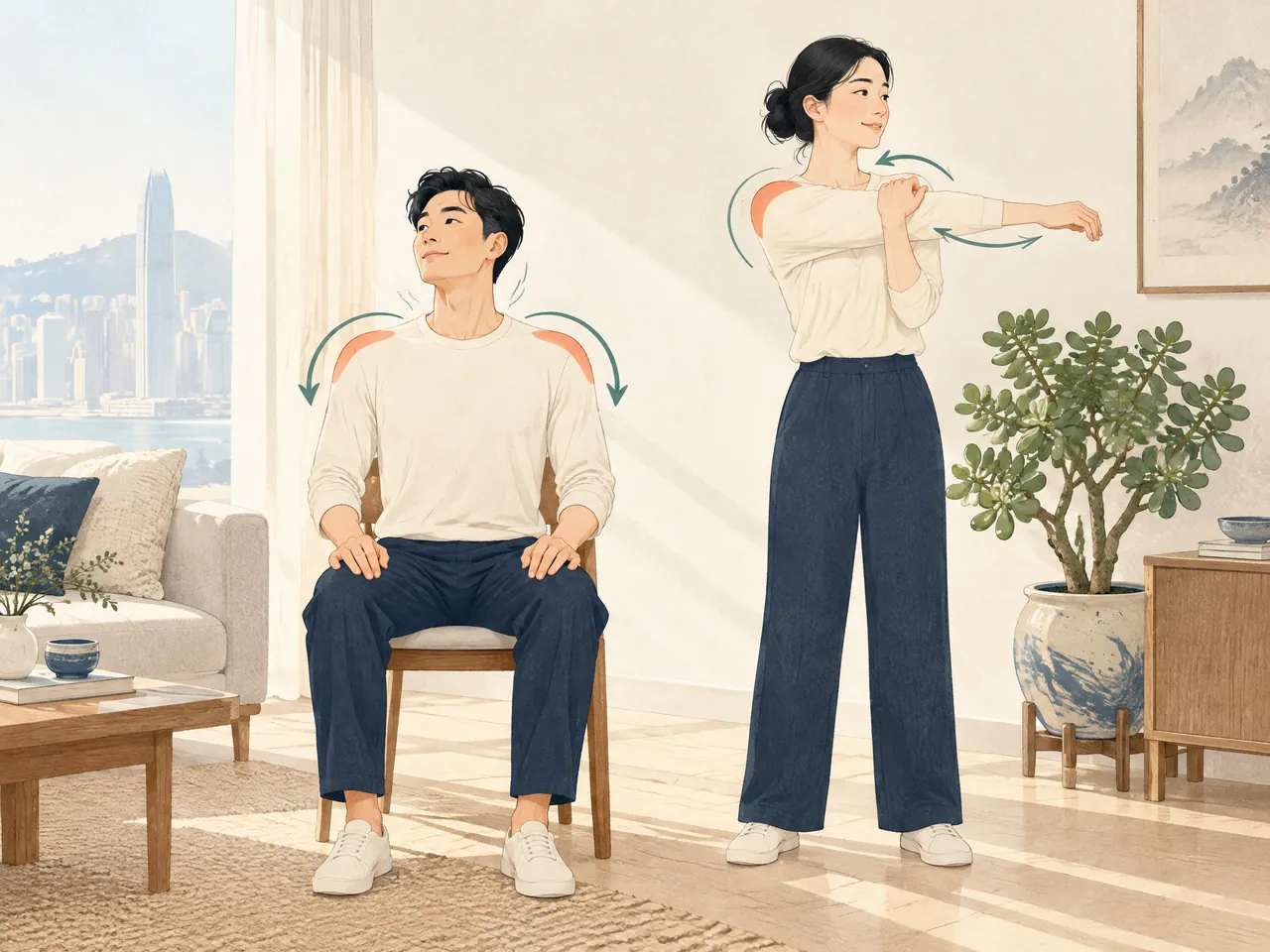
Posture practice works best as a flexible skill rather than a position held rigidly all day. Set up the task first: place frequently used items within reach, support the lower back if it helps, use a screen height that reduces constant neck flexion, and break up a long call or study block with a short walk. Then choose movements you can repeat without a symptom flare. Gentle chest-opening movements, shoulder-blade control and upper-back mobility may suit some people, but a programme should reflect the person’s mobility, shoulder tolerance and diagnosis.
Strengthening is not a contest to pull the shoulders back as hard as possible. The NHS notes that core strengthening can help people with kyphosis [1], and NIAMS notes that physical therapy can strengthen muscles supporting the back and improve mobility, posture and positioning [3]. A physiotherapist can adapt exercise when there is marked stiffness, pain with arm elevation, osteoporosis risk, neurological symptoms or a history of injury. Increase activity gradually, and stop or seek advice if an exercise repeatedly produces sharp pain, radiating symptoms or worsening weakness.
Can acupuncture help rounded shoulders? What does an acupuncture assessment for rounded shoulders involve? Can acupuncture improve postural kyphosis? — Structural concerns and warning signs
Arrange a medical or physiotherapy assessment rather than relying on a posture explanation when the upper-back curve seems pronounced or is getting worse, when pain is severe or persistent, or when normal work, walking, sleep or self-care are affected. The NHS lists back pain and stiffness among possible symptoms and says a severe spinal curve can cause very bad pain and difficulty breathing [1]. A clinician may decide that examination, imaging or another referral is appropriate; not everyone with back symptoms needs imaging, but a visible or changing curve deserves proper context.
Seek urgent medical attention for chest pain, significant breathing difficulty, new arm or leg weakness, spreading numbness, loss of coordination, fever with feeling unwell, or severe pain after a fall, collision or other spinal trauma. These symptoms have causes beyond rounded shoulders and should not be managed by self-stretching or acupuncture first. For a non-urgent conversation about acupuncture after appropriate assessment, TCM Lab can be contacted through the Kwun Tong Chinese medicine clinic or Chinese medicine clinic Prince Edward pages. If you are comparing consultation costs before making an enquiry, see the Chinese medicine clinic price list Hong Kong.
Care and health guide
Shoulder discomfort: care information
This directory brings together services, reading, and visit information related to shoulder discomfort, to help you prepare questions for a consultation.
When shoulder discomfort affects your day, noting when it occurs, its relation to activity, and what you have already tried can help prepare a consultation; acupuncture for shoulder pain is a relevant service or reading entry point.
Individual circumstances differ, and acupuncture Hong Kong offers related information to help you understand options and prepare questions.


Your questions, answered
Frequently asked questions
Can acupuncture help rounded shoulders?
It may be considered for associated muscle tension, stiffness or discomfort after an individual assessment. It is not a method for rebuilding bone or guaranteeing a change in shoulder position. The plan should also address the activities and movements that repeatedly aggravate symptoms.
What does an acupuncture assessment for rounded shoulders involve?
It can include questions about symptoms, work and exercise habits, injury history, medical conditions and medicines, plus observation of sitting and standing posture, comfortable movement and tender or tense areas. Traditional TCM observations add a treatment perspective but do not replace medical diagnosis or imaging when those are indicated.
Can acupuncture improve postural kyphosis?
It should not be expected to straighten a structural spinal curve. If posture-related tightness is present, acupuncture may be discussed for symptoms while a clinician or physiotherapist guides the assessment, activity changes and exercise plan. A noticeable or worsening curve should be professionally assessed.
What should I tell an acupuncturist before treatment?
Mention prior neck, shoulder or spinal injuries, diagnoses, medicines, pregnancy, bleeding issues, allergy history, implants or devices where relevant, and any past reaction to needling. Also explain whether pain travels into an arm, causes numbness or weakness, affects sleep, or started after trauma, because those details can change the appropriate next step.
Sources and further information
- [1] [1] NHS — Kyphosis
Referenced for: Definitions and symptoms of kyphosis; assessment context; treatment and exercise limitations.
- [2] [2] National Center for Complementary and Integrative Health — Acupuncture: Effectiveness and Safety
Referenced for: Acupuncture description, pain evidence context and safety information.
- [3] [3] National Institute of Arthritis and Musculoskeletal and Skin Diseases — Back Pain: Diagnosis, Treatment, and Steps to Take
Referenced for: Clinical assessment context, movement breaks, gradual activity and physical-therapy guidance.