
TCM Lab · Health reading
Plum Blossom Needle for Hair Loss: What Traditional Chinese Medicine Explains
Published Updated
A search for plum blossom needle for hair loss is usually a search for clarity: what is this traditional technique, is it the same as acupuncture, and is it sensible to consider for a thinning scalp? A plum blossom needle, also called a seven-star needle, is a multi-point skin-needling instrument used in some traditional Chinese medicine discussions. Traditional explanations describe light, controlled tapping on selected skin areas rather than a proven way to restart follicle growth. Hair loss can have many causes, including inherited pattern loss, illness, stress, weight change and iron deficiency, so it is important to understand the pattern and seek medical advice when shedding is persistent, sudden or worrying [1].
Appointments are confirmed through WhatsApp. If you have language requirements, please mention them in your enquiry.
The short answer
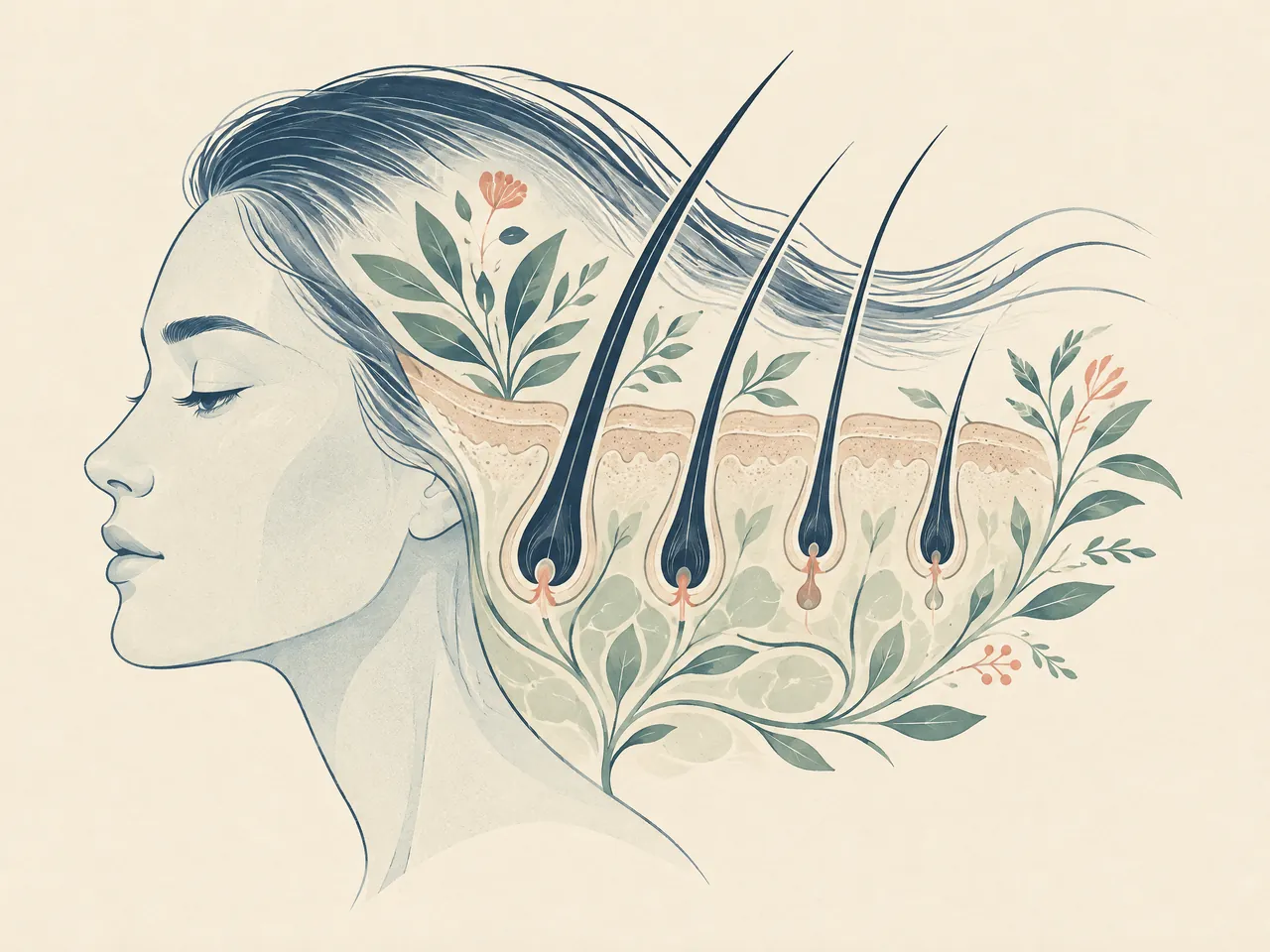
Plum blossom needle for hair loss refers to a traditional Chinese medicine skin-needling approach, sometimes called seven-star needling. In TCM, it may be discussed as scalp-focused care within a wider pattern assessment. It is not a confirmed hair-regrowth mechanism, and the research base for alopecia is limited and varied. Before considering any needling, clarify the cause of new, persistent or worsening hair loss and discuss skin condition, medicines and safety with an appropriately qualified practitioner.
Transparent pricing
See the fees.
Choose your care.
Explore our complete official price list, including first-trial prices, regular prices, packages and branch-specific options.
Opening WhatsApp prepares an enquiry; it does not send a message, take payment or confirm an appointment. Suitability and individual arrangements are confirmed during consultation.
Hair and scalp
All prices in HKDScalp health and hair-loss management
Includes AI scalp analysis, deep scalp and follicle cleansing, and scalp oil-control care.
HK$380 (first trial)
Regular price: HK$680
- 6 sessions: HK$3,480 (HK$580 per session)
- 12 sessions: HK$5,760 (HK$480 per session)
- 20 sessions: HK$8,600 (HK$430 per session)
- 30 sessions: HK$11,400 (HK$380 per session)
Hair acupuncture and Chinese herbal medicine package
Includes scalp acupuncture and 3 days of Chinese herbal medicine that does not require decoction.
HK$580 (single session)
Registered Chinese Medicine Practitioner consultation
- 6 sessions: HK$3,180 (HK$530 per session)
- 12 sessions: HK$5,760 (HK$480 per session)
- 20 sessions: HK$8,600 (HK$430 per session)
- 30 sessions: HK$11,400 (HK$380 per session)
Combined hair and scalp treatment
Combines acupuncture and Chinese herbal medicine with salon-level scalp and follicle care. Packages include complimentary hair-care shampoo and serum.
HK$1,260 (single session)
Combined treatment
- 8 sessions: HK$8,640 (HK$1,080 per session)
- 16 sessions: HK$15,680 (HK$980 per session)
- 20 sessions: HK$18,600 (HK$930 per session)
- 30 sessions: HK$26,400 (HK$880 per session)
Weight management
All prices in HKDFull-body acupoint embedding for weight management
Includes full-body acupoint embedding. Packages include complimentary Chinese herbal medicine for weight management, with the number of included days scaled to the package. Embedding material and the individual treatment arrangement are confirmed during consultation; this is not a cosmetic thread lift.
HK$980 (single session)
No trial session
- 10 sessions: HK$7,800 (HK$780 per session)
- 20 sessions: HK$14,600 (HK$730 per session)
- 30 sessions: HK$20,400 (HK$680 per session)
Facial acupuncture
All prices in HKDFacial acupuncture (basic)
Includes facial acupuncture and meridian-based facial care, including care for facial puffiness.
HK$480 (first trial)
Regular price: HK$680
- 10 sessions: HK$5,200 (HK$520 per session)
- 20 sessions: HK$9,600 (HK$480 per session)
- 30 sessions: HK$13,500 (HK$450 per session)
Facial acupuncture (advanced)
Includes enhanced facial acupuncture with a specially formulated moisturising mask and serum.
HK$780 (first trial)
Regular price: HK$1,180
- 10 sessions: HK$9,000 (HK$900 per session)
- 20 sessions: HK$16,600 (HK$830 per session)
- 30 sessions: HK$23,400 (HK$780 per session)
Pain care
All prices in HKDExtracorporeal shockwave treatment
Shockwave treatment for deep-tissue and fascial care. The Kwun Tong clinic offers the multi-area options shown below.
Priced by branch
Branch-specific pricing
Prince Edward: HK$250 per area
Kwun Tong: HK$250 for 1 area / HK$450 for 2 areas / HK$600 for 3 areas
Pain care (manual therapy)
Includes Chinese medicine musculoskeletal assessment, manual joint techniques and tui na.
HK$580 (single session)
Chinese medicine musculoskeletal assessment
Pain care (acupuncture and manual therapy)
Combines acupuncture and manual therapy.
HK$680 (single session)
Combined care
Chinese medicine
All prices in HKDAcupuncture and Chinese herbal medicine package
Includes a Chinese medicine consultation with pulse assessment, body acupuncture and 3 days of Chinese herbal granules that do not require decoction.
HK$580 (single session)
Chinese medicine consultation with pulse assessment
Plum Blossom Needle for Hair Loss in Traditional Chinese Medicine
In traditional Chinese medicine, hair is often discussed in relation to the body’s overall balance rather than as an isolated cosmetic concern. A practitioner may ask about the timing of shedding, energy, sleep, appetite, stress, menstrual history where relevant, scalp sensations and general health. These questions belong to TCM pattern differentiation. They should not be mistaken for a laboratory diagnosis or for evidence that one traditional label identifies the biological cause of hair loss. For a wider explanation of that language, read the Chinese medicine perspective on hair loss.
It can help to separate what a traditional consultation is trying to understand from what a person hopes will happen. A person may want less visible shedding, less worry when washing their hair, or a clearer explanation of a changing parting. Those are reasonable concerns. Yet the first conversation should also leave room for questions about possible medical causes and the condition of the scalp. Starting with that distinction makes it less likely that an unfamiliar tool will be treated as a diagnosis or a promise.
How Plum Blossom Needle for Hair Loss Is Described Traditionally
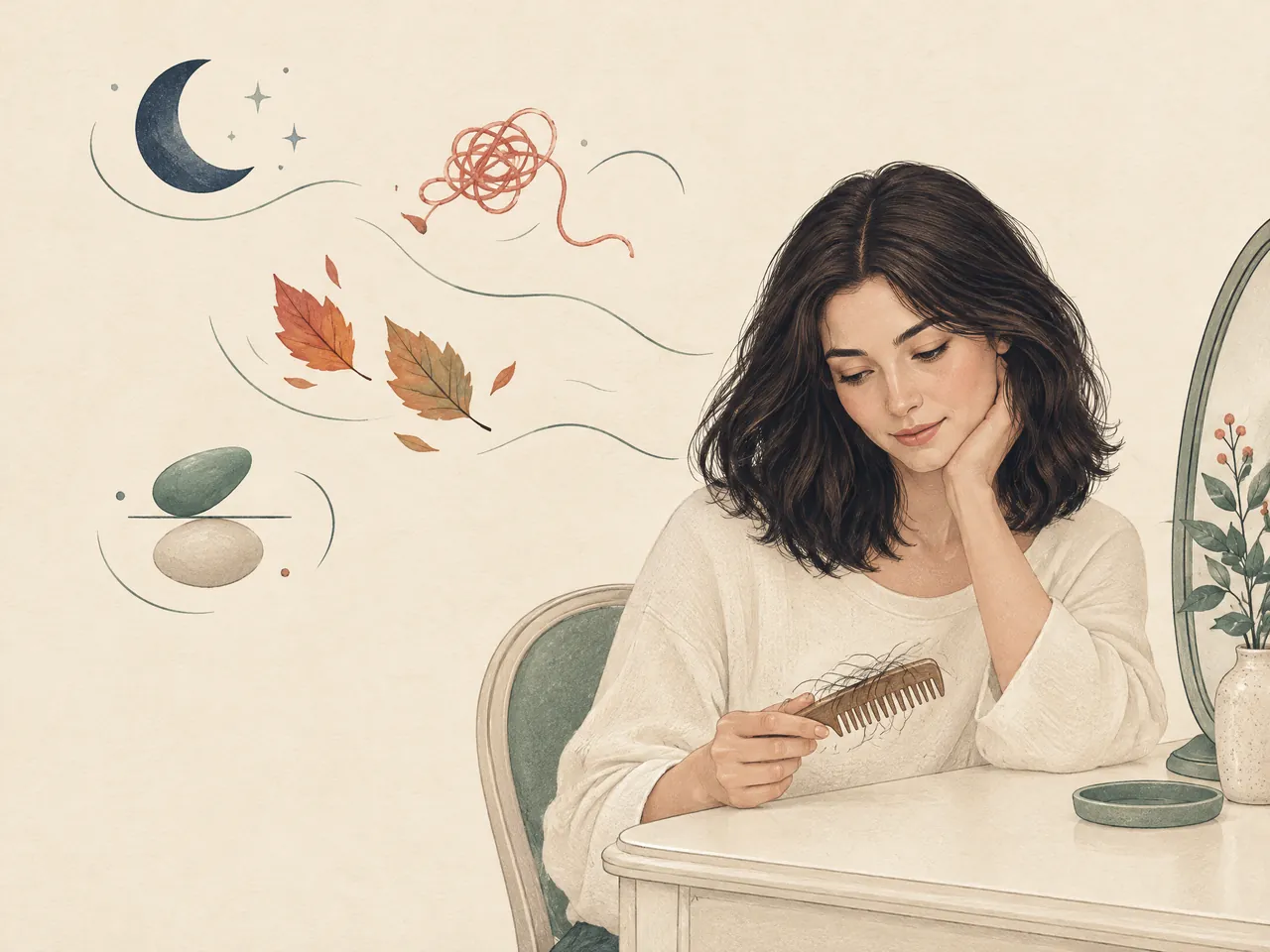
A plum blossom needle has several short points grouped on a small head. In traditional descriptions, a trained practitioner may use controlled superficial tapping over selected scalp areas or body points as part of an external-care discussion. That differs from inserting a single acupuncture needle at a point and differs again from simply rubbing the scalp at home. Terms such as “moving qi and blood” or supporting local circulation express a traditional approach. They do not establish that tapping reverses androgen-related changes, treats inflammation, corrects a nutrient deficiency or switches a resting follicle back into growth.
The words “plum blossom needle” can therefore hide important practical differences. Pressure, area treated, skin response, hygiene and whether the technique is offered at all are matters for an in-person professional discussion. It is not useful to copy a tapping pattern from a video, increase force because shedding feels alarming, or treat temporary redness as evidence that the scalp has been helped. A suitable consultation explains the proposed technique in ordinary language before anything is done.
Plum Blossom Needle for Hair Loss and Pattern Differentiation
Pattern differentiation is the TCM process of bringing several reported signs together before discussing a possible approach. Someone with gradual thinning and someone whose shedding began after illness may use the same search term, yet their histories and medical questions can be very different. A practitioner may traditionally discuss concepts involving liver, kidney, spleen, qi or blood; these are not interchangeable with modern organs, hormone tests or a dermatology diagnosis. The practical value of the conversation is to organise what has changed and what needs clarification, not to assign a needle technique from an online description.
For example, hair that seems less dense over months may be noticed differently from a sudden increase in strands on a brush. The person may also have concerns about oiliness, flakes or discomfort, but these observations do not supply a diagnosis on their own. The guide to hair thinning and TCM offers related context. Keep a short, dated record rather than trying to remember every change at the appointment; it gives both the person and practitioner a more reliable starting point.
Compare your options
| What you notice | Why the detail matters | A useful next question |
|---|---|---|
| Gradual thinning at the parting or hairline | The pace, family history and pattern may help frame the discussion; it does not by itself confirm the cause. | Should I seek medical assessment to clarify the type of hair loss before considering scalp-focused TCM care? |
| More hair shedding after illness, stress, weight change or a new medicine | A timeline can reveal a possible trigger that needs to be discussed with a health professional. | What information or test results should I bring, and should any current medicine be reviewed elsewhere? |
| Itch, scale, redness, soreness, broken skin or pustules | The scalp itself may need assessment; needling irritated or damaged skin is not a routine self-care step. | Is my scalp suitable for any skin-needling discussion, or should another assessment come first? |
| A defined patch of loss or a sudden marked change | A focused change may have a different cause from gradual diffuse thinning and warrants prompt clarification. | Who should assess this change, and what symptoms mean I should not wait for a routine appointment? |
On smaller screens, scroll the table sideways to compare all columns.
Plum Blossom Needle for Hair Loss: What the Traditional Approach Means
Scalp-focused care should begin with an honest description of what you see and feel. Is hair coming away evenly in the shower and on the pillow, or are there defined areas of loss? Is the main issue a slowly widening part, a changing hairline, breakage, itch, flaking, redness or soreness? Record when it began and whether it followed illness, marked stress, dietary change, childbirth, a new medicine, a change in hair products or a period of restrictive eating. The NHS notes that temporary loss can follow illness, stress, weight loss or iron deficiency, while pattern baldness commonly runs in families [1].

Photographs can be useful when they show change over time, not when they are used to judge yourself from day to day. Take them in similar light, from similar angles, with dry hair if possible, and note the date. This can make a widening part, a local patch, a red area or an improvement in scalp comfort easier to explain. It cannot identify the cause by itself, but it may prevent a consultation from relying on a stressful recollection of one unusually bad hair day.
Plum Blossom Needle for Hair Loss and Scalp-Focused Care
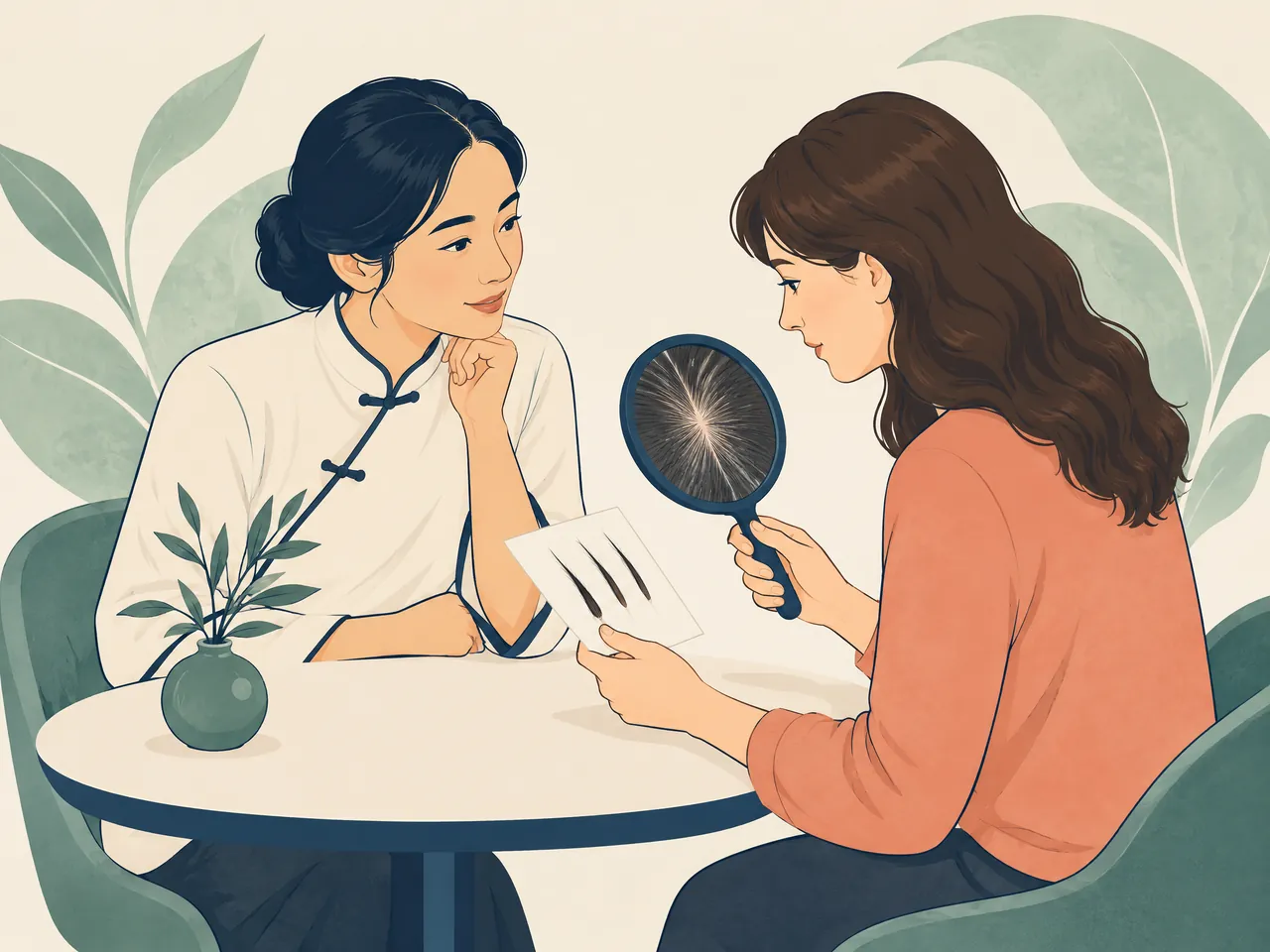
In a TCM consultation, scalp care may be considered alongside gentle hair-care habits and a discussion of general routines. This does not mean scraping, forcefully brushing or using a device on an irritated scalp. When the skin is broken, infected, very inflamed, painful or actively bleeding, self-treatment is not a safe substitute for assessment. The article on plum blossom needle side effects explains why the condition of the skin and the way a technique is delivered matter. Bring a list of medicines and supplements, particularly anything affecting bleeding, as well as any previous reactions to needles.
Everyday scalp care is not a test of commitment to treatment. A gentle wash routine, avoiding aggressive picking or pulling, and pausing products that clearly sting may be sensible temporary choices, but they do not replace a diagnosis. Be especially cautious about combining several new approaches at once. If a new oil, supplement, brush, medicine or device is introduced at the same time, it becomes harder to identify what has aggravated the scalp or changed the shedding pattern.
Plum Blossom Needle for Hair Loss Alongside Acupuncture or Herbal Discussion
A discussion of plum blossom needling does not automatically lead to acupuncture, herbs or a combined plan. Conventional acupuncture uses fine needles inserted into the skin; herbal medicine involves individual prescribing considerations; plum blossom needling is a separate skin technique. Each raises different questions about goals, skin suitability, current care and follow-up. If herbs are mentioned, do not buy a hair-loss formula because it seems familiar online. The question Can Chinese herbal medicine help hair regrowth? needs an individual discussion, especially if you are taking prescribed medicine, are pregnant, or have a relevant medical condition.
Ask for the purpose of each option separately. Is it being discussed for a scalp symptom, for general wellbeing, or because the practitioner believes it fits the traditional pattern described? What preparation is needed? What should be reported after the appointment, and when should the approach be paused? Clear answers are more useful than a long list of modalities. They also avoid the false impression that adding more interventions necessarily makes a hair-loss plan more effective.
Plum Blossom Needle for Hair Loss: Safety, Evidence and Next Steps
The choice is not simply “traditional treatment” versus “do nothing.” A sensible next step may be medical assessment, observation with photographs, a scalp-care change, a discussion with a Registered Chinese Medicine Practitioner, or more than one of these. The comparison below helps separate a description of hair loss from an assumed treatment. It also helps you state what you want from a consultation: explanation, symptom support, a safety check, or guidance about whether another clinician should assess the cause first.
Before booking, write down two or three questions that matter most. You might ask whether the pattern described needs further medical review, whether the scalp is suitable for any skin-based technique, or how progress would be judged without overinterpreting normal day-to-day shedding. Bring any relevant test results or clinical letters if you have them, and say what you are already using. This supports a safer conversation than arriving only with the request to “stimulate” hair growth.
Plum Blossom Needle for Hair Loss and the Limits of Current Evidence
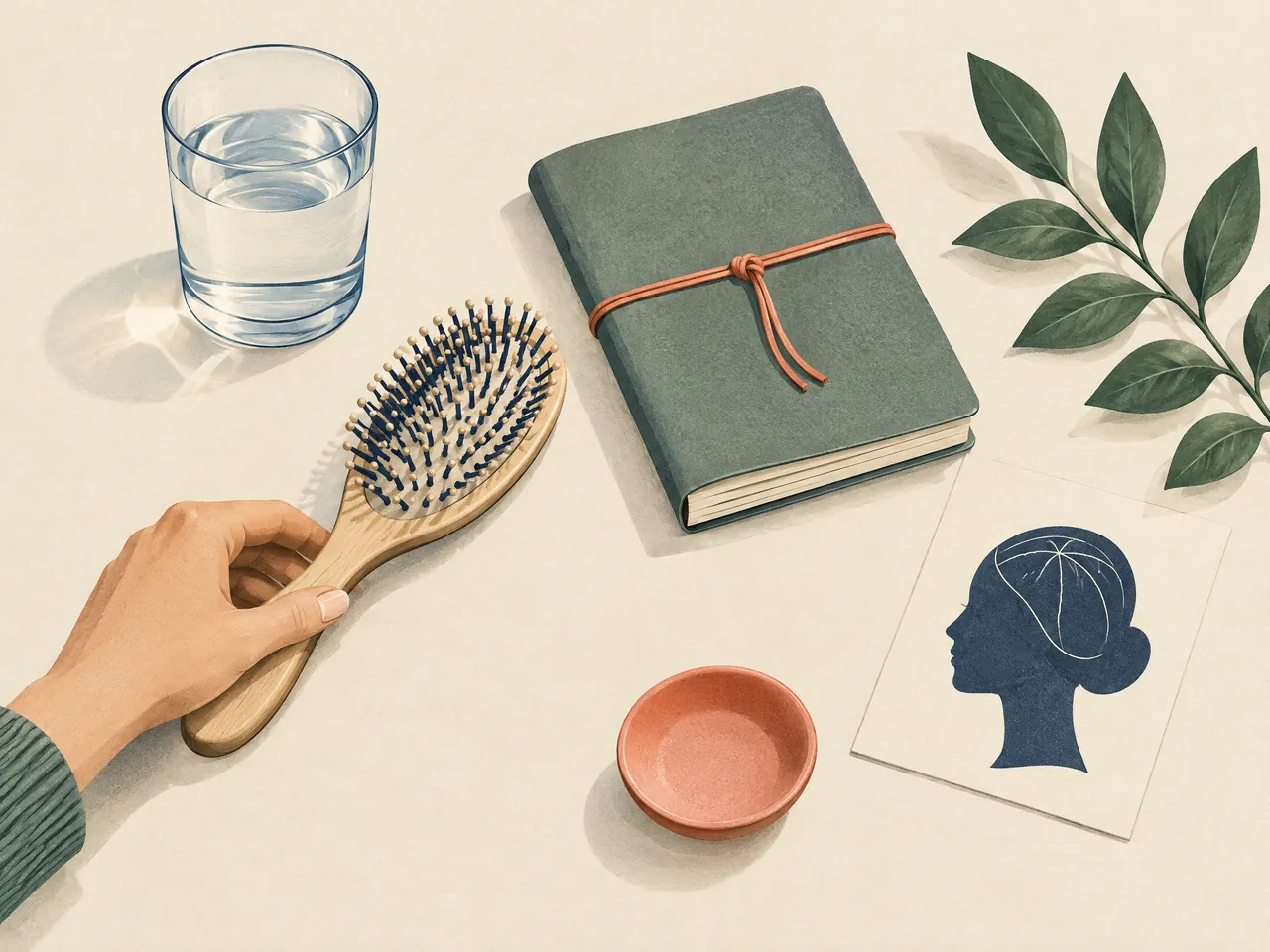
Research on acupuncture and related interventions for alopecia should not be presented as a guarantee for plum blossom needling. A narrative review of acupuncture and moxibustion in alopecia describes the existing evidence as limited and heterogeneous in protocols and outcomes, and calls for randomised studies against first-line treatments [3]. That matters because “alopecia” covers more than one type of hair loss, and a positive finding in one small or differently designed study cannot confirm a result for another person or technique. Ask what is known, what is uncertain and what outcome would mean reassessing the plan.
Evidence questions are practical questions, not an argument against listening to a person’s concern. Ask whether the information concerns the same hair-loss pattern, the same technique and a meaningful comparison. Be wary of before-and-after images without context, claims that a scalp reaction proves follicle stimulation, or a plan presented as necessary before the cause has been explored. A careful practitioner can acknowledge uncertainty while still explaining what a traditional approach is intended to address.

Plum Blossom Needle for Hair Loss When to Seek Further Assessment
Seek medical advice if hair loss is new, rapidly worsening, patchy, distressing or accompanied by scalp pain, marked inflammation, scaling, other physical symptoms or a change in wellbeing. Do not postpone evaluation while trying a complementary approach. The U.S. National Center for Complementary and Integrative Health also advises people not to use acupuncture to delay seeing a health-care provider; it notes that complications can result from nonsterile needles or improper delivery [2]. For a broader decision guide, see Chinese medicine hair loss treatment safety. If you enquire with TCM Lab, explain the hair and scalp changes, your preferred location and your current treatment rather than requesting a fixed technique.
At TCM Lab, consultation enquiries can be made for Prince Edward or Kwun Tong. Describe the main concern, whether there are visible scalp changes, and any practical access needs; the team can explain the current appointment arrangement. If you would like location information before contacting the clinic, see Chinese medicine clinic Prince Edward or Kwun Tong Chinese medicine clinic. A WhatsApp enquiry is a way to start a conversation, not an automatic booking or a commitment to a needling treatment.
Care and health guide
Hair and scalp care information
This directory brings together services, reading, and visit information related to hair and scalp care, to help you prepare questions for a consultation.
For questions about hair or scalp care, noting the everyday concerns and service questions you want to discuss can help prepare a consultation; Chinese medicine for hair loss is a relevant service or reading entry point.
People may have different priorities, and acupuncture Hong Kong offers related information to help you understand options and prepare questions.

Your questions, answered
Frequently asked questions
Does plum blossom needle treatment regrow hair?
It should not be described as a proven hair-regrowth treatment. Traditional explanations may discuss scalp stimulation and overall TCM pattern differentiation, but evidence for acupuncture-related approaches in alopecia is limited and heterogeneous. No fixed result, number of sessions or follicle-regrowth outcome can be promised.
Can I use a plum blossom needle device at home for hair loss?
Do not treat home tapping as harmless scalp care. Technique, hygiene, skin condition, medicines and the reason for hair loss all matter. Nonsterile needles and improper needling can cause complications. If the scalp is sore, inflamed, broken or infected, seek appropriate assessment rather than using a needling device.
What is the difference between plum blossom needling and acupuncture for hair loss?
Plum blossom needling uses a grouped multi-point head for controlled skin tapping, whereas acupuncture commonly uses individual fine needles inserted at selected points. They are different techniques and neither should be assumed suitable just because someone has searched for hair loss treatment. A practitioner should first discuss the hair-loss pattern, skin condition and relevant health information.
How can I ask TCM Lab about a hair-loss consultation in Hong Kong?
WhatsApp +852 6940 5663 with a short summary of when the hair or scalp change began, any itch, pain or scaling, current medicines or treatments, and whether Prince Edward or Kwun Tong is more practical. The team can explain enquiry arrangements; a message does not automatically confirm a treatment, appointment or payment.
Sources and further information
- [1] NHS — Hair loss
Referenced for: Official health guidance on common hair-loss causes, the need to clarify the cause, and reasons to seek medical advice.
- [2] NCCIH — Acupuncture: Effectiveness and Safety
Referenced for: U.S. government health information on acupuncture safety, sterile needles and not delaying health-care evaluation.
- [3] Efficacy of Acupuncture and Moxibustion in Alopecia: A Narrative Review
Referenced for: Narrative review describing the limited and heterogeneous evidence base for acupuncture and moxibustion in types of alopecia.