
TCM Lab · Health reading
Ankle Sprain Functional Tests: A Practical Guide to Running and Sport
Published Updated
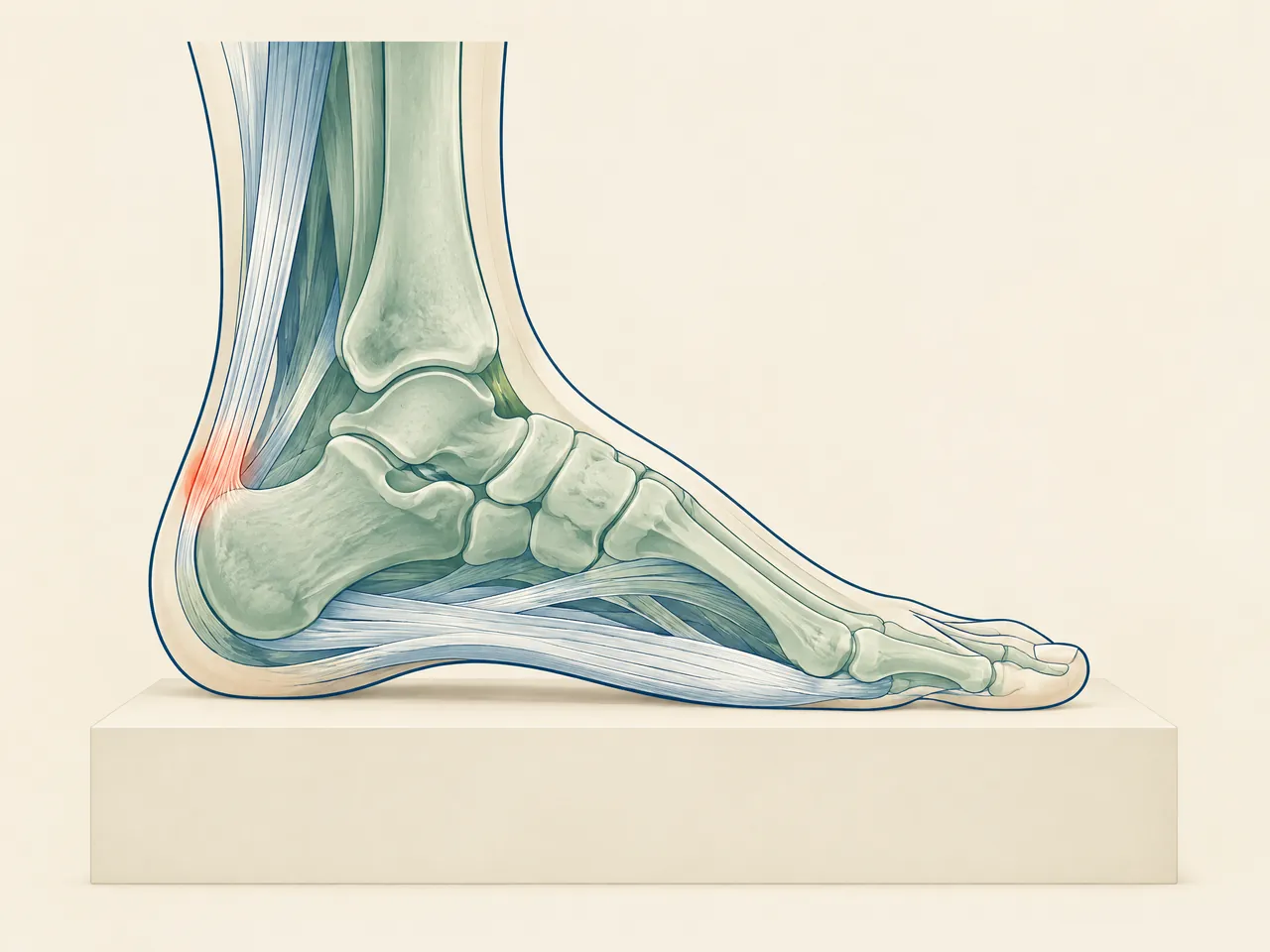
An ankle that lets you get around the flat may still be unready for a run, a court session or a quick step off a kerb. Ankle sprain functional tests give you a more useful picture than the calendar: can you bear weight normally, walk without protecting the sore side, move the ankle, raise through the calf and balance on one leg without a symptom flare? The aim is not to pass a single heroic test. It is to build a calm, repeatable progression from ordinary walking to the demands of your own activity. This guide explains what to notice at each stage, when to step back, and when an assessment should come before further exercise.
Appointments are confirmed through WhatsApp. If you have language requirements, please mention them in your enquiry.
The short answer
Ankle sprain functional tests are a practical check of comfortable weight bearing, normal-looking walking, ankle movement, calf control, single-leg balance and gradually more demanding sport actions. A useful result is repeatable and does not leave pain or swelling worse later that day or the next morning. Start with simple tasks and progress only when they are controlled. If you cannot bear weight, have marked deformity, a cold or discoloured foot, persistent numbness, or worsening pain and swelling, seek medical assessment rather than testing your way through it.
Transparent pricing
See the fees.
Choose your care.
Explore our complete official price list, including first-trial prices, regular prices, packages and branch-specific options.
Opening WhatsApp prepares an enquiry; it does not send a message, take payment or confirm an appointment. Suitability and individual arrangements are confirmed during consultation.
Pain care
All prices in HKDExtracorporeal shockwave treatment
Shockwave treatment for deep-tissue and fascial care. The Kwun Tong clinic offers the multi-area options shown below.
Priced by branch
Branch-specific pricing
Prince Edward: HK$250 per area
Kwun Tong: HK$250 for 1 area / HK$450 for 2 areas / HK$600 for 3 areas
Pain care (manual therapy)
Includes Chinese medicine musculoskeletal assessment, manual joint techniques and tui na.
HK$580 (single session)
Chinese medicine musculoskeletal assessment
Pain care (acupuncture and manual therapy)
Combines acupuncture and manual therapy.
HK$680 (single session)
Combined care
Hair and scalp
All prices in HKDScalp health and hair-loss management
Includes AI scalp analysis, deep scalp and follicle cleansing, and scalp oil-control care.
HK$380 (first trial)
Regular price: HK$680
- 6 sessions: HK$3,480 (HK$580 per session)
- 12 sessions: HK$5,760 (HK$480 per session)
- 20 sessions: HK$8,600 (HK$430 per session)
- 30 sessions: HK$11,400 (HK$380 per session)
Hair acupuncture and Chinese herbal medicine package
Includes scalp acupuncture and 3 days of Chinese herbal medicine that does not require decoction.
HK$580 (single session)
Registered Chinese Medicine Practitioner consultation
- 6 sessions: HK$3,180 (HK$530 per session)
- 12 sessions: HK$5,760 (HK$480 per session)
- 20 sessions: HK$8,600 (HK$430 per session)
- 30 sessions: HK$11,400 (HK$380 per session)
Combined hair and scalp treatment
Combines acupuncture and Chinese herbal medicine with salon-level scalp and follicle care. Packages include complimentary hair-care shampoo and serum.
HK$1,260 (single session)
Combined treatment
- 8 sessions: HK$8,640 (HK$1,080 per session)
- 16 sessions: HK$15,680 (HK$980 per session)
- 20 sessions: HK$18,600 (HK$930 per session)
- 30 sessions: HK$26,400 (HK$880 per session)
Weight management
All prices in HKDFull-body acupoint embedding for weight management
Includes full-body acupoint embedding. Packages include complimentary Chinese herbal medicine for weight management, with the number of included days scaled to the package. Embedding material and the individual treatment arrangement are confirmed during consultation; this is not a cosmetic thread lift.
HK$980 (single session)
No trial session
- 10 sessions: HK$7,800 (HK$780 per session)
- 20 sessions: HK$14,600 (HK$730 per session)
- 30 sessions: HK$20,400 (HK$680 per session)
Facial acupuncture
All prices in HKDFacial acupuncture (basic)
Includes facial acupuncture and meridian-based facial care, including care for facial puffiness.
HK$480 (first trial)
Regular price: HK$680
- 10 sessions: HK$5,200 (HK$520 per session)
- 20 sessions: HK$9,600 (HK$480 per session)
- 30 sessions: HK$13,500 (HK$450 per session)
Facial acupuncture (advanced)
Includes enhanced facial acupuncture with a specially formulated moisturising mask and serum.
HK$780 (first trial)
Regular price: HK$1,180
- 10 sessions: HK$9,000 (HK$900 per session)
- 20 sessions: HK$16,600 (HK$830 per session)
- 30 sessions: HK$23,400 (HK$780 per session)
Chinese medicine
All prices in HKDAcupuncture and Chinese herbal medicine package
Includes a Chinese medicine consultation with pulse assessment, body acupuncture and 3 days of Chinese herbal granules that do not require decoction.
HK$580 (single session)
Chinese medicine consultation with pulse assessment
Ankle Sprain Functional Tests Begin with Pain and Weight Bearing
The first question is not whether you can tolerate a hard drill. It is whether the ankle accepts ordinary load without a substantial limp, guarding or rising symptoms. Think about the moments that actually make up your day: getting out of bed, walking to the MTR, carrying a bag, climbing a few steps and turning in a narrow hallway. Pain at rest, pain when the foot first meets the floor, and pain that climbs with each step describe different problems. Record where it is felt and whether it settles when you reduce the load. This simple baseline helps you avoid treating a good hour as proof that the ankle is ready for everything.
Weight bearing is also a safety question. Ankle sprains and fractures can overlap in pain, bruising and swelling, so a home functional check does not diagnose the injury. A clinician may examine tenderness, movement and stability and decide whether imaging is needed. [1] The Hong Kong College of Orthopaedic Surgeons similarly notes that difficulty walking, swelling, bruising and stiffness can occur with ankle sprain, and that assessment may include imaging when necessary. [2] Do not make a testing plan your substitute for assessment after a severe or unclear injury.

Ankle Sprain Functional Tests for Walking Without Compensation
Use a short level walk as an observation rather than a challenge. First compare your steps: does the injured side take roughly the same time on the ground, and can your heel touch down and the foot roll forward without a sharp catch? Watch for a shortened step, a lifted hip, a foot turned outward to dodge ankle bend, or a need to grab furniture when changing direction. These compensations are useful information, not a reason to force a more normal-looking gait. If they appear, reduce the distance or pace and return to the last comfortable level of loading.
Then repeat the same brief walk at another time of day, rather than adding distance immediately. An ankle can feel easier after it has warmed up and show stiffness or swelling after you stop. A change in the quality of walking is more meaningful than simply enduring more discomfort. If running is the goal, this walking stage is the foundation for the wider return to sport after ankle sprain process. It is reasonable to use a supportive device only as advised for your injury; support does not turn an uneven, painful gait into a readiness pass. [1]

Ankle Sprain Functional Tests and Warning Signs That Need Medical Assessment
Stop self-testing and arrange urgent medical assessment if you cannot bear weight at all, the ankle or foot looks deformed, you heard a crack at the time of injury, or the foot becomes pale, blue, unusually cold, numb or persistently tingly. Escalating pain or swelling, marked bone tenderness, and a foot that feels unsafe to stand on also deserve assessment. Severe sprains can resemble a broken bone; orthopaedic guidance advises prompt evaluation for severe symptoms and further testing when weight bearing or bony tenderness raises concern. [4] These signs call for a clinician, not another set of heel raises or balance trials.
Seek professional advice as well when ordinary walking remains difficult, the ankle repeatedly gives way, or progress stalls despite a sensible reduction in activity. Persistent pain in a broader area may have causes other than a straightforward lateral sprain, so it is useful to understand foot pain and its possible patterns rather than assuming every ache is the same injury. For a clearer discussion of symptoms that can overlap, see foot pain causes. A formal assessment can help separate a load-management problem from a reason to investigate the ankle, foot or lower leg more closely.
Compare your options
| Stage and useful check | What a controlled attempt can look like | Reason to stay at this stage or seek advice |
|---|---|---|
| Everyday loading: level walking and a few ordinary turns | Foot accepts weight, stride is not obviously protective, and symptoms do not build during the walk. | Limping, sharply increasing pain, or swelling that rises afterwards means reduce load; inability to bear weight needs assessment. |
| Movement and calf control: gentle ankle motion and supported heel raises | Motion and rises are controlled within a comfortable range, without a sharp catch or twisting away. | Pinching, loss of control, or a next-day symptom flare means return to an easier exercise or get professional advice. |
| Single-leg control: brief balance near a stable support | You can make small adjustments without repeated touch-downs, giving-way or a painful wobble. | Repeated instability, fear of loading, or a knee and ankle that cannot be controlled calls for further rehabilitation guidance. |
| Sport exposure: easy straight-line run, then task-specific drills | The chosen low-risk task is completed with an even pattern and recovery remains acceptable later and the next day. | New swelling, returning limp, worsening pain, or loss of confidence means step back before adding speed, turns or jumps. |
On smaller screens, scroll the table sideways to compare all columns.
Ankle Sprain Functional Tests for Movement, Strength and Balance
Once comfortable walking is becoming reliable, functional testing shifts from getting through the day to controlling the ankle through its available range. This is a progression, not a scorecard. The key comparison is usually with your other side and with your own usual activity: can you move with similar ease, use the calf to control your body weight, and keep your trunk and knee organised when the base of support becomes smaller? A return-to-sport consensus groups pain, ankle impairments, athlete confidence, sensorimotor control and sport or functional performance as relevant domains, which is why one test alone cannot answer the whole question. [3]

Ankle Sprain Functional Tests for Range of Motion and Calf Strength
For movement, compare gentle ankle bend and straightening with the uninjured side. You might notice a blocked feeling at the front of the ankle when the knee travels forward over the foot, or a pull through the calf when the heel stays down. Do not force through a pinch or sharp pain. Instead, note whether a comfortable repeated movement becomes smoother, stays the same, or worsens. Range of motion is relevant because a stiff ankle can change how you descend stairs, squat, land or take the first steps of a run. It is a useful observation to take to a clinician or rehabilitation professional, not a self-diagnosis.
Calf control matters because the calf helps manage load as you rise onto the forefoot and lower back down. Begin with a supported two-leg heel raise if this is comfortable, using a counter or wall for balance. Progress only when the movement is steady, the heel rises without twisting away, and the ankle does not become increasingly painful. A later single-leg heel raise asks more of the same system; it should be approached as a quality check, not a test to grind through. Rehabilitation guidance commonly progresses movement, strengthening and balance as pain and swelling improve. [1] [4]

Ankle Sprain Functional Tests for Single-Leg Balance and Stability
Single-leg balance is a simple way to observe whether the ankle, leg and trunk can cooperate over a small base. Stand near a stable surface, place the other foot lightly off the floor, and notice the difference between controlled small adjustments and a repeated need to touch down. Look beyond the ankle itself: does the knee collapse inward, does the pelvis tip, or does the ankle feel as if it will give way? Use your hands for support or keep the task shorter when needed. The point is to make the task safe enough to observe, not to prove toughness by removing every support.
Stability also has an internal component. Someone may complete a quiet balance hold yet remain hesitant about stepping off a bus, crossing uneven paving or changing direction in a game. That hesitation is worth recording; confidence and perceived stability are part of the PAASS return-to-sport domains, alongside balance and dynamic control. [3] Build challenge gradually: stable surface before uneven ground, controlled direction changes before reactive ones, and familiar shoes before sport-specific footwear. A recurring sense of giving way, especially after previous sprains, is a reason to discuss a tailored rehabilitation plan rather than simply adding more difficult drills. [2]

Ankle Sprain Functional Tests Before Running or Returning to Sport
Running and sport add speed, repetition and surprise. A jog asks the ankle to accept repeated landings; basketball, football, tennis and trail running add braking, turning and uneven surfaces. Passing a slow, straight-line task is therefore a permission to try the next small step, not a guarantee of readiness for every movement. Choose one variable to increase at a time: pace, duration, terrain, changes of direction or contact. This makes it easier to tell what the ankle tolerated and what needs more preparation. For a focused discussion of timing and progression, read when can I run after an ankle sprain.
Ankle Sprain Functional Tests for Gradual Running Progression
Before a first easy run, look for a cluster of reassuring signs: comfortable ordinary walking, manageable ankle movement, controlled calf work and a stable single-leg task at the level you have practised. Start on a predictable, level route with a pace at which you can pay attention to form. A walk-jog format may make it easier to stop before fatigue changes your stride. Keep sharp turns, hills, jumping and a full training session for later stages. The consensus approach specifically includes hopping, jumping, agility, sport-specific drills and the ability to complete a full training session in the sport-performance domain. [3] Those are progressively harder questions, not compulsory first-day tests.
Match the test to the sport rather than borrowing someone else's routine. A recreational runner may next need a calm, flat run; a badminton player will eventually need side steps and deceleration; a hiker may need controlled descent on varied ground. Introduce the closest low-risk version first, ideally after basic tasks are settled. If you have access to a clinician, show them the activity that matters to you, your footwear and the surface you expect to use. This turns a generic ankle check into a useful plan for a commute, a race or a return to team training without pretending there is one universal finish line.

Ankle Sprain Functional Tests After Exercise: Pain, Swelling and Recovery
The after-effect is part of the functional test. Check how the ankle feels when you cool down, later that evening and the following morning. A mild, short-lived awareness may be different from new swelling, a warmer and tighter ankle, a returning limp, loss of movement or pain that affects sleep. Compare this response with a previous, clearly tolerated session. If symptoms are worse or last longer, reduce the last progression rather than adding the next drill. This response-based approach respects that recovery time varies with injury severity and the demands you place on the ankle. [2]
A concise activity log can make a medical or rehabilitation conversation much more productive: write the task, surface, footwear, duration, pain during, symptoms later and confidence the next day. It also prevents a common trap of comparing today with the best hour yesterday rather than the full response to a session. If you want to discuss how the check relates to an appointment, TCM Lab can be contacted through the Kwun Tong Chinese medicine clinic or Chinese medicine clinic Prince Edward pages. Any supportive care should sit alongside appropriate fracture screening, graded loading and rehabilitation, not replace them.
Care and health guide
Health service information
This directory brings together services, reading, and visit information related to health services, to help you prepare questions for a consultation.
If you are organising health questions, Chinese medicine clinic Hong Kong is a starting point for learning about related services and preparing for a consultation.
People have different needs; acupuncture Hong Kong provides further reading to help you understand options in your own context.


Your questions, answered
Frequently asked questions
What do ankle sprain functional tests check before running?
They look beyond elapsed time. Start with comfortable weight bearing and normal-looking walking, then consider ankle movement, calf control, single-leg balance and a gradual exposure to the demands of running. A sport return decision also considers pain, confidence and sport-specific performance rather than one isolated task. [3]
Can I run if ankle sprain functional tests still cause pain?
Pain during a test is a reason to reduce the task, not to push into a run. Return to the last activity that was controlled and observe symptoms later that day and the next morning. If pain, swelling, instability or difficulty walking persists or worsens, arrange assessment before progressing. [1]
Is standing on one leg enough to show that my ankle is ready for sport?
No. Single-leg balance is useful, but it does not reproduce every demand of running, jumping, turning or a full training session. It should sit alongside movement, strength, confidence and a gradual return to the specific activity you want to do. [3]
When should I seek care instead of doing ankle sprain functional tests?
Seek prompt medical assessment if you cannot bear weight, the foot or ankle is deformed, or you have persistent numbness, colour change or unusual coldness. Severe pain, swelling, bony tenderness, a crack at injury or symptoms that do not improve also warrant professional evaluation because severe sprains can resemble fractures. [4]
Sources and further information
- [1] [1] Mayo Clinic — Sprained ankle: Diagnosis and treatment
Referenced for: Assessment, restoration of movement, strength and stability, balance work, self-care and advice before resuming sport.
- [2] [2] The Hong Kong College of Orthopaedic Surgeons — Ankle Sprain
Referenced for: Hong Kong professional guidance on symptoms, rehabilitation stages, functional restoration and variable recovery.
- [3] [3] British Journal of Sports Medicine — Return to sport decisions after an acute lateral ankle sprain injury
Referenced for: PAASS consensus domains for return-to-sport decisions: pain, ankle impairments, athlete perception, sensorimotor control and sport or functional performance.
- [4] [4] American Academy of Orthopaedic Surgeons — Sprained Ankle
Referenced for: Clinical assessment, fracture considerations, weight-bearing difficulty, phased rehabilitation and progressive activity.