
TCM Lab · Health reading
Elbow Pain Location, Elbow Pain Assessment and Elbow Pain on the Inside
Published Updated
Where elbow pain sits can make everyday tasks feel surprisingly specific: the outside may protest when you turn a key, the inside when you grip a shopping bag, and the tip when it touches a desk. Those patterns are useful observations, not diagnoses. A careful elbow pain assessment brings location together with onset, movement, swelling, sensation and what you can or cannot do. If elbow pain on the inside comes with tingling in the ring or little finger, weakness, a recent injury, or loss of movement, record that detail rather than assuming it is an ordinary strain.
Appointments are confirmed through WhatsApp. If you have language requirements, please mention them in your enquiry.
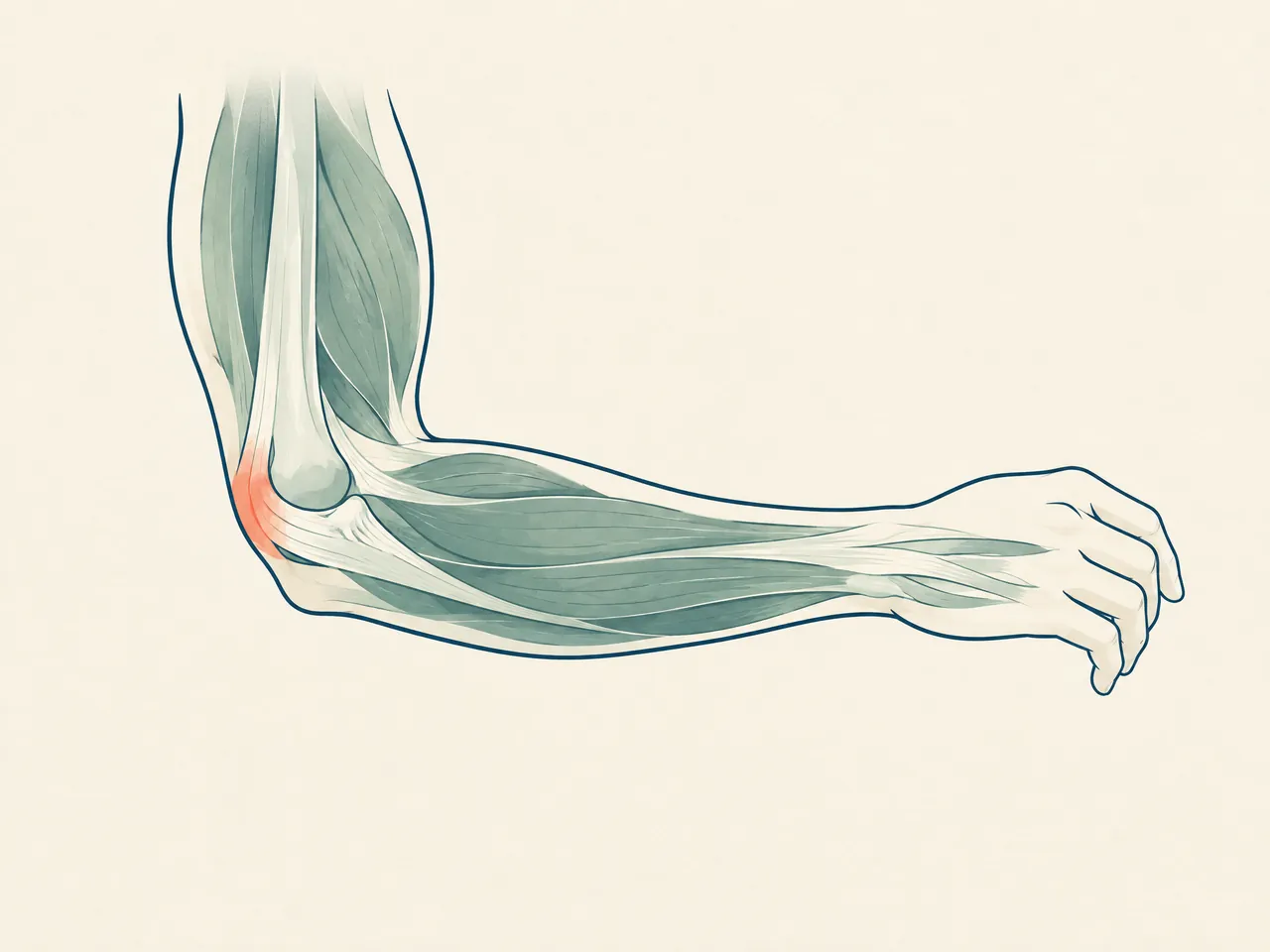
The short answer
Elbow pain location is a starting point for an elbow pain assessment, not proof of a particular condition. For elbow pain on the inside, note whether gripping, lifting, wrist movement or a bent elbow brings it on, and whether numbness reaches the ring or little finger. Also record swelling, stiffness, injury and activity limits. A changed-shaped elbow, severe pain with difficult movement, red-hot swelling with fever, or sudden arm pain with chest pressure needs urgent medical attention.
Transparent pricing
See the fees.
Choose your care.
Explore our complete official price list, including first-trial prices, regular prices, packages and branch-specific options.
Opening WhatsApp prepares an enquiry; it does not send a message, take payment or confirm an appointment. Suitability and individual arrangements are confirmed during consultation.
Pain care
All prices in HKDExtracorporeal shockwave treatment
Shockwave treatment for deep-tissue and fascial care. The Kwun Tong clinic offers the multi-area options shown below.
Priced by branch
Branch-specific pricing
Prince Edward: HK$250 per area
Kwun Tong: HK$250 for 1 area / HK$450 for 2 areas / HK$600 for 3 areas
Pain care (manual therapy)
Includes Chinese medicine musculoskeletal assessment, manual joint techniques and tui na.
HK$580 (single session)
Chinese medicine musculoskeletal assessment
Pain care (acupuncture and manual therapy)
Combines acupuncture and manual therapy.
HK$680 (single session)
Combined care
Hair and scalp
All prices in HKDScalp health and hair-loss management
Includes AI scalp analysis, deep scalp and follicle cleansing, and scalp oil-control care.
HK$380 (first trial)
Regular price: HK$680
- 6 sessions: HK$3,480 (HK$580 per session)
- 12 sessions: HK$5,760 (HK$480 per session)
- 20 sessions: HK$8,600 (HK$430 per session)
- 30 sessions: HK$11,400 (HK$380 per session)
Hair acupuncture and Chinese herbal medicine package
Includes scalp acupuncture and 3 days of Chinese herbal medicine that does not require decoction.
HK$580 (single session)
Registered Chinese Medicine Practitioner consultation
- 6 sessions: HK$3,180 (HK$530 per session)
- 12 sessions: HK$5,760 (HK$480 per session)
- 20 sessions: HK$8,600 (HK$430 per session)
- 30 sessions: HK$11,400 (HK$380 per session)
Combined hair and scalp treatment
Combines acupuncture and Chinese herbal medicine with salon-level scalp and follicle care. Packages include complimentary hair-care shampoo and serum.
HK$1,260 (single session)
Combined treatment
- 8 sessions: HK$8,640 (HK$1,080 per session)
- 16 sessions: HK$15,680 (HK$980 per session)
- 20 sessions: HK$18,600 (HK$930 per session)
- 30 sessions: HK$26,400 (HK$880 per session)
Weight management
All prices in HKDFull-body acupoint embedding for weight management
Includes full-body acupoint embedding. Packages include complimentary Chinese herbal medicine for weight management, with the number of included days scaled to the package. Embedding material and the individual treatment arrangement are confirmed during consultation; this is not a cosmetic thread lift.
HK$980 (single session)
No trial session
- 10 sessions: HK$7,800 (HK$780 per session)
- 20 sessions: HK$14,600 (HK$730 per session)
- 30 sessions: HK$20,400 (HK$680 per session)
Facial acupuncture
All prices in HKDFacial acupuncture (basic)
Includes facial acupuncture and meridian-based facial care, including care for facial puffiness.
HK$480 (first trial)
Regular price: HK$680
- 10 sessions: HK$5,200 (HK$520 per session)
- 20 sessions: HK$9,600 (HK$480 per session)
- 30 sessions: HK$13,500 (HK$450 per session)
Facial acupuncture (advanced)
Includes enhanced facial acupuncture with a specially formulated moisturising mask and serum.
HK$780 (first trial)
Regular price: HK$1,180
- 10 sessions: HK$9,000 (HK$900 per session)
- 20 sessions: HK$16,600 (HK$830 per session)
- 30 sessions: HK$23,400 (HK$780 per session)
Chinese medicine
All prices in HKDAcupuncture and Chinese herbal medicine package
Includes a Chinese medicine consultation with pulse assessment, body acupuncture and 3 days of Chinese herbal granules that do not require decoction.
HK$580 (single session)
Chinese medicine consultation with pulse assessment
Elbow Pain Location, Elbow Pain Assessment and Elbow Pain on the Inside: What to Notice
Point with one finger to the place that feels most sore: the bony outside, bony inside, front crease, back point, or a broader strip into the forearm. Describe it as aching, sharp, burning, electric, tender or stiff. Rather than repeatedly pressing a painful spot, use these observations at an assessment. Elbow pain may involve tendons, bursae, nerves, bones, ligaments or the joint; its source may also be elsewhere, including the neck or shoulder [1] [5].
The location becomes more meaningful when paired with a real-life trigger. For example, a right-handed cook may notice an outside ache after chopping, whereas someone working at a laptop may notice inside discomfort after leaning with a bent elbow. A parent may feel pain when lifting a child; a gym-goer may notice it during a pull or a carry. Write down the activity, not a self-diagnosis. If you are trying to understand a recurring outer-elbow pattern, the related guide on where is my elbow pain coming from can help you organise the questions to raise at a consultation.
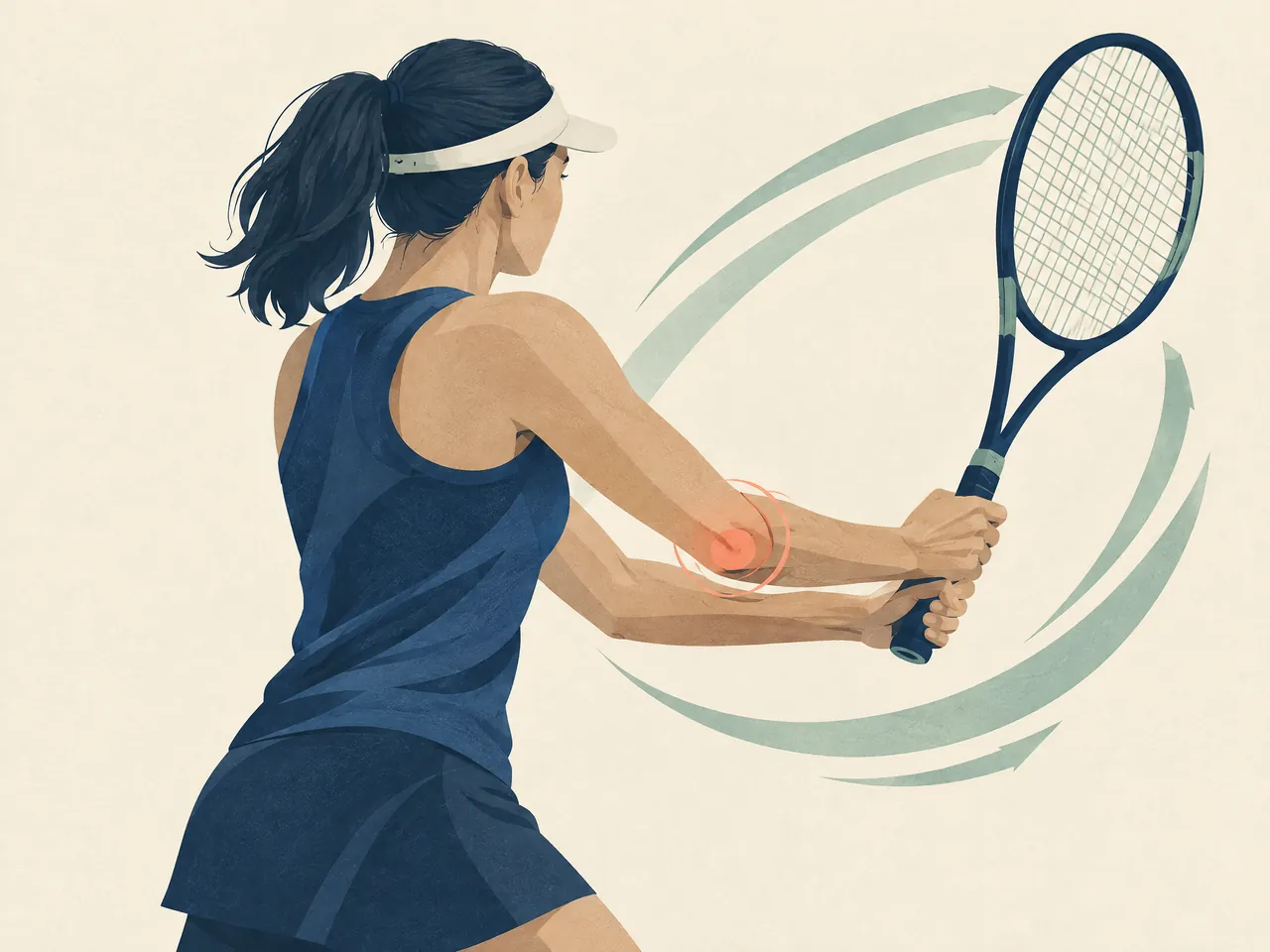
Elbow Pain Location, Elbow Pain Assessment and Elbow Pain on the Inside: Outer, Front and Tip Clues
Outer-elbow pain is often noticed with gripping, carrying a pan, opening a jar, turning a screwdriver or lifting palm-down. These tasks load the forearm and wrist as well as the elbow. ‘Tennis elbow’ is commonly used for one outer-elbow tendon pattern, but it is not confined to tennis and location alone cannot confirm it. If a task brings on symptoms, note the hand used, grip, load and whether pain starts during it, later that evening or next morning. The page on tennis elbow activity modification offers a way to think about adapting a provoking routine without trying to prove the cause at home.
Pain in the front crease of the elbow may feel deeper or may travel into the upper forearm. It deserves the same careful description: did it begin after a pull, lifting, a fall, or without a clear event? At the back, the elbow tip can look or feel puffy after pressure on a hard surface, a knock or repeated leaning. Redness, warmth, a rapidly enlarging lump, fever, a painful swollen joint or a deformity should not be treated as ordinary overuse. A primary-care review identifies traumatic swelling or dislocation and a tender swollen joint as warning features requiring urgent referral [5].
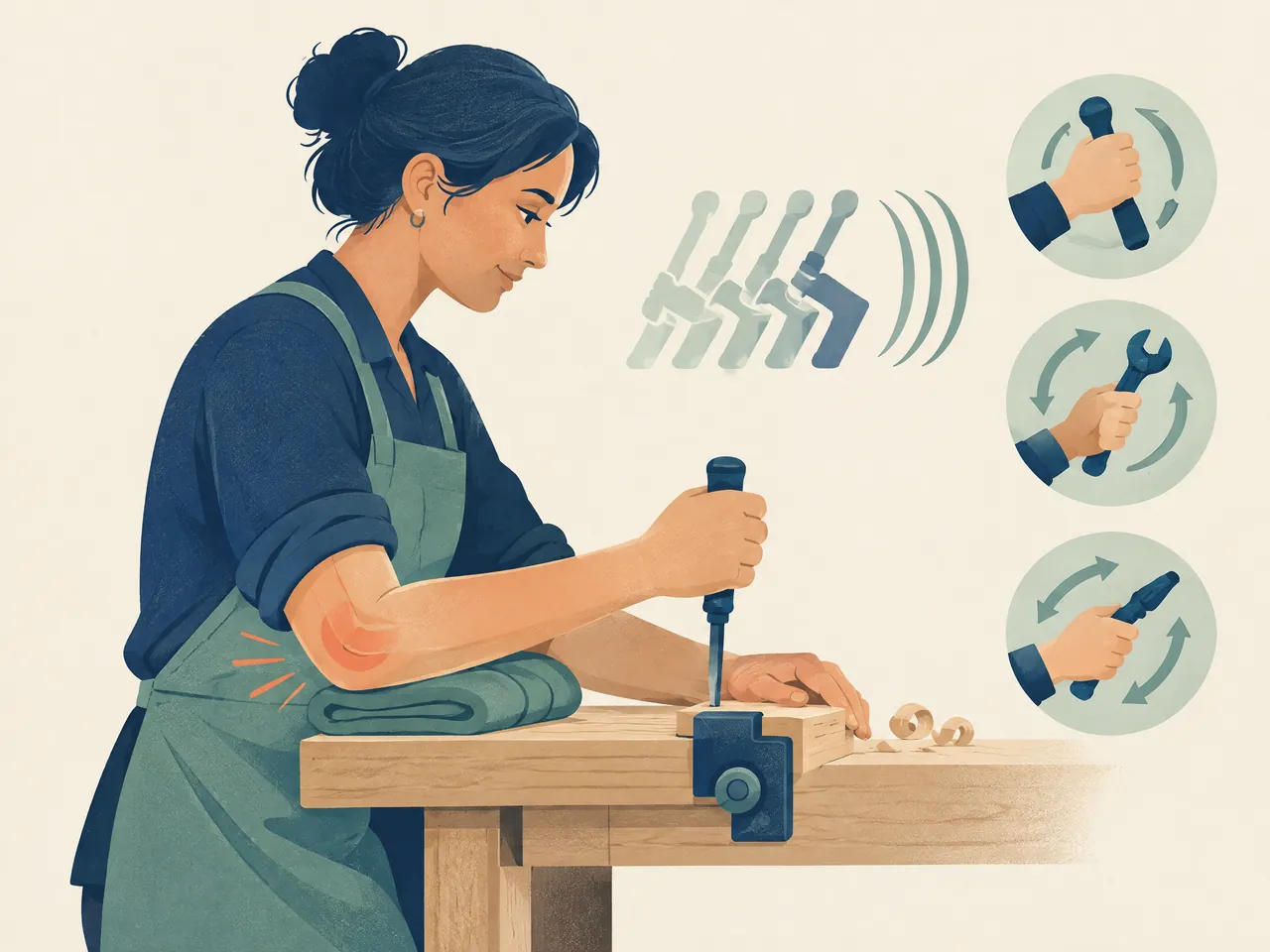
Elbow Pain Location, Elbow Pain Assessment and Elbow Pain on the Inside: Why Symptoms Do Not Confirm a Cause
Elbow pain on the inside may be associated with repeated gripping, lifting or wrist use. Mayo Clinic describes inner-elbow pain and tenderness that may worsen with gripping or lifting in medial epicondylitis, sometimes with stiffness, weakness, numbness or tingling [2]. But this pattern is not exclusive. Tendon-related symptoms, joint problems, an injury and nerve irritation can overlap, so ‘inside pain equals golfer’s elbow’ is too simple. A good record leaves room for assessment: it says what happened and what changed, rather than declaring a condition from a web search.
The inner elbow is also where the ulnar nerve passes behind the bony prominence. AAOS notes that numbness or tingling in the ring and little fingers is common with ulnar nerve entrapment at the elbow, and symptoms can be more noticeable with the elbow bent [3]. That does not mean every finger tingle comes from this nerve, but it is a reason to include exactly which fingers are affected, whether the feeling comes and goes, and whether fine tasks such as typing, buttoning or holding a phone feel different. Persistent or worsening sensory change merits medical assessment rather than vigorous stretching.
Compare your options
| What to observe | Examples to record | Why it adds context | Prompt action |
|---|---|---|---|
| Main pain location | Outside, inside, front crease, tip, or pain spreading into the forearm | Separates a local point from a broader or referred pattern | Describe it at an assessment; do not diagnose from location alone |
| Task and movement | Gripping a bag, lifting, wrist turn, elbow bend, straightening, leaning on a desk | Shows which ordinary load or position changes symptoms | Reduce clearly provoking tasks rather than repeatedly testing them |
| Sensation and strength | Ring/little-finger tingling, reduced feeling, dropping objects, weaker grip | May indicate that nerve symptoms need consideration | Arrange medical assessment, especially if new, persistent or worsening |
| Swelling, shape and illness | Rapid swelling, redness, warmth, fever, bruising, changed shape after injury | Can signal a problem that is not a routine overuse complaint | Seek urgent care for relevant warning signs |
| Daily impact and time course | Sleep disruption, inability to work, symptoms after a fall, improving or worsening over days | Helps establish severity, onset and the effect on function | Bring this record to the clinician or practitioner you consult |
On smaller screens, scroll the table sideways to compare all columns.
Elbow Pain Location, Elbow Pain Assessment and Elbow Pain on the Inside: Linking Pain with Function
Function gives elbow pain assessment its practical centre. Instead of rating pain only at rest, compare a few normal tasks with your usual ability: lifting a mug, fastening clothing, typing, carrying a bag, using chopsticks, driving, turning a door handle, or sleeping with the arm bent. Say whether the task is painful, weak, slow, impossible or simply avoided. Also note whether the elbow fully bends and straightens. A painful catch, a sensation that the joint is locked, or a steadily shrinking range of motion deserves attention; do not force the joint straight to check it.
A short symptom record can prevent the appointment from becoming a memory test. Include when the problem began, whether there was a fall, twist, direct blow or new workload, the exact location, the task that triggers it, and what eases it. Add whether it affects one arm or both, interrupts sleep, or is getting better, unchanged or worse. Clinical assessment commonly considers the nature, onset and duration of symptoms, aggravating activities and injury mechanism, then examines related regions such as the neck, shoulder, wrist and nerves when indicated [5].
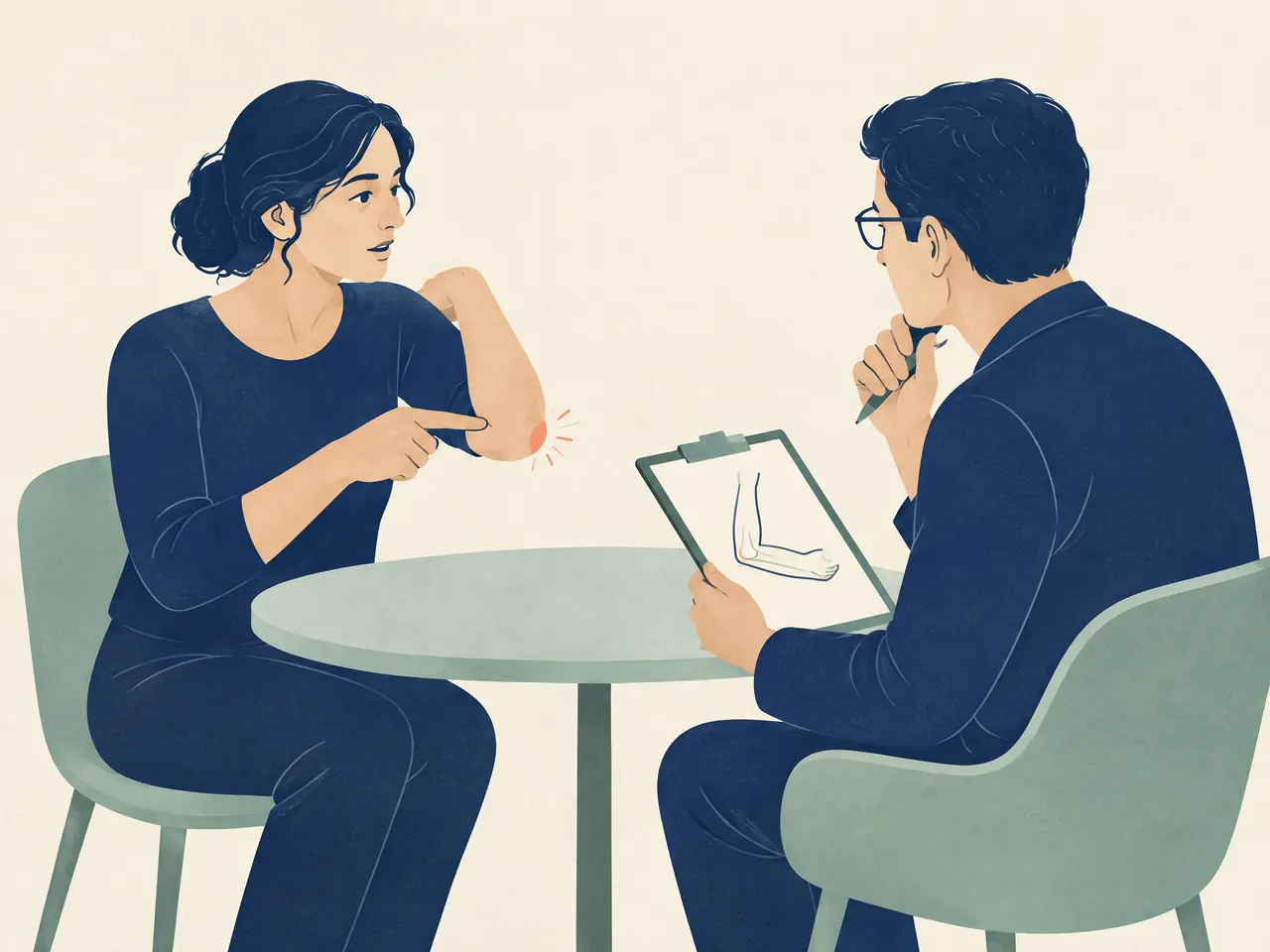
Elbow Pain Location, Elbow Pain Assessment and Elbow Pain on the Inside: Movement, Grip and Rotation
Separate the elbow movement from the hand task when you write your notes. Bending may hurt while talking on a phone or holding a book. Straightening may be limited after prolonged sitting or on waking. Rotating the forearm—turning a key, using a screwdriver, carrying a bowl palm-up, or pouring from a bottle—can change the feeling because the wrist and forearm share working muscles with the elbow. Gripping can be light, such as holding a toothbrush, or forceful, such as carrying groceries. State which version matters, and stop if an activity produces sharp pain, numbness or a sense that the joint is giving way.
It is reasonable to reduce or pace an activity that clearly aggravates symptoms while arranging appropriate advice, but avoid designing a painful home test. Repeated maximum squeezing, forceful stretches or adding weight to see whether it hurts more can make a flare harder to interpret. Practical adjustments, such as using two hands for a heavy pan or avoiding prolonged inner-elbow pressure, are observations about load, not a diagnosis or promise of recovery. If wrist position seems relevant, read wrist flexor stretch for tennis elbow as a discussion prompt; do not use a stretch to rule conditions in or out.

Elbow Pain Location, Elbow Pain Assessment and Elbow Pain on the Inside: Numbness, Stiffness and Injury Records
Numbness, tingling and weakness are different observations. Record the fingers involved, duration, whether it follows a position such as elbow bending, and whether objects are being dropped. AAOS explains that the ulnar nerve supplies sensation to the little finger and part of the ring finger, while more advanced compression can affect grip and finger coordination [3]. These details help a clinician decide whether nerve assessment is needed; they should not be used to self-diagnose a trapped nerve.
Stiffness needs its own description. Is it brief after rest, present all day, or accompanied by swelling elsewhere? Can you move through the range but pain stops you, or is the movement physically blocked? Note clicking or locking only if it occurs naturally; do not repeatedly force a click. After a fall, collision, sudden pull or pop, write down when it occurred, whether the elbow changed shape, whether bruising or swelling appeared, and what movement became difficult. Photographs taken for your own record may show changes in swelling over time, but a picture cannot establish what structure is affected.
Elbow Pain Location, Elbow Pain Assessment and Elbow Pain on the Inside: When to Seek Care
The urgency is shaped by the whole picture, not by whether pain is on the inside or outside. Seek urgent medical help after an injury if the arm looks changed in shape, there was a snapping sound, pain is severe and movement is difficult, or the arm is numb or tingling. The NHS also advises urgent assessment for an arm that is swollen with a very high temperature or hot-and-shivery feeling, and emergency help if sudden arm pain occurs with pressure, heaviness or squeezing across the chest [4]. Do not massage, needle or keep exercising through those warning signs.
For a non-emergency problem, arrange a clinical assessment when symptoms persist, interfere with ordinary work or sleep, recur as you return to an activity, or include new sensory change or loss of strength. Bring your short record and a list of medicines and relevant health conditions. If you are considering an in-person Chinese medicine consultation in Hong Kong after appropriate medical assessment, you can ask a Kwun Tong Chinese medicine clinic or Chinese medicine clinic Prince Edward about appointment availability and explain the elbow symptoms before attending. This conversation does not replace urgent or emergency care.

Elbow Pain Location, Elbow Pain Assessment and Elbow Pain on the Inside: Traditional Chinese Medicine Context
In a face-to-face Traditional Chinese Medicine consultation, a Registered Chinese Medicine Practitioner may ask about the pain location and quality, onset, work or sport load, sleep, digestion, general health and medicines. Observation and examination form part of the traditional consultation, but they are not a substitute for recognising fracture, infection, serious nerve symptoms or a possible heart-related emergency. Be direct about an injury, fever, numbness, previous surgery, blood-thinning medicines and any current treatment. Clear information supports safer coordination with other healthcare professionals.
Traditional Chinese Medicine may describe musculoskeletal discomfort through concepts such as cold-dampness, damp-heat or qi and blood stasis. These are traditional assessment concepts, not modern medical diagnoses, and do not show what tissue is causing an elbow symptom. They should not reinterpret a hot swollen elbow with fever as a routine pattern or delay conventional assessment for a deformed, locked or markedly weak joint. Acupuncture can be discussed as a possible supportive option after individual assessment, but evidence and clinical recommendations differ across elbow conditions; no fixed number of sessions or result can be promised.

Elbow Pain Location, Elbow Pain Assessment and Elbow Pain on the Inside: Safety and Supportive Options
Until you have been assessed, choose support that does not hide an important change. Protect the elbow from obvious pressure or a task that sharply worsens symptoms, but keep a note of what you changed and what happened. Ask a clinician or pharmacist before using medicines if you have medical conditions, take regular medicines, are pregnant or have had a reaction before. Avoid self-needling and do not let a home treatment delay care for numbness, progressive weakness, a warm swollen elbow or injury-related deformity. The aim is to preserve useful information and protect daily function, not to win a test of pain tolerance.
When planning a non-urgent consultation, write down the questions you want answered: What features need examination? Are nerves, neck, shoulder or wrist relevant? Which daily tasks can be modified safely? What would mean I should seek care sooner? If cost information would help you decide where to ask, see the Chinese medicine clinic price list Hong Kong; confirm the current arrangement directly before attending. For any appointment, bring the symptom record rather than a preselected diagnosis. It gives the practitioner a clearer starting point for an elbow pain assessment.
Care and health guide
Pain-care information
This directory brings together services, reading, and visit information related to pain care, to help you prepare questions for a consultation.
When pain care affects your day, noting when it occurs, its relation to activity, and what you have already tried can help prepare a consultation; Chinese medicine pain management Hong Kong is a relevant service or reading entry point.
Individual circumstances differ, and acupuncture Hong Kong offers related information to help you understand options and prepare questions.


Your questions, answered
Frequently asked questions
Does elbow pain location prove that I have tennis elbow?
No. Outer-elbow pain with gripping, lifting or wrist movement may fit a tendon-related pattern, but other problems can feel similar. An elbow pain assessment considers onset, function, examination findings, associated symptoms and injury history rather than naming a condition from one spot of pain.
What should I note about elbow pain on the inside?
Note whether it appears with gripping, lifting, repeated wrist use, leaning on the elbow or prolonged bending. Record any numbness or tingling, especially in the ring or little finger, and any difficulty with fine finger tasks or grip. These features help distinguish what needs further assessment; they do not confirm a cause by themselves.
Is a swollen elbow tip always bursitis?
No. Swelling at the tip can follow pressure or an impact and may involve different tissues. Note when it appeared, whether it is red or warm, whether you have fever, and whether motion is difficult. A red-hot swollen elbow with fever needs urgent medical attention rather than self-treatment.
When does elbow pain need prompt medical assessment?
Seek urgent assessment for an elbow or arm that is deformed after injury, severely painful and difficult to move, numb or tingling, or swollen with fever or feeling hot and shivery. Sudden arm pain with chest pressure, heaviness or squeezing is an emergency. For persistent, recurrent or function-limiting symptoms, arrange a clinical assessment.
Sources and further information
- [1] Cleveland Clinic — Elbow Pain
Referenced for: General elbow-pain location, associated symptoms, possible tissue sources and indications for clinical care.
- [2] Mayo Clinic — Golfer's elbow (medial epicondylitis): Symptoms and causes
Referenced for: Inner-elbow symptom pattern and urgent-care features including warmth, swelling, fever, loss of bending and possible fracture.
- [3] American Academy of Orthopaedic Surgeons — Ulnar Nerve Entrapment at the Elbow
Referenced for: Ulnar-nerve anatomy, ring- and little-finger symptoms, grip changes and clinical assessment context.
- [4] NHS — Elbow and arm pain
Referenced for: Urgent and emergency warning signs for arm and elbow symptoms.
- [5] Javed et al. — Elbow pain: a guide to assessment and management in primary care
Referenced for: Peer-reviewed overview of elbow-pain history, warning features, examination and related-region assessment.