
TCM Lab · Health reading
hair thinning and TCM; TCM scalp care for hair loss; TCM pattern differentiation for hair loss — a practical traditional Chinese medicine explanation
Published Updated
Noticing more scalp at the parting, a widening hairline, extra hairs after washing, or a change in texture can be unsettling. Hair thinning and TCM are often searched together because traditional Chinese medicine looks beyond the scalp alone and asks about sleep, appetite, stress, menstrual or post-illness changes, digestion and the timing of shedding. That traditional lens can make a consultation feel more individual, but it is not a proven biological account of why follicles grow or shrink. Hair loss also has many possible medical and everyday causes, so a new, sudden, patchy, painful or worsening change deserves medical assessment alongside any TCM discussion [1] [2].
Appointments are confirmed through WhatsApp. If you have language requirements, please mention them in your enquiry.
The short answer
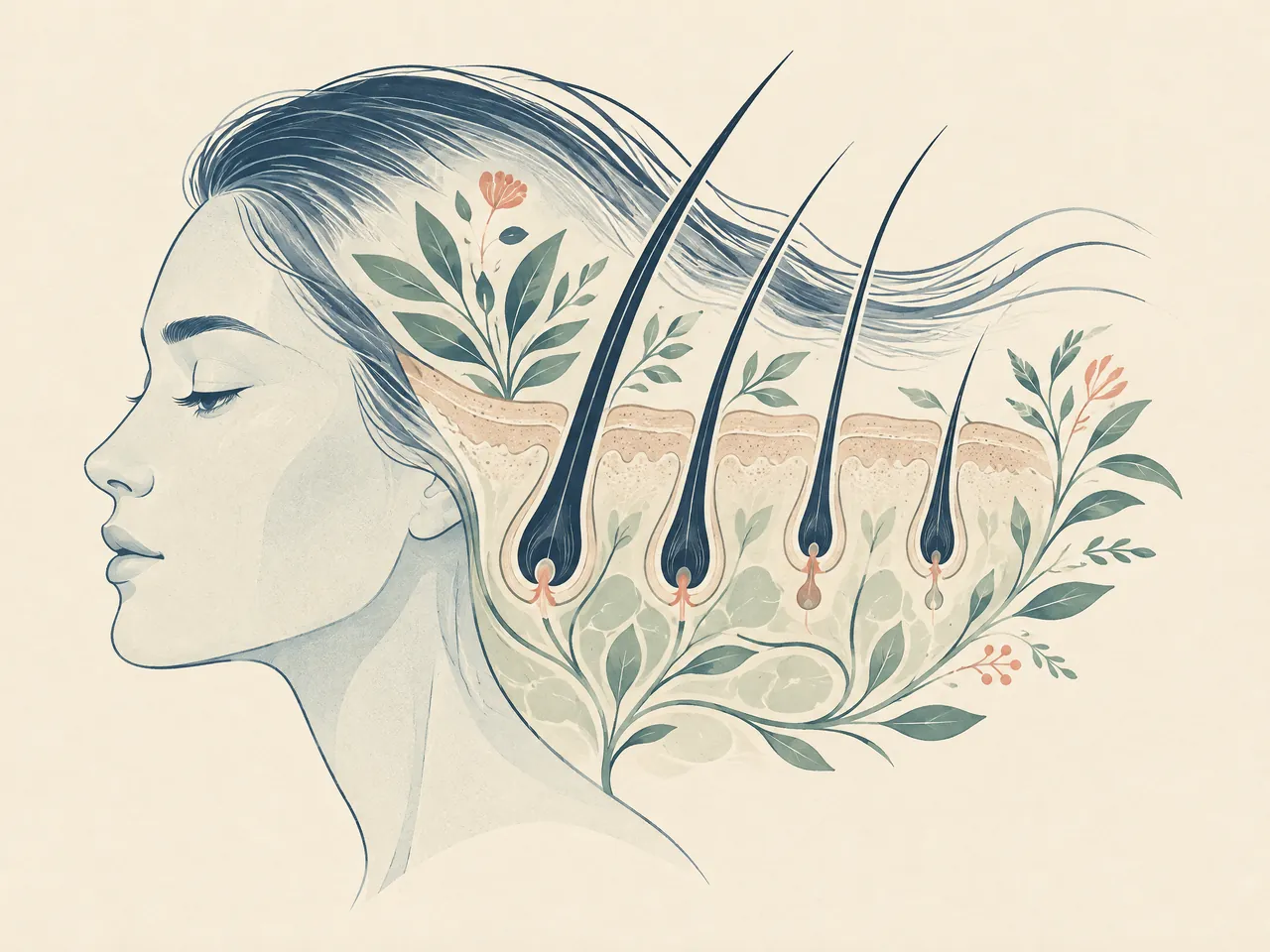
Traditional Chinese medicine discusses hair thinning through patterns involving the Liver, Kidney, Spleen, Qi and Blood, then considers the person’s scalp, symptoms and daily context. These are traditional concepts, not established biological mechanisms, and they cannot confirm a cause of hair loss or promise regrowth. TCM scalp care for hair loss may include gentle care and a consultation about acupuncture or prescribed herbs, while unexplained, rapid or persistent thinning should be medically assessed.
Transparent pricing
See the fees.
Choose your care.
Explore our complete official price list, including first-trial prices, regular prices, packages and branch-specific options.
Opening WhatsApp prepares an enquiry; it does not send a message, take payment or confirm an appointment. Suitability and individual arrangements are confirmed during consultation.
Hair and scalp
All prices in HKDScalp health and hair-loss management
Includes AI scalp analysis, deep scalp and follicle cleansing, and scalp oil-control care.
HK$380 (first trial)
Regular price: HK$680
- 6 sessions: HK$3,480 (HK$580 per session)
- 12 sessions: HK$5,760 (HK$480 per session)
- 20 sessions: HK$8,600 (HK$430 per session)
- 30 sessions: HK$11,400 (HK$380 per session)
Hair acupuncture and Chinese herbal medicine package
Includes scalp acupuncture and 3 days of Chinese herbal medicine that does not require decoction.
HK$580 (single session)
Registered Chinese Medicine Practitioner consultation
- 6 sessions: HK$3,180 (HK$530 per session)
- 12 sessions: HK$5,760 (HK$480 per session)
- 20 sessions: HK$8,600 (HK$430 per session)
- 30 sessions: HK$11,400 (HK$380 per session)
Combined hair and scalp treatment
Combines acupuncture and Chinese herbal medicine with salon-level scalp and follicle care. Packages include complimentary hair-care shampoo and serum.
HK$1,260 (single session)
Combined treatment
- 8 sessions: HK$8,640 (HK$1,080 per session)
- 16 sessions: HK$15,680 (HK$980 per session)
- 20 sessions: HK$18,600 (HK$930 per session)
- 30 sessions: HK$26,400 (HK$880 per session)
Weight management
All prices in HKDFull-body acupoint embedding for weight management
Includes full-body acupoint embedding. Packages include complimentary Chinese herbal medicine for weight management, with the number of included days scaled to the package. Embedding material and the individual treatment arrangement are confirmed during consultation; this is not a cosmetic thread lift.
HK$980 (single session)
No trial session
- 10 sessions: HK$7,800 (HK$780 per session)
- 20 sessions: HK$14,600 (HK$730 per session)
- 30 sessions: HK$20,400 (HK$680 per session)
Facial acupuncture
All prices in HKDFacial acupuncture (basic)
Includes facial acupuncture and meridian-based facial care, including care for facial puffiness.
HK$480 (first trial)
Regular price: HK$680
- 10 sessions: HK$5,200 (HK$520 per session)
- 20 sessions: HK$9,600 (HK$480 per session)
- 30 sessions: HK$13,500 (HK$450 per session)
Facial acupuncture (advanced)
Includes enhanced facial acupuncture with a specially formulated moisturising mask and serum.
HK$780 (first trial)
Regular price: HK$1,180
- 10 sessions: HK$9,000 (HK$900 per session)
- 20 sessions: HK$16,600 (HK$830 per session)
- 30 sessions: HK$23,400 (HK$780 per session)
Pain care
All prices in HKDExtracorporeal shockwave treatment
Shockwave treatment for deep-tissue and fascial care. The Kwun Tong clinic offers the multi-area options shown below.
Priced by branch
Branch-specific pricing
Prince Edward: HK$250 per area
Kwun Tong: HK$250 for 1 area / HK$450 for 2 areas / HK$600 for 3 areas
Pain care (manual therapy)
Includes Chinese medicine musculoskeletal assessment, manual joint techniques and tui na.
HK$580 (single session)
Chinese medicine musculoskeletal assessment
Pain care (acupuncture and manual therapy)
Combines acupuncture and manual therapy.
HK$680 (single session)
Combined care
Chinese medicine
All prices in HKDAcupuncture and Chinese herbal medicine package
Includes a Chinese medicine consultation with pulse assessment, body acupuncture and 3 days of Chinese herbal granules that do not require decoction.
HK$580 (single session)
Chinese medicine consultation with pulse assessment
hair thinning and TCM; TCM scalp care for hair loss; TCM pattern differentiation for hair loss — how traditional theory views hair and the body
The phrase hair thinning and TCM brings together two questions: why hair looks less dense, sheds more or breaks, and how Chinese medicine describes the person behind that change. TCM commonly connects hair with Liver, Kidney and Spleen functions, plus the movement and nourishment described as Qi and Blood. These terms belong to a traditional medical system; they should not be translated into literal claims about hormones, circulation, nutrient delivery or follicle biology. A useful consultation keeps that boundary clear while listening to the story of the hair and scalp.
Before assigning any traditional pattern, separate a scalp observation from an explanation. A greasy scalp is not automatically a cause of loss; dry lengths can break even when follicles are healthy; and more hairs in the shower does not identify a condition. Hereditary pattern loss, illness, stress, weight change, nutritional deficiency, medicines, tight hairstyles and scalp conditions can all be relevant. The NHS advises finding out what may be causing hair loss before turning to a commercial hair clinic [1], and the American Academy of Dermatology notes that the cause shapes whether loss is gradual or abrupt and what care may be needed [2].
hair thinning and TCM; TCM scalp care for hair loss; TCM pattern differentiation for hair loss — Liver, Kidney, Spleen and Qi-Blood concepts
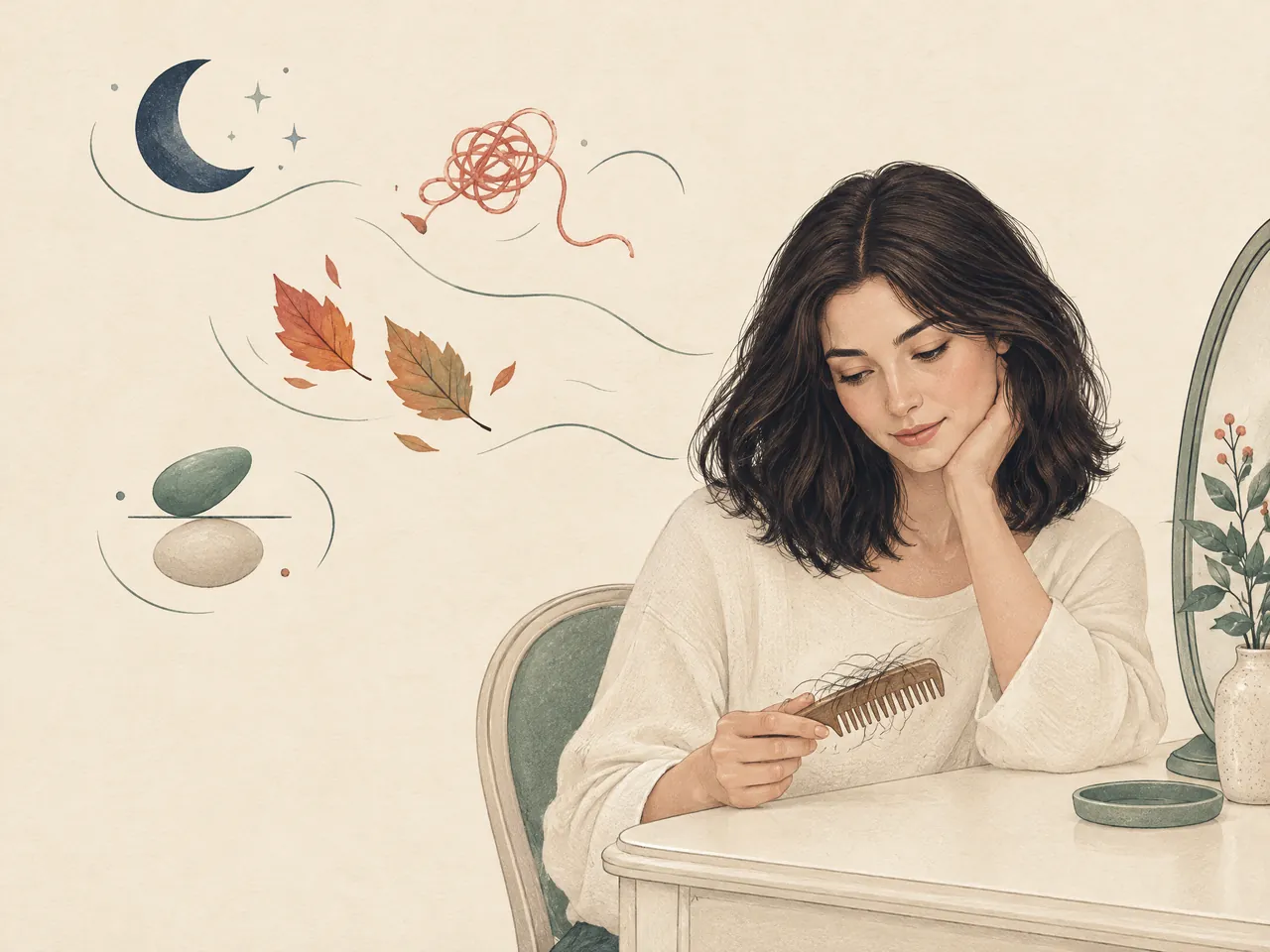
In traditional language, hair may be discussed in relation to Kidney essence and Liver Blood, while the Spleen is considered in the transformation and transport of nourishment. A practitioner may use these ideas to organise a person’s account: gradual fine, dry-looking hair; tiredness after a demanding period; digestive discomfort; sleep disruption; or a scalp that feels oily and itchy. Qi and Blood are also traditional concepts used to describe vitality and nourishment. They are not lab values, and no one can confirm a pattern from a photograph, an online quiz or the state of the hair alone. More than one traditional description may be considered, especially when symptoms and habits have changed over time.
That distinction matters because a traditional pattern should not obscure medical clues. Widening at the part or recession may fit hereditary pattern hair loss, while a sharply defined bare patch, scaling, inflammation or sudden clumps can require a different clinical conversation. In a TCM appointment, onset, rate of change, recent illness, childbirth, dietary restriction, new medicine, family history and styling practices are useful context. For a broader explanation of these perspectives, read our Chinese medicine perspective on hair loss.

hair thinning and TCM; TCM scalp care for hair loss; TCM pattern differentiation for hair loss — why traditional explanations are not proven biology
It can be tempting to treat an appealing traditional phrase as a direct mechanism: to say that an herb feeds follicles, needling switches hair back on, or a pattern proves a hormonal problem. Those claims go further than the evidence supports. Traditional Liver, Kidney, Spleen, Qi and Blood descriptions are not validated equivalents of biological processes. Acupuncture research is condition-specific; information about acupuncture for pain does not establish effectiveness for hair regrowth. Keeping traditional theory and scientific evidence separate protects people from delaying an assessment that could change their next step.
A more grounded use of the traditional vocabulary is as a conversation tool. It may help someone describe a cluster of concerns that includes sleep, appetite, energy, stress and scalp comfort rather than reducing the visit to a strand count. It should not generate a fixed prognosis, a guaranteed course of treatment or a promise that hair will return. If prescribed herbal medicine is discussed, it should follow an individual consultation and a full medication and health history; an online article is not a prescription. Readers considering that route can compare the questions involved in Can Chinese herbal medicine help hair regrowth? before deciding what to ask.
Compare your options
| What you notice | Useful detail to record | Why the detail matters |
|---|---|---|
| Gradual thinning or a wider part | When it began, whether it is getting faster, and any family pattern | Helps distinguish a long-running pattern from a newer change that needs assessment. |
| Sudden diffuse shedding | Recent illness, major stress, weight change, childbirth, restrictive eating or new medicine | These timing clues are useful for a clinician and should not be replaced by a TCM label. |
| Patchy loss or painful scalp | Patch location, itch, scale, redness, crusting, tenderness and hair loss elsewhere | May need timely medical examination before scalp treatments or needling are considered. |
| Breakage, dryness or oiliness | Hair styling, chemical treatments, heat, washing routine and new products | Supports practical scalp and hair-care adjustments without assuming these explain follicle loss. |
On smaller screens, scroll the table sideways to compare all columns.
hair thinning and TCM; TCM scalp care for hair loss; TCM pattern differentiation for hair loss — assessment, daily care and treatment discussions
A useful first consultation is less about finding a dramatic label and more about building a clear timeline. When did the change begin? Is it shedding from the root, breakage along the shaft, a widening part, a receding hairline, or one or more patches? Is the scalp sore, flaky, crusted, itchy or tender? Has there been a recent fever, operation, major stress, rapid dietary change, pregnancy or postpartum period, or a new medicine? These questions do not diagnose the cause by themselves. They do, however, show why TCM pattern differentiation for hair loss needs to sit beside ordinary medical history rather than replace it.
TCM scalp care for hair loss is most helpful when it remains modest and observant. Choose a cleansing routine that feels comfortable rather than harsh, avoid scratching or vigorous brushing on an irritated scalp, and note whether a product, tight style, heat treatment or colour service worsens breakage or discomfort. Eating regularly enough to support general nutrition, allowing time for sleep and seeking support for sustained stress are sensible health measures. None is a proven cure for every type of hair loss. Avoid treating supplements, concentrated oils or internet herb lists as harmless simply because they are marketed as natural.
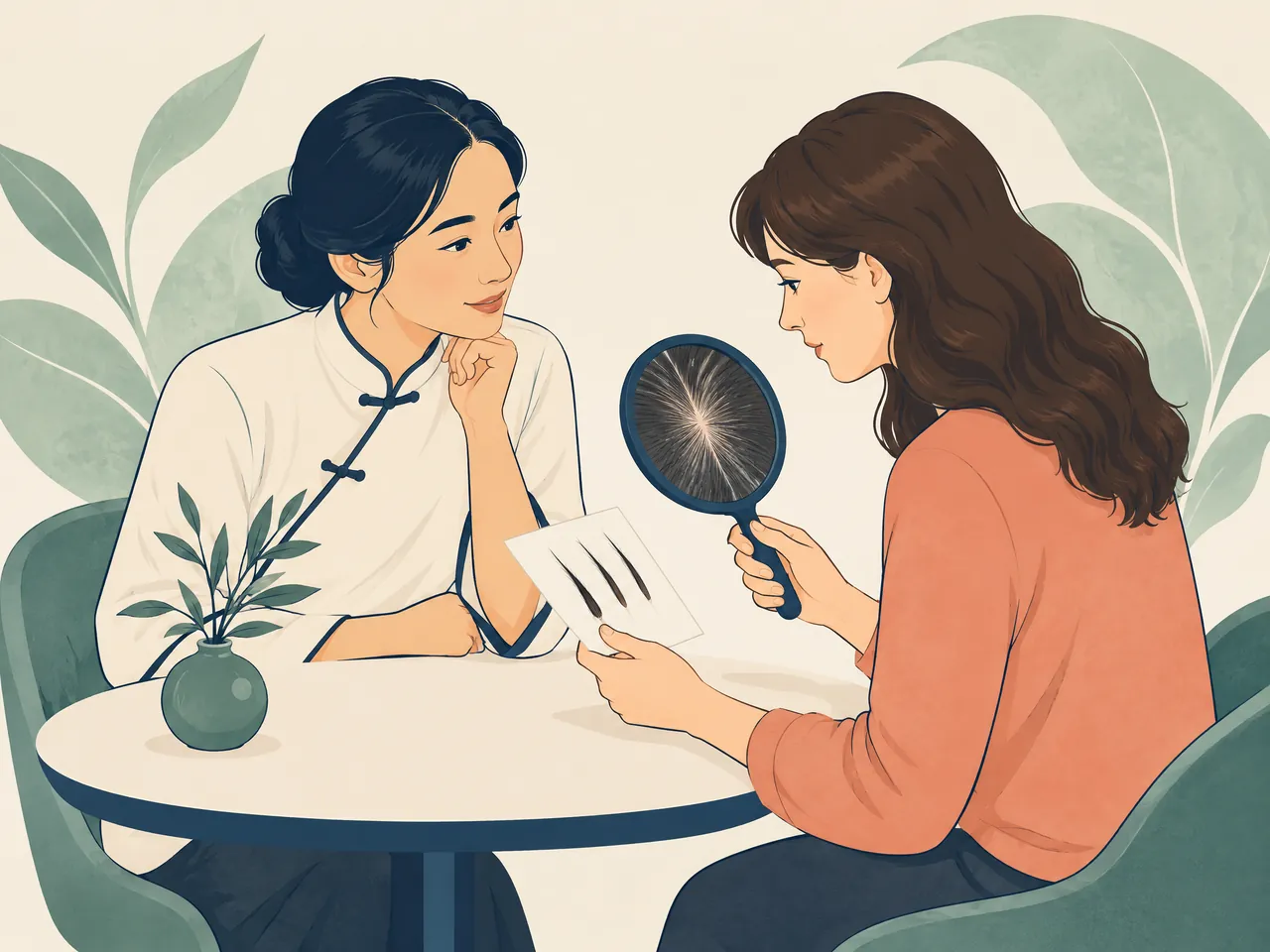
The table below is a preparation aid, not a self-diagnosis tool.
hair thinning and TCM; TCM scalp care for hair loss; TCM pattern differentiation for hair loss — what an individual consultation may consider
An individual discussion may consider scalp appearance, hair density and breakage, but also the person’s wider account of health and routine. A registered Chinese medicine practitioner may ask about digestion, sleep, mood, temperature sensitivity, energy, menstrual changes where relevant, and current treatments. In traditional practice these observations may inform a pattern-based discussion and whether any supportive approach is suitable. The practitioner should also know about prescribed medicines, pregnancy, breastfeeding, allergies, long-term conditions and previous reactions to herbs or needling. This is particularly important because hair thinning may have a cause that needs medical treatment, and because the safe choice of any complementary care depends on context.
Bring a short timeline rather than judging the hair from one stressful morning. Note the first change, whether shedding is diffuse or local, scalp symptoms, recent health events, and the products or treatments you use. If you have already had a medical diagnosis or test result, say so. A consultation should discuss what is uncertain, what needs referral, and what a traditional approach can reasonably aim to support.
hair thinning and TCM; TCM scalp care for hair loss; TCM pattern differentiation for hair loss — acupuncture, scalp needling and practical cautions
Acupuncture uses fine needles inserted through the skin; scalp needling and plum blossom needling are different techniques and should not be treated as interchangeable. In traditional practice, they may be discussed in relation to local and whole-person patterns, but this does not prove that they restart follicles or correct a particular biological cause of thinning. High-quality evidence for hair regrowth remains limited [4], so the discussion should be about informed choice rather than promised results. The U.S. National Center for Complementary and Integrative Health notes that acupuncture complications have occurred with nonsterile needles and improper delivery, and that it should not postpone seeing a health-care provider [3].
Do not attempt needling at home or on broken, infected, severely inflamed or unexplained painful scalp skin. Tell the practitioner about medicines and health conditions before treatment, and ask what hygiene and single-use needle practices apply. A treatment response, or the absence of one, does not establish the original cause of hair loss. If you are comparing terminology, read plum blossom needle for hair loss and Can acupuncture help with hair loss?. For a safety-focused question list, see plum blossom needle side effects.
hair thinning and TCM; TCM scalp care for hair loss; TCM pattern differentiation for hair loss — common presentations and sensible next steps
Common words such as dry, fine and oily describe what someone sees and feels, not the underlying cause. Fine hair may be a long-standing texture, a sign of miniaturisation, or simply more visible when density falls. Dry-looking lengths can reflect weathering, bleach, heat or friction. An oily scalp may be accompanied by itch and scale, but it does not tell us that follicles are blocked or that one traditional pattern is certain. These observations guide gentle care and tell you what to report.
Take photographs in similar lighting and parting positions if you want to describe change over time, but do not let repeated checking become the only response. It is reasonable to seek medical advice if you are worried about hair loss [1]. The case for timely assessment is stronger when loss is sudden, patchy, scarring-looking, painful, inflamed, or affecting eyebrows or other body hair; if hair is coming out in clumps; or if it follows a new medicine or comes with other concerning symptoms. This page cannot identify a cause. It can help you prepare precise questions for a clinician and decide whether complementary care is an appropriate addition rather than the sole plan.
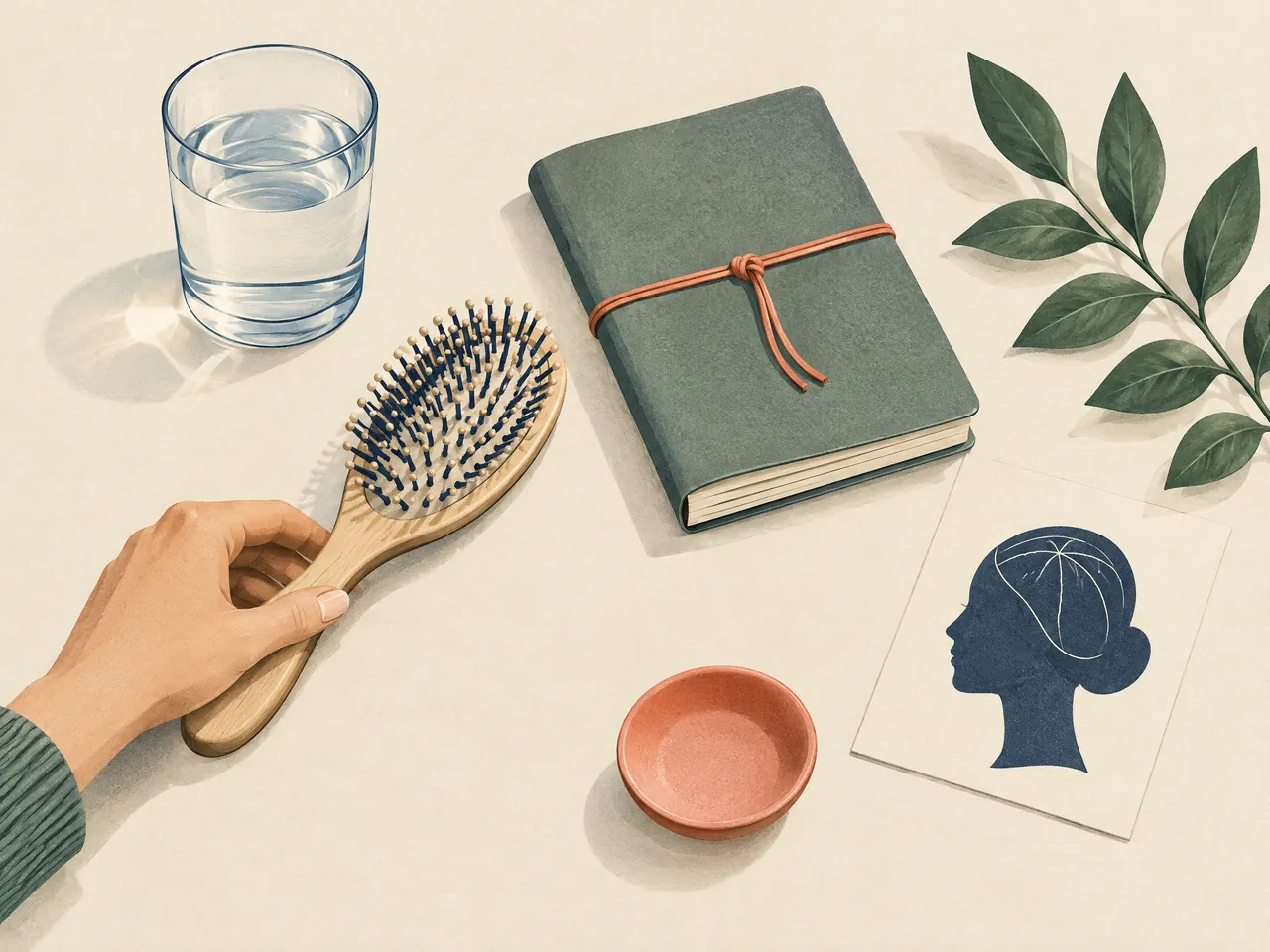
hair thinning and TCM; TCM scalp care for hair loss; TCM pattern differentiation for hair loss — dry, fine or oily scalp presentations
For dry or brittle lengths, reduce unnecessary pulling, very hot tools and repeated chemical processing while you clarify whether the issue is breakage, shedding or both. For a greasy or flaky scalp, resist heavy scratching and note redness, soreness, scaling and products used. For fine hair or a wider-looking part, record when it began and whether close relatives have similar changes. These distinctions make a consultation more useful than the general statement that hair is falling out.
Traditional pattern differentiation may be discussed after those observations are collected. A person with an oily, itchy scalp might be described with a traditional damp-heat concept; another with dry, sparse hair and fatigue might prompt a different traditional conversation. Neither description proves why the scalp is oily or why hair is thinning. Think of the pattern as a practitioner’s traditional synthesis, not a laboratory result.

hair thinning and TCM; TCM scalp care for hair loss; TCM pattern differentiation for hair loss — when to seek medical assessment
Medical assessment should be a priority for a sudden or dramatic change, clearly bordered bald patches, scalp pain, pus, crusting, significant redness, symptoms after a new medicine, or hair loss that is troubling you. A clinician can consider causes that cannot be distinguished by a traditional pattern alone, including scalp disease, nutritional concerns, medicine effects, endocrine issues and forms of alopecia. Do not stop a prescribed medicine because you suspect it is involved; ask the prescriber first. Finding a cause early can matter, and an accurate diagnosis helps avoid spending time and money on an approach that does not match the problem [2].
If you choose to explore TCM as well, be open about all care you are receiving. Ask what is being proposed, what evidence exists for your particular concern, what side effects or interactions are relevant, and when reassessment or referral would be advised. For an in-person discussion of scalp and hair concerns, TCM Lab has a Kwun Tong Chinese medicine clinic and a Chinese medicine clinic Prince Edward; appointment suitability and language needs can be confirmed directly. That conversation is the place for an individual plan, not a substitute for urgent or necessary medical care.
Care and health guide
Hair and scalp care information
This directory brings together services, reading, and visit information related to hair and scalp care, to help you prepare questions for a consultation.
For questions about hair or scalp care, noting the everyday concerns and service questions you want to discuss can help prepare a consultation; Chinese medicine for hair loss is a relevant service or reading entry point.
People may have different priorities, and acupuncture Hong Kong offers related information to help you understand options and prepare questions.

Your questions, answered
Frequently asked questions
How does TCM interpret hair thinning?
Traditional Chinese medicine may discuss hair in relation to Liver, Kidney, Spleen, Qi and Blood concepts and use a pattern-based account of symptoms, scalp concerns and daily health. These concepts are not established biological explanations and do not diagnose the cause of thinning. Medical assessment remains important when the change is unexplained, sudden, persistent or distressing.
Can TCM scalp care for hair loss regrow hair?
No approach should promise regrowth. Gentle scalp care can reduce avoidable irritation and a consultation can discuss supportive options, but evidence for acupuncture or herbal medicine as hair-regrowth treatments is limited and results vary. The first priority is understanding what may be causing the hair loss.
Should I buy Chinese herbs online for thinning hair?
No. Herbs should not be self-selected from a description of a TCM pattern. A registered Chinese medicine practitioner needs to consider your health history, prescribed medicines, allergies and the nature of the hair or scalp concern. Online content cannot determine a safe, appropriate prescription.
When should I see a doctor about hair loss?
Arrange medical assessment if you are worried, and seek prompt advice for sudden or patchy loss, a painful or inflamed scalp, crusting or pus, hair coming out in clumps, loss after a new medicine, or other symptoms that concern you. Complementary care should not delay necessary assessment.
Sources and further information
- [1] [1] NHS: Hair loss
Referenced for: Supports general causes of hair loss, advice to seek assessment when concerned, and the value of clarifying the cause before commercial hair-clinic treatment.
- [2] [2] American Academy of Dermatology: Hair loss—who gets and causes
Referenced for: Supports that hair loss has varied causes and that an accurate diagnosis guides appropriate treatment and may be time-sensitive.
- [3] [3] NCCIH: Acupuncture—effectiveness and safety
Referenced for: Supports general acupuncture safety cautions, including nonsterile needles and improper delivery, and advises not postponing health-care assessment.
- [4] [4] PubMed Central: Efficacy of acupuncture and moxibustion in alopecia—narrative review
Referenced for: Supports the statement that the reviewed acupuncture evidence for alopecia is limited by few studies, frequent combination treatments and a predominance of case reports.