
TCM Lab · Health reading
Acupuncture for Upper Back Pain and Stiffness: How Long Does an Acupuncture Session for Upper Back Pain Take? Where Are Acupuncture Points Used for Upper Back Tension?
Published Updated
Upper-back tightness often becomes noticeable at the end of a laptop day, after a long phone commute, or when lifting and reaching feel less easy than usual. Acupuncture for upper back pain and stiffness may be discussed as one symptom-management option when an individual assessment suggests postural muscle tension is part of the picture. It is not a way to repair a structural spinal curve. This page explains how posture, activity and tenderness may be considered, why an acupuncture appointment commonly includes time with needles retained, where points may be selected, and when a medical or physiotherapy assessment should come first.
Appointments are confirmed through WhatsApp. If you have language requirements, please mention them in your enquiry.

The short answer
For upper-back pain and stiffness linked with postural muscle tension, an acupuncture discussion starts with assessment rather than a fixed point plan. A practical session may take about 20–30 minutes, but positioning, needling and retention time are confirmed individually. Points may be considered around the neck, shoulders and upper back, not only at the sore spot. Acupuncture cannot correct a structural spinal curve. Seek prompt medical assessment for chest pain, breathing difficulty, weakness, numbness, trauma, or sudden severe or rapidly worsening pain.
Transparent pricing
See the fees.
Choose your care.
Explore our complete official price list, including first-trial prices, regular prices, packages and branch-specific options.
Opening WhatsApp prepares an enquiry; it does not send a message, take payment or confirm an appointment. Suitability and individual arrangements are confirmed during consultation.
Pain care
All prices in HKDExtracorporeal shockwave treatment
Shockwave treatment for deep-tissue and fascial care. The Kwun Tong clinic offers the multi-area options shown below.
Priced by branch
Branch-specific pricing
Prince Edward: HK$250 per area
Kwun Tong: HK$250 for 1 area / HK$450 for 2 areas / HK$600 for 3 areas
Pain care (manual therapy)
Includes Chinese medicine musculoskeletal assessment, manual joint techniques and tui na.
HK$580 (single session)
Chinese medicine musculoskeletal assessment
Pain care (acupuncture and manual therapy)
Combines acupuncture and manual therapy.
HK$680 (single session)
Combined care
Hair and scalp
All prices in HKDScalp health and hair-loss management
Includes AI scalp analysis, deep scalp and follicle cleansing, and scalp oil-control care.
HK$380 (first trial)
Regular price: HK$680
- 6 sessions: HK$3,480 (HK$580 per session)
- 12 sessions: HK$5,760 (HK$480 per session)
- 20 sessions: HK$8,600 (HK$430 per session)
- 30 sessions: HK$11,400 (HK$380 per session)
Hair acupuncture and Chinese herbal medicine package
Includes scalp acupuncture and 3 days of Chinese herbal medicine that does not require decoction.
HK$580 (single session)
Registered Chinese Medicine Practitioner consultation
- 6 sessions: HK$3,180 (HK$530 per session)
- 12 sessions: HK$5,760 (HK$480 per session)
- 20 sessions: HK$8,600 (HK$430 per session)
- 30 sessions: HK$11,400 (HK$380 per session)
Combined hair and scalp treatment
Combines acupuncture and Chinese herbal medicine with salon-level scalp and follicle care. Packages include complimentary hair-care shampoo and serum.
HK$1,260 (single session)
Combined treatment
- 8 sessions: HK$8,640 (HK$1,080 per session)
- 16 sessions: HK$15,680 (HK$980 per session)
- 20 sessions: HK$18,600 (HK$930 per session)
- 30 sessions: HK$26,400 (HK$880 per session)
Weight management
All prices in HKDFull-body acupoint embedding for weight management
Includes full-body acupoint embedding. Packages include complimentary Chinese herbal medicine for weight management, with the number of included days scaled to the package. Embedding material and the individual treatment arrangement are confirmed during consultation; this is not a cosmetic thread lift.
HK$980 (single session)
No trial session
- 10 sessions: HK$7,800 (HK$780 per session)
- 20 sessions: HK$14,600 (HK$730 per session)
- 30 sessions: HK$20,400 (HK$680 per session)
Facial acupuncture
All prices in HKDFacial acupuncture (basic)
Includes facial acupuncture and meridian-based facial care, including care for facial puffiness.
HK$480 (first trial)
Regular price: HK$680
- 10 sessions: HK$5,200 (HK$520 per session)
- 20 sessions: HK$9,600 (HK$480 per session)
- 30 sessions: HK$13,500 (HK$450 per session)
Facial acupuncture (advanced)
Includes enhanced facial acupuncture with a specially formulated moisturising mask and serum.
HK$780 (first trial)
Regular price: HK$1,180
- 10 sessions: HK$9,000 (HK$900 per session)
- 20 sessions: HK$16,600 (HK$830 per session)
- 30 sessions: HK$23,400 (HK$780 per session)
Chinese medicine
All prices in HKDAcupuncture and Chinese herbal medicine package
Includes a Chinese medicine consultation with pulse assessment, body acupuncture and 3 days of Chinese herbal granules that do not require decoction.
HK$580 (single session)
Chinese medicine consultation with pulse assessment
Acupuncture for Upper Back Pain and Stiffness: How long does an acupuncture session for upper back pain take? Where are acupuncture points used for upper back tension? — Assessment of Posture and Muscle Tension
Upper-back discomfort is not one single diagnosis. It can describe a dull band between the shoulder blades after desk work, a pulling feeling when the arms reach forward, or stiffness that makes turning the head less comfortable. Rounded shoulders and a forward head position can be part of a posture pattern, but they do not by themselves establish why a person hurts. A useful consultation starts with location, onset, activity triggers, sleep, recent changes in exercise or workload, prior injury and the way symptoms affect work, driving or home tasks. That history helps separate a manageable tension pattern from a concern needing another type of assessment.
The term “hunched” or “rounded” upper back is also used for kyphosis. The NHS explains that kyphosis can relate to posture or to a structural problem in the spine, and that a more noticeable curve can be associated with pain and stiffness [1]. This distinction matters: a person may have postural habits and tight muscles without knowing whether there is a structural curve, while another person may already have a diagnosis that needs coordinated care. Acupuncture for upper back pain and stiffness should therefore be framed as a discussion about symptoms and function, not a promise to straighten the spine or correct every rounded-shoulder appearance.

Acupuncture for Upper Back Pain and Stiffness: How long does an acupuncture session for upper back pain take? Where are acupuncture points used for upper back tension? — Posture, Rounded Shoulders and Muscle Tension
A common daily pattern is chest and front-of-shoulder tightness after sustained screen work, with the upper back feeling tired when the person tries to sit upright. Carrying a bag on one side, cycling in a forward position, studying on a low screen, or repeatedly working with the arms in front can add load. The practical question is not whether posture is “perfect”; it is whether one position is held for too long, whether movement has become guarded, and whether strength or mobility has changed. If rounded shoulders are your main concern, the related guide on acupuncture for rounded shoulders can help you prepare more focused questions for a consultation.
In TCM, a practitioner may describe restricted movement and local tenderness using traditional concepts such as meridian obstruction or qi and blood stagnation. These are traditional assessment approaches, not modern structural diagnoses. The practitioner may observe standing and seated posture, ask you to point to the most bothersome area, and feel for muscle tone or tender regions where appropriate. It is useful to mention headaches, pain travelling into the arm, a recent fall, night pain, fever, unexplained weight loss, or a change in grip or balance. Those details can change the next step and should not be hidden because the appointment began as a posture enquiry.
Acupuncture for Upper Back Pain and Stiffness: How long does an acupuncture session for upper back pain take? Where are acupuncture points used for upper back tension? — What a TCM Assessment Considers
A TCM assessment may combine your account of the problem with observation and palpation, then consider broader patterns such as sleep, energy, temperature preference, digestion and usual activity. For an upper-back concern, the immediately useful facts are still concrete: which movement catches, whether the ache is central or one-sided, whether a stretch helps briefly, and whether the problem follows a new gym routine or an old injury. Bring reports from other clinicians if you have them and list medicines, supplements and treatments already in use. This lets the practitioner discuss acupuncture alongside, rather than in place of, other care.
Before needling, say if you are pregnant, prone to fainting, have a bleeding condition, use medicines that affect bleeding, have a skin infection or irritation near a possible treatment area, or have had an unusual response to needling before. The U.S. National Center for Complementary and Integrative Health notes that acupuncture involves fine needles and that nonsterile needles or improper delivery can lead to complications [2]. These questions are not formalities. They help determine whether acupuncture can be discussed safely, whether the approach needs adapting, or whether another clinician should assess the problem first.
Compare your options
| What you notice | Details to share at assessment | Practical next question |
|---|---|---|
| Tightness after screen work or commuting | When it starts, screen or phone position, breaks, bag use, and whether walking or changing position helps | Could posture-related muscle tension be part of the problem, and what movement changes are realistic? |
| Pain around the neck, shoulder blade or shoulder | Exact location, reach or rotation that is limited, pain into the arm, clicking, injury history and current medicines | Is an upper-back acupuncture discussion appropriate, or should shoulder, medical or physiotherapy assessment come first? |
| First acupuncture appointment | Needle experience, fainting tendency, pregnancy, bleeding-related conditions or medicines, skin concerns and other care in progress | How will positioning, point selection, sensations and a roughly 20–30 minute session be tailored? |
| A rounded or hunched upper back | Whether the curve is new or changing, prior diagnosis, pain severity, breathing changes, activity limits and any scans or reports | Could there be a structural issue that needs medical assessment alongside symptom management? |
| New or worrying symptoms | Sudden onset, severe or fast-worsening pain, chest pain, breathing difficulty, trauma, numbness, weakness, fever or night pain | Should I seek urgent medical care instead of arranging a routine acupuncture consultation? |
On smaller screens, scroll the table sideways to compare all columns.
Acupuncture for Upper Back Pain and Stiffness: How long does an acupuncture session for upper back pain take? Where are acupuncture points used for upper back tension? — Common Locations and Point Selection
Where are acupuncture points used for upper back tension? The answer is individual, but discussion commonly centres on the neck, shoulder-girdle and upper-back regions rather than one universal spot. Traditional examples may include points known as Fengchi near the upper neck, Jianjing around the shoulder region, Tianzong around the shoulder blade, and points beside the upper thoracic spine. A practitioner may also choose points elsewhere on the body according to the overall assessment. Naming a point does not show that it is appropriate for you, and it is not an instruction to press, needle or copy a placement at home.

A person with tightness high at the base of the neck may describe a different problem from someone with aching between the shoulder blades or pain at the shoulder itself. This is why the assessment asks about reach, neck rotation, desk height, training and symptoms into the arm. If pain began after a forceful pull, clicking, weakness or trouble lifting the arm, it may be more useful to first explore the information on acupuncture for rotator cuff injury and arrange appropriate assessment rather than assuming the issue is simply upper-back posture.
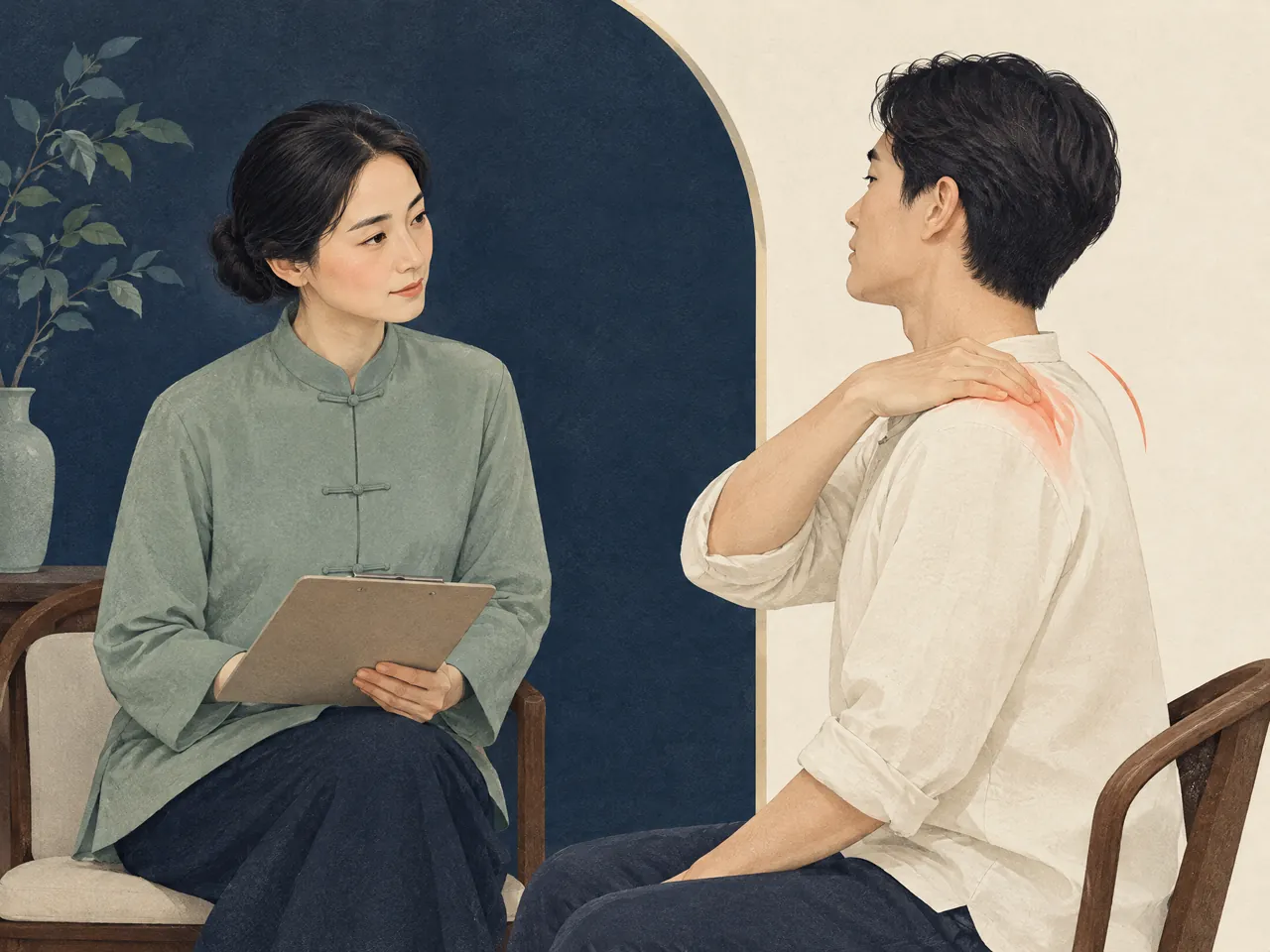
Acupuncture for Upper Back Pain and Stiffness: How long does an acupuncture session for upper back pain take? Where are acupuncture points used for upper back tension? — Shoulder, Neck and Upper-Back Areas
Point selection should follow the pattern found on the day, not an online diagram. For example, a practitioner may compare left and right shoulder movement, ask whether prolonged looking down is a trigger, and check whether tenderness sits in muscle tissue, near the shoulder blade, or closer to the neck. An area can feel tight because it has been overworking, because movement elsewhere is limited, or because pain has led to guarding. The clinical conversation should make room for uncertainty. It is better to say “this is being considered for symptom management” than to claim that a particular point can diagnose or fix a posture problem.
Shoulder symptoms can overlap with upper-back tension, but they are not automatically the same condition. Pain that is localised around the shoulder, affects overhead reach or interrupts dressing may need a shoulder-focused conversation. The page on acupuncture for shoulder pain Hong Kong explains a related enquiry route, while a practitioner can decide whether an upper-back acupuncture discussion is relevant. If symptoms spread down an arm, involve numbness or weakness, or follow significant trauma, do not rely on point selection alone; seek medical evaluation promptly.

Acupuncture for Upper Back Pain and Stiffness: How long does an acupuncture session for upper back pain take? Where are acupuncture points used for upper back tension? — Positioning, Sensations and Session Flow
How long does an acupuncture session for upper back pain take? A practical session may take about 20–30 minutes, but that time is an orientation rather than a fixed promise. You may be asked to lie face-down or on your side so the practitioner can access relevant areas comfortably; the appropriate position depends on mobility, comfort and the assessment. The appointment also includes communication. Tell the practitioner if your face position strains your neck, if you feel cold, if a position makes pain sharper, or if you need help getting on or off the treatment couch.
During needling, some people describe a local dull ache, heaviness, tingling, fullness or spreading sensation. In TCM this may be called de qi; the sensation is a traditional description, not a test of whether treatment is working. Sharp, burning, escalating or otherwise distressing sensations should be reported at once. Needles should be sterile and single-use; NCCIH notes that acupuncture needles are regulated as medical devices in the United States and must be sterile and labelled for single use [2]. Ask your practitioner what you may feel, what to do after the session and when to contact another healthcare provider.
Acupuncture for Upper Back Pain and Stiffness: How long does an acupuncture session for upper back pain take? Where are acupuncture points used for upper back tension? — Limits and Practical Next Steps
Acupuncture can be one part of a plan for muscle tension and discomfort, but it does not substitute for changing the load that keeps provoking symptoms. A treatment session cannot make an unsuitable workstation suitable, restore a suddenly weak arm, or repair a structural spinal curve. The NHS notes that physiotherapy may help posture and relieve pain and stiffness in kyphosis, while exercises can support core strength but do not improve the curve itself or stop it worsening [1]. Your next step may therefore include movement advice, a physiotherapy discussion, medical review, or all of these alongside a TCM consultation.
Note whether you can turn your head more easily, sit through a meeting with fewer breaks, reach a shelf with less guarding, or whether the issue has changed character. Also note new symptoms. This produces a more useful follow-up conversation than saying only that your back is “better” or “worse.” If you want to compare consultation arrangements before attending, see the Chinese medicine clinic price list Hong Kong page, then ask what is appropriate for your own assessment rather than assuming a course or outcome.

Acupuncture for Upper Back Pain and Stiffness: How long does an acupuncture session for upper back pain take? Where are acupuncture points used for upper back tension? — Daily Movement and Posture Support
Small, repeatable changes are usually easier to maintain than trying to hold a rigid “good posture” all day. Position the screen so you are not persistently looking down, place frequently used items within easy reach, vary seated tasks with short walks, and change the side used for carrying a bag where possible. If a stretch makes symptoms sharper, causes tingling or produces pain travelling into the arm, stop and seek individual advice. Strengthening and mobility work should suit the cause, current movement and medical history; do not force the chest, neck or shoulders into an uncomfortable position to copy an idealised posture image.
Daily activity can also reveal patterns that a clinic room cannot. Notice whether tension rises during a video call, after swimming, when carrying a child, or during a commute. Bring that detail to your appointment, together with the type of chair, bag, exercise or tool involved. For location planning, TCM Lab has a Kwun Tong Chinese medicine clinic and a Chinese medicine clinic Prince Edward; contact the team to discuss current appointment arrangements rather than treating this information as a confirmed booking.

Acupuncture for Upper Back Pain and Stiffness: How long does an acupuncture session for upper back pain take? Where are acupuncture points used for upper back tension? — When Further Assessment Matters
Do not wait for a routine acupuncture enquiry if you have chest pain, difficulty breathing, severe pain that started suddenly, pain that is rapidly worsening, or pain after a serious accident. The NHS also advises urgent assessment for back pain with serious systemic symptoms, and emergency care for back pain with chest pain or significant neurological changes [3]. Although that guidance addresses back pain generally, these warning signs are more important than whether the discomfort feels muscular or seems connected to posture. Tell the clinician when symptoms began and what else has changed.
Further assessment is also sensible when upper-back pain persists despite sensible activity changes, is worse at night or at rest, stops you managing normal tasks, or is accompanied by unexplained weight loss, fever, a new deformity, numbness or weakness. A clinician may examine the spine and arms and, when appropriate, arrange imaging or refer to physiotherapy or another specialist. Acupuncture can be revisited after the cause and safety needs are clearer. This approach protects the purpose of an acupuncture consultation: an informed choice about symptom management, not a reason to postpone necessary diagnosis or care.
Care and health guide
Low back discomfort: care information
This directory brings together services, reading, and visit information related to low back discomfort, to help you prepare questions for a consultation.
When low back discomfort affects your day, noting when it occurs, its relation to activity, and what you have already tried can help prepare a consultation; acupuncture for low back pain is a relevant service or reading entry point.
Individual circumstances differ, and acupuncture Hong Kong offers related information to help you understand options and prepare questions.


Your questions, answered
Frequently asked questions
How long does an acupuncture session for upper back pain take?
A practical session may take about 20–30 minutes, but this is confirmed individually. Positioning, discussion, needling and retention time can vary with the assessment and your comfort. A first appointment may need additional time to understand your symptoms and relevant health history.
Where are acupuncture points used for upper back tension?
A practitioner may consider points in the neck, shoulder and upper-back areas, as well as points elsewhere when relevant to the individual assessment. Traditional point names sometimes discussed include Fengchi, Jianjing and Tianzong. Point selection is individual and should not be copied from a diagram.
What does upper-back acupuncture feel like?
Some people notice local dullness, heaviness, tingling, fullness or an ache around a needle. TCM may call this de qi, but the feeling does not prove an effect. Tell the practitioner immediately about sharp, burning, escalating or distressing sensations, and ask about aftercare before you leave.
Can acupuncture correct rounded shoulders or kyphosis?
No. Acupuncture may be considered for symptoms such as muscle tightness or discomfort after assessment, but it cannot repair a structural spinal curve. Posture habits, movement and strengthening may need their own plan, while a suspected or changing spinal curve deserves medical assessment.
When should I seek medical assessment rather than acupuncture for upper-back pain?
Seek urgent care for chest pain, difficulty breathing, severe sudden or rapidly worsening pain, or pain after serious trauma. Medical assessment is also important for weakness, numbness, fever, unexplained weight loss, a new change in spinal shape, persistent night pain or pain that substantially limits daily life.
Sources and further information
- [1] NHS — Kyphosis
Referenced for: Official information on rounded upper-back curvature, postural and structural causes, symptoms, assessment, physiotherapy and exercise limits.
- [2] NCCIH — Acupuncture: Effectiveness and Safety
Referenced for: U.S. national health information on acupuncture, pain evidence context, sterile needles, safety and the need not to postpone healthcare evaluation.
- [3] NHS — Back pain
Referenced for: Official information on back-pain warning signs, urgent assessment and emergency symptoms.