
TCM Lab · Health reading
How should I stretch with elbow pain? When should I see a doctor for elbow pain?
Published Updated
Start by making the elbow quieter, not by trying to force it straighter. For many non-injury patterns, that means temporarily reducing the exact gripping, lifting, twisting or repetitive wrist task that brings on pain, then keeping the arm moving through a comfortable range. A stretch should feel mild and controllable; sharp pain, spreading tingling or a clear flare that lasts afterwards are signals to stop and reassess. The question is not whether you can tolerate more pull, but whether the movement leaves the elbow no worse and helps you return gradually to ordinary tasks. First note the location, trigger and any swelling, weakness or altered sensation. That record gives a safer starting point for elbow pain than labelling every sore outer elbow as tennis elbow.
Appointments are confirmed through WhatsApp. If you have language requirements, please mention them in your enquiry.
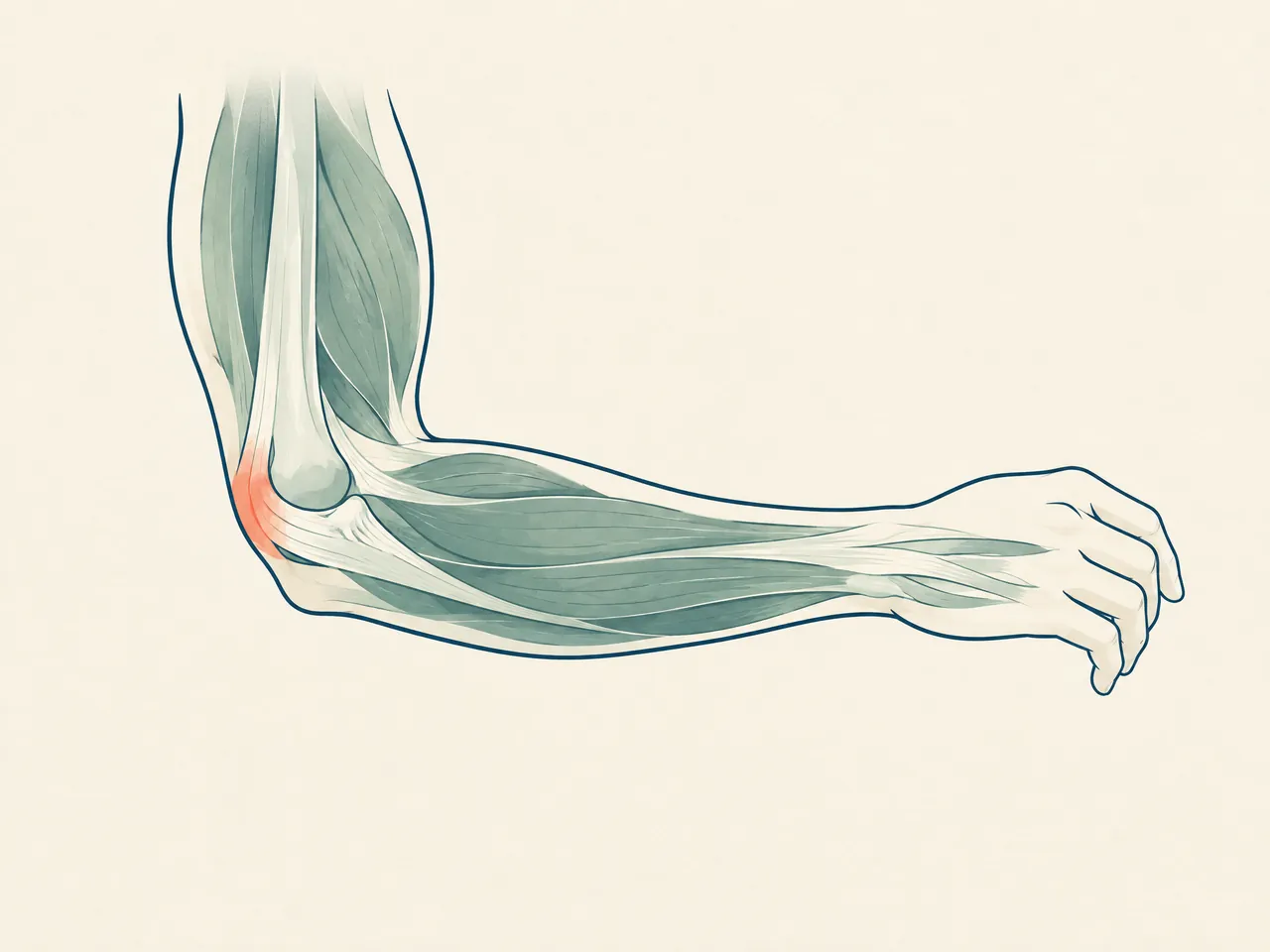
The short answer
With elbow pain, reduce the activity that clearly provokes it and move or stretch only within a mild, comfortable range. Do not push into sharp pain, numbness, tingling, marked weakness or steadily worsening symptoms. Seek urgent medical help after a significant injury with deformity or inability to move, for sudden loss of feeling or power, or for fever with a hot, red, swollen elbow. Sudden arm pain with chest pressure, heaviness or squeezing needs emergency help [1] [3].
Transparent pricing
See the fees.
Choose your care.
Explore our complete official price list, including first-trial prices, regular prices, packages and branch-specific options.
Opening WhatsApp prepares an enquiry; it does not send a message, take payment or confirm an appointment. Suitability and individual arrangements are confirmed during consultation.
Pain care
All prices in HKDExtracorporeal shockwave treatment
Shockwave treatment for deep-tissue and fascial care. The Kwun Tong clinic offers the multi-area options shown below.
Priced by branch
Branch-specific pricing
Prince Edward: HK$250 per area
Kwun Tong: HK$250 for 1 area / HK$450 for 2 areas / HK$600 for 3 areas
Pain care (manual therapy)
Includes Chinese medicine musculoskeletal assessment, manual joint techniques and tui na.
HK$580 (single session)
Chinese medicine musculoskeletal assessment
Pain care (acupuncture and manual therapy)
Combines acupuncture and manual therapy.
HK$680 (single session)
Combined care
Hair and scalp
All prices in HKDScalp health and hair-loss management
Includes AI scalp analysis, deep scalp and follicle cleansing, and scalp oil-control care.
HK$380 (first trial)
Regular price: HK$680
- 6 sessions: HK$3,480 (HK$580 per session)
- 12 sessions: HK$5,760 (HK$480 per session)
- 20 sessions: HK$8,600 (HK$430 per session)
- 30 sessions: HK$11,400 (HK$380 per session)
Hair acupuncture and Chinese herbal medicine package
Includes scalp acupuncture and 3 days of Chinese herbal medicine that does not require decoction.
HK$580 (single session)
Registered Chinese Medicine Practitioner consultation
- 6 sessions: HK$3,180 (HK$530 per session)
- 12 sessions: HK$5,760 (HK$480 per session)
- 20 sessions: HK$8,600 (HK$430 per session)
- 30 sessions: HK$11,400 (HK$380 per session)
Combined hair and scalp treatment
Combines acupuncture and Chinese herbal medicine with salon-level scalp and follicle care. Packages include complimentary hair-care shampoo and serum.
HK$1,260 (single session)
Combined treatment
- 8 sessions: HK$8,640 (HK$1,080 per session)
- 16 sessions: HK$15,680 (HK$980 per session)
- 20 sessions: HK$18,600 (HK$930 per session)
- 30 sessions: HK$26,400 (HK$880 per session)
Weight management
All prices in HKDFull-body acupoint embedding for weight management
Includes full-body acupoint embedding. Packages include complimentary Chinese herbal medicine for weight management, with the number of included days scaled to the package. Embedding material and the individual treatment arrangement are confirmed during consultation; this is not a cosmetic thread lift.
HK$980 (single session)
No trial session
- 10 sessions: HK$7,800 (HK$780 per session)
- 20 sessions: HK$14,600 (HK$730 per session)
- 30 sessions: HK$20,400 (HK$680 per session)
Facial acupuncture
All prices in HKDFacial acupuncture (basic)
Includes facial acupuncture and meridian-based facial care, including care for facial puffiness.
HK$480 (first trial)
Regular price: HK$680
- 10 sessions: HK$5,200 (HK$520 per session)
- 20 sessions: HK$9,600 (HK$480 per session)
- 30 sessions: HK$13,500 (HK$450 per session)
Facial acupuncture (advanced)
Includes enhanced facial acupuncture with a specially formulated moisturising mask and serum.
HK$780 (first trial)
Regular price: HK$1,180
- 10 sessions: HK$9,000 (HK$900 per session)
- 20 sessions: HK$16,600 (HK$830 per session)
- 30 sessions: HK$23,400 (HK$780 per session)
Chinese medicine
All prices in HKDAcupuncture and Chinese herbal medicine package
Includes a Chinese medicine consultation with pulse assessment, body acupuncture and 3 days of Chinese herbal granules that do not require decoction.
HK$580 (single session)
Chinese medicine consultation with pulse assessment
How should I stretch with elbow pain? When should I see a doctor for elbow pain? — Start with the pattern
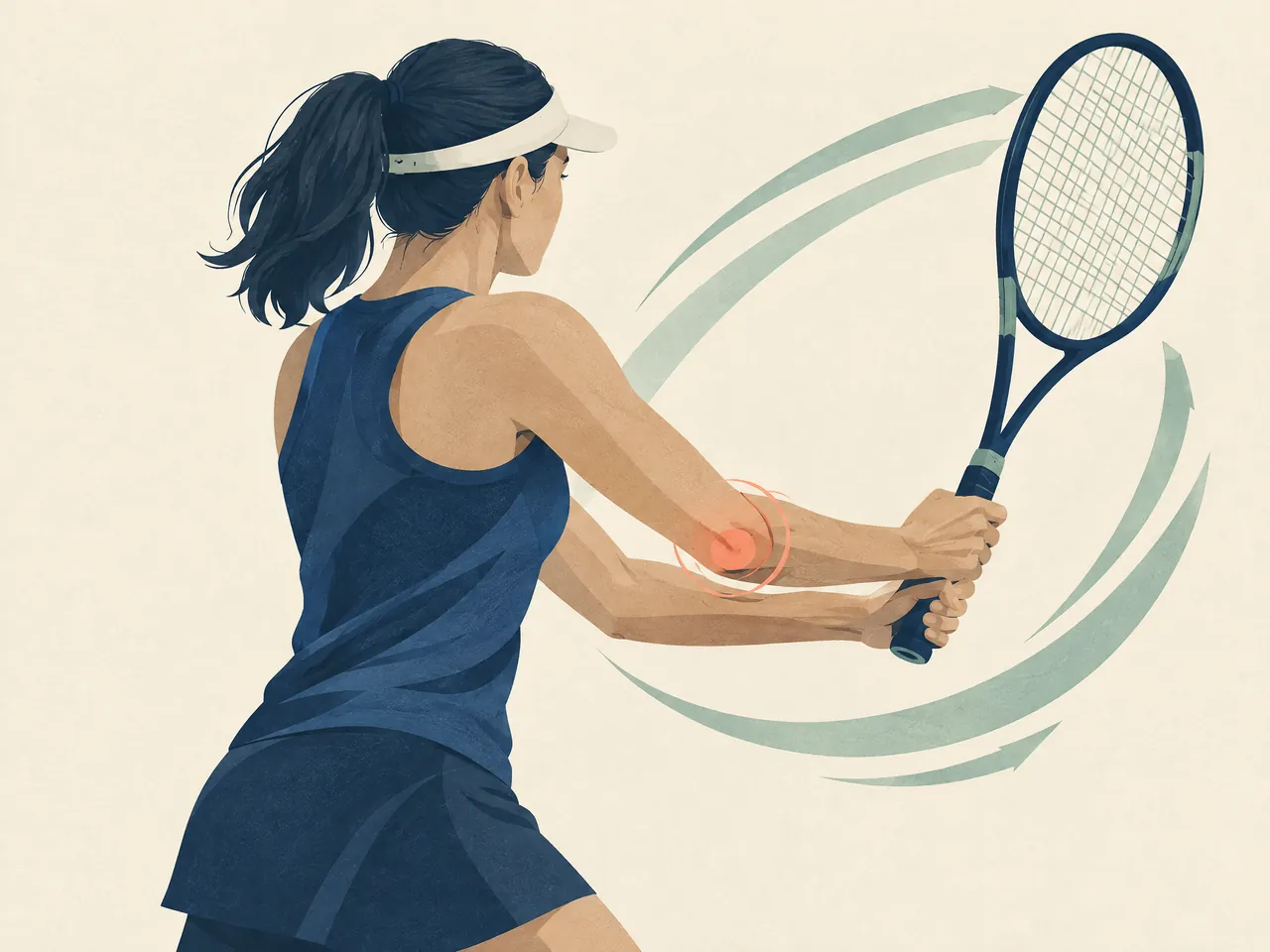
Before choosing a stretch, make a simple map of the problem. Put one finger on the most painful point and describe it as outer, inner, front, back, or more diffuse around the joint. Then notice the task that reproduces it: gripping a cup, turning a key, carrying a pan, pushing up from a chair, typing with the wrist held back, throwing, climbing or a fall. Record whether the elbow feels stiff first thing, becomes painful only after a task, or aches at rest. Also note clicking, catching, visible swelling, bruising, a change in skin warmth, pain travelling from the neck or shoulder, and altered sensation into the hand. This is not a self-diagnosis exercise. It is useful information because elbow symptoms can involve tendons, bursae, bone, nerves or pain referred from the neck or shoulder [2].
Patterns matter more than an internet label. A tender outer elbow that objects to gripping or wrist use may fit a common tendon-loading pattern, but it still does not prove the cause. Inner-elbow discomfort, a painful point behind the elbow, a blocked feeling at the joint, or symptoms that trace into the ring and little fingers call for a different conversation. Start with the description rather than copying a stretch designed for someone else. If your concern is chiefly outside the joint, our page on outer elbow pain can help you organise the questions to raise. If pain started after a fall, a twist, a direct blow or a sudden pop, treat that mechanism as more important than any exercise name.
How should I stretch with elbow pain? When should I see a doctor for elbow pain? — Notice location and triggers
Try a short activity diary for several ordinary days. Note which hand you use, what the elbow position was, how long the task lasted, and what happened later that day or the next morning. ‘Pain when lifting’ is broad; ‘outer-elbow ache when lifting a frying pan palm-down’ is more useful. Include sleep disruption, difficulty opening jars, dropping objects, or a new limit in bending and straightening. If one small change, such as using two hands for a heavy pan or taking breaks from a gripping task, settles the response, that is practical feedback. If symptoms are happening more easily, spreading, or limiting ordinary use despite reducing the trigger, arrange an assessment instead of repeatedly testing the same painful movement.
How should I stretch with elbow pain? When should I see a doctor for elbow pain? — Do not assume tennis elbow
‘Tennis elbow’ is often used for any outer-elbow ache, even in people who never play tennis. It is only one possible explanation. Stiffness, joint swelling, catching or locking, pain after trauma, nerve-type symptoms, and discomfort that seems to begin in the neck or shoulder change the picture. A clinical review of elbow assessment highlights the value of asking about injury, aggravating activity, movement and associated neurological symptoms rather than assigning a label from location alone [2]. A stretch can be reasonable for a familiar, mild pattern, but it cannot rule out a fracture, ligament injury, nerve issue, infection or joint problem. When in doubt, ask what needs assessment before trying to ‘release’ the area.
Compare your options
| What you notice | A sensible immediate response | Stretching approach | When to seek care |
|---|---|---|---|
| A familiar mild ache linked to one repetitive task, with normal sensation and usable movement | Reduce or modify that task and keep other comfortable movement going | Try only a gentle, controlled range; stop if it leaves a clear flare | Arrange review if it persists, recurs or limits daily tasks |
| Pain around the outer or inner elbow with gripping, but no injury or red flags | Record the trigger, grip demand and response after activity | Avoid forcing wrist or forearm positions that reproduce sharp pain | Seek assessment if symptoms spread, worsen or affect work, sleep or grip |
| Tingling, numbness, loss of power, increasing stiffness, catching or locking | Stop provocative testing and protect the arm from heavy or risky tasks | Do not stretch through altered sensation, weakness or a mechanical block | Prompt clinical assessment is appropriate; sudden loss of feeling or power needs urgent advice [3] |
| Deformity after injury, inability to move, hot red swelling with fever, or arm symptoms with chest pressure | Seek urgent or emergency help rather than self-managing | Do not attempt stretching, manipulation or massage | Immediate medical advice is needed; chest-pressure symptoms require emergency help [1] |
On smaller screens, scroll the table sideways to compare all columns.
How should I stretch with elbow pain? When should I see a doctor for elbow pain? — Adjust activity before stretching
Relative rest does not mean keeping the arm completely still for days. It means taking some load away from the movement that is most clearly aggravating it while retaining comfortable everyday movement. For example, split shopping into smaller bags, keep a load close to the body, change the height of a keyboard or mouse, switch hands for a light task if practical, or pause a repetitive training drill. A person whose elbow hurts after hours of food preparation may need shorter chopping or stirring blocks; a gym user may need to pause the painful grip or pulling variation. The University Hospitals Coventry and Warwickshire NHS Trust advises a gradual return to usual activity and exercise rather than abrupt overload [3]. The next step is to test movement calmly, not to prove that the elbow can endure a hard stretch.
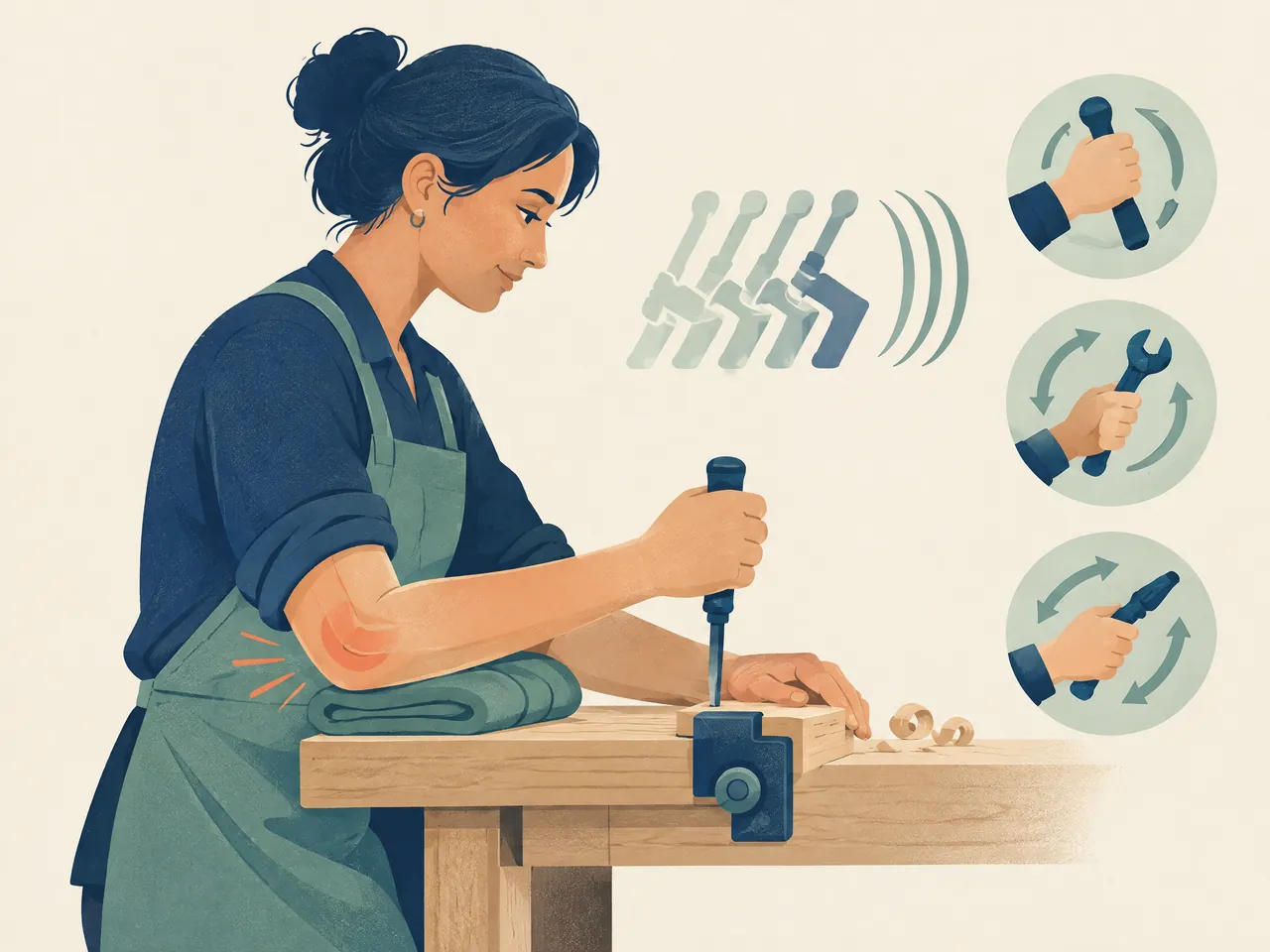
For a simple range check, sit with the shoulder relaxed and slowly bend and straighten the elbow only as far as it remains comfortable. Then turn the palm up and down with the elbow near the side. If these motions are familiar and not sharply painful, you may try a gentle wrist-and-forearm position that does not reproduce symptoms: keep the elbow softly bent at first, move the wrist a little, breathe normally, then release. There is no need to chase a fixed angle, count or dramatic sensation. Compare how the arm feels during the movement, shortly afterwards and with the next relevant task. For more context on building a calm routine, see elbow pain stretching.
How should I stretch with elbow pain? When should I see a doctor for elbow pain? — Use a gradual range
Think of range as a dial, not an all-or-nothing test. Begin well inside the point where pain becomes sharp or guarding begins. Use slow, steady motion rather than bouncing, twisting through resistance or asking another person to push the joint. On a day when the elbow is already irritated from work, sport or a long commute carrying bags, choose a smaller range or skip the stretch and focus on changing the load. A comfortable result is not necessarily no sensation at all; it is a response that remains settled and does not create new tingling, weakness or reduced use later. As daily activity becomes easier, range and load can be discussed and progressed gradually with an appropriate clinician or rehabilitation professional.

How should I stretch with elbow pain? When should I see a doctor for elbow pain? — Stop when symptoms escalate
Stop the movement if pain becomes sharp, electric, burning or clearly spreads toward the hand, or if you notice tingling, numbness, loss of grip, dizziness or a sudden mechanical block. Stop as well if the elbow becomes more swollen, hot or difficult to move after the attempt. Do not keep repeating a test simply because the symptoms fade between tries. The NHS advises urgent assessment for severe arm pain with difficulty moving, post-injury snapping or a changed shape, and for tingling or numbness [1]. For a familiar mild ache, a sensible rule is to judge an experiment by its aftermath: if ordinary tasks are distinctly harder later or the next day, scale back the range or load rather than forcing another session.
How should I stretch with elbow pain? When should I see a doctor for elbow pain? — Recognise when care is needed
The decision to seek care is not reserved for unbearable pain. Make a routine medical appointment if elbow pain persists, keeps returning, is gradually worsening, interferes with work, sleep or basic tasks, or if you cannot explain why it started. A clinician can examine the joint, nearby wrist, neck and shoulder when appropriate, and decide whether further tests or referral are needed. This is particularly worthwhile when there is loss of full movement, recurrent clicking or locking, a new lump, ongoing swelling, or grip changes. The NHS suggests medical review when elbow or arm pain does not go away after a few weeks [1]. Bring your brief activity and symptom record; it can make the consultation clearer than trying to remember every flare on the spot.
Some people also ask whether Chinese medicine or acupuncture can be part of the discussion. That question should come after, not instead of, sensible triage. Research and patient information on acupuncture are mainly framed around lateral epicondylitis or tennis elbow, not every reason for elbow pain. UCLA Health describes mixed findings and notes uncertainty about sustained benefit, while placing acupuncture among several possible approaches [4]. It does not justify a promise of cure or a fixed number of sessions. If you are considering this option after appropriate assessment, does acupuncture help elbow pain explains the question in more detail. Tell any practitioner about an injury, tests, medication, numbness, weakness and care already being received.

How should I stretch with elbow pain? When should I see a doctor for elbow pain? — Urgent warning signs
Seek urgent medical advice after a fall or other injury if the elbow or arm is misshapen and swollen, or you cannot move it. Sudden loss of feeling or power in an arm or hand also needs prompt assessment. Fever with an elbow that is hot, red, swollen and painful is another reason not to wait for a stretch or routine appointment [3]. Call emergency services for sudden arm pain occurring with pressure, heaviness or squeezing across the chest [1]. Breathlessness, sweating, feeling faint or chest pain alongside arm symptoms are not elbow-exercise questions. These signs need immediate emergency care. Do not drive yourself if you may need emergency help.

How should I stretch with elbow pain? When should I see a doctor for elbow pain? — Discuss next steps
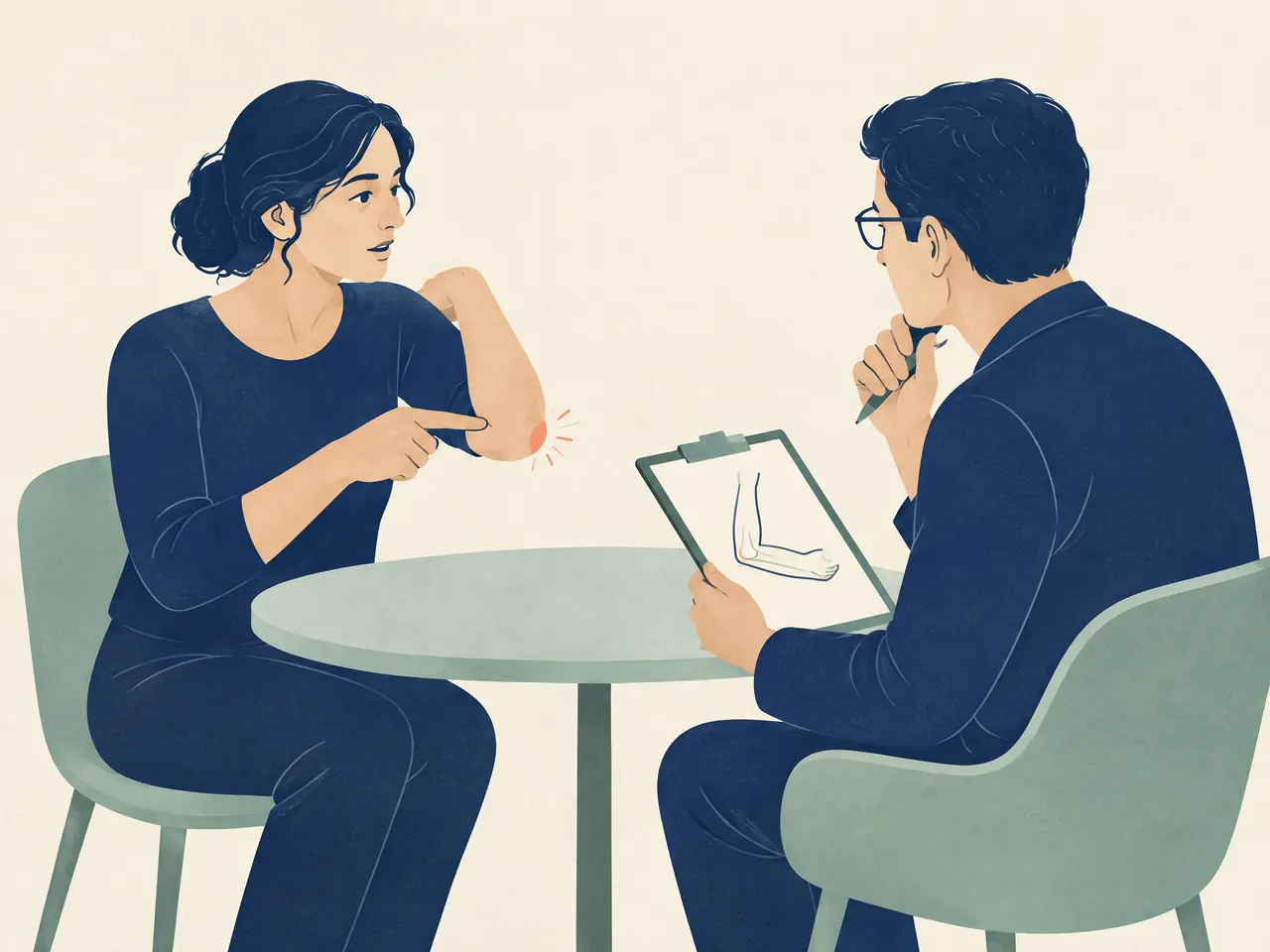
At a non-urgent appointment, be ready to explain location, onset, injury history, work and sport demands, movements that provoke pain, sensations in the hand, night symptoms and what you have already changed. Ask what the working explanation is, whether you should modify a particular task, whether rehabilitation guidance is appropriate, and what change should prompt earlier review. If you want to discuss a Chinese medicine consultation after the necessary medical assessment, the page on elbow pain treatment Hong Kong gives local context. You may enquire with the Kwun Tong Chinese medicine clinic or the Chinese medicine clinic Prince Edward; describe the elbow problem and any red-flag screening or current care when you message. Appointment arrangements are confirmed individually.
Care and health guide
Pain-care information
This directory brings together services, reading, and visit information related to pain care, to help you prepare questions for a consultation.
When pain care affects your day, noting when it occurs, its relation to activity, and what you have already tried can help prepare a consultation; Chinese medicine pain management Hong Kong is a relevant service or reading entry point.
Individual circumstances differ, and acupuncture Hong Kong offers related information to help you understand options and prepare questions.


Your questions, answered
Frequently asked questions
How should I stretch with elbow pain if I work at a computer?
First change the exposure that repeatedly irritates the arm. Check whether long mouse use, gripping the mouse tightly, a bent wrist or no movement breaks are part of the pattern. Use brief, comfortable elbow bending, straightening and palm-turning movements rather than pushing the wrist or elbow to an end range. If tingling, numbness, weakness or pain travelling from the neck occurs, stop and arrange an assessment.
Should I stretch my elbow after lifting or racquet sport?
Only if the movement is comfortable and the elbow settles afterwards. When a session clearly triggered the pain, lowering the next session’s load, grip demand or repetition is usually more useful than forcing a deep stretch immediately afterwards. Persistent pain, a sudden pop, swelling or loss of movement should be assessed rather than trained through.
When should I see a doctor for elbow pain that is not an emergency?
Arrange a medical assessment when pain does not improve after a few weeks, keeps returning, gets worse, affects normal work or sleep, or comes with ongoing stiffness, swelling, clicking, locking, altered grip or symptoms into the hand. Bring a note of the trigger, timeline and any injury.
Can acupuncture replace medical assessment for elbow pain?
No. Acupuncture should not delay evaluation of an injury, infection-type symptoms, neurological symptoms or other warning signs. Evidence discussions are mainly about tennis elbow and do not apply automatically to every cause of elbow pain. If it is considered, share your diagnosis or current assessment, medicines and other treatment with the practitioner.
Sources and further information
- [1] NHS — Elbow and arm pain
Referenced for: [1] Supports the self-care, routine-review, urgent and emergency triage statements for severe pain or limited movement, injury with a changed shape, numbness or tingling, and arm pain with chest pressure.
- [2] British Journal of General Practice — Elbow pain: a guide to assessment and management in primary care
Referenced for: [2] Supports the non-diagnostic discussion of elbow pain sources, provoking activity, injury, neurological symptoms, range of movement and referred neck or shoulder pain.
- [3] University Hospitals Coventry and Warwickshire NHS Trust — Elbow pain
Referenced for: [3] Supports gradual return to activity and immediate medical-advice wording for deformity after injury, inability to move, sudden power or feeling loss, and fever with a hot, red, swollen, painful elbow.
- [4] UCLA Health — Can acupuncture ease the pain of tennis elbow?
Referenced for: [4] Supports the limited, evidence-aware discussion of acupuncture as one possible modality for tennis elbow; it does not support a cure claim, a fixed treatment course or use for all elbow pain.