
TCM Lab · Health reading
Throbbing Headache and Nausea: Migraine Light and Sound Sensitivity Explained
Published Updated
A throbbing headache and nausea can fit a migraine pattern, especially when light, conversation, traffic noise or screens become hard to tolerate. It can interrupt daily life, but it does not prove every painful headache is migraine. Note where the pain begins, whether movement worsens it, what happens beforehand and whether symptoms change. This page explains migraine light and sound sensitivity, useful observations and when prompt medical assessment is safer than managing an episode alone.
Appointments are confirmed through WhatsApp. If you have language requirements, please mention them in your enquiry.
The short answer
Throbbing headache and nausea often occur during migraine, and many people also notice unusual sensitivity to light and sound. A migraine attack may involve one or both sides of the head, worsen with movement, and sometimes include vomiting or aura. Record the timing, associated symptoms and possible triggers rather than self-diagnosing from one episode. Seek urgent medical help for a sudden, extremely painful headache or new neurological symptoms such as weakness, confusion, speech difficulty or vision loss.
Transparent pricing
See the fees.
Choose your care.
Explore our complete official price list, including first-trial prices, regular prices, packages and branch-specific options.
Opening WhatsApp prepares an enquiry; it does not send a message, take payment or confirm an appointment. Suitability and individual arrangements are confirmed during consultation.
Pain care
All prices in HKDExtracorporeal shockwave treatment
Shockwave treatment for deep-tissue and fascial care. The Kwun Tong clinic offers the multi-area options shown below.
Priced by branch
Branch-specific pricing
Prince Edward: HK$250 per area
Kwun Tong: HK$250 for 1 area / HK$450 for 2 areas / HK$600 for 3 areas
Pain care (manual therapy)
Includes Chinese medicine musculoskeletal assessment, manual joint techniques and tui na.
HK$580 (single session)
Chinese medicine musculoskeletal assessment
Pain care (acupuncture and manual therapy)
Combines acupuncture and manual therapy.
HK$680 (single session)
Combined care
Hair and scalp
All prices in HKDScalp health and hair-loss management
Includes AI scalp analysis, deep scalp and follicle cleansing, and scalp oil-control care.
HK$380 (first trial)
Regular price: HK$680
- 6 sessions: HK$3,480 (HK$580 per session)
- 12 sessions: HK$5,760 (HK$480 per session)
- 20 sessions: HK$8,600 (HK$430 per session)
- 30 sessions: HK$11,400 (HK$380 per session)
Hair acupuncture and Chinese herbal medicine package
Includes scalp acupuncture and 3 days of Chinese herbal medicine that does not require decoction.
HK$580 (single session)
Registered Chinese Medicine Practitioner consultation
- 6 sessions: HK$3,180 (HK$530 per session)
- 12 sessions: HK$5,760 (HK$480 per session)
- 20 sessions: HK$8,600 (HK$430 per session)
- 30 sessions: HK$11,400 (HK$380 per session)
Combined hair and scalp treatment
Combines acupuncture and Chinese herbal medicine with salon-level scalp and follicle care. Packages include complimentary hair-care shampoo and serum.
HK$1,260 (single session)
Combined treatment
- 8 sessions: HK$8,640 (HK$1,080 per session)
- 16 sessions: HK$15,680 (HK$980 per session)
- 20 sessions: HK$18,600 (HK$930 per session)
- 30 sessions: HK$26,400 (HK$880 per session)
Weight management
All prices in HKDFull-body acupoint embedding for weight management
Includes full-body acupoint embedding. Packages include complimentary Chinese herbal medicine for weight management, with the number of included days scaled to the package. Embedding material and the individual treatment arrangement are confirmed during consultation; this is not a cosmetic thread lift.
HK$980 (single session)
No trial session
- 10 sessions: HK$7,800 (HK$780 per session)
- 20 sessions: HK$14,600 (HK$730 per session)
- 30 sessions: HK$20,400 (HK$680 per session)
Facial acupuncture
All prices in HKDFacial acupuncture (basic)
Includes facial acupuncture and meridian-based facial care, including care for facial puffiness.
HK$480 (first trial)
Regular price: HK$680
- 10 sessions: HK$5,200 (HK$520 per session)
- 20 sessions: HK$9,600 (HK$480 per session)
- 30 sessions: HK$13,500 (HK$450 per session)
Facial acupuncture (advanced)
Includes enhanced facial acupuncture with a specially formulated moisturising mask and serum.
HK$780 (first trial)
Regular price: HK$1,180
- 10 sessions: HK$9,000 (HK$900 per session)
- 20 sessions: HK$16,600 (HK$830 per session)
- 30 sessions: HK$23,400 (HK$780 per session)
Chinese medicine
All prices in HKDAcupuncture and Chinese herbal medicine package
Includes a Chinese medicine consultation with pulse assessment, body acupuncture and 3 days of Chinese herbal granules that do not require decoction.
HK$580 (single session)
Chinese medicine consultation with pulse assessment
Throbbing Headache and Nausea: Migraine Light and Sound Sensitivity Symptoms
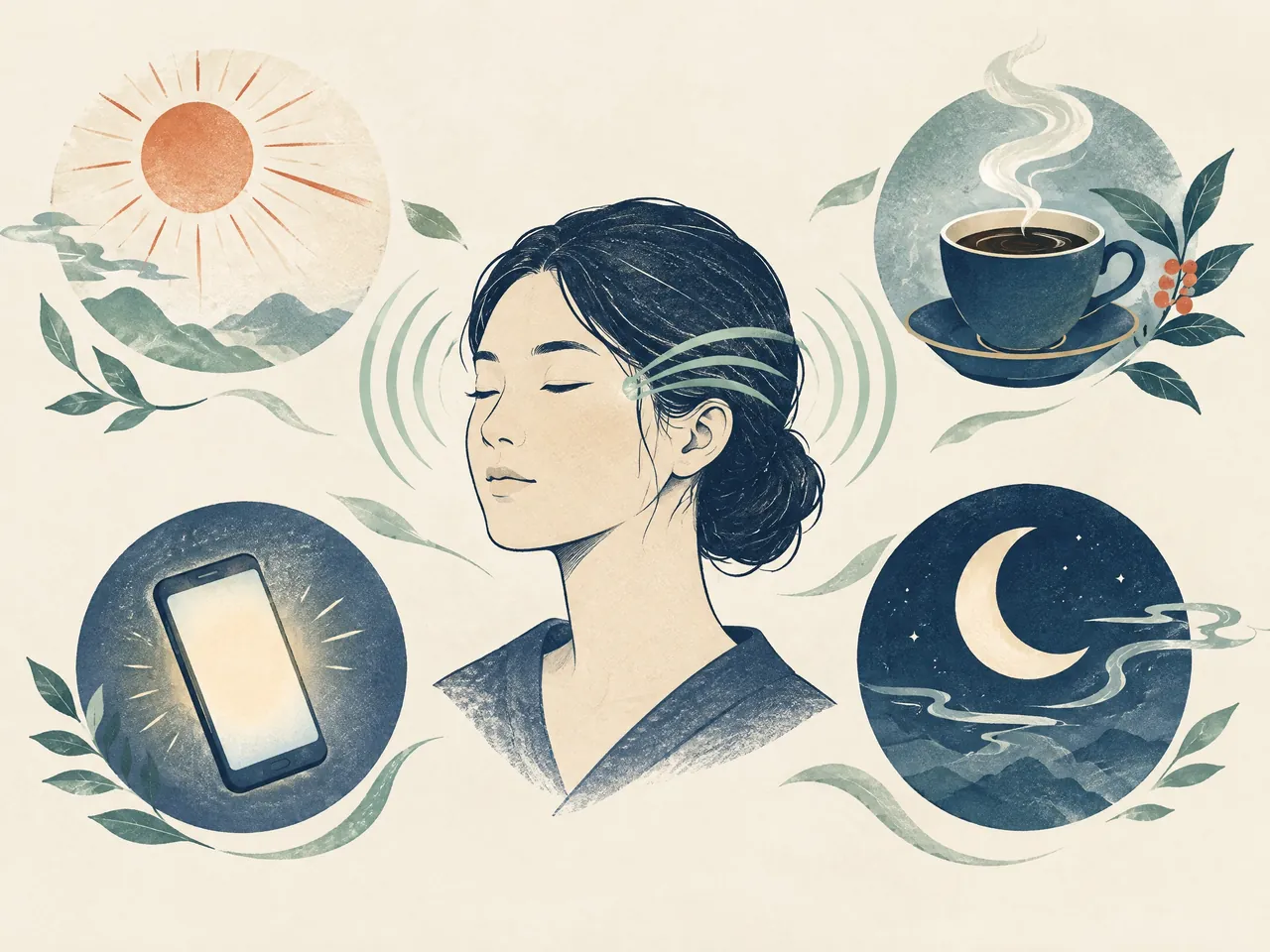
Migraine is more than a label for a bad headache. During an attack, the pain is often throbbing or pulsating, may be severe, and can become worse with ordinary movement such as walking upstairs or hurrying for transport. Nausea can make food, water and medication difficult to manage. For some people, light and sound are not merely irritating: a lit office, MTR announcements, kitchen noise or the glare from a screen can feel overwhelming. The NHS lists throbbing head pain, nausea or vomiting, and marked sensitivity to light and sounds among the main features of a migraine attack [1]. A person may have all of these features, or only some of them, so the whole pattern is more helpful than a single symptom. If you are exploring broader migraine symptoms, compare your own sequence with your usual baseline rather than expecting a checklist to match perfectly.
How Throbbing Headache and Nausea May Present with Migraine Light and Sound Sensitivity
The description of pain matters. A throbbing sensation may feel like a pulse or repeated beat, while another episode may be pressure-like, sharp or sore around the neck. Migraine pain is often on one side, but it can occur on both sides; side alone is not a reliable way to sort headaches. Nausea may remain mild, build as the pain increases, or progress to vomiting. Photophobia means light feels uncomfortable or painful, while phonophobia refers to a similar sensitivity to sound. A person may dim a room, cover their eyes, turn down audio or avoid conversation because these inputs worsen discomfort. Hong Kong Adventist Hospital similarly describes severe throbbing or pulsating pain with nausea, vomiting and increased sensitivity to light and sound [2].
Think about function as well as symptoms. Could you finish a meeting, prepare a meal, travel home or care for a child? Did movement intensify the pain? Did you have to stop using a screen because the brightness felt harsh, or did ordinary background noise become hard to bear? Such specifics tell a clinician more than saying a headache was “very bad.” They can also reveal variation between episodes: one attack may be mainly nausea and visual discomfort; another may be pain-dominant. Keep the wording simple and factual. The aim is not to score yourself against an online description, but to show how the episode affected you and whether the pattern is stable, escalating or new.
Aura, Vomiting and Migraine Light and Sound Sensitivity Alongside Throbbing Headache and Nausea
Aura is not required for migraine, and it is different from light sensitivity. It can involve temporary visual phenomena such as flashing lights, zigzag lines or blind spots. Some people experience tingling, dizziness or difficulty speaking. The NHS says aura symptoms should not last longer than one hour [1]. If you have recurring, assessed migraine with aura, recording the order and duration of these symptoms can help distinguish your usual experience from something different. A first-ever neurological symptom, a change in an established aura, or symptoms that persist should be medically assessed rather than assumed to be familiar migraine.
Vomiting creates a separate practical concern: dehydration, inability to keep fluids down, and difficulty using oral medication. Make a note of how many times it happened, whether you could drink, and whether the headache was still progressing. Avoid trying to “push through” severe symptoms alone if you feel faint, confused or unable to function safely. A migraine attack may last from hours to days; the NHS gives a usual range of four hours to three days [1]. For a focused explanation of duration, see how long does a migraine last. An attack lasting longer than your usual pattern needs clinical advice, even when the pain resembles migraine.
Compare your options
| Feature to note | A pattern that can occur with migraine | What to record or do |
|---|---|---|
| Pain quality and activity | Throbbing or pulsating pain that may worsen with ordinary movement | Note location, intensity, start time and whether walking, stairs or routine activity worsened it. |
| Nausea or vomiting | Feeling sick or vomiting may accompany the headache | Record fluids tolerated, vomiting, medicines taken and whether you could function safely. |
| Light and sound sensitivity | Screens, bright rooms or normal noise may become difficult to tolerate | Describe the setting, what you needed to stop or avoid, and whether reducing stimulation helped comfort. |
| Aura or neurological change | Some people have temporary visual, sensory, dizzy or speech symptoms | Record sequence and duration; seek prompt assessment for a first, prolonged or changing symptom. |
| Sudden or markedly different headache | This is not a feature to assume is routine migraine | Seek urgent or emergency assessment, especially with weakness, confusion, seizure, vision loss, fever or head injury. |
On smaller screens, scroll the table sideways to compare all columns.
Throbbing Headache and Nausea Versus Other Headaches: Migraine Light and Sound Sensitivity Clues
Headache patterns overlap, so a one-sided or throbbing feeling should not be treated as a diagnosis on its own. Tension-type headaches are often described as a pressing or tightening sensation on both sides and may be less likely to include nausea, although individuals vary. Cluster headache is less common and typically brings very severe pain around one eye with features such as tearing, a blocked or runny nose, or eyelid changes. Illness, medication effects, head injury, eye problems and other conditions can also cause headache. The point of comparison is not to make a home diagnosis; it is to notice which features need a clinician to look beyond a familiar migraine explanation. The comparison below can organise observations for an appointment, but it is not a rule-out tool.

Tracking Throbbing Headache and Nausea and Migraine Light and Sound Sensitivity in a Diary
A diary works best when it is brief enough to keep. Use a phone note, calendar or paper page. For each episode, record the date, start and end time, where pain was felt, whether it was throbbing, pressing or another quality, and how activity changed it. Add nausea, vomiting, sensitivity to light or sound, sleep changes, neck discomfort, food or caffeine timing, stressors, menstrual timing if relevant, and any unusual visual or sensory symptoms. Also record what you took or tried and whether it helped, without changing doses on the basis of the diary. The NHS recommends a migraine diary to help identify what might trigger attacks [1]. The diary supports a conversation; it does not prove that a food, stressful day or weather change caused a particular attack.
Look for repeatable sequences rather than blaming every possible factor. For example, two late nights followed by an early commute may coincide with an attack, but that does not mean sleep was the only cause. A clinician can use the diary to consider attack frequency, warning signs, possible medication overuse and whether preventive care should be discussed. Keep a clear line for new symptoms. “Usual left-sided throbbing, but new double vision” is more useful than a general note that the headache was worse. If you are also managing neck or upper-body discomfort, a separate shoulder pain assessment may be relevant, but it should not distract from a new neurological symptom.
When Changing Throbbing Headache and Nausea or Migraine Light and Sound Sensitivity Needs Assessment
Arrange medical assessment when attacks are severe, becoming worse, last longer than usual, occur frequently, or are difficult to control. The NHS also advises urgent help for an attack lasting more than 72 hours, aura lasting more than one hour at a time, and migraine symptoms in pregnancy or soon after childbirth [1]. These are practical thresholds for seeking help, not reasons to wait if you are worried. Repeated reliance on painkillers also deserves a medication review. The NHS cautions that using painkillers on more than two days a week can lead to more headaches and make migraine harder to treat [1]. A pharmacist, doctor or other appropriate clinician can advise on safe options for your circumstances.
Call emergency services or attend emergency care for a headache that comes on suddenly and is extremely painful, or headache with a seizure, confusion or drowsiness, a very high temperature with meningitis symptoms, recent head injury, loss of vision, or new one-sided weakness in the face, arm or leg [1]. New problems speaking or remembering things likewise need immediate attention. Do not drive yourself when these symptoms occur. It is safer to be assessed and find that the cause was not serious than to treat a potentially urgent event as your usual migraine. A dark room, a cold or warm compress and rest may feel comforting, but none of them replaces urgent assessment when red flags are present.
Managing Throbbing Headache and Nausea with Migraine Light and Sound Sensitivity Safely
When an assessed migraine pattern begins, reducing stimulation can be a practical first step. A quieter, dimmer room, a pause from screens, water in small sips if tolerated, and rest may be more manageable than trying to continue as normal. Some people prefer a cool pack; others find gentle warmth around tense neck muscles more comfortable. Use a barrier between the pack and skin, keep the temperature comfortable, and stop if it worsens the symptoms. Regular meals, adequate sleep, hydration, exercise that suits your health, and managing recognised triggers may be part of a wider prevention plan [1]. These measures are not a promise that an attack will stop, and a “healthy” routine should never be used to dismiss persistent symptoms. Use prescribed or pharmacy medicines exactly as directed; do not double doses or mix products because nausea makes relief feel urgent.

Discussing Throbbing Headache and Nausea and Migraine Light and Sound Sensitivity in TCM Consultation
A Traditional Chinese Medicine consultation can be a place to discuss your headache experience in detail, but it should begin with the same safety information used in any clinical conversation. Bring the diary, a current medicine and supplement list, relevant diagnoses, recent test or referral information if you have it, and a description of red flags or changes. A Registered Chinese Medicine Practitioner may ask about the pain quality and location, sleep, digestion, stress, activity, menstrual pattern where relevant and past treatment. In traditional practice, these observations are considered through a pattern-identification approach; that approach is not the same thing as a modern neurological diagnosis. Make clear if a doctor has already diagnosed migraine, if you are awaiting assessment, or if the episode is new or different.
It is reasonable to ask what the consultation can and cannot address, how acupuncture might fit alongside medical care, and what symptoms should prompt referral or urgent care. Share information about anticoagulants, bleeding disorders, pregnancy, implanted devices, infections, needle concerns and previous treatment reactions when relevant. The U.S. National Center for Complementary and Integrative Health advises people not to use acupuncture to postpone seeing a healthcare provider about a health problem [3]. This matters particularly for a sudden severe headache or neurological change. For a practical location enquiry, you can review the Kwun Tong Chinese medicine clinic or Chinese medicine clinic Prince Edward information before contacting TCM Lab.

Acupuncture, Self-Care and Limits for Throbbing Headache and Nausea with Migraine Light and Sound Sensitivity
Acupuncture may be discussed as an adjunctive option for migraine prevention after individual assessment; it is not a guaranteed immediate treatment for throbbing headache and nausea during an attack. A Cochrane review found that adding acupuncture to symptomatic treatment may reduce headache frequency, while the difference from sham acupuncture was small; longer-term studies beyond one year were lacking [4]. NCCIH describes moderate-quality evidence that acupuncture may reduce migraine frequency and notes that the difference from sham acupuncture is small [3]. Those findings support a measured discussion about prevention, not a promise to stop today’s attack, cure migraine or replace medical evaluation.
Safety depends on appropriate assessment and technique. NCCIH notes that serious complications can result from nonsterile needles or improper delivery, while acupuncture needles are regulated as sterile single-use medical devices in the United States [3]. Tell the practitioner about medicines and health conditions so the plan can be considered in context. Do not attempt self-needling from online instructions. Keep conventional care coordinated: if you use a migraine medication, have a GP or specialist plan, or develop new symptoms, say so. The useful outcome of a consultation is an informed next step based on your actual pattern and safety needs, not a fixed number of treatments or a guarantee about how quickly symptoms will change.

Care and health guide
Health service information
This directory brings together services, reading, and visit information related to health services, to help you prepare questions for a consultation.
If you are organising health questions, Chinese medicine clinic Hong Kong is a starting point for learning about related services and preparing for a consultation.
People have different needs; acupuncture Hong Kong provides further reading to help you understand options in your own context.


Your questions, answered
Frequently asked questions
Does throbbing headache and nausea always mean migraine light and sound sensitivity?
No. These symptoms can occur with migraine, but they are not exclusive to it. Migraine commonly includes throbbing pain, nausea or vomiting, and sensitivity to light and sounds, yet other headaches and medical conditions can overlap. A persistent, new, changing or unusually severe pattern should be assessed by a clinician.
How long can throbbing headache and nausea with migraine light and sound sensitivity last?
Migraine attacks usually last between four hours and three days according to the NHS, although the surrounding symptoms can begin before the head pain and end after it. Seek medical advice when an attack lasts longer than your usual pattern; urgent help is recommended for an attack lasting more than 72 hours or aura lasting more than an hour.
Can I use a cold or warm compress for migraine light and sound sensitivity?
A cool or warm compress may be a comfort measure for some people, alongside rest in a darker, quieter space. Protect your skin with a barrier and stop if it makes symptoms worse. It cannot diagnose the headache or replace urgent care for sudden severe pain, neurological symptoms, fever with a stiff neck, or a recent head injury.
Can TCM or acupuncture help throbbing headache and nausea with migraine light and sound sensitivity?
After assessment, acupuncture may be discussed as an adjunctive preventive option. Evidence suggests it may reduce migraine frequency for some people, but the effect over sham acupuncture is small and it is not guaranteed immediate relief during an acute attack. TCM should complement, not replace, necessary medical assessment and treatment.
Sources and further information
- [1] NHS — Migraine
Referenced for: Official UK health guidance for migraine symptoms, aura, duration, diary use, treatment context and urgent warning signs.
- [2] Hong Kong Adventist Hospital — Lifestyle Tips to Prevent Migraines and Headaches
Referenced for: Hong Kong hospital guide for symptom terminology including throbbing pain, nausea, vomiting, light and sound sensitivity, and aura examples.
- [3] NCCIH — Acupuncture: Effectiveness and Safety
Referenced for: U.S. NIH complementary health information on acupuncture evidence for migraine prevention, safety and the need not to postpone healthcare evaluation.
- [4] Cochrane — Acupuncture for the prevention of episodic migraine
Referenced for: Systematic review of acupuncture as migraine prophylaxis, including comparison limitations and long-term evidence gaps.