
TCM Lab · Health reading
Acupuncture for Poor Posture, Acupuncture for Postural Kyphosis and Thoracic Kyphosis Acupuncture
Published Updated
A rounded upper back can be a posture-related pattern, but it can also be a sign that the spine itself needs assessment. Acupuncture for poor posture may be discussed when neck, shoulder or upper-back tightness is part of the picture. It is not a way to straighten a structural spinal curve. For someone searching for acupuncture for postural kyphosis or thoracic kyphosis acupuncture, the useful starting point is to separate day-to-day muscle discomfort from a curve, injury or progressive symptom that warrants medical review.
Appointments are confirmed through WhatsApp. If you have language requirements, please mention them in your enquiry.

The short answer
Acupuncture for poor posture may be considered as one symptom-management option for posture-related neck, shoulder or upper-back tightness after an individual assessment. It cannot repair a structural spinal curve or guarantee that a rounded back will change. A consultation should review posture, symptoms, daily loading and relevant health history. New, severe, worsening or neurological symptoms should be medically assessed before acupuncture is considered.
Transparent pricing
See the fees.
Choose your care.
Explore our complete official price list, including first-trial prices, regular prices, packages and branch-specific options.
Opening WhatsApp prepares an enquiry; it does not send a message, take payment or confirm an appointment. Suitability and individual arrangements are confirmed during consultation.
Chinese medicine
All prices in HKDAcupuncture and Chinese herbal medicine package
Includes a Chinese medicine consultation with pulse assessment, body acupuncture and 3 days of Chinese herbal granules that do not require decoction.
HK$580 (single session)
Chinese medicine consultation with pulse assessment
Hair and scalp
All prices in HKDScalp health and hair-loss management
Includes AI scalp analysis, deep scalp and follicle cleansing, and scalp oil-control care.
HK$380 (first trial)
Regular price: HK$680
- 6 sessions: HK$3,480 (HK$580 per session)
- 12 sessions: HK$5,760 (HK$480 per session)
- 20 sessions: HK$8,600 (HK$430 per session)
- 30 sessions: HK$11,400 (HK$380 per session)
Hair acupuncture and Chinese herbal medicine package
Includes scalp acupuncture and 3 days of Chinese herbal medicine that does not require decoction.
HK$580 (single session)
Registered Chinese Medicine Practitioner consultation
- 6 sessions: HK$3,180 (HK$530 per session)
- 12 sessions: HK$5,760 (HK$480 per session)
- 20 sessions: HK$8,600 (HK$430 per session)
- 30 sessions: HK$11,400 (HK$380 per session)
Combined hair and scalp treatment
Combines acupuncture and Chinese herbal medicine with salon-level scalp and follicle care. Packages include complimentary hair-care shampoo and serum.
HK$1,260 (single session)
Combined treatment
- 8 sessions: HK$8,640 (HK$1,080 per session)
- 16 sessions: HK$15,680 (HK$980 per session)
- 20 sessions: HK$18,600 (HK$930 per session)
- 30 sessions: HK$26,400 (HK$880 per session)
Weight management
All prices in HKDFull-body acupoint embedding for weight management
Includes full-body acupoint embedding. Packages include complimentary Chinese herbal medicine for weight management, with the number of included days scaled to the package. Embedding material and the individual treatment arrangement are confirmed during consultation; this is not a cosmetic thread lift.
HK$980 (single session)
No trial session
- 10 sessions: HK$7,800 (HK$780 per session)
- 20 sessions: HK$14,600 (HK$730 per session)
- 30 sessions: HK$20,400 (HK$680 per session)
Facial acupuncture
All prices in HKDFacial acupuncture (basic)
Includes facial acupuncture and meridian-based facial care, including care for facial puffiness.
HK$480 (first trial)
Regular price: HK$680
- 10 sessions: HK$5,200 (HK$520 per session)
- 20 sessions: HK$9,600 (HK$480 per session)
- 30 sessions: HK$13,500 (HK$450 per session)
Facial acupuncture (advanced)
Includes enhanced facial acupuncture with a specially formulated moisturising mask and serum.
HK$780 (first trial)
Regular price: HK$1,180
- 10 sessions: HK$9,000 (HK$900 per session)
- 20 sessions: HK$16,600 (HK$830 per session)
- 30 sessions: HK$23,400 (HK$780 per session)
Pain care
All prices in HKDExtracorporeal shockwave treatment
Shockwave treatment for deep-tissue and fascial care. The Kwun Tong clinic offers the multi-area options shown below.
Priced by branch
Branch-specific pricing
Prince Edward: HK$250 per area
Kwun Tong: HK$250 for 1 area / HK$450 for 2 areas / HK$600 for 3 areas
Pain care (manual therapy)
Includes Chinese medicine musculoskeletal assessment, manual joint techniques and tui na.
HK$580 (single session)
Chinese medicine musculoskeletal assessment
Pain care (acupuncture and manual therapy)
Combines acupuncture and manual therapy.
HK$680 (single session)
Combined care
Acupuncture for Poor Posture, Acupuncture for Postural Kyphosis and Thoracic Kyphosis Acupuncture: What a Rounded Upper Back May Mean
“Rounded upper back” is a visual description, not a diagnosis. It may describe shoulders that sit forward after long periods at a laptop, a temporary slumped sitting habit, or kyphosis, meaning an increased curve through the upper spine. The distinction matters because kyphosis can relate to posture, spinal structure, injury or other conditions. The NHS notes that a more noticeable or worsening curve can be accompanied by pain and stiffness, and that assessment may include examination and, when needed, imaging. [1] An acupuncture conversation should therefore begin with what is changing, not with an assumption that every rounded posture has the same cause.
Acupuncture for Poor Posture, Acupuncture for Postural Kyphosis and Thoracic Kyphosis Acupuncture: Posture, Rounded Shoulders and Muscle Balance
A common workday pattern is the head moving forward while the upper back rounds and the shoulders drift inward. Over hours, the front of the chest may feel short or tight, while muscles around the shoulder blades and upper back can feel tired or overworked. Looking down at a phone, driving, carrying a bag consistently on one side, or working without regular position changes can all add to the same load. These observations can help explain discomfort, but they do not by themselves confirm postural kyphosis or identify the shape of the spine.
This is why a person may search for acupuncture for rounded shoulders yet need a broader discussion than the shoulder position alone. Ask whether symptoms ease after moving, whether they are local or travel into an arm, and whether there has been a clear change in appearance. A rounded posture that varies with sitting, standing and gentle movement may call for a different plan from a fixed, progressively apparent curve. TCM language about channels and the movement of qi and blood is a traditional assessment approach; it is not a modern structural diagnosis.
Before the consultation, a short symptom record can make the pattern clearer without trying to diagnose it. Note the task being done when discomfort starts, the point at which it eases, the kind of movement that feels comfortable, and whether the feeling is aching, stiff, sharp or spreading. Include recent changes such as a new workstation, more revision time, altered exercise, a fall, or caring responsibilities that involve lifting. This detail helps distinguish a familiar workload pattern from a new problem. It also gives a practitioner a basis for practical questions about pacing and position changes, rather than relying only on a photograph of the shoulders. If symptoms are present at rest, wake someone from sleep, or feel distinctly different from their usual stiffness, that should be raised in medical assessment rather than treated as a routine posture issue.

Acupuncture for Poor Posture, Acupuncture for Postural Kyphosis and Thoracic Kyphosis Acupuncture: When Stiffness and Pain Need Attention
Stiffness after a desk day is not automatically dangerous, but it deserves context. Note whether the discomfort began gradually or suddenly, whether it settles with a change of position, and whether ordinary tasks such as turning the head, reaching overhead or taking a deeper breath are affected. The NHS describes back pain and stiffness as possible symptoms when a spinal curve is more noticeable or worsening, while a severe curve may cause very bad pain or breathing difficulty. [1] Those features are reasons not to treat the issue as a simple posture habit.
Seek medical assessment promptly rather than waiting for an acupuncture appointment if back pain is severe or rapidly worsening, if there is numbness or weakness in an arm or leg, if chest pain or breathing difficulty occurs, or if symptoms follow a significant spinal injury. A clinician may need to consider causes outside posture and decide whether examination, physiotherapy or imaging is appropriate. If the main concern is lower or middle back discomfort rather than upper-back rounding, the related pages on mid back pain acupuncture and Hong Kong acupuncture for back pain can help frame a more focused enquiry.
Compare your options
| What you notice | Most useful first focus | Why it matters before acupuncture |
|---|---|---|
| Tight upper back after prolonged sitting that eases with movement | Describe the work, study and device routine; consider an assessment of muscle discomfort | The pattern may be posture-related, but the consultation should still review health history and change over time. |
| A rounded appearance that is new, fixed or becoming more noticeable | Seek medical assessment and discuss whether a spinal examination or imaging is indicated | A visible curve may have causes beyond muscle tension and needs a structural assessment when appropriate. |
| Severe pain, breathing difficulty, numbness, weakness or symptoms after injury | Obtain prompt medical assessment rather than waiting for a routine treatment discussion | These symptoms need evaluation for causes that acupuncture should not delay. |
| Known kyphosis with a physiotherapy or medical plan | Follow that plan and discuss acupuncture only as possible symptom support | Acupuncture cannot replace management of the underlying curve or a clinician’s recommendations. |
On smaller screens, scroll the table sideways to compare all columns.
Acupuncture for Poor Posture, Acupuncture for Postural Kyphosis and Thoracic Kyphosis Acupuncture: How a TCM Assessment Works
A TCM assessment for posture-related upper-back discomfort is individual rather than a pre-set sequence of points. The practitioner first needs to understand the person’s concern in ordinary terms: where the discomfort is felt, how long it has been present, what makes it worse or easier, and what medical assessment has already occurred. Observation and palpation may be used to discuss posture, muscle tension and tender areas. If acupuncture is suitable, the goal of that discussion is symptom management around the presenting tightness or discomfort, not a claim to reverse a spinal deformity.
Acupuncture for Poor Posture, Acupuncture for Postural Kyphosis and Thoracic Kyphosis Acupuncture: Standing, Sitting and Daily Activity Review
Standing and sitting can look quite different. During review, it is useful to describe a normal work or study day: the height of the monitor, how often the position changes, time spent looking down at a device, commute, sleep position, training routine and recent changes in workload. The aim is not to impose a single “perfect” posture. It is to identify sustained positions or repeated tasks that may be linked with a person’s symptoms and to see whether a few manageable changes might reduce repeated strain.
A practical account is more helpful than a general statement such as “my posture is bad.” For example, someone may notice upper-back fatigue late in the afternoon, neck tightness after scrolling in bed, or pain after restarting gym training. Someone else may already have been told they have kyphosis, osteoporosis, arthritis or a previous spinal injury. Bring that information, including reports or imaging if available, to the appointment. It allows the practitioner to keep acupuncture planning within its appropriate role and to encourage medical or physiotherapy input where it is needed.

Acupuncture for Poor Posture, Acupuncture for Postural Kyphosis and Thoracic Kyphosis Acupuncture: Areas Considered During Treatment Planning
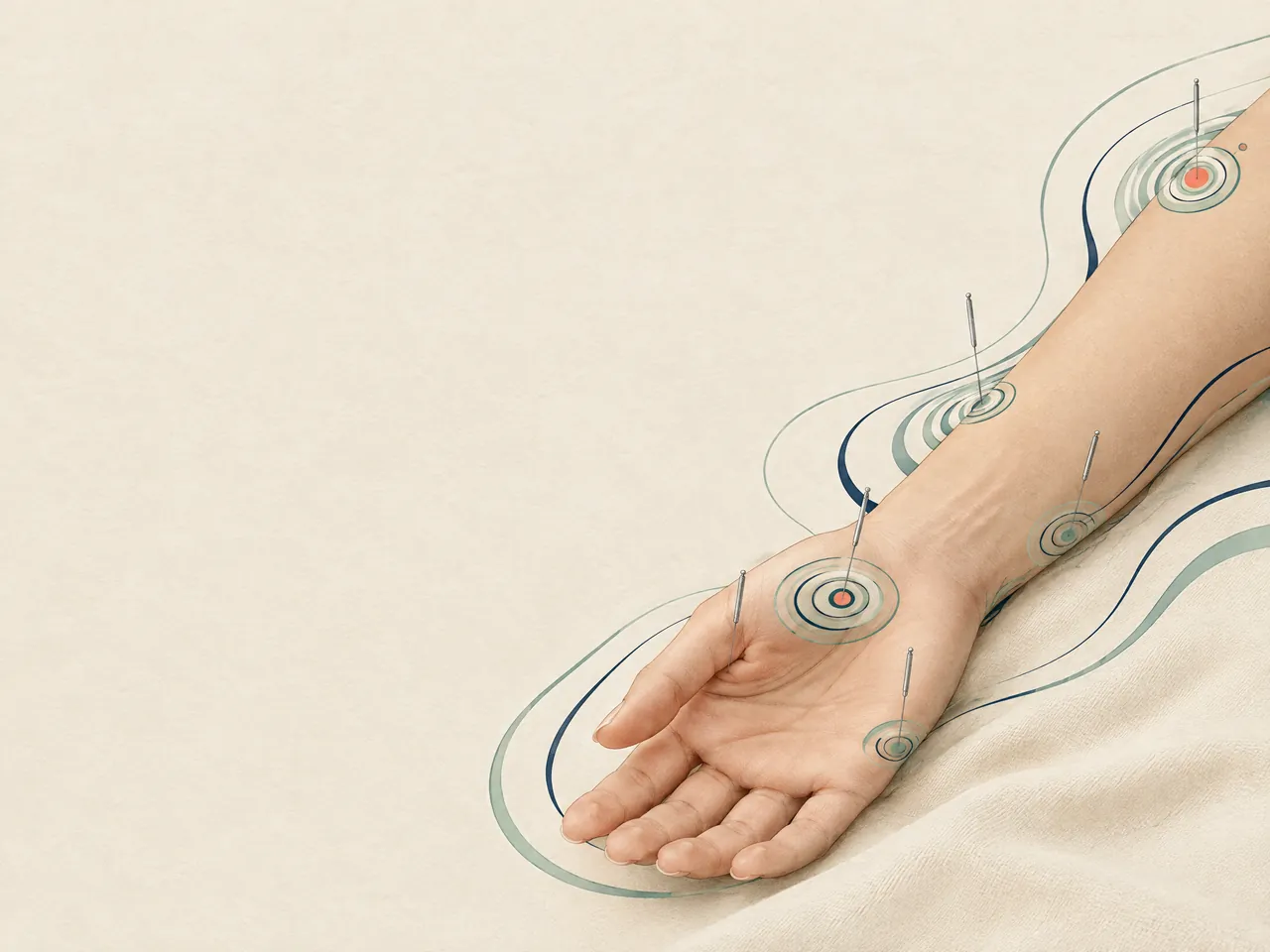
For a posture-related presentation, attention may be considered around the neck, shoulders, upper back and shoulder-blade region, according to findings and comfort. A person is commonly positioned lying face down or on the side so the relevant areas can be approached without forcing the posture. The practitioner should explain the intended areas, obtain consent and invite questions before needling. Needling and retention are not identical for every person, and a perceived needle sensation should not be treated as proof that a structural problem has been corrected.
Health information changes the safety discussion. Tell the practitioner about pregnancy, a bleeding disorder, medicines that affect bleeding, implanted devices, skin infection near the intended area, fainting with needles and any significant medical condition. The U.S. National Center for Complementary and Integrative Health reports that serious complications have occurred with nonsterile needles or improper delivery, and notes that acupuncture needles regulated in the United States are sterile and single-use. [2] It also advises people not to postpone seeing a health-care provider about a health problem. [2]
Acupuncture for Poor Posture, Acupuncture for Postural Kyphosis and Thoracic Kyphosis Acupuncture: Limits, Activities and Safety
The most balanced answer to “can thoracic kyphosis acupuncture help?” is that it depends on what “help” means. If the goal is to assess and manage posture-related muscle tightness or discomfort, acupuncture may be a topic for an individual consultation. If the goal is to correct vertebral shape, stop a curve progressing or replace assessment for a possible structural condition, acupuncture is not the answer. A plan that clearly separates symptom support, daily habits and medical follow-up is more useful than a promise about posture or appearance.

Acupuncture for Poor Posture, Acupuncture for Postural Kyphosis and Thoracic Kyphosis Acupuncture: Why Exercise and Posture Habits Still Matter
A treatment session is only one part of a week that may include many hours of sitting, device use, commuting or repetitive work. Small changes can be more realistic than trying to hold a rigid posture all day: place a frequently used screen at a workable height, vary the sitting position, take movement breaks, and choose activity that is comfortable and appropriate for existing diagnoses. If a physiotherapist or doctor has provided an exercise programme, follow their individual guidance rather than copying a generic online routine.
Exercise can support general function, but it should not be advertised as a way to straighten every curve. The NHS states that people with kyphosis should generally be able to exercise and that core strengthening can help; exercises from physiotherapy may help reduce pain and stiffness, but will not improve the spinal curve or prevent it worsening. [1] That distinction protects against unrealistic expectations. If movement causes sharp pain, new neurological symptoms or marked breathlessness, stop and seek appropriate assessment rather than pushing through.

Acupuncture for Poor Posture, Acupuncture for Postural Kyphosis and Thoracic Kyphosis Acupuncture: When to Seek Medical Assessment First
Medical review comes first when a curve is new, clearly worsening, associated with severe pain, or accompanied by breathing difficulty, weakness, numbness, fever, unexplained weight change or symptoms after trauma. The NHS specifically advises seeing a doctor if you think you or your child may have kyphosis; specialist assessment can include checking the back while bending forward and may include X-ray or MRI to look at the spine in more detail. [1] This is not a failure of conservative care. It is the sensible step when the question is structural rather than simply muscular.
For a non-urgent enquiry, be ready to say what you hope to improve: comfort at a desk, an upper-back pulling sensation, awareness of shoulder position, or support alongside a clinician’s plan. TCM Lab can discuss whether an appointment is suitable and how to prepare. You may contact a Chinese medicine clinic Prince Edward or a Kwun Tong Chinese medicine clinic through WhatsApp, while making clear if there has been a diagnosis, prior imaging or a red-flag symptom. That makes the first conversation safer and more relevant.

Care and health guide
Health service information
This directory brings together services, reading, and visit information related to health services, to help you prepare questions for a consultation.
If you are organising health questions, Chinese medicine clinic Hong Kong is a starting point for learning about related services and preparing for a consultation.
People have different needs; acupuncture Hong Kong provides further reading to help you understand options in your own context.


Your questions, answered
Frequently asked questions
How is a rounded upper back assessed before acupuncture?
The consultation may review standing and sitting posture, the location and pattern of discomfort, muscle tension or tender areas, everyday activities, health history and any existing diagnosis or imaging. Traditional TCM observations are not a substitute for a structural diagnosis.
What might an acupuncture session for posture-related tightness involve?
If appropriate after assessment, the practitioner may consider relevant neck, shoulder and upper-back areas. Positioning, needling and retention are individual. Tell the practitioner about medicines, pregnancy, bleeding concerns, medical conditions and anything that makes needling unsafe or uncomfortable.
Can acupuncture alone correct postural kyphosis or thoracic kyphosis?
No. It cannot repair vertebral shape, guarantee a change in a rounded back or replace medical assessment of a structural curve. Movement habits, physiotherapy or other care may be relevant depending on the cause and the person’s clinical assessment.
When should I seek medical assessment before considering acupuncture?
Seek medical assessment first if a curve is new or worsening, pain is severe or rapidly changing, breathing is difficult, there is numbness or weakness, symptoms follow trauma, or there are other concerning health changes. If you are worried about kyphosis, arrange a medical review.
Sources and further information
- [1] [1] NHS: Kyphosis
Referenced for: Definitions, symptoms, assessment, treatment limits and exercise guidance for kyphosis.
- [2] [2] National Center for Complementary and Integrative Health: Acupuncture—What You Need To Know
Referenced for: Acupuncture safety, sterile single-use needles and avoiding delay of health-care assessment.
- [3] [3] MANA Healthcare: Thoracic Kyphosis / Round Shoulder
Referenced for: Hong Kong usage of thoracic kyphosis, round shoulder and posture-related muscle-tension terminology.