
TCM Lab · Health reading
Hair Loss with Flaky Scalp and Hair Loss with Itchy Scalp: What Does Hair Loss with an Itchy Scalp Mean?
Published Updated
An itchy or flaky scalp can make every strand in the shower feel alarming, but the useful question is not simply how many hairs are on the drain cover. Hair loss with flaky scalp or hair loss with itchy scalp needs to be described as a pattern: where it is happening, whether hairs are shedding or breaking, how quickly it changed, and what the scalp looks and feels like. This guide explains what does hair loss with an itchy scalp mean and how to record the changes clearly for an assessment.
Appointments are confirmed through WhatsApp. If you have language requirements, please mention them in your enquiry.
The short answer
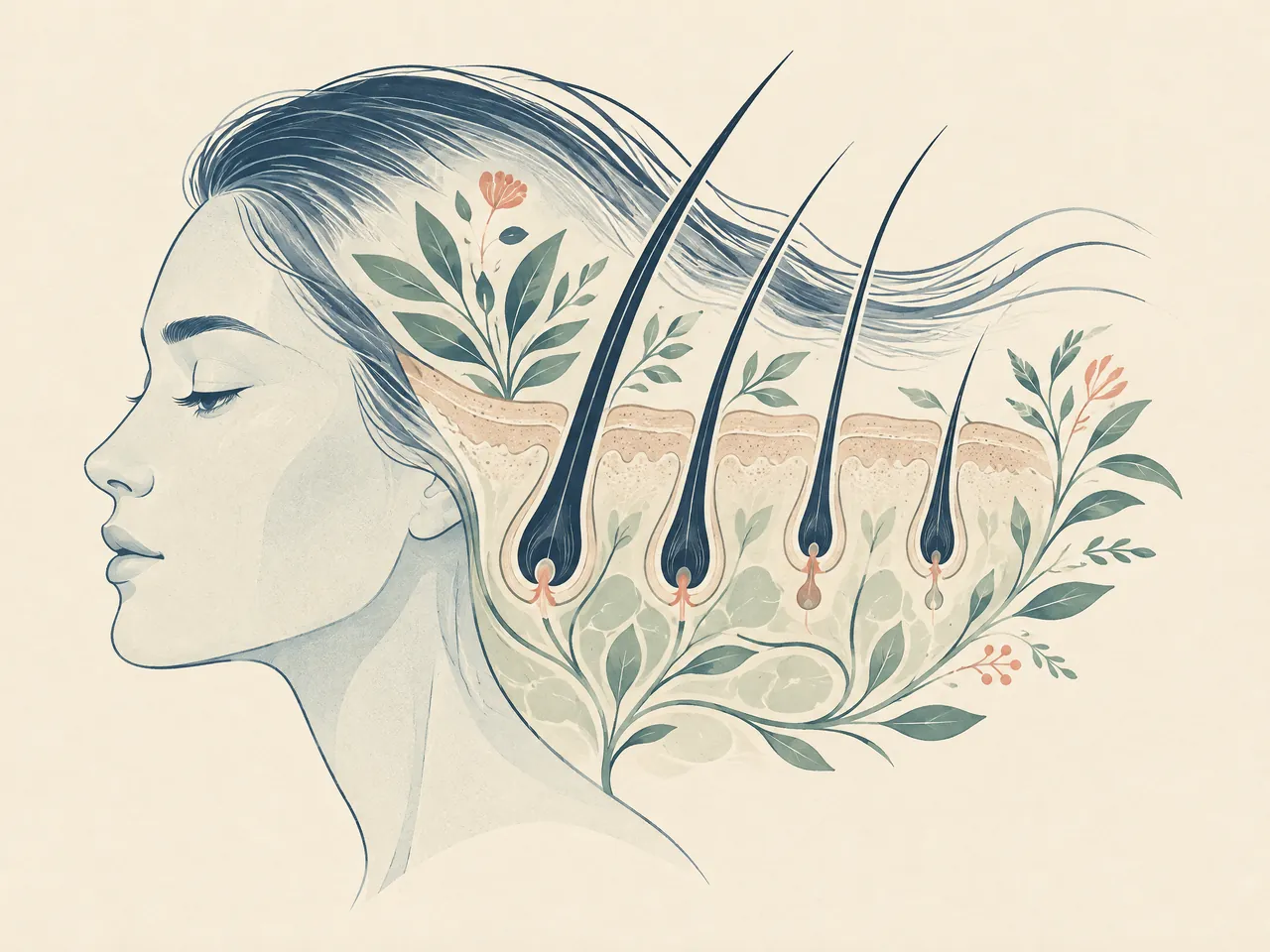
Hair loss with flaky scalp or hair loss with itchy scalp can occur with a range of scalp and hair conditions, so the symptom combination does not name one cause by itself. Arrange medical advice promptly for sudden or expanding bald patches, rapidly increased shedding, redness, swelling, pain, crusting, blisters, discharge, or skin that looks scarred. For gradual or persistent changes, note the pattern, timing, scalp symptoms, health changes, medicines, and hair practices before an assessment.
Transparent pricing
See the fees.
Choose your care.
Explore our complete official price list, including first-trial prices, regular prices, packages and branch-specific options.
Opening WhatsApp prepares an enquiry; it does not send a message, take payment or confirm an appointment. Suitability and individual arrangements are confirmed during consultation.
Hair and scalp
All prices in HKDScalp health and hair-loss management
Includes AI scalp analysis, deep scalp and follicle cleansing, and scalp oil-control care.
HK$380 (first trial)
Regular price: HK$680
- 6 sessions: HK$3,480 (HK$580 per session)
- 12 sessions: HK$5,760 (HK$480 per session)
- 20 sessions: HK$8,600 (HK$430 per session)
- 30 sessions: HK$11,400 (HK$380 per session)
Hair acupuncture and Chinese herbal medicine package
Includes scalp acupuncture and 3 days of Chinese herbal medicine that does not require decoction.
HK$580 (single session)
Registered Chinese Medicine Practitioner consultation
- 6 sessions: HK$3,180 (HK$530 per session)
- 12 sessions: HK$5,760 (HK$480 per session)
- 20 sessions: HK$8,600 (HK$430 per session)
- 30 sessions: HK$11,400 (HK$380 per session)
Combined hair and scalp treatment
Combines acupuncture and Chinese herbal medicine with salon-level scalp and follicle care. Packages include complimentary hair-care shampoo and serum.
HK$1,260 (single session)
Combined treatment
- 8 sessions: HK$8,640 (HK$1,080 per session)
- 16 sessions: HK$15,680 (HK$980 per session)
- 20 sessions: HK$18,600 (HK$930 per session)
- 30 sessions: HK$26,400 (HK$880 per session)
Weight management
All prices in HKDFull-body acupoint embedding for weight management
Includes full-body acupoint embedding. Packages include complimentary Chinese herbal medicine for weight management, with the number of included days scaled to the package. Embedding material and the individual treatment arrangement are confirmed during consultation; this is not a cosmetic thread lift.
HK$980 (single session)
No trial session
- 10 sessions: HK$7,800 (HK$780 per session)
- 20 sessions: HK$14,600 (HK$730 per session)
- 30 sessions: HK$20,400 (HK$680 per session)
Facial acupuncture
All prices in HKDFacial acupuncture (basic)
Includes facial acupuncture and meridian-based facial care, including care for facial puffiness.
HK$480 (first trial)
Regular price: HK$680
- 10 sessions: HK$5,200 (HK$520 per session)
- 20 sessions: HK$9,600 (HK$480 per session)
- 30 sessions: HK$13,500 (HK$450 per session)
Facial acupuncture (advanced)
Includes enhanced facial acupuncture with a specially formulated moisturising mask and serum.
HK$780 (first trial)
Regular price: HK$1,180
- 10 sessions: HK$9,000 (HK$900 per session)
- 20 sessions: HK$16,600 (HK$830 per session)
- 30 sessions: HK$23,400 (HK$780 per session)
Pain care
All prices in HKDExtracorporeal shockwave treatment
Shockwave treatment for deep-tissue and fascial care. The Kwun Tong clinic offers the multi-area options shown below.
Priced by branch
Branch-specific pricing
Prince Edward: HK$250 per area
Kwun Tong: HK$250 for 1 area / HK$450 for 2 areas / HK$600 for 3 areas
Pain care (manual therapy)
Includes Chinese medicine musculoskeletal assessment, manual joint techniques and tui na.
HK$580 (single session)
Chinese medicine musculoskeletal assessment
Pain care (acupuncture and manual therapy)
Combines acupuncture and manual therapy.
HK$680 (single session)
Combined care
Chinese medicine
All prices in HKDAcupuncture and Chinese herbal medicine package
Includes a Chinese medicine consultation with pulse assessment, body acupuncture and 3 days of Chinese herbal granules that do not require decoction.
HK$580 (single session)
Chinese medicine consultation with pulse assessment
Hair Loss with Flaky Scalp, Hair Loss with Itchy Scalp, and What Does Hair Loss with an Itchy Scalp Mean?
Hair loss with flaky scalp is often searched as though it must have one answer. In practice, flakes, itch, visible thinning, broken hairs, and hairs that have come out from the root are observations, not a diagnosis. More than one contributor can be present: a longstanding family-pattern change may coincide with a new irritated scalp, or shedding after illness may make ordinary flaking more noticeable. A careful description helps a clinician decide what needs attention first. The Hong Kong Centre for Health Protection advises seeking medical advice to identify possible underlying causes before starting treatment for hair loss [1].
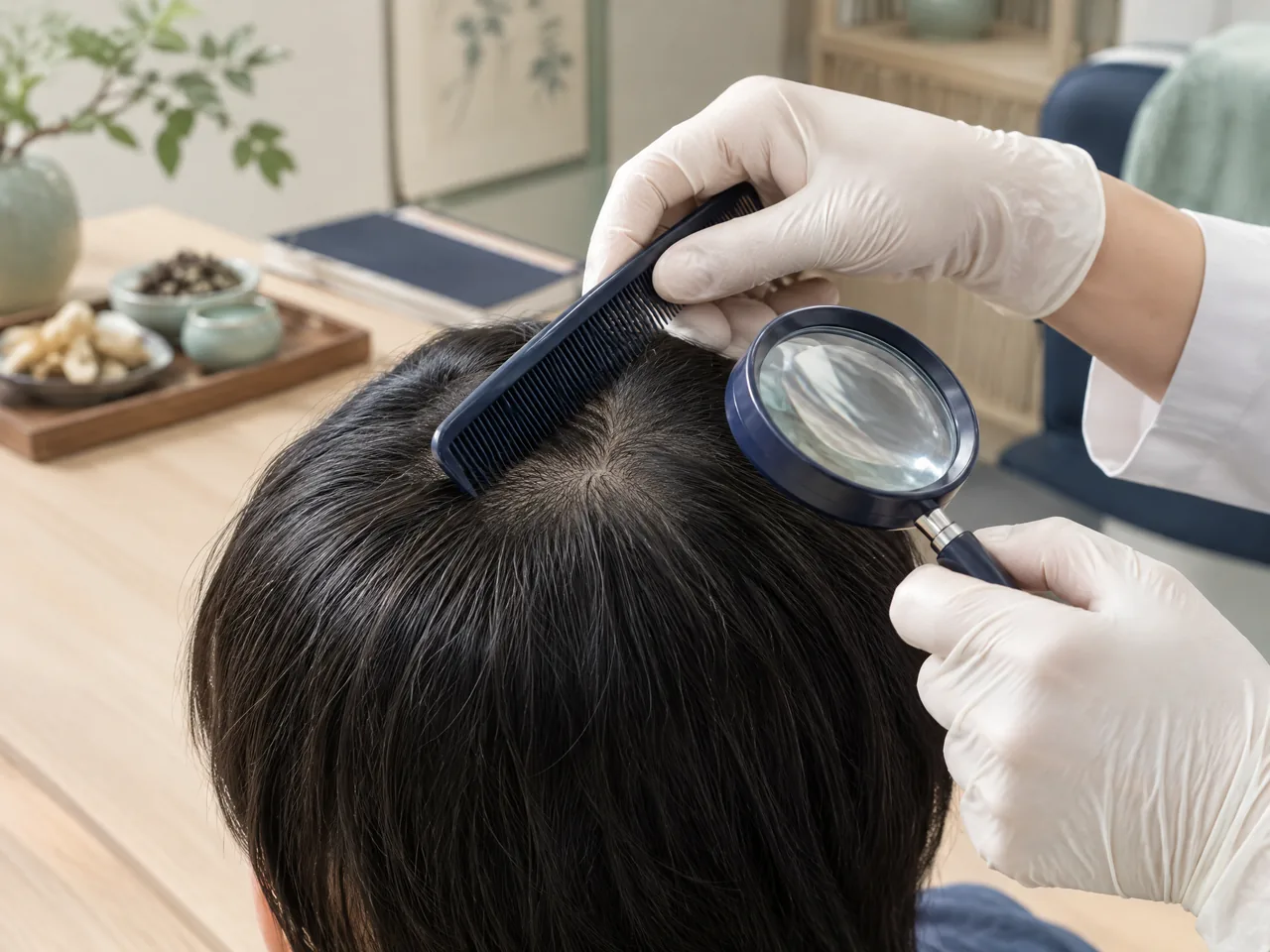
Start with location. Is the concern mainly at the parting, temples, crown, hairline, sides, or one defined area? Is it symmetric, or is one patch different from the surrounding scalp? Then add scalp details: loose or adherent flakes, redness, tenderness, burning, crusting, spots, or a wet area are not interchangeable findings. If you are unsure whether a hair is shedding or snapping, describe what you see. Examination of the scalp, nails, and other affected areas provides useful clues [2].

It is also reasonable to be concerned when hair change affects confidence, daily routines, or wellbeing even without an emergency sign. Rather than repeatedly counting every strand, compare the change with your usual hair density and grooming experience over time. The companion guide on how much hair loss is normal can help frame that observation, but it cannot determine a cause for an individual. Persistent worry is itself a valid reason to arrange a non-urgent medical discussion; the NHS advises seeing a GP if you are worried about hair loss [3].
Hair Loss with Flaky Scalp, Hair Loss with Itchy Scalp, and What Does Hair Loss with an Itchy Scalp Mean? — Notice the Pattern
A useful pattern note answers ordinary questions in plain language. When did you first notice the change? Did the itch begin before the shedding, after it, or at about the same time? Does it flare after washing, sweating, wearing a helmet, applying a new product, colouring, or tightly styling the hair? Say whether you see hair on the pillow or clothing, more hair while washing, short broken pieces, or a widening part. These observations do not prove a cause, but they are much more informative than saying only that the hair feels thinner.
Look at the scalp in good light without scratching or picking at it. Scratching can make soreness, flakes, and broken hairs harder to interpret. Photographs taken from the same angle and distance may document change at the parting, crown, and hairline. Keep them private and use them as a memory aid, not a self-diagnosis tool. Note whether brows, eyelashes, beard hair, body hair, or nails have changed too, as these details may matter during an assessment [2].

Hair Loss with Flaky Scalp, Hair Loss with Itchy Scalp, and What Does Hair Loss with an Itchy Scalp Mean? — Gradual Versus Sudden Change
Gradual thinning over months can feel less urgent than a sudden shower of hair, but pace alone does not settle the question. A widening parting, crown change, or receding hairline may be noticed through styling before it is obvious in a mirror. A family pattern can be relevant, yet it should not stop someone mentioning a new scalp symptom or an unfamiliar change. The Centre for Health Protection describes male-pattern changes at the temples and crown, and lists family history among possible contributors [1].
By contrast, a clear increase in shedding over days or weeks, a sudden localised area, or a rapidly enlarging area deserves timely attention. Recent illness, surgery, stress, weight change, childbirth, dietary change, or a new or stopped medicine belong in the timeline, not as explanations to assume. The NHS lists illness, stress, weight loss, and iron deficiency among possible causes of temporary hair loss [3]. Share the sequence with a clinician rather than adding several products at once.
Compare your options
| What to notice | Useful detail to record | Why it helps the discussion |
|---|---|---|
| Timing | First date noticed; gradual, sudden, or recurring change | Shows the sequence of shedding and scalp symptoms |
| Distribution | Parting, crown, hairline, sides, or one defined patch | Distinguishes diffuse thinning from a localised change |
| Scalp appearance | Flakes, redness, tenderness, burning, crusting, blisters, or fluid | Highlights findings that may need prompt assessment |
| Hair change | Whole hairs, short broken hairs, widening part, or bald area | Helps describe what is seen without assuming a cause |
| Recent context | Illness, surgery, childbirth, stress, weight or diet change, medicines, products, or hair practices | Gives relevant background for targeted questions |
On smaller screens, scroll the table sideways to compare all columns.
Hair Loss with Flaky Scalp, Hair Loss with Itchy Scalp, and What Does Hair Loss with an Itchy Scalp Mean? — Warning Signs
Warning signs are not intended to make every itchy scalp sound dangerous. They help identify situations where waiting for a routine change in shampoo is not a good plan. A smooth, round or oval area without hair, a defined patch with short broken hairs, or a rapidly spreading area calls for an assessment. Hong Kong’s Centre for Health Protection notes that alopecia areata can present as small, round patchy hair loss on the scalp [1]. That description is not a way to diagnose yourself; it is a reason to report the shape, timing, and any additional hair loss accurately.
The condition of the skin can be more urgent than the apparent volume of hair shed. Redness, swelling, tenderness, pain, burning, crusts, blisters, oozing, or a distinctly abnormal-looking scalp should be brought to medical attention, especially if the area is worsening. Do not treat a painful or weeping scalp as a cosmetic inconvenience. Infection, inflammation, and skin damage are among the possibilities a clinician may consider, and prompt examination can clarify what is happening [1] [2].
A useful rule is to act on change, not panic. If the scalp is acutely sore, swollen, blistered, or discharging fluid, seek urgent medical advice. If there is no acute distress but a patch is new, shedding is clearly accelerating, or flaking and itch keep returning despite gentle care, arrange an appointment rather than cycling through remedies. For broader context on deciding when to see a doctor for hair loss, focus on the whole picture: speed, distribution, scalp appearance, and associated health changes.
Hair Loss with Flaky Scalp, Hair Loss with Itchy Scalp, and What Does Hair Loss with an Itchy Scalp Mean? — Patches and Rapid Shedding
A patch is more than an area that looks less dense under bright light. It is a localised difference with a discernible border or contrast with nearby coverage. Note whether the surface looks smooth, flaky, inflamed, shiny, or unchanged; whether it is tender or itchy; and whether similar areas are appearing elsewhere. Mention eyebrow, eyelash, beard, or body-hair changes. The term patchy hair loss is descriptive, not a diagnosis, and helps a clinician know where to look and what timeline to explore.
Rapid shedding can be hard to judge because washing frequency and hair length change the visual impact. Instead of relying on one dramatic wash day, note whether the amount is repeatedly unlike your own usual experience, whether it happens with gentle combing, and when it began. Record relevant events in the preceding weeks or months, including fever or other illness, an operation, delivery, major dietary restriction, emotional strain, and medication changes. The AAD specifically recommends asking how long hair loss has been present and whether it came on quickly when identifying its cause [2].
Hair Loss with Flaky Scalp, Hair Loss with Itchy Scalp, and What Does Hair Loss with an Itchy Scalp Mean? — Redness, Pain, or Crusting
Itch is common and can range from an occasional mild urge to an intense sensation that disrupts sleep or leads to repeated rubbing. Add precision: is it itch alone, itch with scale, burning, soreness, or pain when the scalp is touched? Is there redness around follicles, thick crusting, bleeding after scratching, pustules, or fluid? These are different observations with different implications. Avoid harsh exfoliation, picking at crusts, or repeatedly applying multiple new products to an already inflamed area, as these steps can worsen irritation and make the original pattern harder to see.
A scalp that appears shiny, depressed, or without visible follicle openings, or skin that becomes painful or develops crusts, should be assessed promptly. These findings cannot be safely classified from a consumer product review or a social-media comparison image. A clinician may examine the scalp and may decide whether further investigation is appropriate. In the AAD’s overview, blood tests or a scalp biopsy may be considered when disease, deficiency, hormone imbalance, or infection is suspected; they are not automatic tests for every person [2].
Hair Loss with Flaky Scalp, Hair Loss with Itchy Scalp, and What Does Hair Loss with an Itchy Scalp Mean? — Preparing for Advice
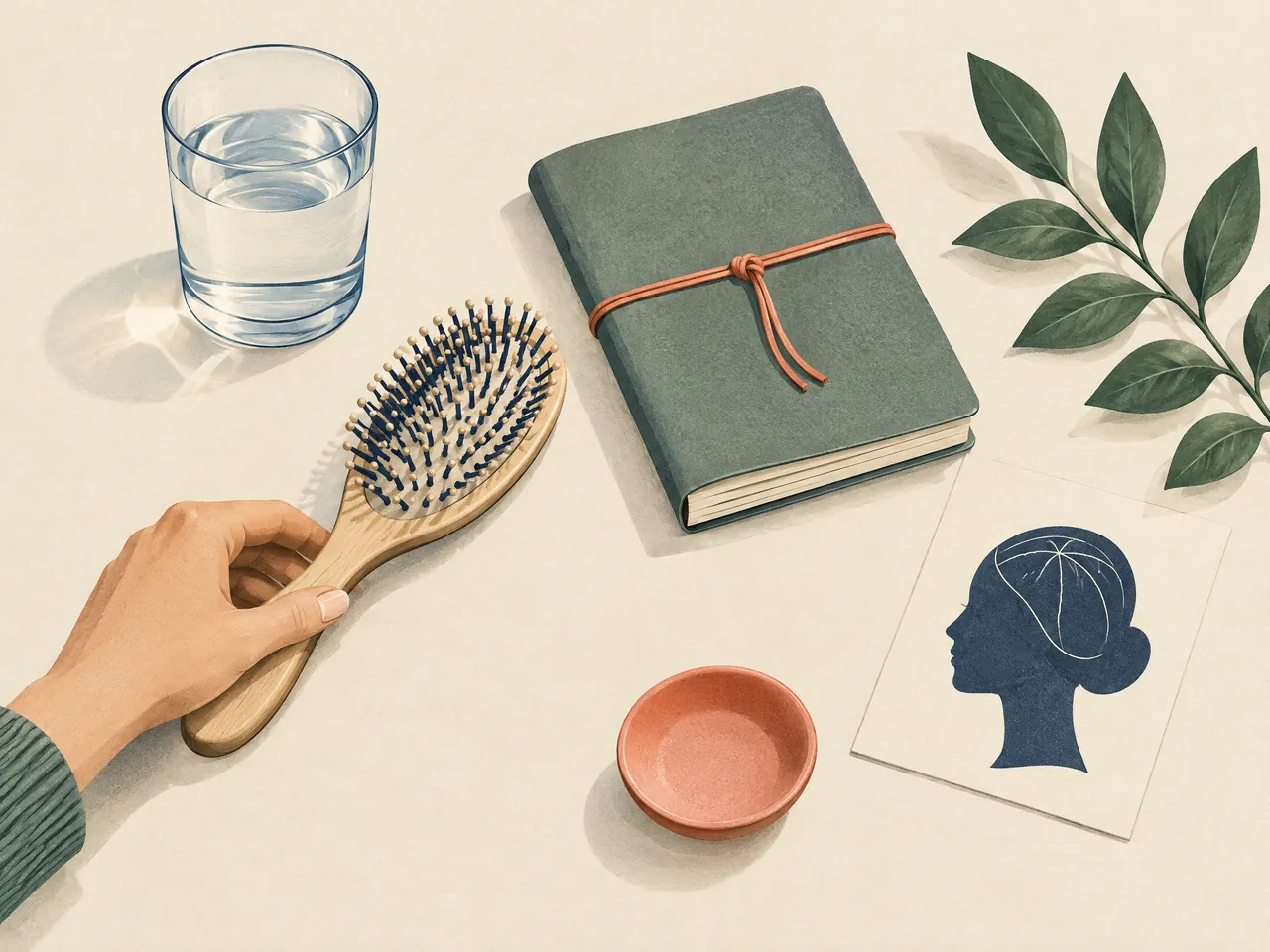
Preparing for an appointment does not mean researching until you can label the condition yourself. Make a short, accurate record so time with a clinician can focus on the relevant changes. Bring photos only if they show a sequence over time and were taken consistently. Write down products, hair treatments, supplements, prescription medicines, and over-the-counter medicines, including items started, stopped, or changed when symptoms began. The list prevents important context from being missed.
State what you want from the visit. You may be most concerned about itch, visible flakes, a bald patch, shedding, breakage, or how to protect the scalp while the cause is investigated. Say if symptoms affect sleep, work, head covering, exercise, grooming, or confidence. If you have tried a treatment, describe how often you used it, for how long, and whether irritation occurred. This avoids the vague conclusion that something ‘did not work’.
Do not assume that everyone needs the same laboratory work or procedure. Assessment begins with the story and examination. Depending on what is found, a clinician may look closely at the scalp and hair, gently test hair behaviour, or decide whether blood tests, sampling, or a biopsy would add useful information [2]. The related hair loss blood test page explains why a blood test may be part of a tailored assessment rather than a universal answer.
Hair Loss with Flaky Scalp, Hair Loss with Itchy Scalp, and What Does Hair Loss with an Itchy Scalp Mean? — Details to Record
Use a simple note on your phone or paper. Record the first date you noticed the issue, then the order in which hair loss, itch, flaking, redness, or discomfort appeared. Describe location and spread. Include whether the issue is constant or comes and goes, and whether washing, exercise, headwear, a new hair product, colouring, heat styling, or tension from hairstyles seems to coincide with a flare. Keep the language descriptive: ‘itchy, fine white flakes at the parting’ is more helpful than naming a condition you are not sure of.
Add wider health context. Recent fever, infection, hospital care, surgery, childbirth, stress, eating changes, weight change, or menstrual changes can be relevant. Also note family patterns of thinning, skin or nail symptoms, and known health conditions. The NHS emphasises that hair loss can have different causes and advice should begin with understanding what is causing it [3]. This record does not replace assessment; it gives the conversation a clearer start.

Hair Loss with Flaky Scalp, Hair Loss with Itchy Scalp, and What Does Hair Loss with an Itchy Scalp Mean? — What an Assessment May Consider
During an assessment, the clinician may ask about the timeline, family history, health conditions, medicines, diet, recent events, and hair practices. They may examine the scalp, the hair shafts, and sometimes nails or other hair-bearing areas. This is why a clear answer to ‘what does hair loss with an itchy scalp mean?’ cannot be supplied by one symptom alone. The clinical task is to decide whether the visible scalp change and hair pattern point toward one issue, more than one issue, or a need for additional testing [2].
Bring up any worry about a particular possibility, including alopecia, but allow the assessment to distinguish descriptive terms from a diagnosis. If you are considering support from TCM Lab after appropriate medical guidance, you can enquire about a consultation at the Kwun Tong Chinese medicine clinic or Chinese medicine clinic Prince Edward. When messaging, say that the concern involves hair loss with flaky scalp or hair loss with itchy scalp, describe any urgent skin symptoms, and mention your language needs so arrangements can be confirmed.
Care and health guide
Hair and scalp care information
This directory brings together services, reading, and visit information related to hair and scalp care, to help you prepare questions for a consultation.
For questions about hair or scalp care, noting the everyday concerns and service questions you want to discuss can help prepare a consultation; Chinese medicine for hair loss is a relevant service or reading entry point.
People may have different priorities, and acupuncture Hong Kong offers related information to help you understand options and prepare questions.

Your questions, answered
Frequently asked questions
When should I seek medical advice for hair loss with flaky scalp or hair loss with itchy scalp?
Seek prompt medical advice for a new or enlarging bald patch, rapid or strikingly increased shedding, redness, swelling, pain, burning, crusting, blisters, discharge, or a scalp that looks markedly abnormal. If changes are gradual but persistent, different from your usual pattern, or worrying you, arrange a non-urgent assessment rather than relying on hair counts or product switches alone.
Does an itchy scalp mean that the itch is causing my hair loss?
Not necessarily. Itch and hair loss may be related, or they may occur together for different reasons. The useful details are the timing, distribution, scalp appearance, any broken hairs or shedding, and relevant health or hair-care changes. An examination is needed to determine what is happening.
Is a bald patch always alopecia areata?
No. A new round or oval patch can be seen with alopecia areata, but appearance alone cannot establish that diagnosis. Note when it appeared, whether it is expanding, whether the skin is smooth, scaly, painful, or inflamed, and whether other hair-bearing areas are affected. Arrange medical assessment for a new patch.
Will I automatically need a blood test or scalp biopsy?
No. An assessment commonly starts with your history and an examination of the scalp and hair. Further tests are selected according to the pattern and findings. The AAD notes that blood testing or scalp biopsy may be used when a clinician suspects an underlying disease, deficiency, hormone imbalance, or infection; not every person needs the same investigations [2].
Sources and further information
- [1] Hong Kong Centre for Health Protection — Men’s Health Line: Alopecia
Referenced for: Official Hong Kong health guidance used for possible contributors, round patchy hair loss, medical advice, and possible investigations.
- [2] American Academy of Dermatology — Hair loss: Diagnosis and treatment
Referenced for: Professional dermatology guidance used for assessment history, scalp examination, hair testing, and when further testing may be considered.
- [3] NHS — Hair loss
Referenced for: Public health guidance used for general causes, non-urgent advice, and the need to understand the cause before pursuing treatment.