
TCM Lab · Health reading
Acne Scar Types and Atrophic Acne Scars: Facial Acupuncture for Acne Scars Explained
Published Updated
A lingering mark after a spot has healed is not automatically a scar. A flat red area, a brown or grey-brown patch, and a dent that changes the way light falls across the cheek point to different acne scar types and call for different expectations. Atrophic acne scars are structural depressions, whereas post-acne colour changes can fade gradually. Facial acupuncture for acne scars can be discussed as a local skin-management option only after an individual assessment; it cannot be promised to clear marks or rebuild a depressed scar. If there is active inflammation, pus, infection or broken skin, dealing with that problem comes first.
Appointments are confirmed through WhatsApp. If you have language requirements, please mention them in your enquiry.
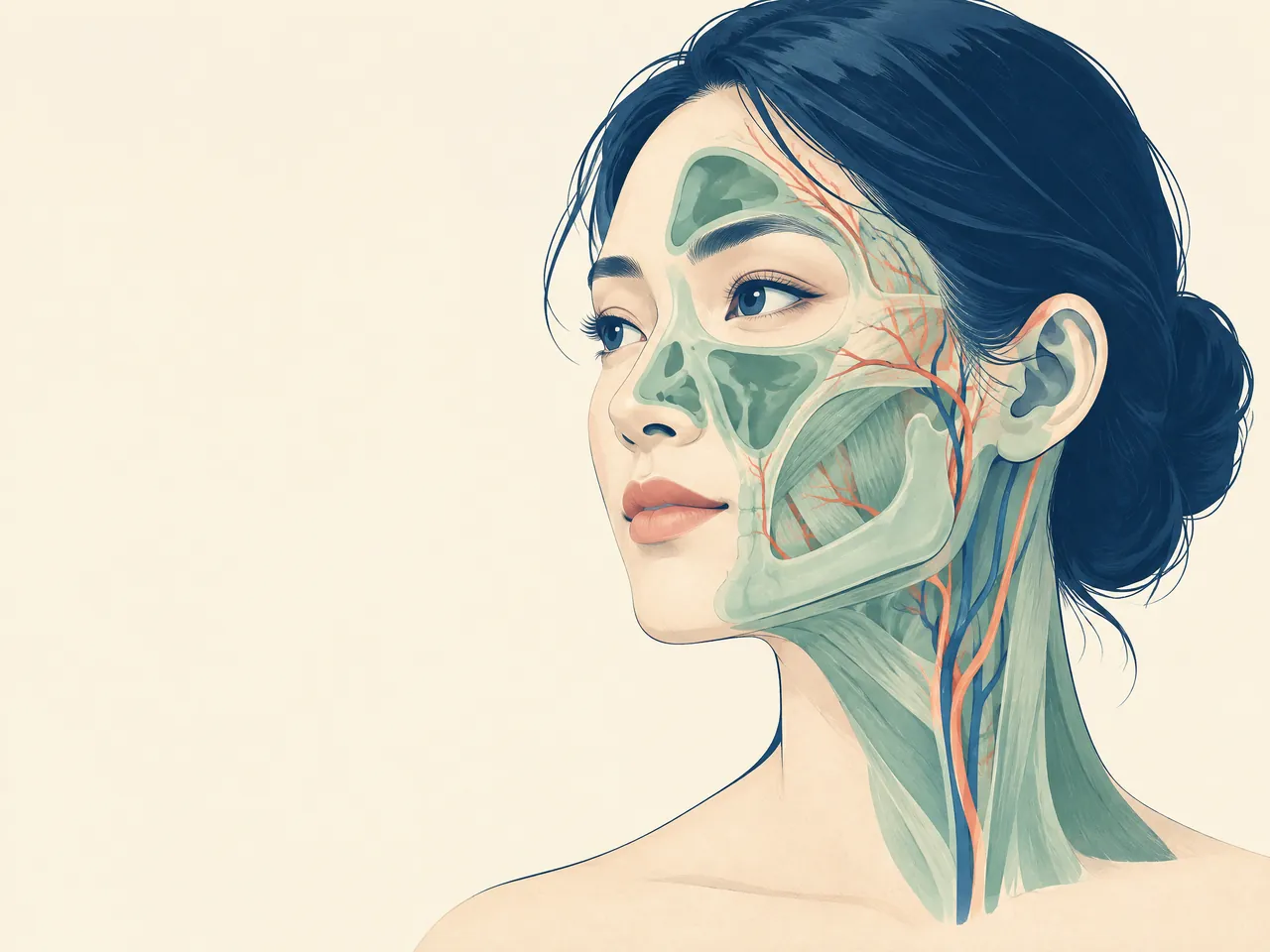
The short answer
Acne scar types include flat red or dark post-acne marks, depressed atrophic acne scars, and less commonly raised scars. Redness and pigmentation may improve with time, while texture changes such as ice-pick, boxcar or rolling scars are structural and merit a careful skin assessment. Facial acupuncture for acne scars is not a proven way to repair structural scars or guarantee mark removal. Active, painful, infected or open areas should be assessed and managed before any local needling is considered.
Transparent pricing
See the fees.
Choose your care.
Explore our complete official price list, including first-trial prices, regular prices, packages and branch-specific options.
Opening WhatsApp prepares an enquiry; it does not send a message, take payment or confirm an appointment. Suitability and individual arrangements are confirmed during consultation.
Facial acupuncture
All prices in HKDFacial acupuncture (basic)
Includes facial acupuncture and meridian-based facial care, including care for facial puffiness.
HK$480 (first trial)
Regular price: HK$680
- 10 sessions: HK$5,200 (HK$520 per session)
- 20 sessions: HK$9,600 (HK$480 per session)
- 30 sessions: HK$13,500 (HK$450 per session)
Facial acupuncture (advanced)
Includes enhanced facial acupuncture with a specially formulated moisturising mask and serum.
HK$780 (first trial)
Regular price: HK$1,180
- 10 sessions: HK$9,000 (HK$900 per session)
- 20 sessions: HK$16,600 (HK$830 per session)
- 30 sessions: HK$23,400 (HK$780 per session)
Hair and scalp
All prices in HKDScalp health and hair-loss management
Includes AI scalp analysis, deep scalp and follicle cleansing, and scalp oil-control care.
HK$380 (first trial)
Regular price: HK$680
- 6 sessions: HK$3,480 (HK$580 per session)
- 12 sessions: HK$5,760 (HK$480 per session)
- 20 sessions: HK$8,600 (HK$430 per session)
- 30 sessions: HK$11,400 (HK$380 per session)
Hair acupuncture and Chinese herbal medicine package
Includes scalp acupuncture and 3 days of Chinese herbal medicine that does not require decoction.
HK$580 (single session)
Registered Chinese Medicine Practitioner consultation
- 6 sessions: HK$3,180 (HK$530 per session)
- 12 sessions: HK$5,760 (HK$480 per session)
- 20 sessions: HK$8,600 (HK$430 per session)
- 30 sessions: HK$11,400 (HK$380 per session)
Combined hair and scalp treatment
Combines acupuncture and Chinese herbal medicine with salon-level scalp and follicle care. Packages include complimentary hair-care shampoo and serum.
HK$1,260 (single session)
Combined treatment
- 8 sessions: HK$8,640 (HK$1,080 per session)
- 16 sessions: HK$15,680 (HK$980 per session)
- 20 sessions: HK$18,600 (HK$930 per session)
- 30 sessions: HK$26,400 (HK$880 per session)
Weight management
All prices in HKDFull-body acupoint embedding for weight management
Includes full-body acupoint embedding. Packages include complimentary Chinese herbal medicine for weight management, with the number of included days scaled to the package. Embedding material and the individual treatment arrangement are confirmed during consultation; this is not a cosmetic thread lift.
HK$980 (single session)
No trial session
- 10 sessions: HK$7,800 (HK$780 per session)
- 20 sessions: HK$14,600 (HK$730 per session)
- 30 sessions: HK$20,400 (HK$680 per session)
Pain care
All prices in HKDExtracorporeal shockwave treatment
Shockwave treatment for deep-tissue and fascial care. The Kwun Tong clinic offers the multi-area options shown below.
Priced by branch
Branch-specific pricing
Prince Edward: HK$250 per area
Kwun Tong: HK$250 for 1 area / HK$450 for 2 areas / HK$600 for 3 areas
Pain care (manual therapy)
Includes Chinese medicine musculoskeletal assessment, manual joint techniques and tui na.
HK$580 (single session)
Chinese medicine musculoskeletal assessment
Pain care (acupuncture and manual therapy)
Combines acupuncture and manual therapy.
HK$680 (single session)
Combined care
Chinese medicine
All prices in HKDAcupuncture and Chinese herbal medicine package
Includes a Chinese medicine consultation with pulse assessment, body acupuncture and 3 days of Chinese herbal granules that do not require decoction.
HK$580 (single session)
Chinese medicine consultation with pulse assessment
Acne Scar Types, Atrophic Acne Scars and Facial Acupuncture for Acne Scars: Red, Dark and Raised Changes
The most useful first question is not "How do I erase this?" but "What is actually left behind?" Acne can leave a flat colour change, a change in texture, or both. Neither observation alone establishes a permanent scar. Dermatology guidance distinguishes post-inflammatory erythema and hyperpigmentation from the structural changes of acne scarring, while recognising that they may occur together [1]. This distinction prevents a smooth, flat mark from being described as a pitted scar and prevents a visible depression from being dismissed as pigmentation alone.
Atrophic acne scars are indentations caused by tissue change after inflammation. They often stand out more under side lighting, makeup or a phone camera than when a face is viewed straight on. Raised scars are different again: they sit above the surrounding surface and deserve a separate assessment, particularly if they are enlarging, itchy or uncomfortable. Note whether the concern is colour, contour, ongoing breakouts, or several of these at once; that gives a practitioner a sound starting point for a focused conversation.

Acne Scar Types, Atrophic Acne Scars and Facial Acupuncture for Acne Scars: How Red and Dark Marks Differ
Post-inflammatory erythema is the clinical term often used for a lingering pink or red appearance after an acne lesion settles. Post-inflammatory hyperpigmentation describes a darker brown, grey-brown or blackened area after inflammation. DermNet notes that colour changes associated with acne can improve over months or longer, and that hyperpigmentation is more common in darker skin types [1]. That time course can feel slow, but it is not evidence by itself that a dented scar is forming. Our guide to post-inflammatory erythema acne looks more closely at the red-mark pattern, while acne marks after acne explains why colour and texture should be separated in everyday language.
A practical home observation is to look at the area in consistent daylight without squeezing or rubbing it. Ask whether it remains flat when viewed from the side, whether its colour changes with warmth or flushing, and whether the mark is still appearing beside new spots. These observations do not replace diagnosis, but they help avoid vague labels such as "scarred everywhere." Sun exposure can make a contrast in colour more apparent, so discuss your current sun-protection and skincare habits with a qualified clinician rather than adding several strong products at once. If you are already using prescribed acne treatment, keep that prescriber informed before changing your routine.
Acne Scar Types, Atrophic Acne Scars and Facial Acupuncture for Acne Scars: When Texture Signals a Scar
A scar becomes more likely when there is a persistent change in the surface itself: a narrow deep pit, a sharply edged hollow, or a wider shallow dip that creates shadowing. Dermatology references classify the main atrophic patterns as ice-pick, boxcar and rolling scars [1]. Ice-pick scars tend to look narrow and deep; boxcar scars are broader depressions with more distinct edges; rolling scars create a gently undulating appearance. Names are useful for discussion, not a reason to diagnose yourself from a close-up photograph.
Raised or thickened areas need care in the opposite direction: instead of a loss of contour, there is excess scar tissue. DermNet describes hypertrophic scars as remaining within the size of the original lesion and keloids as growing beyond it [1]. A new, fast-changing, painful, hot or draining lesion is not a cosmetic texture question to manage casually. Seek timely medical advice, especially for deep tender nodules, spreading redness, substantial pus or fever. Avoid picking and squeezing: further injury to active lesions can increase the likelihood of scarring [1].
Compare your options
| What you may notice | How it differs | Useful next discussion |
|---|---|---|
| Flat pink or red area after a spot | Often fits post-inflammatory erythema; colour is present but the surface may remain smooth | Check for continuing breakouts and discuss skin irritation, sun protection and whether the area is fully settled |
| Flat brown, grey-brown or darker patch | Often fits post-inflammatory hyperpigmentation rather than a depression | Review current products and skin type; avoid assuming that all persistent colour is a structural scar |
| Persistent pit, hollow or uneven contour | May be an atrophic scar such as an ice-pick, boxcar or rolling pattern | Seek an assessment of scar type and ask whether dermatology input is appropriate |
| Thick or raised tissue | Suggests a raised scar pattern rather than atrophic scarring | Discuss medical assessment, especially if it is changing, itchy, painful or extending |
On smaller screens, scroll the table sideways to compare all columns.
Acne Scar Types, Atrophic Acne Scars and Facial Acupuncture for Acne Scars: Assessment Before Care
Assessment is where a broad search term becomes a useful personal plan. It should establish which areas are flat marks, which have altered texture, whether active acne is continuing, and whether there are signs of infection or another skin condition. The American Academy of Dermatology notes that different acne types can need different treatment and that some acne-like eruptions are different conditions altogether [2]. For that reason, a practitioner should not assume that every red bump beside an old mark is simply "scar activity." A straightforward review can also clarify which products, procedures or medicines have already irritated the skin or changed its appearance.
In a Chinese-medicine consultation, a registered practitioner may ask about the timing and distribution of breakouts alongside sleep, stress, diet, menstrual or other health context where relevant. This is a traditional assessment approach and does not substitute for a dermatology diagnosis of a structural scar. The immediate decision is practical: is the skin calm and intact enough to discuss local care, or is medical acne control or dermatology review the more appropriate next step? CUHK’s clinic information describes Chinese-medicine consultations and acupuncture as options in an individualised skin programme, but does not establish that acupuncture repairs acne scars [3].

Acne Scar Types, Atrophic Acne Scars and Facial Acupuncture for Acne Scars: What to Tell the Practitioner
Bring a simple timeline rather than trying to remember every detail at the appointment. Say when the acne began, whether it is still recurring, and which areas are new versus longstanding. Mention painful lumps, discharge, bleeding, crusting, frequent picking, or a tendency to form raised scars. List current cleansers, retinoids, exfoliating acids, spot treatments, supplements, oral medicines and prescriptions. Also mention recent procedures such as laser, chemical peel, microneedling or injections. This helps the practitioner understand whether the barrier may be irritated and whether timing or referral needs discussion rather than assuming that a single approach suits every face.
Photos can be useful if a mark changes between visits, but take them in similar lighting and do not rely on filtered images. If you want to discuss facial acupuncture for acne scars, explain your goal in plain terms: perhaps you are mainly concerned about leftover redness, uneven-looking tone, a shallow cheek hollow, or the fact that acne keeps returning. It may also be useful to read can facial acupuncture help acne marks before your visit. A specific goal makes it easier to explain what local care can and cannot reasonably address.

Acne Scar Types, Atrophic Acne Scars and Facial Acupuncture for Acne Scars: Why Active Acne Matters
Active acne changes the order of priorities. A new inflamed papule, pustule, painful nodule, weeping area or open excoriation is not the same as a settled mark. DermNet specifically advises treating active acne before starting scar management [1]. This sequencing makes sense because ongoing inflammation can continue to leave new marks or scars, and it becomes difficult to judge whether any later skin change relates to the original acne, a treatment or natural settling. The AAD similarly identifies clearing existing acne, stopping new breakouts and preventing scars as linked goals of acne care [2].
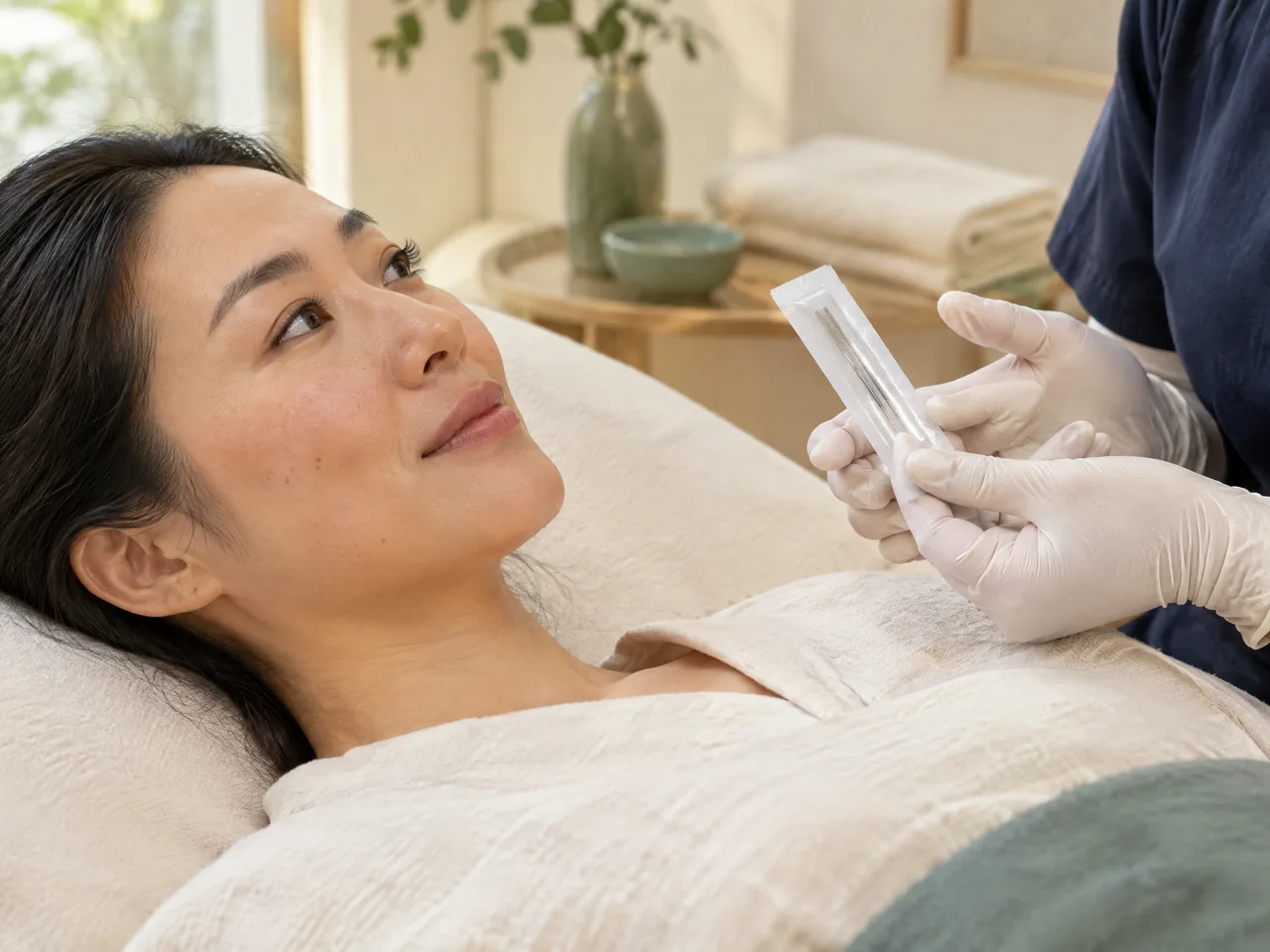
For facial acupuncture, an intact and appropriately assessed treatment area matters. Acupuncture is not risk-free merely because the needles are fine: the U.S. National Center for Complementary and Integrative Health states that complications can result from nonsterile needles or improper delivery, and that acupuncture needles should be sterile and single-use [4]. Do not needle a site that is infected, visibly broken or producing pus. Tell the practitioner if you have fainted with needling before, take medicines that may affect bleeding, are pregnant, or have a medical condition that could alter the plan. If symptoms are severe or spreading, seek medical care promptly rather than waiting for a cosmetic consultation.
Acne Scar Types, Atrophic Acne Scars and Facial Acupuncture for Acne Scars: Realistic Next Steps
Realistic next steps begin with matching the concern to the right kind of support. A person with smooth, flat colour change may chiefly need guidance about active acne prevention, gentle routine choices and time. A person whose main concern is a clear depression, raised tissue or mixed scarring may benefit from dermatology input about options selected for scar type, depth, location and skin characteristics. DermNet describes scar management as individualised and notes that more than one treatment type may be used for colour, texture and volume [1]. No single consultation should be framed as a guarantee that every acne mark will disappear.

Facial acupuncture for acne scars may be discussed after assessment as part of local skin management, not as a replacement for medical care of active or infected acne and not as a claim to reconstruct lost tissue. Ask what area would be considered, why it is appropriate at that time, how the skin will be kept clean, and what signs mean you should pause and seek medical assessment. The useful outcome of a first conversation may simply be a clearer classification of marks, an agreed priority, and a plan to review response rather than a promise attached to a fixed number of sessions.

Acne Scar Types, Atrophic Acne Scars and Facial Acupuncture for Acne Scars: What a Consultation Covers
A careful consultation can look at colour, texture, location and whether the skin is currently inflamed. It can also cover previous treatments, current products, relevant medical history and any tendency to bruise or faint. If facial acupuncture is considered suitable, the practitioner should explain the proposed local approach and give you room to ask questions before proceeding. A typical acupuncture safety discussion includes the use of sterile, single-use needles and reporting unexpected discomfort. It should not imply that the procedure has a guaranteed effect on red marks, pigmentation or atrophic scars. Clear information lets you decide whether local care fits your priorities.
It is reasonable to ask when a dermatology assessment should happen first. This is especially important for deep pitted scars, substantial raised scars, persistent painful lesions, unclear diagnoses, or acne that continues despite prior treatment. You can also ask whether recently performed procedures change the appropriate timing of needling. For example, if this applies to you, discuss facial acupuncture after Botox openly rather than assuming that aesthetic treatments are interchangeable. Bring any aftercare instructions from another clinician so plans can be coordinated safely.

Acne Scar Types, Atrophic Acne Scars and Facial Acupuncture for Acne Scars: Safety and Expectations
Set expectations around observation, not a countdown to perfect skin. Natural fading, changes in lighting, new breakouts and changes in skincare can all affect what you see in the mirror. Keep notes on new lesions, soreness, itch, redness and product reactions rather than judging the skin every hour. Stop and seek clinical advice if redness spreads rapidly, an area becomes increasingly hot or painful, there is significant discharge, or you feel unwell with fever. These are not situations to treat as routine marks. A practitioner can help you decide when local acupuncture discussion is appropriate and when another service should take priority.
TCM Lab Hong Kong can discuss your history and whether an in-person assessment is appropriate at its Prince Edward or Kwun Tong locations. The conversation should remain centred on your actual skin pattern and safety, not on an assumed result. For a related decision guide, see Is facial acupuncture suitable for acne scars?. When you enquire, say whether you have active acne, open skin, recent procedures, current medication and any concern about pitted or raised texture. That preparation supports a more useful, honest discussion of the next step.
Care and health guide
Facial acupuncture information
This directory brings together services, reading, and visit information related to facial acupuncture, to help you prepare questions for a consultation.
When exploring facial acupuncture, noting the service-arrangement questions you want to discuss can help prepare a consultation; facial acupuncture Hong Kong is a relevant service or reading entry point.
People may have different priorities, and acupuncture Hong Kong offers related information to help you understand options and prepare questions.

Your questions, answered
Frequently asked questions
What are the main acne scar types?
The main structural patterns are depressed atrophic scars and raised scars. Atrophic acne scars include ice-pick, boxcar and rolling patterns. Acne can also leave flat post-inflammatory redness or hyperpigmentation; these are colour changes and may occur with or without structural scarring.
Can facial acupuncture for acne scars remove atrophic acne scars?
Facial acupuncture for acne scars cannot be guaranteed to remove marks or repair depressed structural scars. It may be discussed as part of local skin management after an individual assessment, but a persistent pit or raised scar may need dermatology assessment for options tailored to that scar type.
Should active acne be controlled before facial acupuncture for acne scars?
Yes. Active inflammation, pus, infection and broken skin should be assessed and managed before local needling is considered. Treating active acne first helps reduce ongoing inflammation and makes a later discussion about marks or scars clearer.
What should I bring to an acne-mark or scar consultation?
Bring a timeline of acne and marks, a list of skincare products and medicines, information about previous laser, peel or other procedures, and any history of fainting with needles or abnormal scarring. Say whether the issue is colour, dents, raised tissue, active breakouts or a mixture.
Sources and further information
- [1] DermNet: Acne scarring
Referenced for: Supports terminology for post-inflammatory colour changes, atrophic scar patterns, raised scars, active-acne sequencing and the need for individualised scar management.
- [2] American Academy of Dermatology: Acne diagnosis and treatment
Referenced for: Supports the need to distinguish acne types and the linked goals of clearing acne, preventing new breakouts and preventing scars.
- [3] CUHK Integrative Medical Centre: Chinese Medicine for Skin Condition Improvement Program
Referenced for: Supports local terminology for individualised Chinese-medicine consultation and acupuncture in a skin-related service context; it is not evidence that acupuncture repairs scars.
- [4] National Center for Complementary and Integrative Health: Acupuncture
Referenced for: Supports the safety statements about sterile single-use needles and risks from nonsterile needles or improper delivery.