
TCM Lab · Health reading
Is acupuncture better than physiotherapy for tennis elbow? A careful comparison
Published Updated
Acupuncture is not proven to be better than physiotherapy for tennis elbow in every person or at every stage. The more useful question is whether the pain has been assessed as lateral epicondylitis, what you need your arm to do, and which part of care is currently missing. Acupuncture may be discussed as one option for symptom management, but the available studies do not establish that it outperforms a personalised rehabilitation plan for durable function. Physiotherapy commonly centres on understanding painful tasks, adjusting load and building forearm capacity. An assessment can help put those approaches together safely rather than treating pain relief during one session as proof that the tendon has recovered.
Appointments are confirmed through WhatsApp. If you have language requirements, please mention them in your enquiry.
The short answer
No. Current evidence does not reliably show that acupuncture is better than physiotherapy for tennis elbow. The acupuncture studies mainly involve adults with confirmed lateral epicondylitis and compare needles with sham treatment, medicines or local injections—not a tailored physiotherapy programme. Some results suggest short-term symptom change, but sham comparisons, long-term follow-up, functional outcomes and safety reporting are limited. Confirm the pain source, then discuss activity load, rehabilitation and acupuncture in relation to your goals.
Transparent pricing
See the fees.
Choose your care.
Explore our complete official price list, including first-trial prices, regular prices, packages and branch-specific options.
Opening WhatsApp prepares an enquiry; it does not send a message, take payment or confirm an appointment. Suitability and individual arrangements are confirmed during consultation.
Pain care
All prices in HKDExtracorporeal shockwave treatment
Shockwave treatment for deep-tissue and fascial care. The Kwun Tong clinic offers the multi-area options shown below.
Priced by branch
Branch-specific pricing
Prince Edward: HK$250 per area
Kwun Tong: HK$250 for 1 area / HK$450 for 2 areas / HK$600 for 3 areas
Pain care (manual therapy)
Includes Chinese medicine musculoskeletal assessment, manual joint techniques and tui na.
HK$580 (single session)
Chinese medicine musculoskeletal assessment
Pain care (acupuncture and manual therapy)
Combines acupuncture and manual therapy.
HK$680 (single session)
Combined care
Hair and scalp
All prices in HKDScalp health and hair-loss management
Includes AI scalp analysis, deep scalp and follicle cleansing, and scalp oil-control care.
HK$380 (first trial)
Regular price: HK$680
- 6 sessions: HK$3,480 (HK$580 per session)
- 12 sessions: HK$5,760 (HK$480 per session)
- 20 sessions: HK$8,600 (HK$430 per session)
- 30 sessions: HK$11,400 (HK$380 per session)
Hair acupuncture and Chinese herbal medicine package
Includes scalp acupuncture and 3 days of Chinese herbal medicine that does not require decoction.
HK$580 (single session)
Registered Chinese Medicine Practitioner consultation
- 6 sessions: HK$3,180 (HK$530 per session)
- 12 sessions: HK$5,760 (HK$480 per session)
- 20 sessions: HK$8,600 (HK$430 per session)
- 30 sessions: HK$11,400 (HK$380 per session)
Combined hair and scalp treatment
Combines acupuncture and Chinese herbal medicine with salon-level scalp and follicle care. Packages include complimentary hair-care shampoo and serum.
HK$1,260 (single session)
Combined treatment
- 8 sessions: HK$8,640 (HK$1,080 per session)
- 16 sessions: HK$15,680 (HK$980 per session)
- 20 sessions: HK$18,600 (HK$930 per session)
- 30 sessions: HK$26,400 (HK$880 per session)
Weight management
All prices in HKDFull-body acupoint embedding for weight management
Includes full-body acupoint embedding. Packages include complimentary Chinese herbal medicine for weight management, with the number of included days scaled to the package. Embedding material and the individual treatment arrangement are confirmed during consultation; this is not a cosmetic thread lift.
HK$980 (single session)
No trial session
- 10 sessions: HK$7,800 (HK$780 per session)
- 20 sessions: HK$14,600 (HK$730 per session)
- 30 sessions: HK$20,400 (HK$680 per session)
Facial acupuncture
All prices in HKDFacial acupuncture (basic)
Includes facial acupuncture and meridian-based facial care, including care for facial puffiness.
HK$480 (first trial)
Regular price: HK$680
- 10 sessions: HK$5,200 (HK$520 per session)
- 20 sessions: HK$9,600 (HK$480 per session)
- 30 sessions: HK$13,500 (HK$450 per session)
Facial acupuncture (advanced)
Includes enhanced facial acupuncture with a specially formulated moisturising mask and serum.
HK$780 (first trial)
Regular price: HK$1,180
- 10 sessions: HK$9,000 (HK$900 per session)
- 20 sessions: HK$16,600 (HK$830 per session)
- 30 sessions: HK$23,400 (HK$780 per session)
Chinese medicine
All prices in HKDAcupuncture and Chinese herbal medicine package
Includes a Chinese medicine consultation with pulse assessment, body acupuncture and 3 days of Chinese herbal granules that do not require decoction.
HK$580 (single session)
Chinese medicine consultation with pulse assessment
Is acupuncture better than physiotherapy for tennis elbow? Start with the diagnosis
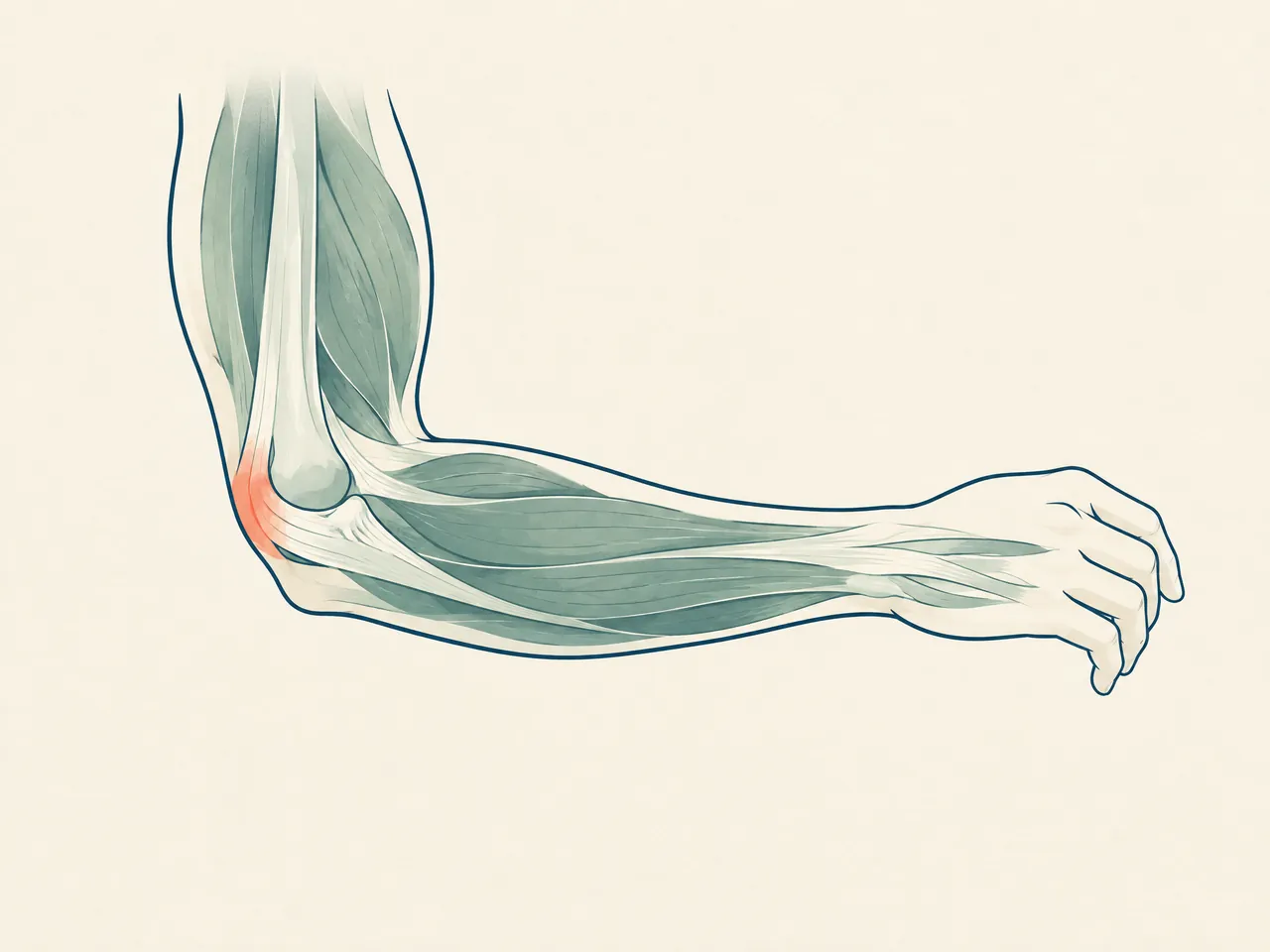
Before comparing treatments, clarify what ‘tennis elbow’ means in your case. Lateral epicondylitis is pain and tenderness around the outer elbow that can be linked with repeated use of the forearm and wrist. Holding a racquet, turning a tool, shaking hands, lifting a pan or gripping a laptop bag may aggravate it. Weak grip and pain on the outside of the elbow are common patterns, but they are not a diagnosis by themselves. A clinician usually asks how symptoms began, which tasks bring them on, whether there was an injury and where tenderness is felt. The American Academy of Orthopaedic Surgeons describes this history and examination as central to identifying lateral epicondylitis and ruling out other contributors. [3]
That starting point changes a treatment comparison. Physiotherapy is not one fixed procedure: it can involve assessment, advice on temporarily changing an aggravating task, and exercises selected for the person’s movement and capacity. Acupuncture is also not a single, standard protocol in research. For a wider introduction to the question of does acupuncture help elbow pain, keep the limits of the diagnosis in view. An outer-elbow pattern may justify a discussion of tennis elbow; it does not automatically tell you whether needles, rehabilitation, medication, a brace or another approach is appropriate today.
Is acupuncture better than physiotherapy for tennis elbow? Not every elbow pain is tennis elbow
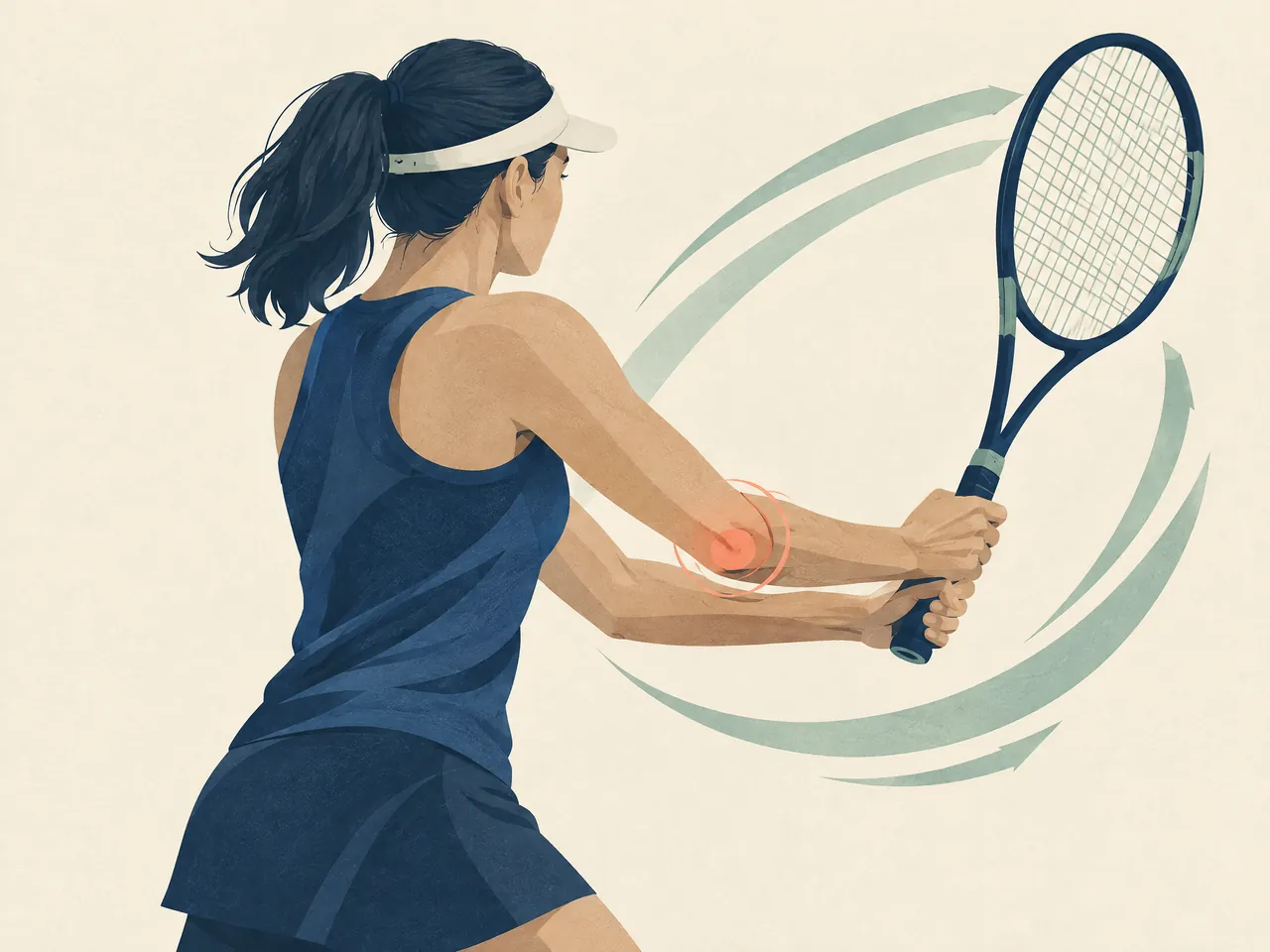
Pain at or near the elbow can arise in more than one situation. NHS guidance lists possibilities including tendon problems, bursitis, sprains or strains, arthritis and joint infection, while arm pain may also need consideration after an injury or alongside neurological symptoms. [2] Pain on the inner elbow, at the point of the elbow, spreading from the neck or shoulder, or accompanied by altered sensation does not simply become lateral epicondylitis because gripping hurts. That is why a comparison based on the phrase ‘tennis elbow’ can be misleading before assessment. If you are wondering Can acupuncture repair an elbow injury?, first establish whether there is an injury that needs medical investigation rather than assuming a tendon complaint.
Is acupuncture better than physiotherapy for tennis elbow? Why the pain source matters
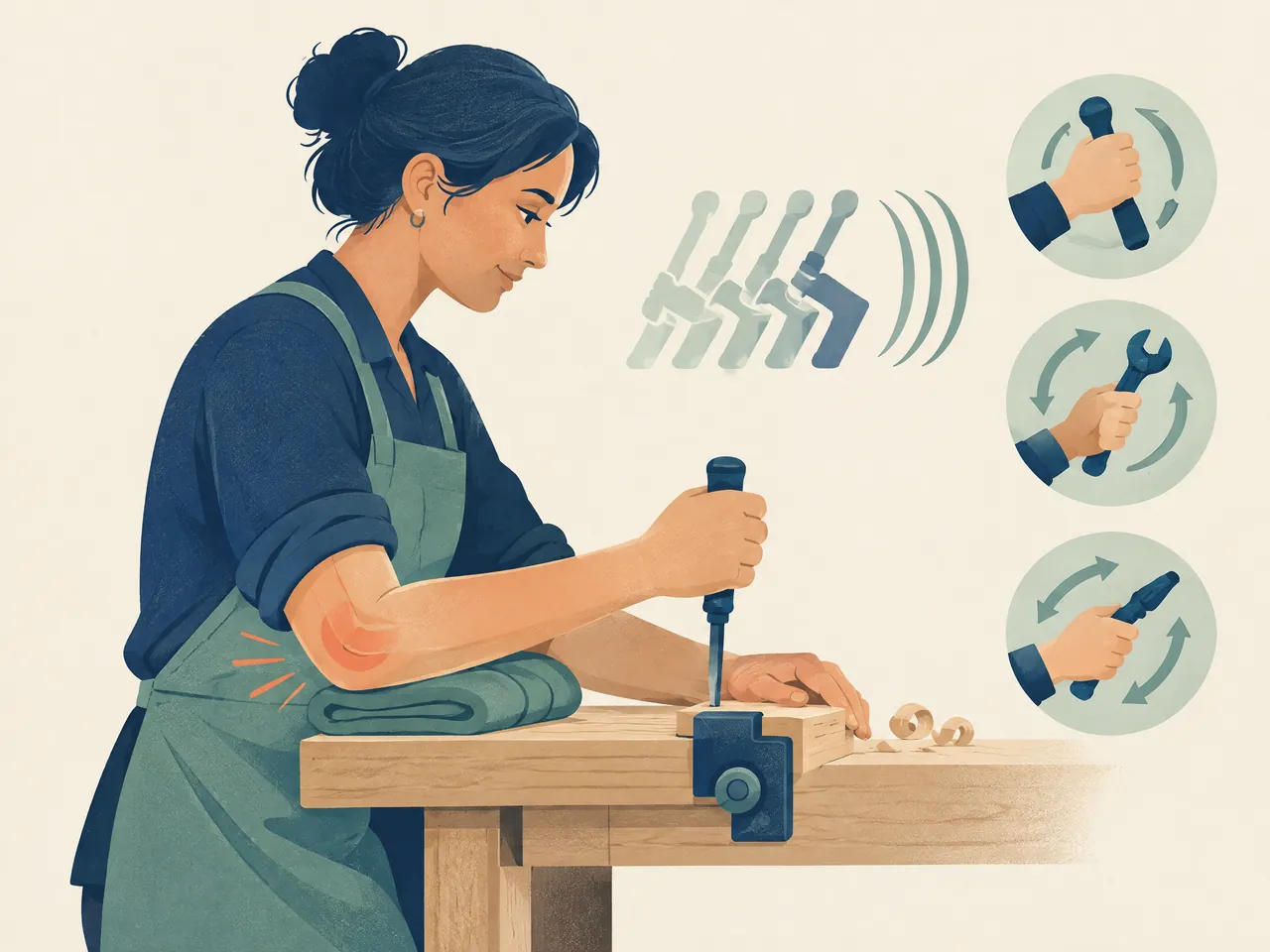
Knowing the likely source helps define a sensible goal. If a confirmed outer-elbow tendon problem is aggravated by repeated wrist or hand work, the conversation may include how to reduce the provoking load for a period, how to reintroduce it gradually and how to measure useful change. Pain relief alone may matter, especially when sleep or a work shift is difficult, but it is only one outcome. Being able to pour a kettle, use a mouse, open a jar or complete a shift with a more manageable response gives a clearer picture. A treatment that feels helpful immediately is not automatically superior if grip, confidence and task tolerance do not move with it. That distinction is useful when considering Is acupuncture suitable for elbow pain?.
Compare your options
| Question to bring | What acupuncture evidence can and cannot answer | What a physiotherapy-focused discussion can address |
|---|---|---|
| Is this definitely lateral epicondylitis? | Research mainly concerns adults with confirmed lateral epicondylitis; it does not diagnose the cause of your elbow pain. [1] | Assessment of symptom pattern, aggravating tasks, movement and whether another cause needs referral. |
| What does short-term relief mean? | Some study comparisons suggest symptom change, but sham results were variable and do not prove durable superiority. [1] | How symptoms respond while task load, movement and exercise choices are adjusted over time. |
| What outcome matters at work or home? | Function was reported inconsistently in the trials, so a treatment-session pain change is not enough to show recovery. [1] | A relevant task such as gripping, carrying, keyboard work or sport can be selected and tracked. |
| What needs checking before treatment? | The review had limited safety reporting; treatment should not replace assessment of new or concerning symptoms. [1] | Injury history, altered sensation, load demands and whether medical assessment is needed can shape the plan. |
| Can both be discussed? | The evidence does not settle a universal winner, so acupuncture may be discussed as one option without claiming it replaces rehabilitation. | Education, activity adjustment and strengthening can be tailored; coordination with other care can be discussed when appropriate. |
On smaller screens, scroll the table sideways to compare all columns.
Is acupuncture better than physiotherapy for tennis elbow? Read the evidence carefully
The short answer remains cautious because the research does not answer a clean acupuncture-versus-physiotherapy question. A systematic review of randomised trials in lateral epicondylitis grouped acupuncture or electroacupuncture against sham acupuncture, medicines and local ‘blocking’ injections. [1] Those are different comparisons with different expectations, so they cannot be combined into a verdict that acupuncture beats every rehabilitation programme. In particular, a medication comparison does not tell you how acupuncture performs beside education, load modification and progressive exercise planned after an examination. That gap is important for anyone choosing between care routes rather than simply seeking a short-term change in pain.
The review found that study methods and acupuncture protocols varied. It also reported incomplete details on randomisation, allocation concealment and blinding in many trials. Follow-up was absent or inconsistent in most studies, and only a small number reported elbow function using different scales. [1] These are not minor technicalities: they affect how confidently a reader can apply a result to their own hand use, occupation and recovery timeline. The evidence is a reason to have a measured discussion, not a reason to promise that acupuncture will repair a tendon or deliver the same result for each person.
Is acupuncture better than physiotherapy for tennis elbow? What comparisons actually tested
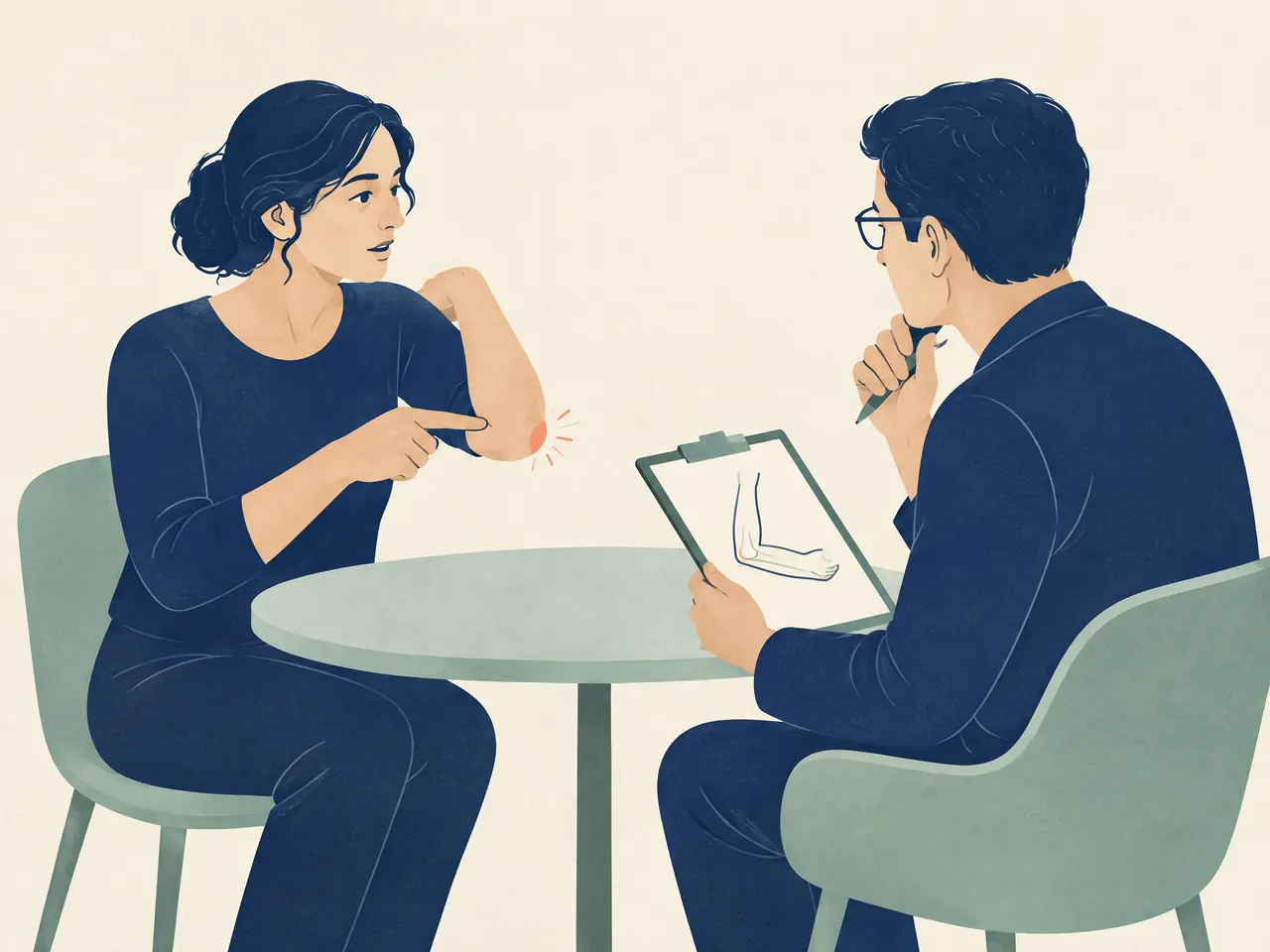
In the sham-acupuncture subgroup, the pooled results were highly heterogeneous and did not show a statistically clear difference for the outcomes reported. [1] That does not mean nobody notices a symptom change; it means the studies do not give a reliable, uniform answer about benefit beyond a sham comparison. The medicine and injection comparisons in the review are also not a proxy for physiotherapy, because they tested particular alternatives rather than an individual rehabilitation plan. When reading claims about acupuncture for elbow pain, ask what the comparison group actually received, whether participants had confirmed lateral epicondylitis, and whether the outcome was pain, function, grip or return to a task. Those details keep a headline from deciding more than the study can support.

Is acupuncture better than physiotherapy for tennis elbow? Short-term relief versus lasting function
A lower pain score after treatment may make daily activity easier, but it is not a direct measure of tissue repair or lasting capacity. The acupuncture review could not assess functional recovery comprehensively because relatively few trials reported it and the measures differed. It also found that adverse effects and complications were reported too sparsely for meaningful analysis. [1] Physiotherapy discussions often return to function because the goal is practical: a comfortable enough grip, a manageable lift, a return to a hobby or less disruption at work. If you are considering acupuncture for tennis elbow, it can be reasonable to decide in advance which one or two tasks will show whether the wider plan is helping, rather than judging only the feeling immediately after needling.
Is acupuncture better than physiotherapy for tennis elbow? Plan a safer discussion
A useful appointment discussion is less about choosing a winning label and more about matching options to the current problem. Bring a short account of the painful activity, whether symptoms started after a distinct injury or gradually, where pain is located, and what has already been tried. Mention medicines, blood-thinning treatment, health conditions, previous reactions and any new numbness or weakness. Acupuncture is not risk-free: the U.S. National Center for Complementary and Integrative Health notes that complications can occur with nonsterile needles or improper delivery and advises people not to delay appropriate health care. [4] That is a practical reason to share the whole picture, not to treat acupuncture as either automatically harmless or automatically unsuitable.

Is acupuncture better than physiotherapy for tennis elbow? Track movement, grip and daily tasks
Make the comparison personal and observable. Choose a repeatable task that matters: carrying a grocery bag, lifting a saucepan, using a screwdriver, clicking through a workday or holding a racquet. Note the task, the outer-elbow symptoms during it, and how the arm feels later that day or the next morning. You need not force a painful test; the purpose is to describe the pattern clearly. Pair that record with the changes in workload, tool position, breaks or exercises you have made. It gives a physiotherapist, doctor or registered Chinese medicine practitioner something more useful than a single pain rating. An assessment conversation can be requested at the Kwun Tong Chinese medicine clinic or the Chinese medicine clinic Prince Edward by appointment.

Is acupuncture better than physiotherapy for tennis elbow? When to seek medical assessment
Do not wait for a routine treatment comparison if the arm has severe pain and is difficult to move, an injury caused a snapping sound or change in shape, or there is tingling or numbness; NHS guidance recommends urgent assessment for these situations. Swelling with a high temperature, or feeling hot, cold or shivery, also needs prompt advice. [2] Sudden arm pain with pressure, heaviness or squeezing in the chest is an emergency pattern, not a tennis-elbow question. For pain that persists for weeks, changes in grip, movement or symptoms should be assessed rather than managed by repeatedly increasing treatments. A careful assessment can also identify when a different service, investigation or rehabilitation approach should take priority.
Care and health guide
Health service information
This directory brings together services, reading, and visit information related to health services, to help you prepare questions for a consultation.
If you are organising health questions, Chinese medicine clinic Hong Kong is a starting point for learning about related services and preparing for a consultation.
People have different needs; acupuncture Hong Kong provides further reading to help you understand options in your own context.


Your questions, answered
Frequently asked questions
Is acupuncture better than physiotherapy for tennis elbow if I need quick pain relief?
Not necessarily. Some acupuncture comparisons reported symptom changes, but the review does not establish that acupuncture is better than tailored physiotherapy for durable function. Decide with a clinician what needs to improve now and which task will show meaningful progress. [1]
Can I assume outer-elbow pain is tennis elbow?
Does acupuncture research prove tendon repair for tennis elbow?
No. The studies assessed outcomes such as pain and clinical response. Their limited and inconsistent functional reporting does not prove tendon repair, full strength restoration or prevention of recurrence. [1]
Should I stop rehabilitation if acupuncture feels helpful?
Sources and further information
- [1] [1] Jia et al., Effectiveness of Acupuncture for Lateral Epicondylitis: systematic review and meta-analysis
Referenced for: Supports the description of the included comparisons, sham-comparison uncertainty, methodological limitations, limited functional data and inadequate adverse-event reporting for acupuncture trials in lateral epicondylitis.
- [2] [2] NHS, Elbow and arm pain
Referenced for: Supports the non-diagnostic symptom framing, possible causes, persistent-pain advice and urgent warning signs for elbow and arm pain.
- [3] [3] American Academy of Orthopaedic Surgeons, Tennis Elbow (Lateral Epicondylitis)
Referenced for: Supports the description of lateral epicondylitis, examination context, activities that can aggravate symptoms and the role of nonsurgical rehabilitation discussions.
- [4] [4] National Center for Complementary and Integrative Health, Acupuncture: Effectiveness and Safety
Referenced for: Supports the general safety caution that improper or nonsterile acupuncture delivery can cause complications and that complementary care should be discussed with health care providers.