
TCM Lab · Health reading
What Causes Pain Between the Shoulder Blades? Can Acupuncture Help Pain Between the Shoulder Blades? Can I Have Acupuncture for Upper Back Pain with a Slipped Disc?
Published Updated
A tight, aching or sharp feeling between the shoulder blades can follow a long day at a screen, repeated lifting, an unfamiliar workout or a minor strain, but it is not one diagnosis. The area includes muscles, ribs, shoulder-blade attachments and the thoracic spine. Pain can also be felt there when the source is elsewhere in the body. Acupuncture may be worth discussing for some non-urgent pain presentations after assessment, but it cannot identify the cause or replace care for chest symptoms, breathing difficulty, trauma or neurological changes.
Appointments are confirmed through WhatsApp. If you have language requirements, please mention them in your enquiry.

The short answer
Pain between the shoulder blades may involve muscle or soft-tissue strain, repetitive load, the thoracic spine, ribs or shoulder structures; less commonly, it may be referred from inside the body. Acupuncture has evidence for some back- or neck-pain conditions, not for every cause of upper-back pain. If a slipped disc is suspected, or if there is weakness, numbness, chest pain or breathing trouble, obtain appropriate medical assessment first. Acupuncture can then be discussed as an adjunct where suitable.
Transparent pricing
See the fees.
Choose your care.
Explore our complete official price list, including first-trial prices, regular prices, packages and branch-specific options.
Opening WhatsApp prepares an enquiry; it does not send a message, take payment or confirm an appointment. Suitability and individual arrangements are confirmed during consultation.
Pain care
All prices in HKDExtracorporeal shockwave treatment
Shockwave treatment for deep-tissue and fascial care. The Kwun Tong clinic offers the multi-area options shown below.
Priced by branch
Branch-specific pricing
Prince Edward: HK$250 per area
Kwun Tong: HK$250 for 1 area / HK$450 for 2 areas / HK$600 for 3 areas
Pain care (manual therapy)
Includes Chinese medicine musculoskeletal assessment, manual joint techniques and tui na.
HK$580 (single session)
Chinese medicine musculoskeletal assessment
Pain care (acupuncture and manual therapy)
Combines acupuncture and manual therapy.
HK$680 (single session)
Combined care
Hair and scalp
All prices in HKDScalp health and hair-loss management
Includes AI scalp analysis, deep scalp and follicle cleansing, and scalp oil-control care.
HK$380 (first trial)
Regular price: HK$680
- 6 sessions: HK$3,480 (HK$580 per session)
- 12 sessions: HK$5,760 (HK$480 per session)
- 20 sessions: HK$8,600 (HK$430 per session)
- 30 sessions: HK$11,400 (HK$380 per session)
Hair acupuncture and Chinese herbal medicine package
Includes scalp acupuncture and 3 days of Chinese herbal medicine that does not require decoction.
HK$580 (single session)
Registered Chinese Medicine Practitioner consultation
- 6 sessions: HK$3,180 (HK$530 per session)
- 12 sessions: HK$5,760 (HK$480 per session)
- 20 sessions: HK$8,600 (HK$430 per session)
- 30 sessions: HK$11,400 (HK$380 per session)
Combined hair and scalp treatment
Combines acupuncture and Chinese herbal medicine with salon-level scalp and follicle care. Packages include complimentary hair-care shampoo and serum.
HK$1,260 (single session)
Combined treatment
- 8 sessions: HK$8,640 (HK$1,080 per session)
- 16 sessions: HK$15,680 (HK$980 per session)
- 20 sessions: HK$18,600 (HK$930 per session)
- 30 sessions: HK$26,400 (HK$880 per session)
Weight management
All prices in HKDFull-body acupoint embedding for weight management
Includes full-body acupoint embedding. Packages include complimentary Chinese herbal medicine for weight management, with the number of included days scaled to the package. Embedding material and the individual treatment arrangement are confirmed during consultation; this is not a cosmetic thread lift.
HK$980 (single session)
No trial session
- 10 sessions: HK$7,800 (HK$780 per session)
- 20 sessions: HK$14,600 (HK$730 per session)
- 30 sessions: HK$20,400 (HK$680 per session)
Facial acupuncture
All prices in HKDFacial acupuncture (basic)
Includes facial acupuncture and meridian-based facial care, including care for facial puffiness.
HK$480 (first trial)
Regular price: HK$680
- 10 sessions: HK$5,200 (HK$520 per session)
- 20 sessions: HK$9,600 (HK$480 per session)
- 30 sessions: HK$13,500 (HK$450 per session)
Facial acupuncture (advanced)
Includes enhanced facial acupuncture with a specially formulated moisturising mask and serum.
HK$780 (first trial)
Regular price: HK$1,180
- 10 sessions: HK$9,000 (HK$900 per session)
- 20 sessions: HK$16,600 (HK$830 per session)
- 30 sessions: HK$23,400 (HK$780 per session)
Chinese medicine
All prices in HKDAcupuncture and Chinese herbal medicine package
Includes a Chinese medicine consultation with pulse assessment, body acupuncture and 3 days of Chinese herbal granules that do not require decoction.
HK$580 (single session)
Chinese medicine consultation with pulse assessment
What Causes Pain Between the Shoulder Blades? Can Acupuncture Help Pain Between the Shoulder Blades? Can I Have Acupuncture for Upper Back Pain with a Slipped Disc? — common causes and assessment
The first useful question is not simply whether the spot hurts, but how it started and what comes with it. Upper-back pain covers the area from the base of the neck to the lower edge of the rib cage, including the thoracic spine. A sore band after carrying a bag, reaching repeatedly, rowing, housework or hours of computer work may fit a load-related muscle or soft-tissue problem. Pain that is linked to a shoulder movement can also involve the shoulder-blade region rather than the spine alone. The same location does not guarantee the same cause for two people. shoulder pain with limited movement is a separate pattern worth describing clearly rather than calling all discomfort “upper-back pain.”
A brief symptom record can make an assessment more useful. Write down whether the pain was sudden or gradual, sharp or dull, constant or intermittent, and whether turning your neck, taking a deep breath, sitting, lying down or lifting changes it. Include recent falls, new training, long journeys and any previous spine diagnosis. Cleveland Clinic notes that upper-back pain may arise from muscles, the spine, shoulder blades and structures inside the body; it also describes referred pain, where pain is felt away from its source. [2] That is why an assessment should look beyond one tender point.

What Causes Pain Between the Shoulder Blades? Can Acupuncture Help Pain Between the Shoulder Blades? Can I Have Acupuncture for Upper Back Pain with a Slipped Disc? — muscles, thoracic spine and referred pain
Muscles between the shoulder blades can feel painful after doing more than usual, sustaining an awkward position or returning to activity after a quiet period. The joints where ribs meet the spine, the thoracic vertebrae and the tissues around the shoulder blade can also produce symptoms in this region. Osteoarthritis, inflammatory conditions, spinal curvature, fractures and nerve compression are among the broad categories clinicians may consider, depending on history and examination. It is more accurate to say that pain is located between the shoulder blades than to assume that a knot, posture or a “pinched nerve” is the explanation.
A slipped or herniated disc means disc material has moved beyond its usual boundary. It can occur in different parts of the spine, and the relevance of that finding depends on its level, symptoms and clinical assessment. Upper-back pain alone does not prove a slipped disc. Conversely, a person already told they have a disc problem should not assume that every new ache is from it. Pain travelling around the chest, altered sensation, loss of strength or a change after trauma deserves medical attention. For a wider discussion of non-urgent options, read acupuncture for upper back pain alongside an individual assessment.
What Causes Pain Between the Shoulder Blades? Can Acupuncture Help Pain Between the Shoulder Blades? Can I Have Acupuncture for Upper Back Pain with a Slipped Disc? — symptoms that need medical attention
Do not book a complementary treatment first if the pain comes with chest pain, trouble breathing, faintness or other symptoms that might point to a heart or lung emergency. These symptoms need urgent medical help. Sudden severe pain after a significant injury, or pain that is rapidly worsening, should also be assessed promptly. Referred pain can sometimes come from the heart, lungs or digestive tract, and it may not feel like an ordinary pulled muscle. The absence of a clear injury is information to share, not a reason to dismiss the symptom.
Seek prompt medical advice for new tingling or numbness, increasing muscle weakness, difficulty walking, fever, unexplained weight loss, or changes in bladder or bowel control. Emergency assessment is needed for weakness or paralysis in the legs or loss of bladder or bowel control. [2] A clinician may decide whether examination, imaging or another pathway is appropriate. The practical question when should I see a doctor for upper back pain is especially important when symptoms are new, persistent or accompanied by these warning signs.
Compare your options
| Pattern or context | Details worth noting | Appropriate next step | Why acupuncture should not be the first decision |
|---|---|---|---|
| After a new activity or prolonged position | Onset, task, exact spot, movement that changes it and whether it settles with rest | Arrange a non-urgent clinical or acupuncture discussion if there are no warning signs | The pain may be load-related, but a consultation still needs the history rather than an assumption |
| Known or suspected slipped disc | Where the diagnosis came from, pain spread, numbness, weakness and any activity advice already given | Follow the clinician managing the condition; ask whether an adjunct is suitable | Needling cannot diagnose the disc or replace advice for nerve or spinal symptoms |
| Pain without a clear injury | Breathing, chest symptoms, fever, weight change, timing and other body symptoms | Seek medical assessment, urgently when chest pain or breathing difficulty is present | Referred pain is possible and needs consideration before treating the site of pain |
| New neurological symptoms or major trauma | Weakness, altered sensation, walking changes, bladder or bowel changes, and injury details | Obtain urgent medical care | Possible nerve, spinal-cord or fracture concerns require medical assessment first |
On smaller screens, scroll the table sideways to compare all columns.
What Causes Pain Between the Shoulder Blades? Can Acupuncture Help Pain Between the Shoulder Blades? Can I Have Acupuncture for Upper Back Pain with a Slipped Disc? — evidence and realistic expectations
It is reasonable to ask whether acupuncture could help with pain between the shoulder blades, but the answer depends on the problem being treated. The evidence base usually groups people by broader conditions such as back pain or neck pain; it does not establish that every pain pattern in the thoracic or shoulder-blade area responds in the same way. The U.S. National Center for Complementary and Integrative Health reports that acupuncture may be helpful for several pain conditions, including back or neck pain. [1] This supports a conversation about an adjunct, not a promise to repair a structure, remove a disc problem or deliver a fixed recovery time.

Useful goals are personal and measurable without overpromising: perhaps being able to turn comfortably at a desk, sleep in a preferred position, tolerate a commute, or participate in a clinician-recommended rehabilitation plan. It is also reasonable to stop and reassess if symptoms change, worsen or fail to follow the expected course. Activities such as gentle movement, ergonomic changes and physical therapy may be part of medical advice for some non-emergency upper-back problems. [2] An acupuncture discussion should sit within, rather than compete with, that wider plan.
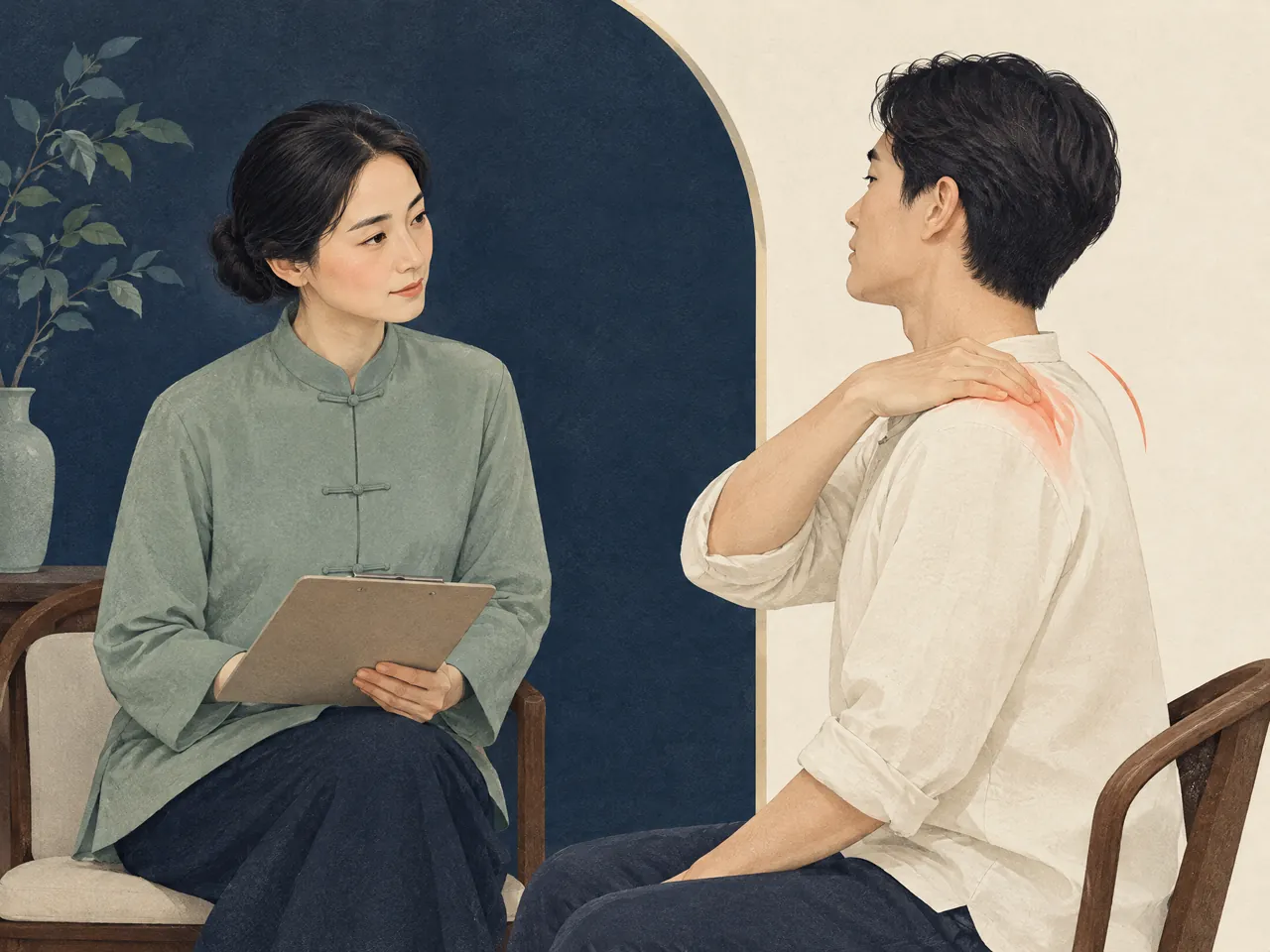
What Causes Pain Between the Shoulder Blades? Can Acupuncture Help Pain Between the Shoulder Blades? Can I Have Acupuncture for Upper Back Pain with a Slipped Disc? — what research can and cannot show
Research comparisons matter. NCCIH summarises a review in which acupuncture outperformed no treatment and sham acupuncture for back or neck pain, but the difference versus no treatment was larger than the difference versus sham acupuncture. [1] This is one reason not to turn general back-pain evidence into certainty for pain between the shoulder blades, a newly painful thoracic disc or an individual result. Studies also differ in the people included, treatment methods, duration and outcomes measured.
Acupuncture is a technique involving fine needles placed through the skin. It can be used as a nondrug option for a pain discussion, but it is not evidence that a symptom has a harmless cause. It cannot confirm a diagnosis, substitute for emergency care or guarantee that a damaged tissue has healed. If a diagnosis such as a slipped disc has already been raised, ask the clinician managing that condition what activity limits, investigations or treatments are needed. Then ask whether acupuncture is compatible with the plan, rather than treating it as an alternative to the plan.

What Causes Pain Between the Shoulder Blades? Can Acupuncture Help Pain Between the Shoulder Blades? Can I Have Acupuncture for Upper Back Pain with a Slipped Disc? — discussing an adjunctive option
A non-urgent acupuncture conversation should begin with the timeline, diagnosis if known, current care and personal goals. Bring information about prior scans or reports only if they are available; a scan result without current symptoms and examination does not by itself decide treatment. Say whether the pain spreads to an arm, the chest or around the ribs; whether coughing or deep breathing affects it; and which work, sport or home tasks are limited. These details help distinguish a focused pain-management conversation from one that needs medical referral first. You may also wish to explore Can acupuncture help upper back pain? before deciding what to ask.
During a consultation, clarify what acupuncture is intended to complement and how progress would be reviewed. Do not equate temporary relief after any treatment with a diagnosis or a cure. If another professional has advised rehabilitation, medicines or a period away from certain activities, tell the practitioner. A sensible plan leaves room to return to the treating clinician if red flags develop or function declines. For a Hong Kong enquiry, the most helpful first message is a short description of the pain pattern, any diagnosed condition and whether warning symptoms have been medically assessed.
What Causes Pain Between the Shoulder Blades? Can Acupuncture Help Pain Between the Shoulder Blades? Can I Have Acupuncture for Upper Back Pain with a Slipped Disc? — safety and next steps
Safety starts before needle insertion. Tell the practitioner about all current symptoms, a suspected or confirmed disc condition, recent injury, pregnancy, bleeding tendencies, medicines that affect bleeding, implants or devices, infection, allergies and other treatment you are receiving. This information can change whether acupuncture is appropriate, how it is approached or whether you should be referred first. It is also useful to state plainly if you have been advised to seek emergency or specialist care. A treatment discussion should never delay that care.
For non-urgent questions, choose a practitioner who can explain the proposed role of treatment, listen to your history and answer questions about hygiene and follow-up. You can ask what body areas may be involved, what sensations or minor effects might occur, and which symptoms should prompt you to contact a medical clinician. If you are comparing practical arrangements, see the Chinese medicine clinic price list Hong Kong rather than making assumptions about fees or what a consultation includes.

What Causes Pain Between the Shoulder Blades? Can Acupuncture Help Pain Between the Shoulder Blades? Can I Have Acupuncture for Upper Back Pain with a Slipped Disc? — sterile needles, history and risk discussion
Acupuncture needles should be sterile and labelled for single use. NCCIH says that complications have been reported with nonsterile needles and improper delivery, including infections, punctured organs and central nervous system injury. [1] These uncommon but serious possibilities are a reason to discuss safety openly, particularly around the upper back where structures below the skin must be respected. Sterile technique and appropriate training are safeguards, not reasons to ignore a concerning symptom pattern.
Minor soreness, bleeding or bruising where needles enter the skin can occur. Mayo Clinic advises people considering acupuncture to disclose issues such as pregnancy and a pacemaker, especially where electrical stimulation might be used. [3] Ask in advance if you are unsure whether a medicine, medical device or health condition matters. An honest history is more useful than trying to decide alone that an upper-back complaint is “only muscular.”

What Causes Pain Between the Shoulder Blades? Can Acupuncture Help Pain Between the Shoulder Blades? Can I Have Acupuncture for Upper Back Pain with a Slipped Disc? — when to seek urgent care
Urgent medical care takes priority over acupuncture when shoulder-blade pain occurs with chest pain, shortness of breath or other signs of a possible heart or lung problem. It also takes priority after major trauma, or when there is severe or increasing weakness, paralysis, new loss of bladder or bowel control, fever or unexplained weight loss. These are not symptoms to monitor through a course of complementary care. If in doubt, seek medical advice promptly; local emergency services are appropriate for emergency symptoms.
When no urgent warning signs are present and appropriate assessment has not advised against it, you may contact TCM Lab to discuss a non-urgent acupuncture enquiry. You can ask about arrangements at the Kwun Tong Chinese medicine clinic or the Chinese medicine clinic Prince Edward. Include the onset of symptoms, any medical diagnosis and your preferred language needs in a WhatsApp message, so the enquiry can be directed appropriately.
Care and health guide
Shoulder discomfort: care information
This directory brings together services, reading, and visit information related to shoulder discomfort, to help you prepare questions for a consultation.
When shoulder discomfort affects your day, noting when it occurs, its relation to activity, and what you have already tried can help prepare a consultation; acupuncture for shoulder pain is a relevant service or reading entry point.
Individual circumstances differ, and acupuncture Hong Kong offers related information to help you understand options and prepare questions.


Your questions, answered
Frequently asked questions
What causes pain between the shoulder blades?
Possible causes include muscle or soft-tissue strain, repetitive loading, shoulder-blade or rib-related problems, thoracic-spine conditions and referred pain from elsewhere in the body. The start of the pain, what triggers it and accompanying symptoms help determine the next step.
Can acupuncture help pain between the shoulder blades?
Acupuncture may be discussed as an adjunct for some non-urgent back-pain presentations. Evidence on broader back or neck pain does not prove that it will help every pain pattern between the shoulder blades. It should follow appropriate assessment, especially for new or persistent symptoms.
Can I have acupuncture for upper back pain with a slipped disc?
First obtain advice from the clinician assessing or managing the suspected or confirmed disc condition. Tell the acupuncturist about the diagnosis, symptoms, medicines and any activity restrictions. Acupuncture should not replace assessment for numbness, weakness, walking difficulty or bladder or bowel changes.
When is pain between the shoulder blades urgent?
Seek urgent medical help for chest pain, breathing difficulty, symptoms of a possible heart or lung emergency, major trauma, severe or worsening weakness, paralysis, new loss of bladder or bowel control, fever or unexplained weight loss. Do not delay care to try acupuncture first.
What should I tell an acupuncture practitioner about upper-back pain?
Share when it began, what brings it on or eases it, recent injury or activity, pain that spreads, any imaging or diagnosis, medicines, pregnancy, bleeding risks, devices such as a pacemaker and all medical treatment already in progress.
Sources and further information
- [1] [1] National Center for Complementary and Integrative Health — Acupuncture: Effectiveness and Safety
Referenced for: Supports the definition of acupuncture, evidence limits for broader back or neck pain, the role of sham comparisons, and sterile single-use needle safety information. It does not establish benefit for every upper-back condition or a slipped disc.
- [2] [2] Cleveland Clinic — Upper Back Pain
Referenced for: Supports the thoracic-area description, broad causes, referred-pain context, non-emergency care context and urgent warning symptoms.
- [3] [3] Mayo Clinic — Acupuncture
Referenced for: Supports general preparation, sterile disposable needle practice, common minor effects and the importance of disclosing pregnancy, a pacemaker and relevant health history.