
TCM Lab · Health reading
Tennis Elbow Tenderness and Swelling — Tennis Elbow Pain When Moving the Wrist
Published Updated
Tenderness on the outside of the elbow, with discomfort when you grip a mug, turn a key or move your wrist, is a pattern often associated with tennis elbow. Some people also notice mild swelling or pain that tracks into the forearm. The name can be misleading: racquet sport is only one possible contributor. Repeated mouse use, tool work, lifting and twisting can load the same area. Knowing whether pain follows one particular movement can make an assessment conversation more precise. This page explains what that pattern can and cannot tell you, how to reduce avoidable irritation, and when assessment matters.
Appointments are confirmed through WhatsApp. If you have language requirements, please mention them in your enquiry.
The short answer
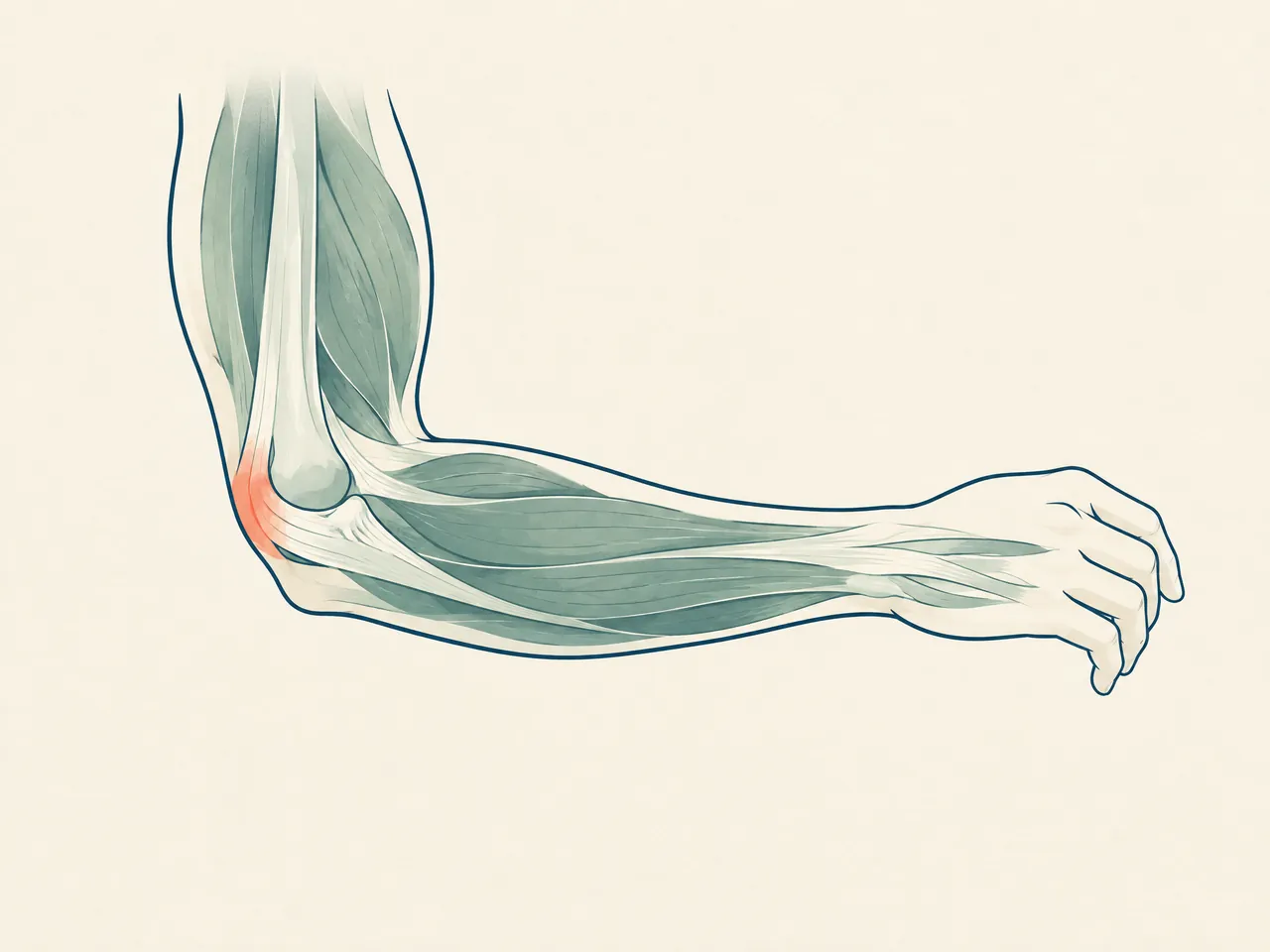
Tennis elbow tenderness and swelling usually sit around the bony outer edge of the elbow. Tennis elbow pain when moving the wrist may be more noticeable during gripping, lifting, turning a handle or repeated forearm use. These clues do not confirm a diagnosis, because joint, nerve and injury-related problems can overlap. Reduce clearly painful loading, use simple comfort measures carefully, and arrange assessment if symptoms are severe, unusual, worsening or not settling.
Transparent pricing
See the fees.
Choose your care.
Explore our complete official price list, including first-trial prices, regular prices, packages and branch-specific options.
Opening WhatsApp prepares an enquiry; it does not send a message, take payment or confirm an appointment. Suitability and individual arrangements are confirmed during consultation.
Pain care
All prices in HKDExtracorporeal shockwave treatment
Shockwave treatment for deep-tissue and fascial care. The Kwun Tong clinic offers the multi-area options shown below.
Priced by branch
Branch-specific pricing
Prince Edward: HK$250 per area
Kwun Tong: HK$250 for 1 area / HK$450 for 2 areas / HK$600 for 3 areas
Pain care (manual therapy)
Includes Chinese medicine musculoskeletal assessment, manual joint techniques and tui na.
HK$580 (single session)
Chinese medicine musculoskeletal assessment
Pain care (acupuncture and manual therapy)
Combines acupuncture and manual therapy.
HK$680 (single session)
Combined care
Hair and scalp
All prices in HKDScalp health and hair-loss management
Includes AI scalp analysis, deep scalp and follicle cleansing, and scalp oil-control care.
HK$380 (first trial)
Regular price: HK$680
- 6 sessions: HK$3,480 (HK$580 per session)
- 12 sessions: HK$5,760 (HK$480 per session)
- 20 sessions: HK$8,600 (HK$430 per session)
- 30 sessions: HK$11,400 (HK$380 per session)
Hair acupuncture and Chinese herbal medicine package
Includes scalp acupuncture and 3 days of Chinese herbal medicine that does not require decoction.
HK$580 (single session)
Registered Chinese Medicine Practitioner consultation
- 6 sessions: HK$3,180 (HK$530 per session)
- 12 sessions: HK$5,760 (HK$480 per session)
- 20 sessions: HK$8,600 (HK$430 per session)
- 30 sessions: HK$11,400 (HK$380 per session)
Combined hair and scalp treatment
Combines acupuncture and Chinese herbal medicine with salon-level scalp and follicle care. Packages include complimentary hair-care shampoo and serum.
HK$1,260 (single session)
Combined treatment
- 8 sessions: HK$8,640 (HK$1,080 per session)
- 16 sessions: HK$15,680 (HK$980 per session)
- 20 sessions: HK$18,600 (HK$930 per session)
- 30 sessions: HK$26,400 (HK$880 per session)
Weight management
All prices in HKDFull-body acupoint embedding for weight management
Includes full-body acupoint embedding. Packages include complimentary Chinese herbal medicine for weight management, with the number of included days scaled to the package. Embedding material and the individual treatment arrangement are confirmed during consultation; this is not a cosmetic thread lift.
HK$980 (single session)
No trial session
- 10 sessions: HK$7,800 (HK$780 per session)
- 20 sessions: HK$14,600 (HK$730 per session)
- 30 sessions: HK$20,400 (HK$680 per session)
Facial acupuncture
All prices in HKDFacial acupuncture (basic)
Includes facial acupuncture and meridian-based facial care, including care for facial puffiness.
HK$480 (first trial)
Regular price: HK$680
- 10 sessions: HK$5,200 (HK$520 per session)
- 20 sessions: HK$9,600 (HK$480 per session)
- 30 sessions: HK$13,500 (HK$450 per session)
Facial acupuncture (advanced)
Includes enhanced facial acupuncture with a specially formulated moisturising mask and serum.
HK$780 (first trial)
Regular price: HK$1,180
- 10 sessions: HK$9,000 (HK$900 per session)
- 20 sessions: HK$16,600 (HK$830 per session)
- 30 sessions: HK$23,400 (HK$780 per session)
Chinese medicine
All prices in HKDAcupuncture and Chinese herbal medicine package
Includes a Chinese medicine consultation with pulse assessment, body acupuncture and 3 days of Chinese herbal granules that do not require decoction.
HK$580 (single session)
Chinese medicine consultation with pulse assessment
Tennis Elbow Tenderness and Swelling: Recognising Tennis Elbow Pain When Moving the Wrist
The phrase ‘tennis elbow’ commonly describes pain around the outer elbow, also called the lateral side. A person may point to the small bony area on that side and say it hurts to press, lean on a desk, carry a bag, shake hands or pick up a pan with the palm facing down. The discomfort may remain local, or it may be felt along the upper forearm toward the wrist. According to the NHS, outer-elbow pain, tenderness or swelling, forearm pain and difficulty fully straightening the arm can occur in tennis elbow, with symptoms often worse during gripping or wrist movement [1]. The exact location and trigger are useful clues to describe, not a way to diagnose yourself from a checklist.
A useful first observation is the difference between a familiar load-related ache and a new or dramatic change. A gradual outer-elbow ache after several days of extra computer work, decorating, cooking or racket play may fit an overuse pattern. In contrast, a pop during a fall, a visibly changed joint shape, bruising after impact, or pain that makes it impossible to use the arm has a different urgency. Note whether the tenderness is one pinpoint area or a broad painful region, whether swelling is subtle or obvious, and whether the elbow is hot or red. Those details help a clinician decide whether the pattern is likely tendon-related or needs another line of assessment. For a broader overview, see tennis elbow symptoms.
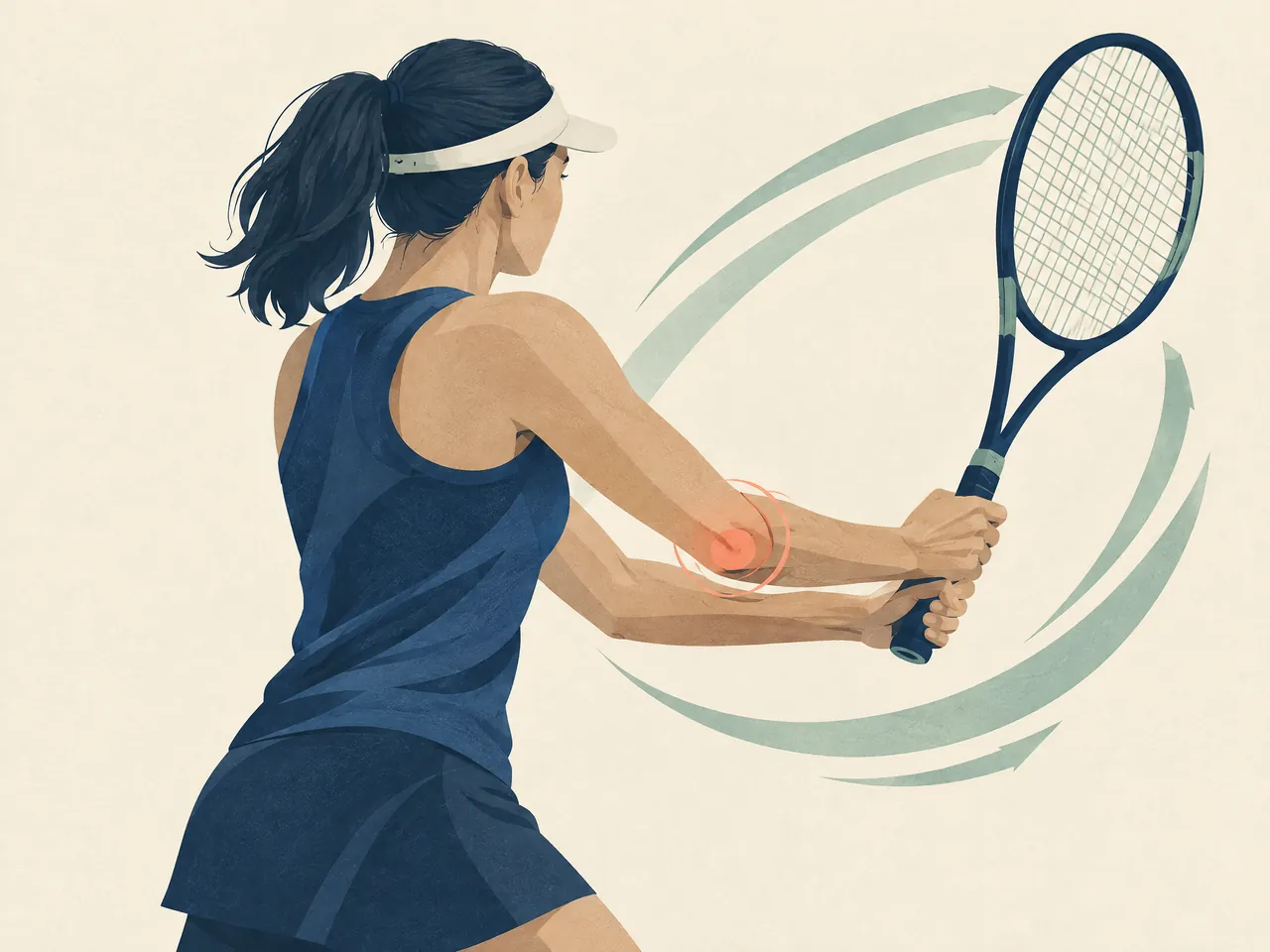
Tennis Elbow Tenderness and Swelling: Typical Outer-Elbow Symptoms with Tennis Elbow Pain When Moving the Wrist
Tennis elbow pain when moving the wrist is often easiest to notice when the wrist is working against a load rather than when the hand is completely relaxed. Common examples include lifting a kettle, holding a phone with the wrist bent back, opening a tight jar, using a screwdriver, pulling luggage or holding a mouse for a long period. Grip can feel less secure because gripping recruits the forearm muscles that connect near the painful elbow. The American Academy of Orthopaedic Surgeons describes pain or burning on the outer elbow and weak grip as common signs, often made worse by actions such as turning a wrench or shaking hands [2]. Symptoms can be on the dominant side, but that is not a rule.
Tennis Elbow Tenderness and Swelling with Tennis Elbow Pain When Moving the Wrist: Everyday Activities
Look for the task pattern rather than blaming one sport. Long stretches of clicking and typing, repeated scanning or packing, sewing, chopping, carrying shopping, do-it-yourself repairs and instrument practice can each involve a combination of grip, wrist position and forearm rotation. A single task is more informative when you can say exactly which phase hurts: lifting the object, holding it steady, twisting, lowering it, or letting go. You can then make a temporary change that is specific: use two hands for a heavy pan, break a long task into shorter bouts, bring an object closer to the body, or alternate hands where practical. The related guide Can tennis elbow be caused by lifting or twisting the wrist? explains why these movements can be relevant.
Compare your options
| What you notice | How it may fit the tennis-elbow pattern | Practical next step |
|---|---|---|
| Tender outer elbow after gripping, lifting or turning the wrist | Often consistent with a load-related outer-elbow pattern, but not diagnostic on its own | Reduce the clearly aggravating task, note the trigger and arrange assessment if it persists or limits activity |
| Pain mainly on the inner elbow | Less typical for tennis elbow and may reflect a different elbow structure or condition | Describe the exact location and provoking movement to a clinician rather than copying an outer-elbow plan |
| Neck pain with tingling, numbness or pain travelling into the hand | May suggest a nerve-related source or a problem beyond the local elbow | Seek medical assessment, particularly if weakness or sensation change is new or worsening |
| Hot, red, markedly swollen elbow, deformity, or symptoms after a significant fall | Not a routine overuse presentation to manage with home measures alone | Seek prompt medical evaluation |
| Mild flare after a known repetitive task without warning signs | May be appropriate for careful activity modification and comfort measures while monitoring | Use a wrapped hot or cold pack if comfortable and obtain advice if symptoms do not settle |
On smaller screens, scroll the table sideways to compare all columns.
Tennis Elbow Tenderness and Swelling: Comparing Tennis Elbow Pain When Moving the Wrist
Outer-elbow tenderness can be consistent with tennis elbow, but it is not exclusive to it. Pain mainly on the inside of the elbow points to a different region and may have a different mechanical pattern. A stiff, generally painful joint with loss of movement deserves a broader joint assessment. Pain beginning in the neck or shoulder and travelling down the arm, especially with tingling or numbness, may involve a nerve-related problem rather than only a local tendon issue. A sudden injury may raise concern for a sprain, fracture or another structural problem. The purpose of comparing patterns is not to make a home diagnosis; it is to avoid treating every sore elbow as the same condition. You can also review lateral epicondylitis symptoms for a focused description of the usual outer-elbow pattern.
How the symptom behaves provides another comparison point. A tendon-related overuse pattern often builds with a particular load and settles somewhat when that load stops. Pain at rest, pain that repeatedly disturbs sleep, rapidly progressing swelling, a feverish or unwell feeling, colour change, or a marked loss of grip or sensation should not be managed as routine self-care. Cleveland Clinic advises assessment when elbow pain is severe enough to disrupt usual activities or sleep, when the elbow is swollen or discoloured, when movement is difficult, or when pain persists [3]. In Hong Kong, seek urgent medical care after serious trauma, with visible deformity, or when new weakness or numbness is pronounced.
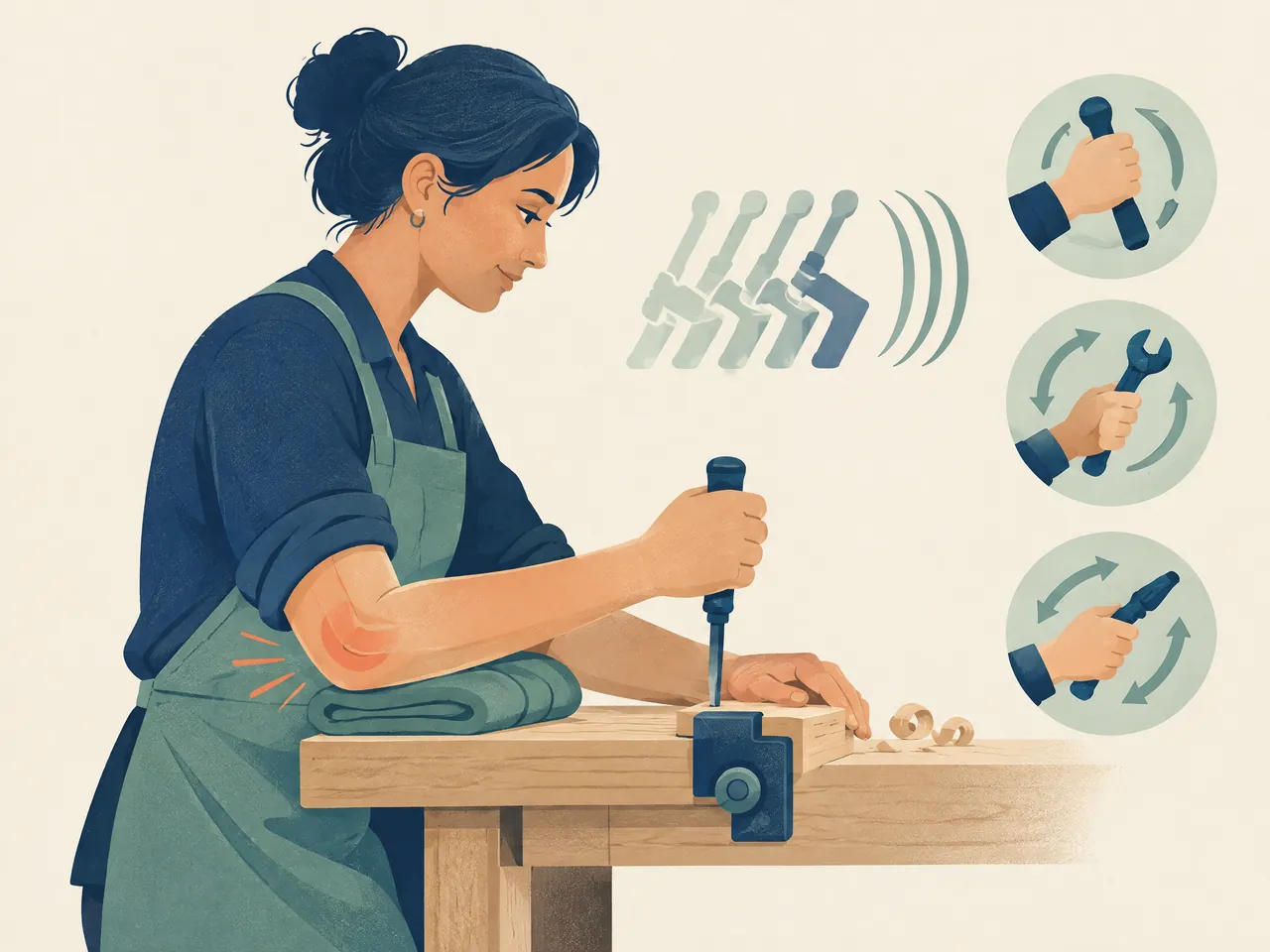
Tennis Elbow Tenderness and Swelling: When Tennis Elbow Pain When Moving the Wrist May Have Another Cause
Consider a different cause when the story does not centre on the outer elbow and a repeatable loading task. Numbness in the hand, shooting pain from the neck, or symptoms that change clearly with neck movement may require a clinician to consider nerve involvement. Tenderness directly after a blow, a wound, or a rapid swelling is also not a typical reason to simply carry on with stretches. A medical assessment may use the history, an examination of the neck, shoulder, elbow, wrist and hand, and tests only when they are needed to clarify the diagnosis. Tell the clinician about previous elbow injuries, arthritis, nerve conditions, work demands and any medicine you take. A clearer description supports safer decisions than choosing treatment based solely on the word ‘tennis’.
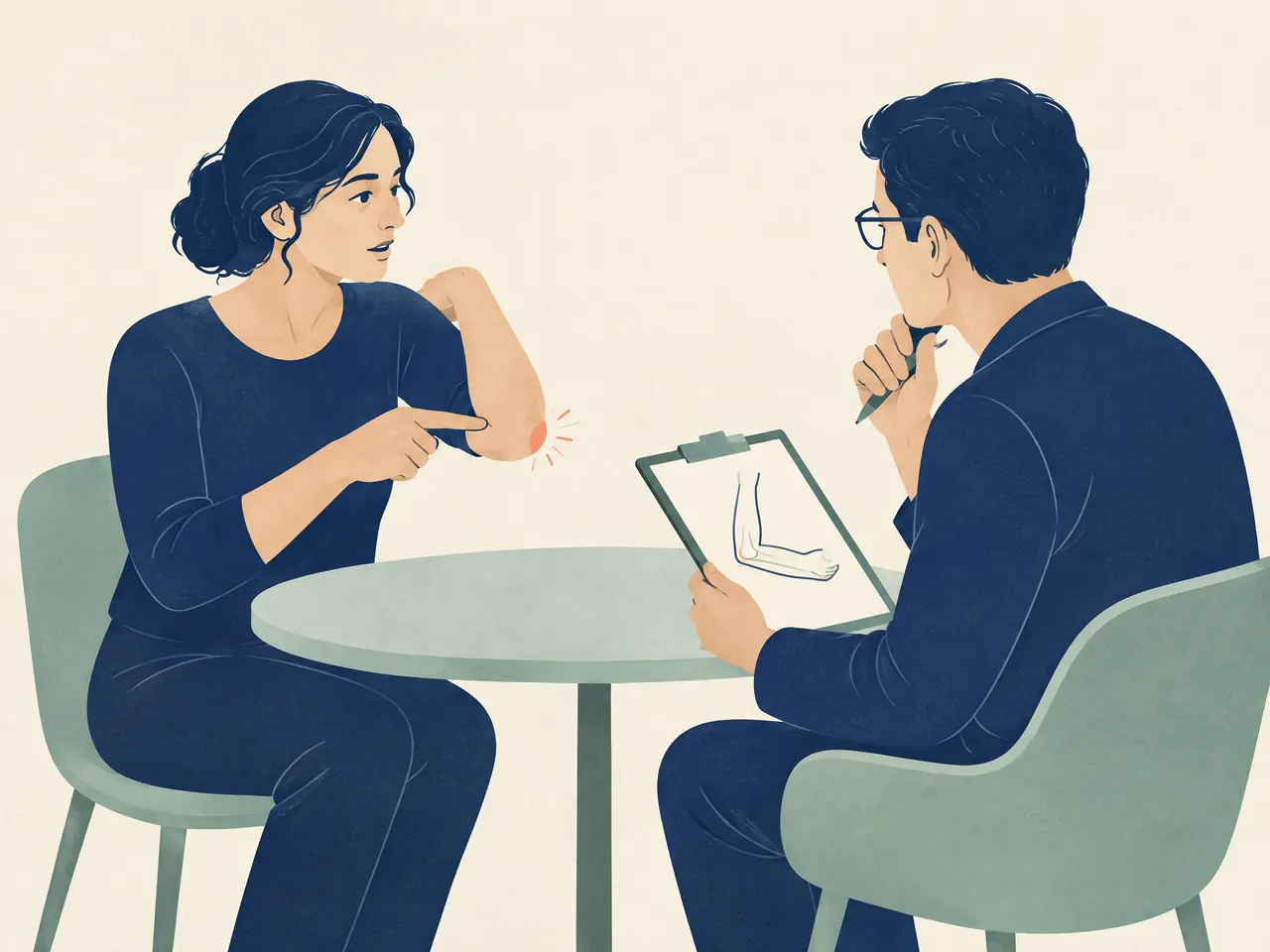
Tennis Elbow Tenderness and Swelling: Assessment for Tennis Elbow Pain When Moving the Wrist
Assessment usually begins with questions: when did symptoms begin, was there an injury, which exact movements reproduce the pain, and what does the problem stop you doing? A clinician may press around the outer elbow, compare movement and grip with the other side, and ask you to move the wrist or fingers against resistance. AAOS notes that additional tests can be used when necessary to rule out issues such as arthritis, neck-related causes or nerve compression [2]. If you arrange a consultation, bring a short symptom timeline and a list of current treatments. An assessment should clarify whether supportive care is reasonable, whether rehabilitation input is needed, and which warning signs should change the plan.
Tennis Elbow Tenderness and Swelling: Self-Care for Tennis Elbow Pain When Moving the Wrist
Self-care is most useful when it reduces a clearly aggravating load without making the whole arm inactive for longer than needed. Start by identifying the one or two actions that cause the sharpest flare, then modify their amount, grip or timing. For example, pause repetitive twisting while symptoms are irritable, use a larger handle if available, share a carrying task, take short breaks from mouse work, or keep the wrist closer to a neutral position while lifting. This is not a demand to stop every activity. It is a way to stop repeatedly provoking the same pain while you monitor the response. The guide to tennis elbow causes can help you identify relevant repetitive loads without assuming that one activity is the only explanation.

Record a simple before-and-after pattern for a few days: the task, its duration, the pain during it, and how the elbow feels later that day and the following morning. This can reveal that a short, frequent task is more provocative than an occasional heavy one. It also gives a physiotherapist or clinician something concrete to work with. Avoid testing the elbow again and again just to see whether it still hurts; repeated provocative checks can keep an irritated area sensitive. If over-the-counter pain relief is being considered, a pharmacist or clinician can advise what is appropriate for your health history and other medicines. Do not use pain relief as a signal to return abruptly to a painful workload.

Tennis Elbow Tenderness and Swelling: Heat, Cold and Gradual Exercise for Tennis Elbow Pain When Moving the Wrist
A wrapped hot or cold pack can be chosen for comfort rather than as a cure. The NHS suggests a hot or cold pack wrapped in a towel for up to 20 minutes every two to three hours, while also advising people to reduce activities that worsen symptoms [1]. Protect the skin, do not fall asleep with a pack in place, and stop if it increases discomfort or changes skin colour. When the acute irritation has eased, gentle movement and a gradual, individually suitable strengthening programme may be discussed with a physiotherapist or other qualified clinician. The aim is to rebuild tolerance to real tasks step by step, not to force through sharp pain or follow an exercise video that does not match your presentation.

Tennis Elbow Tenderness and Swelling: Discussing Supportive Care for Tennis Elbow Pain When Moving the Wrist
Some people want to discuss Chinese medicine as a supportive option while also addressing activity modification and rehabilitation. A Registered Chinese Medicine Practitioner can ask about the pain pattern, injury history, sleep, work and current medicines, then explain what can appropriately be considered in that consultation. Traditional Chinese medicine pattern descriptions are not a substitute for a modern medical diagnosis, and they should not delay evaluation of red-flag symptoms. Be open about physiotherapy, injections, pain medicines, anticoagulants, skin conditions, pregnancy and other care already in place. You may enquire with TCM Lab about an elbow symptom consultation at the Kwun Tong Chinese medicine clinic or Chinese medicine clinic Prince Edward; the practitioner can discuss whether supportive care is suitable after assessment.
Care and health guide
Pain-care information
This directory brings together services, reading, and visit information related to pain care, to help you prepare questions for a consultation.
When pain care affects your day, noting when it occurs, its relation to activity, and what you have already tried can help prepare a consultation; Chinese medicine pain management Hong Kong is a relevant service or reading entry point.
Individual circumstances differ, and acupuncture Hong Kong offers related information to help you understand options and prepare questions.


Your questions, answered
Frequently asked questions
Can tennis elbow cause visible swelling?
Tenderness or swelling can occur around the outer elbow, but obvious swelling is not specific to tennis elbow. Marked, warm, red, rapidly enlarging or discoloured swelling, especially after injury or with severe pain, should be medically assessed.
Why does my tennis elbow hurt when I move my wrist?
Wrist and finger movements use forearm muscles whose tendons connect near the outer elbow. Gripping, lifting and wrist extension can therefore make pain in that region more noticeable. The same symptom can have other causes, so persistent or unusual pain deserves assessment.
Should I use heat or cold for tennis elbow tenderness and swelling?
Either may be used for comfort if it feels helpful, with a towel between the pack and skin. The NHS advises a wrapped hot or cold pack for up to 20 minutes every two to three hours. Stop if it worsens symptoms or affects the skin, and do not treat packing as a replacement for assessment when symptoms are concerning.
When should I seek help for outer-elbow pain?
Arrange assessment when pain is severe, disrupts sleep or usual activity, limits movement, lasts despite reducing aggravating activity, or is accompanied by weakness, numbness or unusual swelling. Seek urgent care after serious trauma, deformity, pronounced neurological symptoms, or a hot red swollen joint.
Sources and further information
- [1] NHS — Tennis elbow
Referenced for: Official UK health guidance on common symptoms, repetitive triggers, hot or cold packs, activity modification and when to seek non-urgent assessment.
- [2] American Academy of Orthopaedic Surgeons — Tennis Elbow Lateral Epicondylitis
Referenced for: Professional orthopaedic information on outer-elbow symptoms, examination, differential assessment and conservative management.
- [3] Cleveland Clinic — Tennis Elbow Lateral Epicondylitis
Referenced for: Academic medical-centre information on overuse patterns, symptoms and care-seeking indicators.