
TCM Lab · Health reading
Digestive Health Acupuncture, Acupuncture for Digestive Issues and IBS and Digestive Issues Chinese Medicine
Published Updated
Digestive discomfort is rarely just one symptom. A person may feel upper-abdominal pressure after lunch, burning that reaches the throat at night, or cramping that changes after a bowel movement. Digestive health acupuncture can be discussed as a complementary option, but the useful first step is to describe the pattern clearly and make sure symptoms that need medical assessment are not missed. Acupuncture for digestive issues and IBS and digestive issues Chinese medicine are consultation topics, not stand-alone diagnoses or substitutes for prescribed treatment, testing or urgent care.
Appointments are confirmed through WhatsApp. If you have language requirements, please mention them in your enquiry.

The short answer
Digestive health acupuncture may be discussed after a registered Chinese medicine practitioner reviews the timing and location of symptoms, meals, bowel changes, medicines and any previous investigations. For IBS and digestive issues Chinese medicine, it is important not to assume every episode of bloating, pain or altered stool is IBS. Keep medical assessment central when symptoms are new, persistent, severe or accompanied by bleeding, vomiting, swallowing difficulty or unexplained weight loss.
Transparent pricing
See the fees.
Choose your care.
Explore our complete official price list, including first-trial prices, regular prices, packages and branch-specific options.
Opening WhatsApp prepares an enquiry; it does not send a message, take payment or confirm an appointment. Suitability and individual arrangements are confirmed during consultation.
Chinese medicine
All prices in HKDAcupuncture and Chinese herbal medicine package
Includes a Chinese medicine consultation with pulse assessment, body acupuncture and 3 days of Chinese herbal granules that do not require decoction.
HK$580 (single session)
Chinese medicine consultation with pulse assessment
Hair and scalp
All prices in HKDScalp health and hair-loss management
Includes AI scalp analysis, deep scalp and follicle cleansing, and scalp oil-control care.
HK$380 (first trial)
Regular price: HK$680
- 6 sessions: HK$3,480 (HK$580 per session)
- 12 sessions: HK$5,760 (HK$480 per session)
- 20 sessions: HK$8,600 (HK$430 per session)
- 30 sessions: HK$11,400 (HK$380 per session)
Hair acupuncture and Chinese herbal medicine package
Includes scalp acupuncture and 3 days of Chinese herbal medicine that does not require decoction.
HK$580 (single session)
Registered Chinese Medicine Practitioner consultation
- 6 sessions: HK$3,180 (HK$530 per session)
- 12 sessions: HK$5,760 (HK$480 per session)
- 20 sessions: HK$8,600 (HK$430 per session)
- 30 sessions: HK$11,400 (HK$380 per session)
Combined hair and scalp treatment
Combines acupuncture and Chinese herbal medicine with salon-level scalp and follicle care. Packages include complimentary hair-care shampoo and serum.
HK$1,260 (single session)
Combined treatment
- 8 sessions: HK$8,640 (HK$1,080 per session)
- 16 sessions: HK$15,680 (HK$980 per session)
- 20 sessions: HK$18,600 (HK$930 per session)
- 30 sessions: HK$26,400 (HK$880 per session)
Weight management
All prices in HKDFull-body acupoint embedding for weight management
Includes full-body acupoint embedding. Packages include complimentary Chinese herbal medicine for weight management, with the number of included days scaled to the package. Embedding material and the individual treatment arrangement are confirmed during consultation; this is not a cosmetic thread lift.
HK$980 (single session)
No trial session
- 10 sessions: HK$7,800 (HK$780 per session)
- 20 sessions: HK$14,600 (HK$730 per session)
- 30 sessions: HK$20,400 (HK$680 per session)
Facial acupuncture
All prices in HKDFacial acupuncture (basic)
Includes facial acupuncture and meridian-based facial care, including care for facial puffiness.
HK$480 (first trial)
Regular price: HK$680
- 10 sessions: HK$5,200 (HK$520 per session)
- 20 sessions: HK$9,600 (HK$480 per session)
- 30 sessions: HK$13,500 (HK$450 per session)
Facial acupuncture (advanced)
Includes enhanced facial acupuncture with a specially formulated moisturising mask and serum.
HK$780 (first trial)
Regular price: HK$1,180
- 10 sessions: HK$9,000 (HK$900 per session)
- 20 sessions: HK$16,600 (HK$830 per session)
- 30 sessions: HK$23,400 (HK$780 per session)
Pain care
All prices in HKDExtracorporeal shockwave treatment
Shockwave treatment for deep-tissue and fascial care. The Kwun Tong clinic offers the multi-area options shown below.
Priced by branch
Branch-specific pricing
Prince Edward: HK$250 per area
Kwun Tong: HK$250 for 1 area / HK$450 for 2 areas / HK$600 for 3 areas
Pain care (manual therapy)
Includes Chinese medicine musculoskeletal assessment, manual joint techniques and tui na.
HK$580 (single session)
Chinese medicine musculoskeletal assessment
Pain care (acupuncture and manual therapy)
Combines acupuncture and manual therapy.
HK$680 (single session)
Combined care
Digestive Health Acupuncture, Acupuncture for Digestive Issues and IBS and Digestive Issues Chinese Medicine: Start With a Clear Symptom Timeline
A symptom timeline turns an unfocused concern such as “my digestion is poor” into information a clinician can use. Start with the first day the problem appeared, whether it comes in episodes or is present most days, and whether it is settling, recurring or progressing. Mark the site with ordinary words: upper abdomen, around the navel, lower abdomen, chest or throat. Then add what was happening before it started: a meal, coffee, alcohol, a late night, a change in routine, travel, a stomach infection, stress, menstruation or a new medicine. This does not identify the cause by itself, but it makes a consultation safer and more specific. The broader Chinese medicine for digestive problems guide can help readers separate upper-digestive discomfort from bowel-related questions before they enquire about acupuncture.
Use the same record for a few typical days and a bad day, rather than trying to remember everything at the appointment. Note appetite, early fullness, nausea, burping, wind, reflux, pain and the effect on work, sleep or eating. For stools, describe frequency, urgency and whether constipation, loose stool or both occur; do not assume alternating bowel habits automatically mean IBS. NIDDK describes IBS as repeated abdominal pain together with changes in bowel movements, and notes that clinicians use the symptom pattern, medical and family history and a physical examination when assessing it [1]. If pain and bloating are the main concern, the focused discussion in stomach pain and bloating Chinese medicine may help you organise the questions to ask without labelling yourself.
Digestive Health Acupuncture, Acupuncture for Digestive Issues and IBS and Digestive Issues Chinese Medicine: Link Symptoms to Meals and Bloating
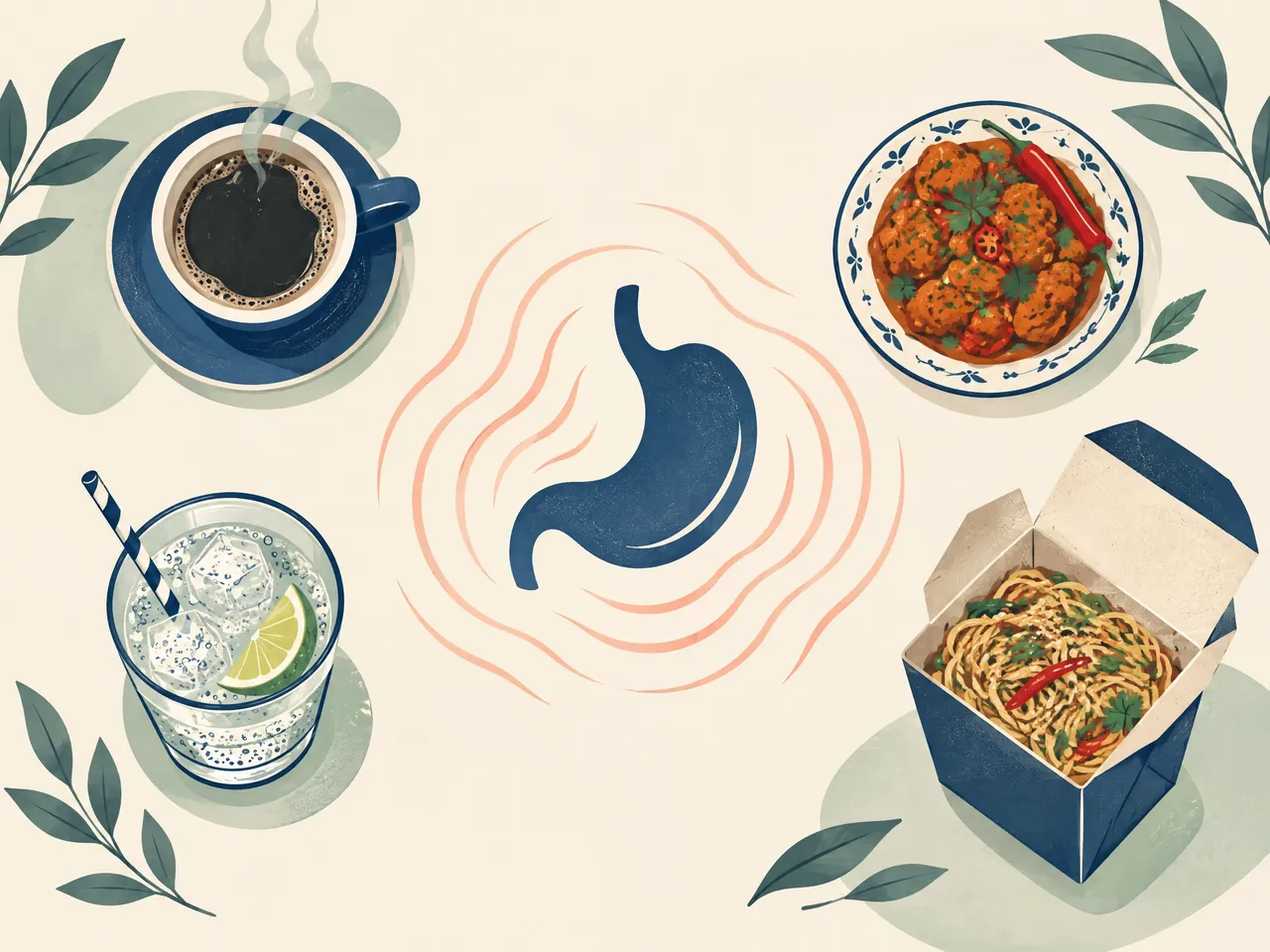
Linking discomfort to meals means recording timing, not deciding that a particular food is the culprit after one difficult day. Write down whether pain starts before food, while eating, within an hour, several hours later or when the stomach is empty. Include rough portion size and the meal context: rushed desk lunch, rich late dinner, milk tea, spicy food, carbonated drink or a meal skipped because of nausea. Also record whether bloating feels like pressure in the upper abdomen, a visibly distended lower abdomen, or fullness with burping. CUHK lists bloating, stomach pain, burping, loss of appetite, acid reflux, heartburn, nausea, abdominal pain, constipation and diarrhoea among symptoms for which its Chinese medicine digestive programme invites consultation [2]. That list is useful vocabulary, not a diagnosis or proof that one treatment suits every symptom pattern.
Avoid turning the diary into a long list of forbidden foods. A practical aim is to identify repeatable associations and to show whether regular meals, fluids and rest change the experience. For example, a person who feels uncomfortable after very large evening meals should also note whether the same meal is tolerated earlier, whether symptoms include burning or regurgitation, and whether lying down changes them. Someone who bloats after several different foods should note bowel activity and recent changes in medicine rather than immediately removing whole food groups. Bring the record to the clinician who is assessing you. It is particularly important to mention anti-inflammatory pain medicines, acid-suppressing medicines, antibiotics, laxatives, antidiarrhoeal medicines and supplements, because they can change symptoms or affect a treatment discussion.
Digestive Health Acupuncture, Acupuncture for Digestive Issues and IBS and Digestive Issues Chinese Medicine: Note Reflux and Bowel Changes
Reflux-type symptoms and bowel changes deserve their own lines in the diary because they can point the conversation in different directions. Write whether there is sour fluid, burning behind the breastbone, a sensation in the throat, cough at night or symptoms after lying down. Record vomiting separately from nausea, including how often it happens and whether fluids can be kept down. For bowel changes, identify the usual baseline first. Then note loose stool, constipation, urgency, straining, a feeling of incomplete emptying, mucus that you have noticed, or pain that eases or worsens around a bowel movement. This detail helps distinguish a broad digestive complaint from the abdominal-pain-and-bowel-change pattern that can be considered in an IBS assessment [1].
The reason for recording changes is not to self-diagnose from a checklist. Reflux can coexist with upper-abdominal discomfort, while bowel changes can occur for many reasons. Sudden onset, an obvious deterioration, or a pattern that is changing your ability to eat and drink should be said plainly when seeking advice. A practitioner discussing digestive health acupuncture may use traditional Chinese medicine terms such as a spleen-and-stomach weakness, constrained liver qi or damp-heat as part of a pattern assessment. Those terms are not interchangeable with gastritis, ulcer disease, reflux disease or IBS. Keep the modern diagnosis, tests and the traditional discussion in their proper roles, and ask what information still needs to be checked.
Compare your options
| What to record | Useful detail | Why it changes the conversation |
|---|---|---|
| Timing and location | First episode, typical duration, upper or lower abdomen, chest or throat | Helps distinguish meal-related discomfort, reflux-type symptoms and bowel-related pain |
| Meals and bloating | Before or after food, portion size, lying down, burping, nausea or fullness | Shows repeatable context without assuming one food is the cause |
| Bowel pattern | Usual baseline, constipation, loose stool, urgency, straining and pain around a bowel movement | Gives a clinician the detail needed to consider IBS and other causes |
| Medicines and tests | Prescriptions, over-the-counter products, herbs, supplements, allergies and prior investigations | Supports safer coordination and avoids replacing a recommended assessment |
On smaller screens, scroll the table sideways to compare all columns.
Digestive Health Acupuncture, Acupuncture for Digestive Issues and IBS and Digestive Issues Chinese Medicine: What Consultation Covers
A careful consultation starts by clarifying what you want help with and what has already happened clinically. Say whether your priority is meal-related discomfort, recurring bloating, reflux symptoms, constipation, diarrhoea, abdominal pain or a diagnosed condition with continuing symptoms. Bring referral letters or reports if you have them, but do not delay appropriate medical assessment while trying to assemble perfect notes. A practitioner can ask follow-up questions about sleep, appetite, temperature sensations, energy, stress, menstrual history where relevant, and the effect on normal activities. These questions build a picture for a traditional assessment; they do not replace examination, laboratory testing, imaging or endoscopy where a medical clinician considers those appropriate.

A complementary conversation should be collaborative rather than competitive. Johns Hopkins has an Acupuncture and Chinese Medicine Clinic within an Integrative Medicine and Digestive Center, and lists gastrointestinal concerns including heartburn, reflux, abdominal pain, diarrhoea and constipation among the concerns its licensed acupuncturist addresses [3]. That shows how Chinese medicine may be considered beside digestive care; it does not establish an outcome for an individual or make an acupuncture appointment a substitute for diagnosis. If herbs are part of the question, read Chinese herbal medicine for digestion as preparation, then disclose every medicine and supplement rather than starting products independently.

Digestive Health Acupuncture, Acupuncture for Digestive Issues and IBS and Digestive Issues Chinese Medicine: Discuss Traditional Patterns
Traditional pattern language is a way of organising observations within Chinese medicine. A practitioner may ask about whether discomfort is dull or sharp, whether it feels better with warmth or after passing stool, whether there is thirst, fatigue, a coated tongue or a change in appetite. The resulting pattern may guide the practitioner’s discussion of acupuncture, food habits or, when suitable, herbs. It is not a laboratory result and should not be treated as a translation of a named digestive disease. A useful question is: “What does this pattern help you consider, and what symptoms would mean I should return to my doctor?” This keeps the discussion clear, particularly when a person has both a conventional diagnosis and ongoing symptoms.
People sometimes search for IBS and digestive issues Chinese medicine because they want one explanation for bloating, pain, stress and bowel changes. It is reasonable to discuss how those experiences are connected in daily life, but it is not reasonable to assume they share one cause. Ask the practitioner to explain the proposed role of acupuncture in plain language, the information they need from other clinicians, and how changes will be reviewed. A symptom diary can help make that review concrete: it may show a change in the timing or severity of a symptom, but it cannot by itself exclude another condition. For a focused perspective on upper-abdominal pain, can Chinese medicine help with stomach pain addresses questions that should still be discussed alongside medical assessment.

Digestive Health Acupuncture, Acupuncture for Digestive Issues and IBS and Digestive Issues Chinese Medicine: Review Medicines and Tests
Before an acupuncture or Chinese medicine consultation, make a simple list of prescription medicines, over-the-counter products, herbal products and supplements. Include the name, dose if known, when you take it and why you started it. Mention drug allergies, pregnancy or the possibility of pregnancy, major health conditions and previous reactions to acupuncture or herbs. Also bring results or dates of relevant tests if available, such as blood tests, stool tests, H. pylori testing, scans or endoscopy. The point is not to request every investigation; it is to prevent a complementary plan from being made without important safety and diagnostic information.
Do not stop an acid-suppressing medicine, bowel medicine or any other prescribed treatment merely because you are considering acupuncture for digestive issues. The clinician who prescribed it should remain involved when a medicine change is being considered. Likewise, a short-term improvement or a good day after a session does not show that a serious cause has been ruled out. If an investigation has been recommended, ask why it matters and how the timing of any complementary care fits around it. Keep a copy of the plan and say promptly if symptoms have changed since the referral or the last medical review.
Digestive Health Acupuncture, Acupuncture for Digestive Issues and IBS and Digestive Issues Chinese Medicine: Safe Next Steps and Red Flags
The safest next step depends on the symptom pattern, not on how strongly a person prefers a particular therapy. A short, stable, already-assessed symptom pattern may be a reason to ask how digestive health acupuncture could sit within a wider plan. New, persistent or disruptive symptoms deserve medical advice so that a clinician can decide if testing or referral is needed. Seek prompt medical assessment instead of relying on dietary changes or an acupuncture enquiry for sudden severe or worsening abdominal pain, pain with marked tenderness, vomiting blood, black or bloody stool, persistent vomiting, difficulty swallowing, chest pain, breathing difficulty, fever or unexplained weight loss. St. Paul’s Hospital identifies vomiting blood and black stools as symptoms that can occur in more severe H. pylori-related stomach or duodenal ulcer disease [4].
Red flags are not a diagnosis, and their absence does not make every ongoing symptom harmless. They are practical reasons to change the order of care: medical assessment first, then a discussion about complementary support if appropriate. The article When should I see a doctor for digestive symptoms? is a useful starting point when deciding what to report. If you have already received a diagnosis, describe what is new or different rather than assuming it is simply a flare. Tell the medical team about any acupuncture, herbs or supplements you are considering so that care is coordinated instead of fragmented.

Digestive Health Acupuncture, Acupuncture for Digestive Issues and IBS and Digestive Issues Chinese Medicine: Do Not Replace Diagnosis
Acupuncture is not a gastroscopy, a scan, a blood test or a stool test. It cannot determine from a traditional pattern alone whether reflux symptoms are due to a particular condition, whether stomach pain has an ulcer-related cause, or whether a bowel change meets criteria for IBS. NIDDK explains that clinicians diagnosing IBS review the symptom pattern, medical and family history and physical examination, and may order tests in some cases to rule out other problems [1]. That is why a person should share a previous diagnosis with the Chinese medicine practitioner and share the complementary-care plan with their usual clinician. Clear communication supports choice; it does not require choosing one system of care over the other.
Be equally cautious with internet claims that promise to cure a broad category such as “gut problems.” A good consultation makes room for uncertainty. It should identify the symptom goal that matters to you, what has already been assessed, the medicine list, and the signs that would mean the plan needs to pause for medical review. For example, a person with ongoing reflux may be asked to track timing and triggers while continuing a clinician-directed plan; a person with pain and new bowel changes may need assessment before any complementary approach is considered. Do not use a traditional label or a temporary change in symptoms as evidence that diagnosis is complete.

Digestive Health Acupuncture, Acupuncture for Digestive Issues and IBS and Digestive Issues Chinese Medicine: Know When to Seek Care
Seek urgent help for severe symptoms rather than waiting to complete a diary. Vomiting blood, black or bloody stools, chest pain, breathing difficulty, severe or escalating abdominal pain, repeated vomiting or inability to keep fluids down require prompt conventional medical attention. Difficulty swallowing, fever and unexplained weight loss also need timely assessment. If symptoms are less urgent but keep returning, wake you at night, affect your food intake or lead you to avoid daily activities, arrange a medical review and bring your record. The useful question is not “can I manage this online?” but “what information does the clinician need to judge the next step?”
When you are ready to ask about a complementary consultation, share the symptom timeline and medical information first. TCM Lab can be contacted about an appointment at a Kwun Tong Chinese medicine clinic or a Chinese medicine clinic Prince Edward; mention any language needs when you enquire so arrangements can be confirmed. An enquiry is also a chance to ask what to bring and whether current symptoms call for medical review before a visit. This approach respects the reason people seek acupuncture for digestive issues while keeping diagnosis, prescribed treatment and urgent care where they belong.
Care and health guide
Health service information
This directory brings together services, reading, and visit information related to health services, to help you prepare questions for a consultation.
If you are organising health questions, acupuncture Hong Kong is a starting point for learning about related services and preparing for a consultation.
People have different needs; Chinese medicine pain management Hong Kong provides further reading to help you understand options in your own context.


Your questions, answered
Frequently asked questions
What should I record before asking about digestive health acupuncture?
Record where discomfort occurs, when it began, how it relates to meals and bowel movements, and whether you have reflux, vomiting, bloating or appetite changes. Add current medicines, supplements, allergies, relevant investigations and recent weight changes. A few representative days and one difficult day are often more helpful than trying to give a perfect food history.
Can acupuncture for digestive issues replace a gastroscopy or medical diagnosis?
No. A traditional Chinese medicine pattern discussion is not the same as a gastroscopy or modern medical diagnosis. A qualified healthcare professional decides whether blood tests, imaging, endoscopy or another assessment is appropriate. Continue prescribed treatment unless the clinician who manages it advises a change.
Is IBS and digestive issues Chinese medicine appropriate if I have not been diagnosed with IBS?
It can be a topic for discussion, but do not assume that bloating, abdominal pain, constipation or diarrhoea confirms IBS. IBS is assessed from a pattern of repeated abdominal pain and bowel changes together with medical history and examination. New, persistent or changing symptoms should be medically assessed first.
When should I seek medical care rather than wait for a complementary consultation?
Seek prompt conventional medical assessment for sudden or worsening severe abdominal pain, vomiting blood, black or bloody stools, difficulty swallowing, repeated vomiting, chest pain, breathing difficulty, fever or unexplained weight loss. These symptoms should not be managed only with dietary adjustment, online advice or a self-directed traditional remedy.
Sources and further information
- [1] [1] National Institute of Diabetes and Digestive and Kidney Diseases — Irritable Bowel Syndrome (IBS)
Referenced for: Supports the description of IBS symptoms and the clinical assessment approach; it does not support treatment-effect claims.
- [2] [2] The Chinese University of Hong Kong — Chinese Medicine Treatment Program for Digestive Diseases
Referenced for: Supports Hong Kong digestive symptom terminology and the context for Chinese medicine consultation.
- [3] [3] Johns Hopkins Medicine — Acupuncture and Chinese Medicine Clinic
Referenced for: Supports the example of an integrative digestive setting that lists gastrointestinal concerns; it is not evidence of individual treatment outcomes.
- [4] [4] St. Paul's Hospital — What is Helicobacter pylori? A Guide to Symptoms, Features & Treatments
Referenced for: Supports the warning that vomiting blood and black stools may occur with more severe ulcer-related stomach disease.