
TCM Lab · Health reading
tennis elbow exercises: What exercises help tennis elbow? and tennis elbow stretching
Published Updated
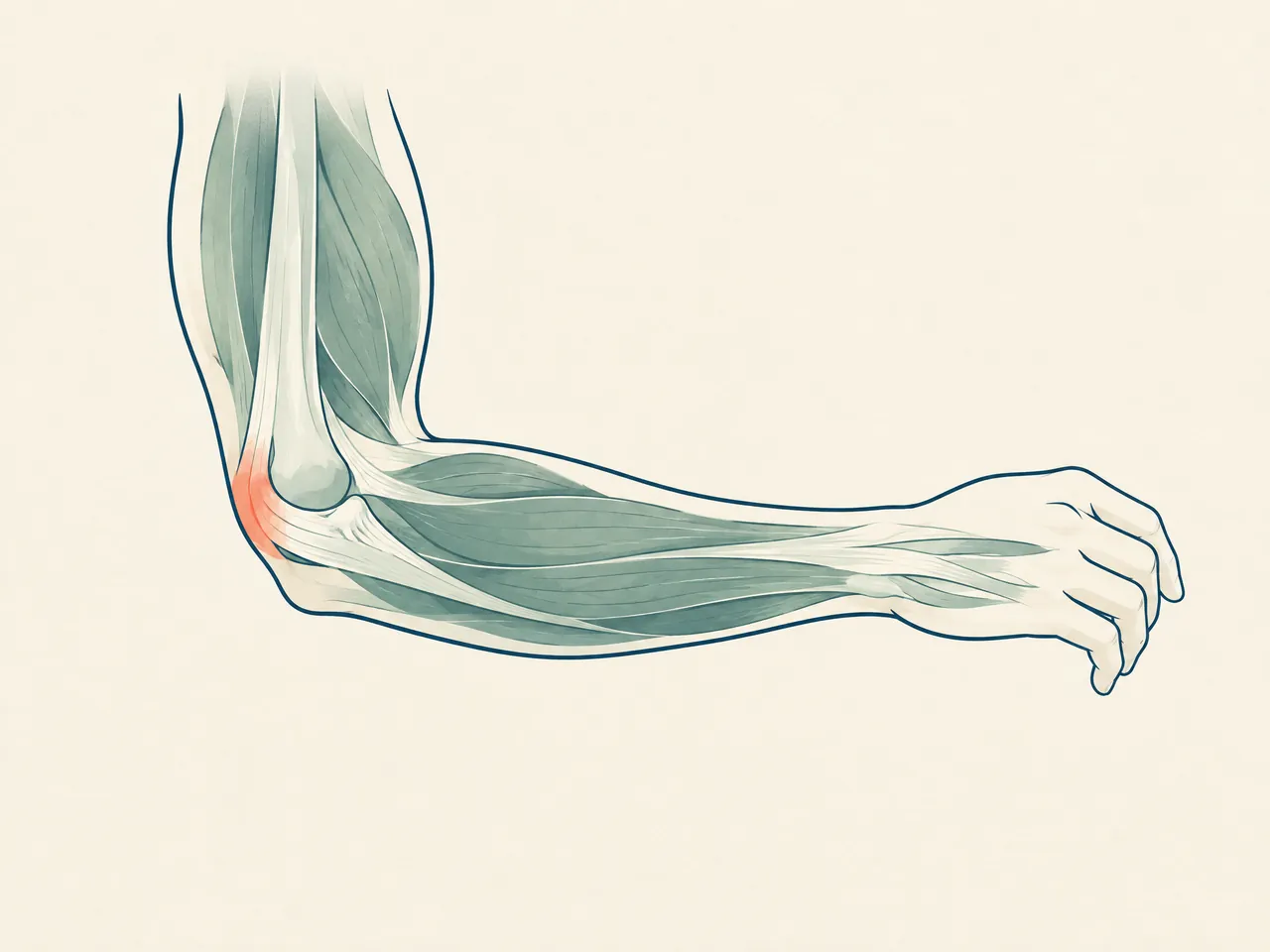
The exercises that help most with tennis elbow are usually the ones you can perform with control and without provoking a sharp flare: gentle wrist and forearm movement, comfortable stretching, then gradual strengthening when that is tolerated. The better question is not “Which one exercise fixes it?” but “Which movement can I dose sensibly while I reduce the task that keeps setting it off?” Outside-elbow pain can make an ordinary mug, mouse, suitcase or towel feel surprisingly demanding.
Appointments are confirmed through WhatsApp. If you have language requirements, please mention them in your enquiry.
The short answer
What exercises help tennis elbow? Start with pain-limited wrist and forearm movement and comfortable tennis elbow stretching, then introduce gradual grip and wrist-strength work only if symptoms settle between sessions. Avoid forcing a stretch or repeatedly testing a painful grip. Reducing the work, household or sport movement that provokes the pain is part of the plan. Seek assessment rather than exercising through numbness, marked weakness, significant injury or worsening pain.
Transparent pricing
See the fees.
Choose your care.
Explore our complete official price list, including first-trial prices, regular prices, packages and branch-specific options.
Opening WhatsApp prepares an enquiry; it does not send a message, take payment or confirm an appointment. Suitability and individual arrangements are confirmed during consultation.
Pain care
All prices in HKDExtracorporeal shockwave treatment
Shockwave treatment for deep-tissue and fascial care. The Kwun Tong clinic offers the multi-area options shown below.
Priced by branch
Branch-specific pricing
Prince Edward: HK$250 per area
Kwun Tong: HK$250 for 1 area / HK$450 for 2 areas / HK$600 for 3 areas
Pain care (manual therapy)
Includes Chinese medicine musculoskeletal assessment, manual joint techniques and tui na.
HK$580 (single session)
Chinese medicine musculoskeletal assessment
Pain care (acupuncture and manual therapy)
Combines acupuncture and manual therapy.
HK$680 (single session)
Combined care
Hair and scalp
All prices in HKDScalp health and hair-loss management
Includes AI scalp analysis, deep scalp and follicle cleansing, and scalp oil-control care.
HK$380 (first trial)
Regular price: HK$680
- 6 sessions: HK$3,480 (HK$580 per session)
- 12 sessions: HK$5,760 (HK$480 per session)
- 20 sessions: HK$8,600 (HK$430 per session)
- 30 sessions: HK$11,400 (HK$380 per session)
Hair acupuncture and Chinese herbal medicine package
Includes scalp acupuncture and 3 days of Chinese herbal medicine that does not require decoction.
HK$580 (single session)
Registered Chinese Medicine Practitioner consultation
- 6 sessions: HK$3,180 (HK$530 per session)
- 12 sessions: HK$5,760 (HK$480 per session)
- 20 sessions: HK$8,600 (HK$430 per session)
- 30 sessions: HK$11,400 (HK$380 per session)
Combined hair and scalp treatment
Combines acupuncture and Chinese herbal medicine with salon-level scalp and follicle care. Packages include complimentary hair-care shampoo and serum.
HK$1,260 (single session)
Combined treatment
- 8 sessions: HK$8,640 (HK$1,080 per session)
- 16 sessions: HK$15,680 (HK$980 per session)
- 20 sessions: HK$18,600 (HK$930 per session)
- 30 sessions: HK$26,400 (HK$880 per session)
Weight management
All prices in HKDFull-body acupoint embedding for weight management
Includes full-body acupoint embedding. Packages include complimentary Chinese herbal medicine for weight management, with the number of included days scaled to the package. Embedding material and the individual treatment arrangement are confirmed during consultation; this is not a cosmetic thread lift.
HK$980 (single session)
No trial session
- 10 sessions: HK$7,800 (HK$780 per session)
- 20 sessions: HK$14,600 (HK$730 per session)
- 30 sessions: HK$20,400 (HK$680 per session)
Facial acupuncture
All prices in HKDFacial acupuncture (basic)
Includes facial acupuncture and meridian-based facial care, including care for facial puffiness.
HK$480 (first trial)
Regular price: HK$680
- 10 sessions: HK$5,200 (HK$520 per session)
- 20 sessions: HK$9,600 (HK$480 per session)
- 30 sessions: HK$13,500 (HK$450 per session)
Facial acupuncture (advanced)
Includes enhanced facial acupuncture with a specially formulated moisturising mask and serum.
HK$780 (first trial)
Regular price: HK$1,180
- 10 sessions: HK$9,000 (HK$900 per session)
- 20 sessions: HK$16,600 (HK$830 per session)
- 30 sessions: HK$23,400 (HK$780 per session)
Chinese medicine
All prices in HKDAcupuncture and Chinese herbal medicine package
Includes a Chinese medicine consultation with pulse assessment, body acupuncture and 3 days of Chinese herbal granules that do not require decoction.
HK$580 (single session)
Chinese medicine consultation with pulse assessment
tennis elbow exercises for identifying painful movements — What exercises help tennis elbow? and tennis elbow stretching
Before choosing tennis elbow exercises, identify the movement that is actually difficult. Pain from tennis elbow is commonly felt around the outside of the elbow and may be worse with gripping, lifting, bending the arm or moving the wrist [2]. A coffee cup, a full shopping bag, a jar lid, a mouse, a screwdriver or a wet towel can each load the forearm in a slightly different way. Write down the task, the hand position, the weight or duration, and whether the ache appears during the task or afterwards.
The name can mislead. Tennis elbow, often called lateral epicondylitis, is not reserved for racket-sport players. Repeated wrist and arm movements in work and daily tasks may be involved, and pain can travel into the forearm or wrist [4]. A painful outer elbow also is not a diagnosis you can make from location alone. A recent fall, a locked joint, neck-to-arm symptoms, altered sensation or pain that does not fit the usual load pattern deserves a clinician’s assessment rather than an increasingly ambitious home programme.
tennis elbow exercises for grip, lifting and wrist use: What exercises help tennis elbow? with tennis elbow stretching
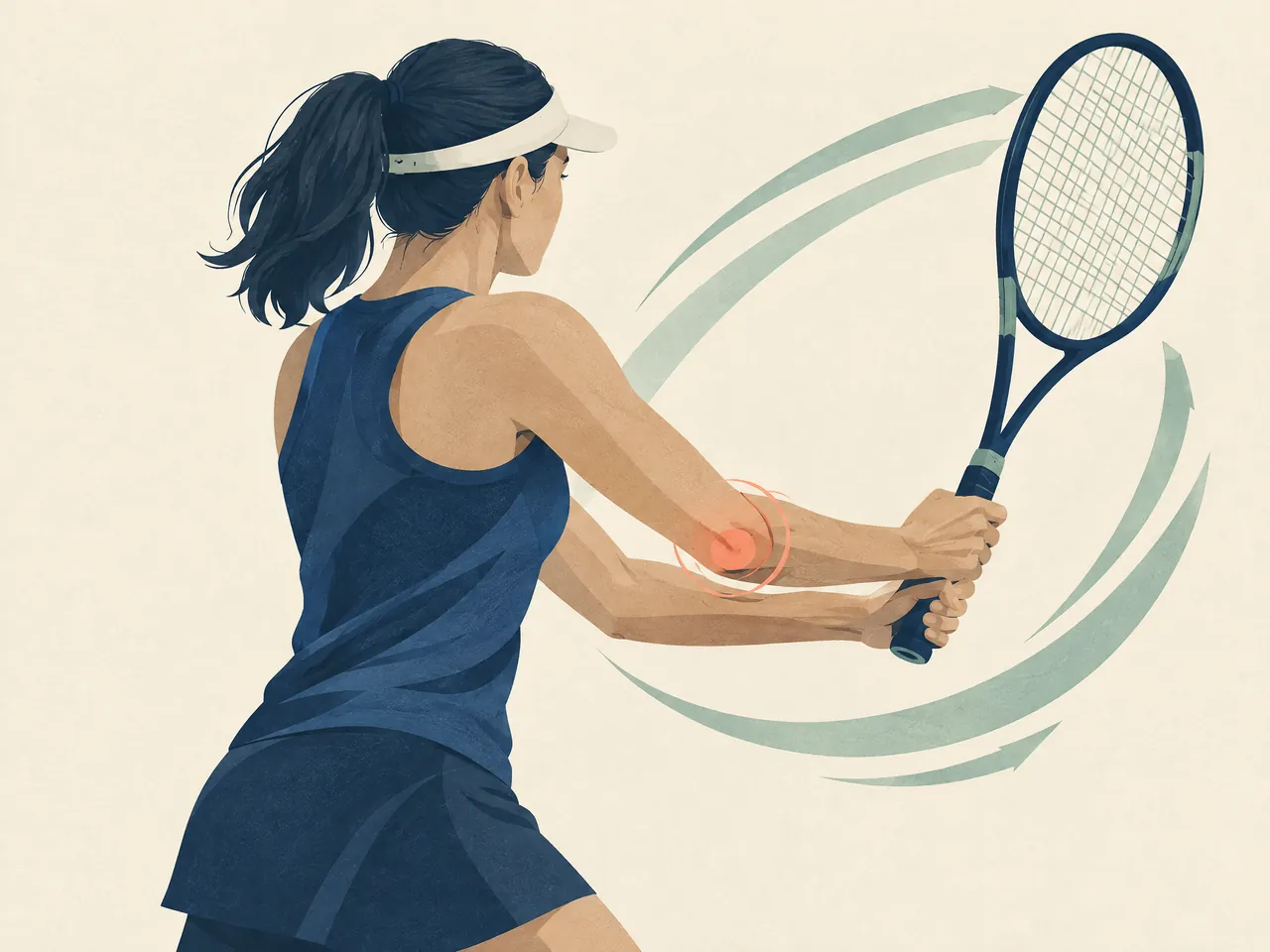
Separate grip from wrist movement when you test an activity. Holding a light cup with the wrist straight may be manageable, while lifting it with the palm down or twisting the wrist may not be. Likewise, a mouse may be tolerable for a short spell but painful when the forearm is held tense for hours. Observe whether the elbow hurts with squeezing, turning, lifting away from the body, or extending the wrist. That distinction helps you choose a lower-irritation variation, such as using two hands for a heavier item, keeping the item close, or taking a short pause before the grip becomes hard.
For tennis elbow stretching, the sensation should be a manageable pull through the forearm, not a contest to reach the furthest position. Alberta’s public exercise handout describes wrist flexor and extensor stretches as gentle movements and advises people to start slowly and ease off if pain begins [1]. You might use that principle by supporting the arm, moving the wrist only to a mild stretch, and returning to neutral instead of holding an aggressive end range. If opening the fingers, turning the palm or straightening the elbow produces tingling or burning, stop testing it and seek individual advice. Stretching cannot compensate for a repeated trigger that continues unchanged all day.
tennis elbow exercises beyond sport: What exercises help tennis elbow? and tennis elbow stretching at work
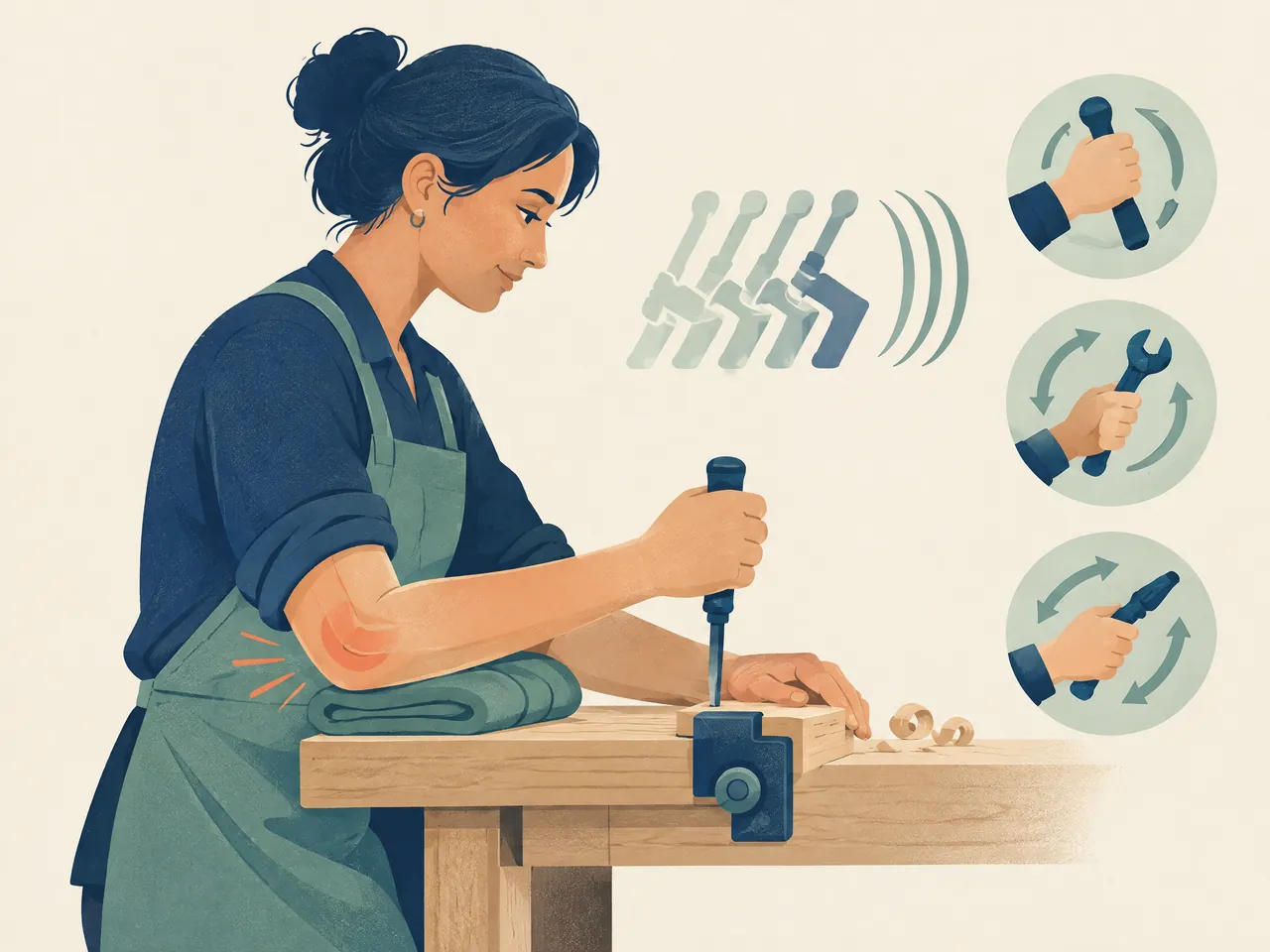
Look beyond sport for the cumulative load. Computer work, typing and mouse use, sewing, tool use and other tasks involving gripping and repeated wrist-and-forearm twisting are all listed as possible contributors by the NHS [2]. In a kitchen, a larger-handled tool or two-handed lift may feel easier. With DIY or cleaning, split a long task into shorter blocks and alternate hands if that does not create a new problem on the other side.
These changes are not a substitute for exercise; they create room for exercise to be tolerable. A short movement break may be more useful than saving all activity for one intense evening session after a demanding day. If a job cannot be altered, record the exact work cycle that causes the pain and discuss modifications with an appropriate clinician or workplace adviser. Readers comparing common triggers can also review What causes tennis elbow?. The aim is not to avoid every sensation forever, but to stop repeatedly exceeding the level that your forearm can currently manage.
Compare your options
| What you notice | Lower-load option to consider | What tells you to reduce or seek advice |
|---|---|---|
| The elbow is sore with a normal cup or light keyboard use | Brief, comfortable elbow and wrist movement with the forearm supported | Pain is increasing during the movement or everyday use is clearly worse afterwards |
| You feel a mild forearm tightness but can move the wrist normally | A gentle wrist flexor or extensor stretch within a mild pull | Sharp pain, tingling, numbness or a lasting flare replaces the mild stretch |
| Grip is tolerable only at low effort | A relaxed squeeze of a soft ball or rolled sock, if it stays comfortable | You cannot hold the item reliably, the grip becomes sharply painful, or weakness is marked |
| Wrist movement is comfortable and daily symptoms are settled | Slow supported wrist strengthening with very light resistance | The wrist jerks, compensation appears, or next-day symptoms are noticeably worse |
| The elbow is hot, very swollen, numb, injured or unusually weak | Pause self-directed exercise and arrange appropriate medical assessment | Do not use forceful stretching or loading to test an uncertain injury |
On smaller screens, scroll the table sideways to compare all columns.
What exercises help tennis elbow? A measured approach to tennis elbow exercises and tennis elbow stretching
A measured progression has three parts: comfortable motion, a gradual return of forearm capacity, and sensible management of the provoking task. Begin with the easiest part. If a wrist stretch is comfortable but gripping a ball makes the outer elbow sting, use the stretch or simple wrist movement as a starting point rather than jumping to squeezes. If even light movement increases symptoms substantially, the priority is not another exercise variation; it is to reduce the aggravating load and consider assessment. The Hong Kong College of Orthopaedic Surgeons includes stretching and a reduction in repetitive overuse activities in non-surgical management information [3].
Use your response across time, not only the first repetition, to decide whether a session was suitable. During the exercise, discomfort should remain mild and controllable rather than sharp, electric or escalating. Afterwards, check whether ordinary actions such as turning a key, carrying a phone or lifting a kettle are noticeably worse. If they are, reduce the movement range, repetitions, resistance or frequency next time. If symptoms remain similar or settle, continue at that modest level before adding a little more. This approach is slower than chasing a quick fix, but it gives the tendon and surrounding muscles a clearer chance to adapt to the load you are asking of them.
What exercises help tennis elbow? Start gently with tennis elbow exercises and tennis elbow stretching
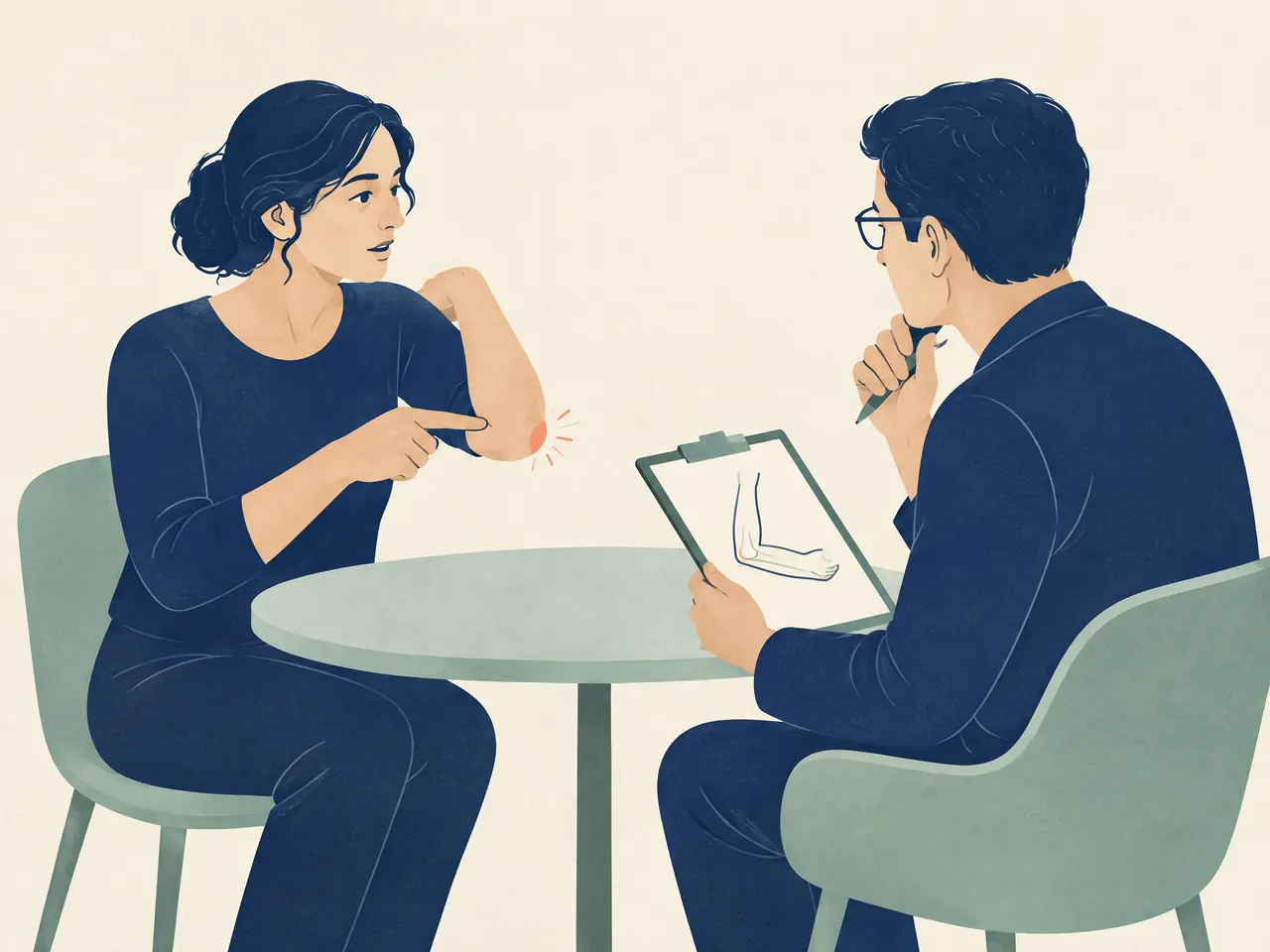
Start with a brief check-in: where is the pain today, which daily task was hardest, and can you fully open and close the hand without unusual symptoms? Then choose one or two movements. Gentle elbow bending and straightening, controlled wrist movement with the forearm supported, or a mild flexor or extensor stretch may be enough initially. The Alberta handout includes wrist movement, a soft ball or rolled-sock squeeze, and later resisted wrist work among its examples, while emphasising a slow start and easing off with pain [1]. Those examples are options, not a requirement to complete every exercise in one session.
Position can change the challenge. Supporting the forearm on a table reduces the need to stabilise the whole arm; a rolled towel beneath the wrist may help you move with less guarding. Keep the shoulder relaxed and avoid clenching the jaw or making a fist with the other hand while you work. Breathe normally, move slowly in both directions, and stop before technique turns into a shrug, twist or forceful pull. If you choose a light object for later wrist strengthening, it should be light enough that the wrist moves deliberately rather than jerking through the lift. More resistance is not automatically more helpful.

What exercises help tennis elbow? Balance tennis elbow exercises, tennis elbow stretching and load management
Stretching may improve comfort for some people, but it is only one component. A person who stretches the forearm each morning yet spends the rest of the day carrying boxes palm-down, wringing cloths or gripping a vibrating tool may still exceed their current tolerance. Pair any exercise with one practical change to the trigger: lighten the load, change the handle, keep the wrist nearer neutral, take a pause, or postpone a non-essential repetitive task. If you are considering packs for short-term comfort, the separate guide Should I use heat or ice for tennis elbow? explains questions to consider; a pack does not make it safe to push through worsening activity.
Progress is personal, so avoid copying a training plan from a friend who plays tennis or lifts weights. The useful dose is the one that lets you maintain calm, controlled movement and continue ordinary activities without a clear deterioration. People returning to sport may need coaching on grip, equipment, technique and volume; people returning to manual work may need a task-specific plan. A physiotherapist or another suitably qualified clinician can help when it is hard to find the right level. For a symptom checklist to take to that discussion, see tennis elbow symptoms.
tennis elbow stretching and tennis elbow exercises: When What exercises help tennis elbow? is not enough
Exercises are not the answer to every outer-elbow problem. Seek prompt medical assessment after a fall or blow that leaves the elbow visibly deformed, rapidly swollen, or difficult to move. Do not self-treat a hot, red joint accompanied by fever, a quickly enlarging lump, persistent numbness or burning, marked loss of grip, or pain that seems to run from the neck into the arm. These features can point away from a straightforward overuse pattern. Forceful stretching, deep pressure or repeatedly “testing” the grip may make an uncertain problem harder to interpret.
Even without an obvious injury, arrange a clinical review if rest and sensible self-care are not helping, if pain is interfering with sleep or ordinary tasks, or if the pattern keeps returning whenever you resume normal activity. The NHS advises seeking medical advice when elbow pain remains after at least two weeks of rest and self-care, and notes that physiotherapy may be considered when home treatment has not helped [2]. An assessment can consider the location of tenderness, motion, strength, neck and nerve features, work demands and whether another condition should be ruled out. It is more useful than trying to diagnose the problem by how much a stretch hurts.

tennis elbow stretching safety, tennis elbow exercises and signs to seek assessment: What exercises help tennis elbow?
Stop an exercise immediately if it produces sharp pain, a snap, new tingling, numbness, spreading burning, dizziness or a sudden feeling that the arm is weak. Do not try to “release” the area with a hard massage or a stronger stretch after that response. Make a note of the movement, position and timing of the symptom instead. This record can be valuable if you see a clinician because outside-elbow pain can have more than one source. Mayo Clinic also notes that conditions affecting connective tissue or an injury can less often be associated with tennis-elbow-like symptoms [4].
A review is also sensible when grip has become clearly less reliable, when you drop objects, or when the pain changes character from task-linked soreness to unrelenting rest pain. Bring details of your exercise attempts, work or sport changes, current medicines and any previous injury. If you want to enquire about a Chinese medicine consultation alongside appropriate medical care, TCM Lab arranges consultations at Chinese medicine clinic Prince Edward and Kwun Tong Chinese medicine clinic. An enquiry should describe the symptom pattern and ask what assessment is appropriate; it is not a promise that any particular technique will be recommended.

tennis elbow stretching after injury, tennis elbow exercises and clinical review: What exercises help tennis elbow?
After an injury, wait for appropriate medical advice before restarting tennis elbow exercises, especially if there was a fall, a pop, bruising, major swelling, a new loss of motion or pain around a different part of the elbow. The first concern may be to exclude a fracture, joint injury or another cause, not to regain a stretch quickly. The Hong Kong College of Orthopaedic Surgeons explains that assessment may use the history and examination and, where needed, imaging to exclude other causes of elbow pain [3]. A generic online sequence cannot decide that for you.
When clinical review supports a gradual return, use the same pacing principles: start below the level that provokes a flare, change only one variable at a time, and build around the tasks you need most. It may help to list priorities—typing through a meeting, carrying a child, preparing meals, returning to racquet sport—so the progression reflects your life rather than a random exercise list. A patient approach to tennis elbow stretching and strength work is not passive. It is active observation, controlled loading and timely reassessment when the symptoms do not behave as expected.
Care and health guide
Health service information
This directory brings together services, reading, and visit information related to health services, to help you prepare questions for a consultation.
If you are organising health questions, Chinese medicine clinic Hong Kong is a starting point for learning about related services and preparing for a consultation.
People have different needs; acupuncture Hong Kong provides further reading to help you understand options in your own context.


Your questions, answered
Frequently asked questions
What exercises help tennis elbow?
Begin with a movement you can control without sharp pain, such as gentle elbow or supported wrist movement, and use comfortable stretching if it does not aggravate symptoms. When that level is settled, gradual grip or wrist strengthening may be considered. The right starting point depends on the task that triggers your pain and on how your arm responds later that day and the next morning.
How often should I do tennis elbow stretching?
There is no single schedule that fits every elbow. Start slowly, use a mild stretch rather than forcing range, and observe whether daily tasks feel the same, better or worse afterwards. If stretching produces sharp pain, tingling, numbness or a sustained increase in symptoms, stop and reduce the load rather than adding sessions.
Can I keep working if I have tennis elbow?
Many people can continue with modified work, but repeated gripping, wrist twisting or prolonged mouse use may need to be reduced or changed. Try a closer mouse position, forearm support, shorter task blocks, lighter loads or a two-handed lift where practical. If you cannot alter a painful task or symptoms persist, seek task-specific clinical advice.
When should I stop tennis elbow exercises and seek help?
Stop and seek assessment after a deforming injury, rapidly increasing swelling, redness with fever, persistent numbness or burning, marked grip loss, or pain travelling from the neck into the arm. Also arrange a review when careful self-care and activity changes are not helping or pain is disrupting normal function or sleep.
Sources and further information
- [1] MyHealth.Alberta.ca — Tennis Elbow: Exercises
Referenced for: Public health exercise examples for wrist and forearm movement, light strengthening and the instruction to start slowly and ease off with pain.
- [2] NHS — Tennis elbow
Referenced for: Official health information on outer-elbow symptoms, everyday triggers, self-care, exercises and when to seek non-urgent review.
- [3] Hong Kong College of Orthopaedic Surgeons — Tennis Elbow
Referenced for: Hong Kong professional information on lateral elbow pain, assessment, activity modification, stretching and rehabilitation.
- [4] Mayo Clinic — Tennis elbow: Symptoms and causes
Referenced for: Clinical information on tennis elbow, common activity triggers, symptoms and the need for assessment when self-care is not effective.