
TCM Lab · Health reading
Elbow Pain Exercises: Elbow Pain Stretching Exercises and Gentle Elbow Exercises
Published Updated
Elbow pain exercises are not a test of whether the elbow can be “worked loose”. If there has been no recent injury and you do not have warning signs, a calm, unloaded bend-and-straighten can be a sensible way to reintroduce movement. Sit or stand steadily, leave the hand empty, bend only as far as feels comfortable, then lower the arm slowly. The goal is to notice your response, not to touch the shoulder, force full straightening, or stretch through sharp pain. If you already have a diagnosis, have recently had elbow surgery, or were given activity restrictions, follow that individual plan instead of replacing it with a general exercise page.
Appointments are confirmed through WhatsApp. If you have language requirements, please mention them in your enquiry.
The short answer
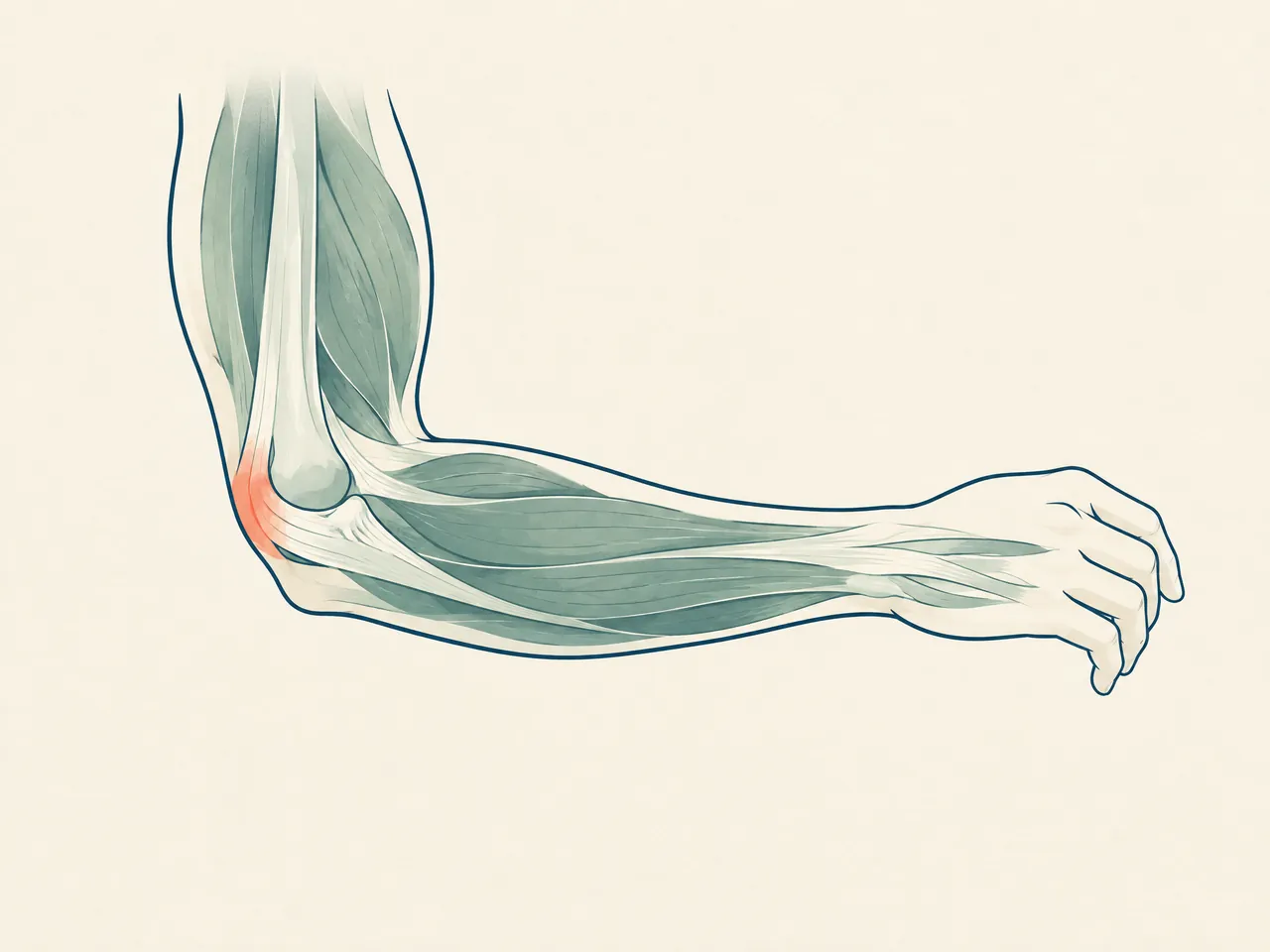
Elbow pain does not always need stretching first. When there is no recent trauma, marked swelling or heat, numbness, deformity, or major loss of movement, begin with a small unloaded elbow bend and straighten in a comfortable range. Stop for new pain or an overall worsening response, including the next morning. Do not force a stretch to “release” the elbow. If symptoms are uncertain, persistent, or follow surgery or a diagnosed condition, ask a healthcare professional for individual guidance.
Transparent pricing
See the fees.
Choose your care.
Explore our complete official price list, including first-trial prices, regular prices, packages and branch-specific options.
Opening WhatsApp prepares an enquiry; it does not send a message, take payment or confirm an appointment. Suitability and individual arrangements are confirmed during consultation.
Pain care
All prices in HKDExtracorporeal shockwave treatment
Shockwave treatment for deep-tissue and fascial care. The Kwun Tong clinic offers the multi-area options shown below.
Priced by branch
Branch-specific pricing
Prince Edward: HK$250 per area
Kwun Tong: HK$250 for 1 area / HK$450 for 2 areas / HK$600 for 3 areas
Pain care (manual therapy)
Includes Chinese medicine musculoskeletal assessment, manual joint techniques and tui na.
HK$580 (single session)
Chinese medicine musculoskeletal assessment
Pain care (acupuncture and manual therapy)
Combines acupuncture and manual therapy.
HK$680 (single session)
Combined care
Hair and scalp
All prices in HKDScalp health and hair-loss management
Includes AI scalp analysis, deep scalp and follicle cleansing, and scalp oil-control care.
HK$380 (first trial)
Regular price: HK$680
- 6 sessions: HK$3,480 (HK$580 per session)
- 12 sessions: HK$5,760 (HK$480 per session)
- 20 sessions: HK$8,600 (HK$430 per session)
- 30 sessions: HK$11,400 (HK$380 per session)
Hair acupuncture and Chinese herbal medicine package
Includes scalp acupuncture and 3 days of Chinese herbal medicine that does not require decoction.
HK$580 (single session)
Registered Chinese Medicine Practitioner consultation
- 6 sessions: HK$3,180 (HK$530 per session)
- 12 sessions: HK$5,760 (HK$480 per session)
- 20 sessions: HK$8,600 (HK$430 per session)
- 30 sessions: HK$11,400 (HK$380 per session)
Combined hair and scalp treatment
Combines acupuncture and Chinese herbal medicine with salon-level scalp and follicle care. Packages include complimentary hair-care shampoo and serum.
HK$1,260 (single session)
Combined treatment
- 8 sessions: HK$8,640 (HK$1,080 per session)
- 16 sessions: HK$15,680 (HK$980 per session)
- 20 sessions: HK$18,600 (HK$930 per session)
- 30 sessions: HK$26,400 (HK$880 per session)
Weight management
All prices in HKDFull-body acupoint embedding for weight management
Includes full-body acupoint embedding. Packages include complimentary Chinese herbal medicine for weight management, with the number of included days scaled to the package. Embedding material and the individual treatment arrangement are confirmed during consultation; this is not a cosmetic thread lift.
HK$980 (single session)
No trial session
- 10 sessions: HK$7,800 (HK$780 per session)
- 20 sessions: HK$14,600 (HK$730 per session)
- 30 sessions: HK$20,400 (HK$680 per session)
Facial acupuncture
All prices in HKDFacial acupuncture (basic)
Includes facial acupuncture and meridian-based facial care, including care for facial puffiness.
HK$480 (first trial)
Regular price: HK$680
- 10 sessions: HK$5,200 (HK$520 per session)
- 20 sessions: HK$9,600 (HK$480 per session)
- 30 sessions: HK$13,500 (HK$450 per session)
Facial acupuncture (advanced)
Includes enhanced facial acupuncture with a specially formulated moisturising mask and serum.
HK$780 (first trial)
Regular price: HK$1,180
- 10 sessions: HK$9,000 (HK$900 per session)
- 20 sessions: HK$16,600 (HK$830 per session)
- 30 sessions: HK$23,400 (HK$780 per session)
Chinese medicine
All prices in HKDAcupuncture and Chinese herbal medicine package
Includes a Chinese medicine consultation with pulse assessment, body acupuncture and 3 days of Chinese herbal granules that do not require decoction.
HK$580 (single session)
Chinese medicine consultation with pulse assessment
Elbow Pain Exercises, Elbow Pain Stretching Exercises and Gentle Elbow Exercises: When to Start
The right starting point is less about finding the “best” stretch and more about deciding whether self-directed movement is reasonable today. Elbow pain can arise around the outside, inside, front, or back of the joint, and the same task can feel different depending on grip, wrist position, load, and how long it is repeated. An ache after a long session of mouse work is not automatically the same issue as pain after a fall, nor is every outer-elbow symptom automatically tennis elbow. The NHS advises against self-diagnosis because elbow and arm pain can have several possible causes [2]. Use the location and pattern as useful information for a clinician, not as a label that decides your exercise programme. If gentle motion feels safe and unforced, begin with a small range and review the response before adding stretching, wrist work, resistance, or more repetitions.
Elbow Pain Exercises, Elbow Pain Stretching Exercises and Gentle Elbow Exercises: Check for Warning Signs
Pause the idea of home exercise and arrange appropriate assessment first if there is severe pain with difficulty moving the arm, a snapping sound or change in shape after an injury, tingling or numbness, or swelling with a high temperature or feeling feverish. Sudden arm pain together with pressure, heaviness, or squeezing across the chest needs emergency help, rather than an elbow routine. These are practical triage points reflected in NHS symptom guidance [2]. A new inability to use the arm normally, marked redness and heat, or symptoms that feel alarming are reasons not to see whether a deeper stretch will fix the problem. Equally, a person with a known elbow condition, a recent procedure, or instructions to protect the joint should use the advice supplied by their own treating team. General online movement guidance cannot account for the stage of healing, examination findings, or restrictions that apply to one person.
Elbow Pain Exercises, Elbow Pain Stretching Exercises and Gentle Elbow Exercises: Know When to Pause
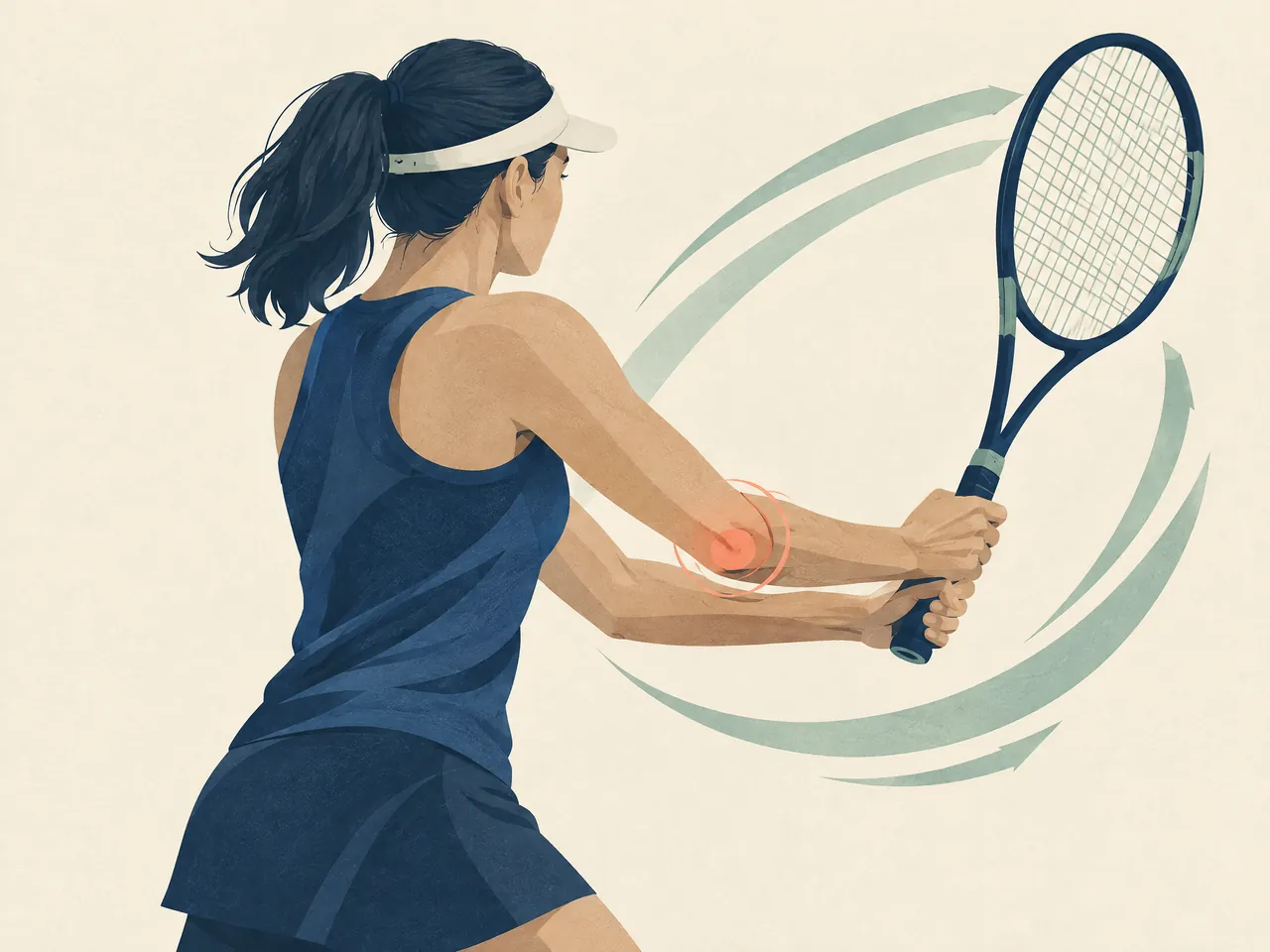
A movement may be worth modifying before it is abandoned, but it should not be chased through a worsening pattern. New sharp pain, spreading symptoms, a catching sensation that is new for you, increasing numbness, or a clear overall deterioration are signals to stop that movement and get advice. For a focused discussion of thresholds, see When should I stop elbow exercises?. NHS Inform similarly says to stop exercises that make symptoms worse or cause new pain [1]. A temporary awareness of a previously stiff joint is different from trying to overpower pain, but the page cannot judge that distinction for you. When in doubt, leave the range smaller, return to ordinary gentle use, and describe the pattern to a healthcare professional rather than adding intensity.
Compare your options
| What you notice | A cautious next step | What to record or ask |
|---|---|---|
| No recent injury; small, familiar discomfort; arm moves comfortably | Try a small unloaded bend-and-straighten in a controllable range, then review the response. | Note the range, the task that preceded symptoms, and whether the elbow is broadly unchanged the next morning. |
| Symptoms increase when you move faster, farther, or more often | Reduce range, speed, or amount; add rest rather than pushing through the painful point. | Record which change made symptoms worse and whether normal daily use is also affected. |
| Pain follows repeated gripping, lifting, turning, or computer work | Modify the provoking task where possible and use shorter, more manageable bouts. | Describe the grip, wrist position, load, duration, and exact pain location to a clinician. |
| New numbness, major movement loss, marked swelling or heat, deformity, or severe pain after injury | Do not use stretching to test the elbow; obtain prompt medical assessment. | Report the injury or symptom onset, changes in shape or sensation, and associated fever or chest symptoms if present. |
On smaller screens, scroll the table sideways to compare all columns.
Elbow Pain Exercises, Elbow Pain Stretching Exercises and Gentle Elbow Exercises: A Low-Load Bend and Straighten
A low-load bend and straighten is deliberately simple. Choose a stable chair or stand where you will not lose balance. Let the affected arm hang by your side with the hand empty and shoulder relaxed. Slowly bend the elbow so the hand travels towards the same-side shoulder, stopping well before any forced end point; then lower the arm slowly to the starting position. NHS Inform describes the same broad flex-and-extend pattern as a seated or standing movement, with the arms by the side and the elbow brought up then lowered [1]. This is movement information, not a diagnosis-specific prescription. Keep the wrist and fingers easy rather than gripping, do not use the other hand to press the elbow straight, and do not bounce at either end of the motion. The quality of the movement matters more than making it large.
Elbow Pain Exercises, Elbow Pain Stretching Exercises and Gentle Elbow Exercises: Find a Comfortable Range
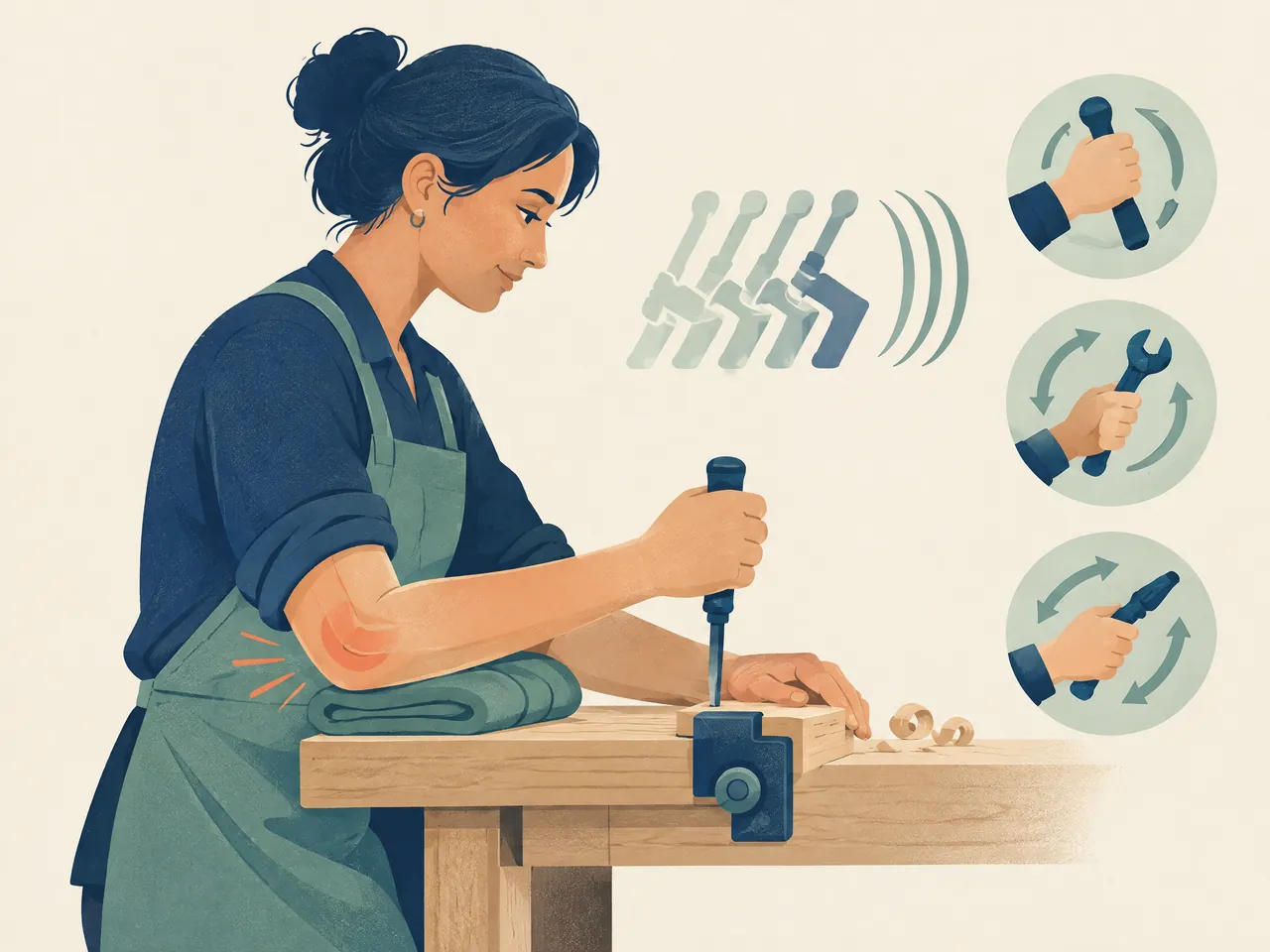
Comfortable range means the range you can control without bracing the shoulder, holding your breath, or trying to prove that the elbow is better. On one day it may be only a small bend; on another day it may be close to the usual arc. Both are useful observations. Start with a small amount rather than treating an online number as a target. NHS Inform suggests that people starting a new elbow exercise may begin with two or three repetitions at a time and add gradually as it becomes easier [1]. That general example is not a rule for every painful elbow. If an old diagnosis, a clinician's plan, medication effects, or surgery changes your situation, use that plan. Readers looking specifically at discomfort through the motion can compare their observations with elbow pain when bending and straightening, then seek assessment if the pattern is unclear or worsening.
Elbow Pain Exercises, Elbow Pain Stretching Exercises and Gentle Elbow Exercises: Adjust Your Daily Load
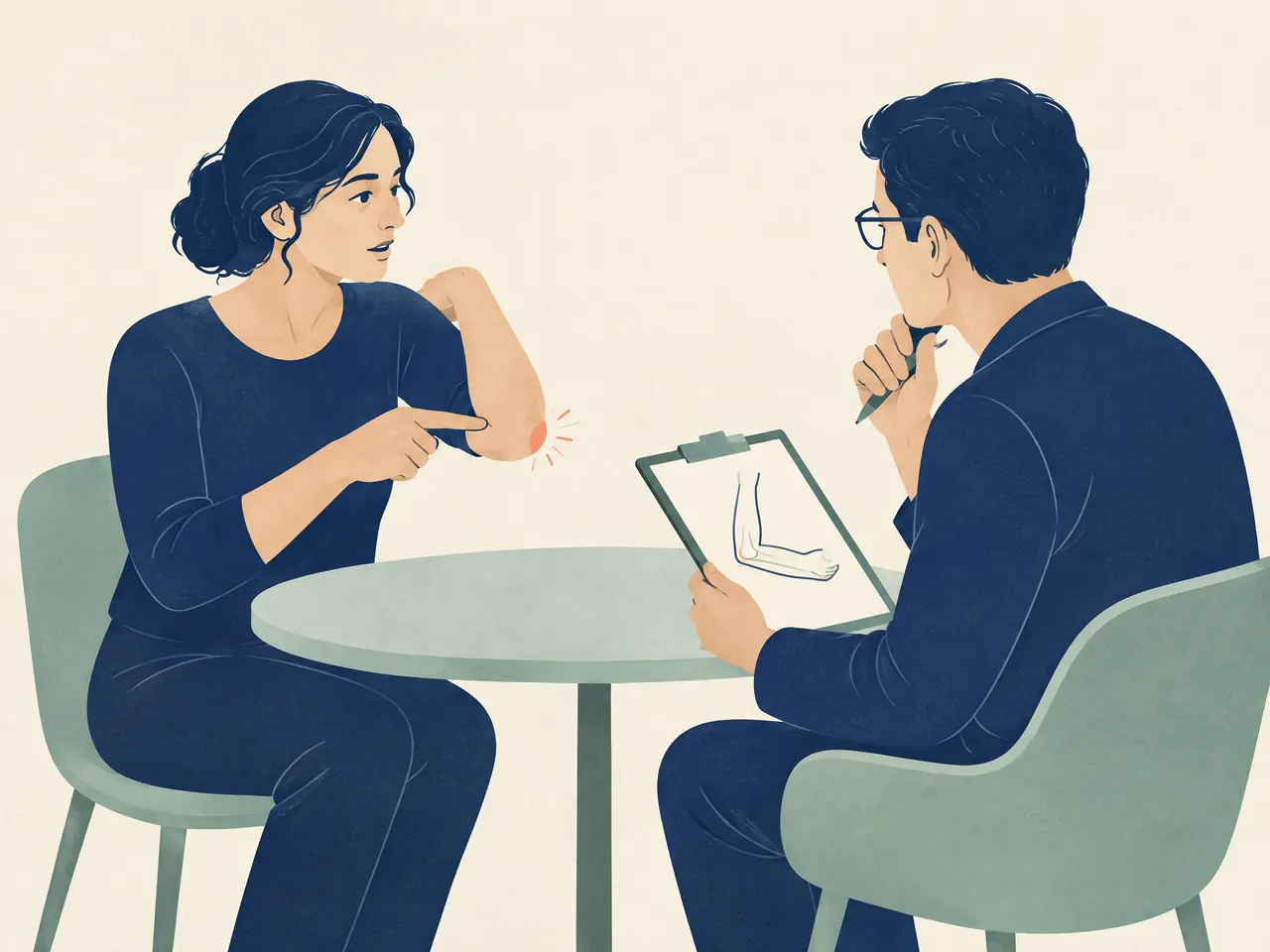
The bend-and-straighten is only one small part of the day. Notice which ordinary tasks repeatedly reproduce symptoms: carrying a bag with the palm down, opening a stubborn jar, using a screwdriver, long periods on a mouse, a heavy pan, a racquet sport, or lifting with the elbow far from the body. Adjusting one variable can be more useful than stopping all arm use. Try splitting a task into shorter bouts, using both hands for a heavier item, changing the handle or grip where possible, pausing before fatigue builds, or keeping a load closer to the trunk. These are load-management experiments, not proof of a particular diagnosis. If the pain is chiefly on one side of the joint, elbow pain on the outside may help you form a clearer description for an appointment; it should not be used to decide that every symptom has the same cause.

Elbow Pain Exercises, Elbow Pain Stretching Exercises and Gentle Elbow Exercises: Monitor Your Response
Monitoring turns a vague “I did some stretches” into information you can act on. Before moving, notice the resting ache, stiffness, swelling you can see, and how easily the elbow performs one ordinary task. During the movement, note whether discomfort stays mild and familiar or changes character. Later that day, check whether using the arm for normal life feels broadly similar, easier, or harder. NHS Inform advises that exercise should not make existing elbow pain worse overall and that pain should be no worse the following morning [1]. This gives you a practical reason to progress slowly instead of measuring success by a single session. A more detailed response log is often more useful to a clinician than a guess about the diagnosis.

Elbow Pain Exercises, Elbow Pain Stretching Exercises and Gentle Elbow Exercises: Track Symptoms and Activity
Keep a short record for several days if the problem keeps returning. Write down where the pain is felt, when it begins, the activity immediately before it, the motion or grip that changes it, and whether there is stiffness, weakness, tingling, swelling, or disturbed sleep. Add what you changed: a smaller bend, slower speed, fewer repetitions, a rest break, a lighter object, or a different way of carrying it. Also record what happened the next morning. This is not a self-diagnosis tool; it is a way to see patterns and to avoid increasing several variables at once. If you notice elbow pain after exercise, distinguish the specific session, the exercise type, the grip and load, and the timing of symptoms. That detail helps a healthcare professional decide what needs examination and what daily adjustment is realistic.

Elbow Pain Exercises, Elbow Pain Stretching Exercises and Gentle Elbow Exercises: Decide When to Seek Help
Seek clinical advice when pain is not settling over the following weeks, keeps interfering with work, sleep, lifting, or self-care, or leaves you unsure how to return to activity. NHS guidance says to seek medical advice if elbow or arm pain does not go away after a few weeks [2]; do so sooner if warning signs or a significant injury are involved. Bring your symptom-and-activity notes and say what movement you tried, rather than only saying that you “stretched”. If you want to ask TCM Lab about a consultation, an enquiry can begin with the pattern, prior diagnosis or treatment, medicines, and a preferred location. Visit-planning information is available for the Kwun Tong Chinese medicine clinic and Chinese medicine clinic Prince Edward. A WhatsApp enquiry does not replace urgent assessment and does not automatically confirm an appointment or treatment.
Care and health guide
Pain-care information
This directory brings together services, reading, and visit information related to pain care, to help you prepare questions for a consultation.
When pain care affects your day, noting when it occurs, its relation to activity, and what you have already tried can help prepare a consultation; Chinese medicine pain management Hong Kong is a relevant service or reading entry point.
Individual circumstances differ, and acupuncture Hong Kong offers related information to help you understand options and prepare questions.


Your questions, answered
Frequently asked questions
Should I stretch my elbow if it hurts?
Not automatically. If there was no significant injury and no warning signs, a small unloaded bend-and-straighten may be a gentler starting point than a forceful stretch. Avoid pushing into sharp pain or forcing full range. Get advice first after surgery, with a diagnosed condition, or if symptoms are persistent or uncertain.
How many gentle elbow exercises should I do?
There is no one amount for every elbow problem. NHS Inform suggests starting a new elbow movement with two or three repetitions at a time and adding gradually only as it becomes easier. Treat this as general guidance, not a replacement for an individual plan, and reduce or stop if symptoms worsen overall or are worse the next morning.
What should I avoid when doing elbow pain stretching exercises?
Avoid holding a weight while testing a new movement, bouncing, using the other hand to force the elbow straight, and trying to reach a painful end range. Do not treat a stretch as a way to rule out injury. Change the task, slow down, or stop when there is new pain, increasing tingling, or worsening function.
When should I seek help instead of continuing gentle elbow exercises?
Seek prompt assessment for severe pain with difficulty moving the arm, a snapping sound or deformity after injury, numbness or tingling, or swelling with feverish symptoms. Seek advice if pain does not improve over a few weeks or continues to disrupt daily activity. Sudden arm pain with chest pressure, heaviness, or squeezing is an emergency.
Sources and further information
- [1] NHS Inform - Exercises for elbow problems
Referenced for: Official public-health guidance for a basic elbow flex-and-extend movement, gradual progression, symptom response, and when to stop exercises.
- [2] NHS - Elbow and arm pain
Referenced for: Official symptom guidance for non-diagnostic framing, urgent warning signs, and when elbow or arm pain merits medical assessment.