
TCM Lab · Health reading
Acupuncture for shoulder pain Hong Kong: rotator cuff injury treatment Hong Kong explained
Published Updated
Shoulder pain is frustrating when it interrupts sleep, makes a shirt difficult to put on, or turns a simple reach for the MTR handrail into a guarded movement. Acupuncture for shoulder pain Hong Kong may be considered as supportive care for pain and surrounding muscle tightness, but it should not replace assessment when a rotator cuff injury is possible. A painful shoulder may involve a tendon, joint stiffness, bursa, neck referral or another problem. This page explains what rotator cuff injury treatment Hong Kong should clarify first, where acupuncture may fit, and when medical assessment takes priority.
Appointments are confirmed through WhatsApp. If you have language requirements, please mention them in your enquiry.

The short answer
Acupuncture for shoulder pain Hong Kong may be used as supportive care to discuss pain, tightness and movement comfort after an individual assessment. It does not reconnect a torn tendon or establish whether shoulder pain is caused by a rotator cuff tear. Sudden injury, marked weakness, inability to lift the arm, deformity, persistent tingling, fever or a hot swollen shoulder should be medically assessed promptly; imaging or rehabilitation may be more important than acupuncture at that stage.
Transparent pricing
See the fees.
Choose your care.
Explore our complete official price list, including first-trial prices, regular prices, packages and branch-specific options.
Opening WhatsApp prepares an enquiry; it does not send a message, take payment or confirm an appointment. Suitability and individual arrangements are confirmed during consultation.
Pain care
All prices in HKDExtracorporeal shockwave treatment
Shockwave treatment for deep-tissue and fascial care. The Kwun Tong clinic offers the multi-area options shown below.
Priced by branch
Branch-specific pricing
Prince Edward: HK$250 per area
Kwun Tong: HK$250 for 1 area / HK$450 for 2 areas / HK$600 for 3 areas
Pain care (manual therapy)
Includes Chinese medicine musculoskeletal assessment, manual joint techniques and tui na.
HK$580 (single session)
Chinese medicine musculoskeletal assessment
Pain care (acupuncture and manual therapy)
Combines acupuncture and manual therapy.
HK$680 (single session)
Combined care
Hair and scalp
All prices in HKDScalp health and hair-loss management
Includes AI scalp analysis, deep scalp and follicle cleansing, and scalp oil-control care.
HK$380 (first trial)
Regular price: HK$680
- 6 sessions: HK$3,480 (HK$580 per session)
- 12 sessions: HK$5,760 (HK$480 per session)
- 20 sessions: HK$8,600 (HK$430 per session)
- 30 sessions: HK$11,400 (HK$380 per session)
Hair acupuncture and Chinese herbal medicine package
Includes scalp acupuncture and 3 days of Chinese herbal medicine that does not require decoction.
HK$580 (single session)
Registered Chinese Medicine Practitioner consultation
- 6 sessions: HK$3,180 (HK$530 per session)
- 12 sessions: HK$5,760 (HK$480 per session)
- 20 sessions: HK$8,600 (HK$430 per session)
- 30 sessions: HK$11,400 (HK$380 per session)
Combined hair and scalp treatment
Combines acupuncture and Chinese herbal medicine with salon-level scalp and follicle care. Packages include complimentary hair-care shampoo and serum.
HK$1,260 (single session)
Combined treatment
- 8 sessions: HK$8,640 (HK$1,080 per session)
- 16 sessions: HK$15,680 (HK$980 per session)
- 20 sessions: HK$18,600 (HK$930 per session)
- 30 sessions: HK$26,400 (HK$880 per session)
Weight management
All prices in HKDFull-body acupoint embedding for weight management
Includes full-body acupoint embedding. Packages include complimentary Chinese herbal medicine for weight management, with the number of included days scaled to the package. Embedding material and the individual treatment arrangement are confirmed during consultation; this is not a cosmetic thread lift.
HK$980 (single session)
No trial session
- 10 sessions: HK$7,800 (HK$780 per session)
- 20 sessions: HK$14,600 (HK$730 per session)
- 30 sessions: HK$20,400 (HK$680 per session)
Facial acupuncture
All prices in HKDFacial acupuncture (basic)
Includes facial acupuncture and meridian-based facial care, including care for facial puffiness.
HK$480 (first trial)
Regular price: HK$680
- 10 sessions: HK$5,200 (HK$520 per session)
- 20 sessions: HK$9,600 (HK$480 per session)
- 30 sessions: HK$13,500 (HK$450 per session)
Facial acupuncture (advanced)
Includes enhanced facial acupuncture with a specially formulated moisturising mask and serum.
HK$780 (first trial)
Regular price: HK$1,180
- 10 sessions: HK$9,000 (HK$900 per session)
- 20 sessions: HK$16,600 (HK$830 per session)
- 30 sessions: HK$23,400 (HK$780 per session)
Chinese medicine
All prices in HKDAcupuncture and Chinese herbal medicine package
Includes a Chinese medicine consultation with pulse assessment, body acupuncture and 3 days of Chinese herbal granules that do not require decoction.
HK$580 (single session)
Chinese medicine consultation with pulse assessment
Acupuncture for shoulder pain Hong Kong: understanding rotator cuff injury treatment Hong Kong needs
The rotator cuff is a group of muscles and tendons around the shoulder that helps keep the upper arm positioned in the joint while the arm lifts and rotates. Irritation, degeneration, a partial tear and a complete tear sit on a broad spectrum; they are not interchangeable labels. A fall onto an outstretched arm, a sharp pull while lifting, long periods of repetitive overhead work, sport, or gradual wear can all be part of the story. The practical question is not simply whether the shoulder hurts, but how the pain began, which movements are lost, and whether strength changed suddenly. Mayo Clinic notes that rotator cuff problems can cause a deep ache, night discomfort, weakness and reduced range of motion, while some injuries may not be painful at all. [2]
That distinction matters in Hong Kong because a busy workday can encourage people to work around an injured shoulder for weeks. Pain when hanging laundry, reaching a high shelf, fastening a bra, washing hair or turning in bed deserves a clearer description than “stiff shoulder.” A cuff problem is one possibility, but frozen shoulder, arthritis, bursa irritation, instability and pain referred from the neck can also affect the area. Hong Kong Adventist Hospital similarly describes shoulder pain as having several possible causes and uses history, examination and, where appropriate, MRI or ultrasound to assess a suspected cuff tear. [1] If you are comparing explanations, the overview of rotator cuff injury symptoms can help you frame useful observations for an appointment without trying to diagnose yourself.

Acupuncture for shoulder pain Hong Kong: symptoms that may relate to rotator cuff injury treatment Hong Kong
A symptom pattern can guide the next question, not confirm a tear at home. People often describe a dull ache felt within the shoulder, discomfort when lowering or raising the arm, interrupted sleep on the affected side, or an arm that feels unexpectedly weak when lifting a kettle or bag. A sudden loss of strength after a fall or pulling incident is more concerning than a familiar ache after an unusually long day. Clicking, stiffness or a feeling that the arm will not cooperate may be worth mentioning too, but each can occur in more than one shoulder condition. Keep track of the specific reach that triggers pain, whether both active and assisted movement are limited, and whether symptoms are improving, stable or worsening. This makes the assessment more useful than relying on a pain score alone.

Acupuncture for shoulder pain Hong Kong: how assessment informs rotator cuff injury treatment Hong Kong
A careful consultation starts with the mechanism and timing: gradual onset or injury, repeated overhead tasks, previous shoulder trouble, sleep disturbance, and what the arm can no longer do. It may then include observing posture and swelling, feeling for local tenderness, and comparing comfortable movement in several directions. These findings do not replace an orthopaedic or medical examination where a serious structural injury is suspected. Rather, they help decide whether supportive acupuncture is sensible now or whether a medical review should come first. For example, a shoulder that is sore but moving gradually better calls for a different conversation from one that became weak immediately after trauma. Asking about prior scans, a physiotherapy plan and medicines also helps avoid treating the shoulder as an isolated muscle problem.
Compare your options
| What you notice | Why it changes the plan | Useful next step |
|---|---|---|
| Gradual ache with no injury, tolerable movement and no major weakness | Several shoulder and neck-related problems can produce this pattern; it is not possible to name the cause from pain alone. | Arrange an assessment, describe the tasks that provoke symptoms, and discuss whether supportive acupuncture and a rehabilitation plan are appropriate. |
| Pain when reaching, dressing, washing hair or sleeping on one side | These daily limits are useful functional clues and can occur in rotator cuff problems or other shoulder conditions. | Record which movement is difficult and whether it is improving; seek assessment rather than assuming a tear. |
| Sudden weakness or pain after a fall, pull or heavy lift | Acute injury can involve a tendon, bone, joint or ligament and may need examination or imaging. | Seek prompt medical assessment before acupuncture for shoulder pain Hong Kong. |
| Pain is easing but the shoulder remains guarded during prescribed rehabilitation | Pain and protective muscle tension may make it harder to carry out an agreed plan, while the underlying diagnosis still directs care. | Discuss symptom support, activity pacing and coordination with the clinician or physiotherapist already involved. |
| Inability to move the arm, visible change in shape, persistent tingling, numbness, hot or cold arm, fever or marked swelling | These are red flags for urgent medical review rather than a routine conservative-treatment decision. | Seek urgent medical care. |
On smaller screens, scroll the table sideways to compare all columns.
Acupuncture for shoulder pain Hong Kong: what rotator cuff injury treatment Hong Kong can and cannot do
For a person whose shoulder has already been assessed, acupuncture may be discussed as one part of conservative symptom management. The aim should be clear: easing a painful, protective feeling around the shoulder or neck, addressing muscle tightness that makes comfortable movement difficult, and creating space to follow an agreed rehabilitation plan. It is not a test for whether a tendon is intact, and a temporary change in pain is not proof that a tear has healed. Evidence on acupuncture varies by pain condition and study design; the U.S. National Center for Complementary and Integrative Health says mechanisms are not fully understood and advises people not to use acupuncture to postpone seeing a health professional about a problem. [4] That is a useful boundary when symptoms point to a possible injury.
At a conventional appointment, the practitioner should first ask about your health, the affected area and any warning signs, then decide whether treatment is appropriate. If proceeding, the skin is cleaned and fine single-use sterile needles are placed at selected points; some people notice a brief prick followed by aching, heaviness, tingling or a spreading sensation. Needle retention and any additional technique should be explained beforehand, and you should say so immediately if a sensation feels sharp, alarming or intolerable. Acupuncture has risks when it is not delivered properly, including infection and more serious complications, which is why sterile single-use needles and a suitable practitioner matter. [4] The discussion should also cover skin infection, bleeding or clotting concerns and any health issue that may affect suitability.

Acupuncture for shoulder pain Hong Kong: symptom support within rotator cuff injury treatment Hong Kong
Symptom support works best when it is connected to a functional goal rather than a promise to “fix” the shoulder. One person may want to sleep without repeatedly waking when turning over; another may need enough comfort to carry a laptop with both hands or complete clinician-prescribed exercises. After the session, notice ordinary activities: putting on a T-shirt, reaching a cupboard at a safe height, typing with relaxed shoulders, or lifting only what has been approved. Do not use a short-lived reduction in discomfort as a reason to test the shoulder with heavy gym equipment or a demanding overhead workout. For related questions about treatment boundaries, read Does acupuncture help rotator cuff pain? The useful measure is whether the overall care plan supports steadier function and safer decision-making, not a dramatic same-day result.

Acupuncture for shoulder pain Hong Kong: limits of rotator cuff injury treatment Hong Kong for tears
Acupuncture cannot stitch, reattach or regenerate a tendon that is completely torn. It also cannot determine tear size or rule out a fracture, dislocation or another cause of acute weakness. Hong Kong Adventist Hospital explains that assessment may use medical history, physical examination and MRI or ultrasound; it describes conservative management for a partially torn tendon as potentially including medication and physical therapy, while management of a complete tear takes account of age and the shoulder function needed in daily life. [1] This does not mean that every painful shoulder needs surgery or imaging. It means a structural decision belongs with medical assessment, especially after trauma or when function is distinctly reduced. If you have already been given an imaging report, bring its wording and the name of the referring clinician rather than trying to translate it from memory.
Acupuncture for shoulder pain Hong Kong: combining rotator cuff injury treatment Hong Kong with care planning
A joined-up plan gives each option a defined job. Medical assessment identifies injuries that need urgent attention or imaging. Physiotherapy or clinician-directed exercise may work on mobility, control and strength. Acupuncture, where appropriate, may be used to discuss symptoms and tissue sensitivity so that everyday movement and prescribed rehabilitation feel more manageable. Work demands deserve the same attention: a teacher reaching at a whiteboard, a parent lifting a child, a salon worker holding tools aloft, and an office worker spending hours with shoulders elevated do not load the joint in the same way. Explain the real task that you cannot currently do. The plan can then address modifications, pacing and review rather than offering a generic list of stretches.
A short activity record is often more helpful than guessing what made the shoulder worse. Note the task, the arm position, how long it lasted, the symptom during it, and the response later that evening or the next morning. This can reveal whether prolonged overhead reaching, carrying on one side, a low sofa, sleeping position or neck tension is consistently involved. Shoulder and upper-back symptoms also commonly overlap in daily posture and workload, so acupuncture for upper back pain and stiffness may be relevant when a practitioner has assessed that broader pattern. It is not a substitute for checking a sudden shoulder injury. Avoid adding several new exercises, treatments and gym sessions at once; it becomes impossible to tell what your shoulder tolerates.

Acupuncture for shoulder pain Hong Kong: movement advice alongside rotator cuff injury treatment Hong Kong
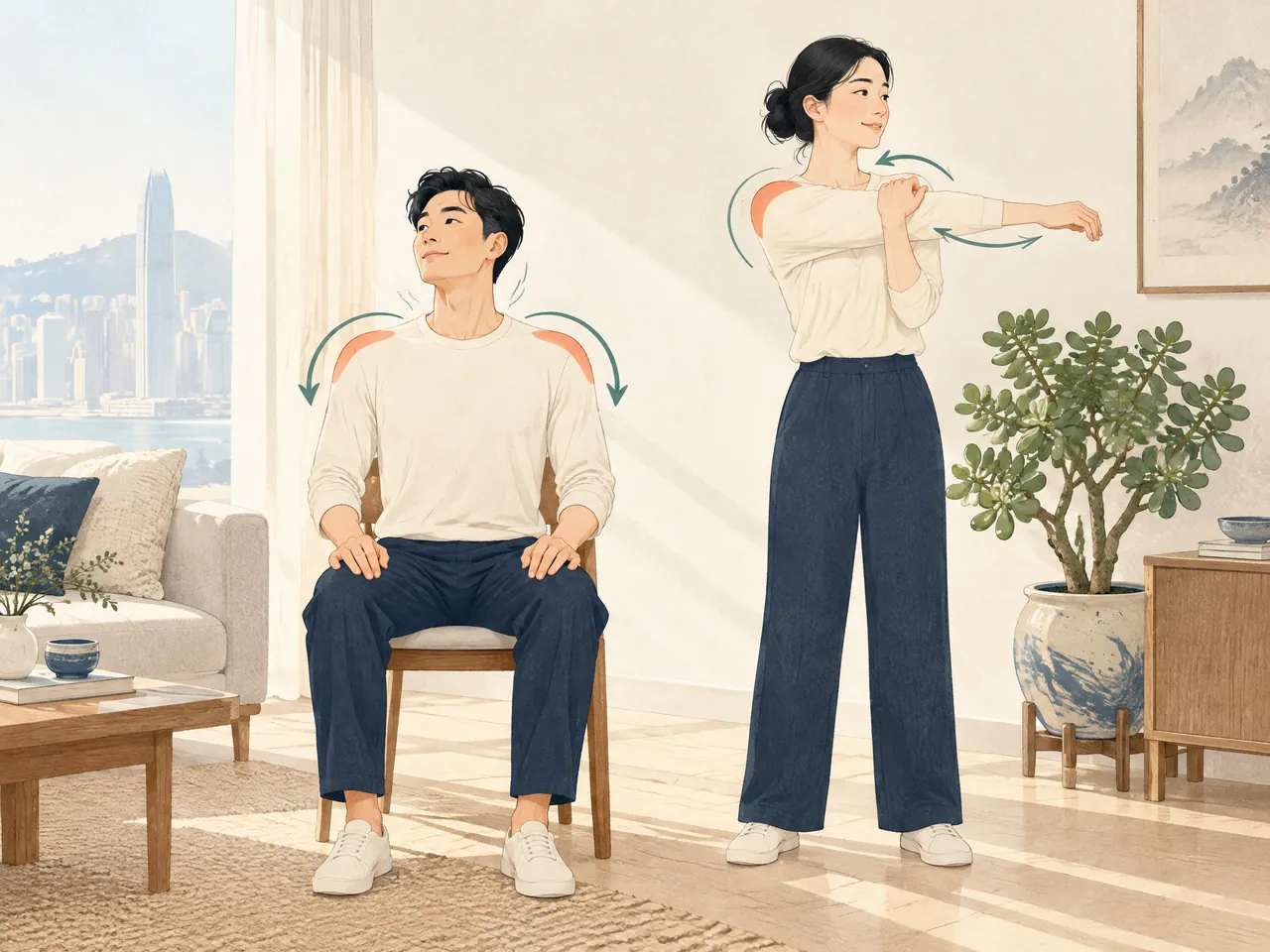
Complete rest can leave a shoulder feeling more guarded, but “keep moving” does not mean forcing painful range or designing a workout from social media. The NHS advises gentle shoulder movement, avoiding activities that make symptoms worse, and not making up strenuous exercises or using heavy gym equipment; it also advises professional review when movement is very difficult or pain fails to start improving. [3] Use that principle in ordinary life: keep objects within an easy reach, use two hands for awkward items, take breaks before fatigue makes the shoulder shrug upward, and follow exercises only as prescribed for your diagnosis. If a physiotherapist or doctor has supplied a programme, ask how acupuncture sessions should sit alongside it. The better plan is usually the one that you can repeat calmly, observe, and adjust with the clinician who knows the injury.
Acupuncture for shoulder pain Hong Kong: when to seek medical review before rotator cuff injury treatment Hong Kong
Seek prompt medical care rather than booking supportive treatment first when pain is sudden or severe, the arm cannot be moved, the shoulder looks deformed, or there is marked swelling after an injury. Persistent pins and needles, loss of sensation, an arm that feels hot or cold, fever or feeling unwell are further reasons for urgent review. [3] Immediate arm weakness following an injury also warrants timely medical advice. [2] Acute redness, warmth and swelling need assessment before needling. These signs do not identify one diagnosis by themselves, but they change the priority from symptom relief to finding out what needs attention. For non-urgent but persistent symptoms, arrange a medical assessment if the shoulder is worsening, is very difficult to move, or is not beginning to settle. If you would like to discuss a conservative acupuncture assessment after appropriate triage, TCM Lab accepts enquiries at its Kwun Tong Chinese medicine clinic and Chinese medicine clinic Prince Edward locations.
Care and health guide
Shoulder discomfort: care information
This directory brings together services, reading, and visit information related to shoulder discomfort, to help you prepare questions for a consultation.
When shoulder discomfort affects your day, noting when it occurs, its relation to activity, and what you have already tried can help prepare a consultation; acupuncture for shoulder pain is a relevant service or reading entry point.
Individual circumstances differ, and acupuncture Hong Kong offers related information to help you understand options and prepare questions.


Your questions, answered
Frequently asked questions
Can acupuncture repair a rotator cuff tear?
No. Acupuncture cannot reconnect a partially or completely torn tendon. It may be discussed for symptom support after an appropriate assessment, but structural decisions require medical evaluation and, when indicated, imaging and rehabilitation planning.
How do I know whether shoulder pain needs imaging?
Imaging is not decided by pain alone. A clinician considers how symptoms began, weakness, movement, examination findings and whether a significant injury occurred. Sudden weakness after trauma, inability to move the arm, deformity or marked swelling should be assessed promptly.
What should I wear or bring to an acupuncture assessment for shoulder pain?
Wear clothing that allows comfortable access to the shoulder and upper arm, or bring a loose top. Bring any imaging report, referral letter, medicine list and physiotherapy exercise plan. It also helps to note the movement that hurts, how symptoms affect sleep and whether a fall or lifting incident started the problem.
Can I exercise straight after acupuncture for shoulder pain?
Follow the advice given after your assessment and your existing rehabilitation plan. Avoid treating a less painful shoulder as permission for heavy lifting or forceful overhead exercise. Gentle activity may be appropriate for some people, but the safe level depends on the suspected condition and current function.
Sources and further information
- [1] [1] Hong Kong Adventist Hospital — Rotator Cuff Tear: The Culprit Behind Shoulder Pain
Referenced for: Hong Kong hospital guidance supporting multiple possible causes of shoulder pain, assessment by history, examination and MRI or ultrasound, and the distinction between conservative management and complete-tear decisions.
- [2] [2] Mayo Clinic — Rotator cuff injury: Symptoms and causes
Referenced for: Supports general rotator cuff anatomy, symptoms, contributors and prompt assessment for immediate weakness after injury.
- [3] [3] NHS — Shoulder pain
Referenced for: Supports general shoulder-pain self-care boundaries, professional review and urgent warning signs.
- [4] [4] National Center for Complementary and Integrative Health — Acupuncture: Effectiveness and Safety
Referenced for: Supports general acupuncture description, evidence uncertainty, sterile-needle safety and the need not to delay healthcare assessment.