
TCM Lab · Health reading
Walking with Hip Pain and Hip Pain Activity Modification: A Practical Guide
Published Updated
A painful hip does not automatically mean that every walk must stop. For many people, the useful question is which part of the walk changes symptoms: the first few steps after sitting, a longer distance, a hill, a crowded MTR interchange, or the trip home after carrying shopping. Walking with hip pain is best approached as a function-and-load problem while the cause is being assessed. When there is no injury-related emergency or other warning sign, hip pain activity modification can mean keeping a manageable amount of movement, then reducing features that make pain or limping worse. Location, timing, and weight-bearing ability give a clinician more useful information than a pain score alone.
Appointments are confirmed through WhatsApp. If you have language requirements, please mention them in your enquiry.
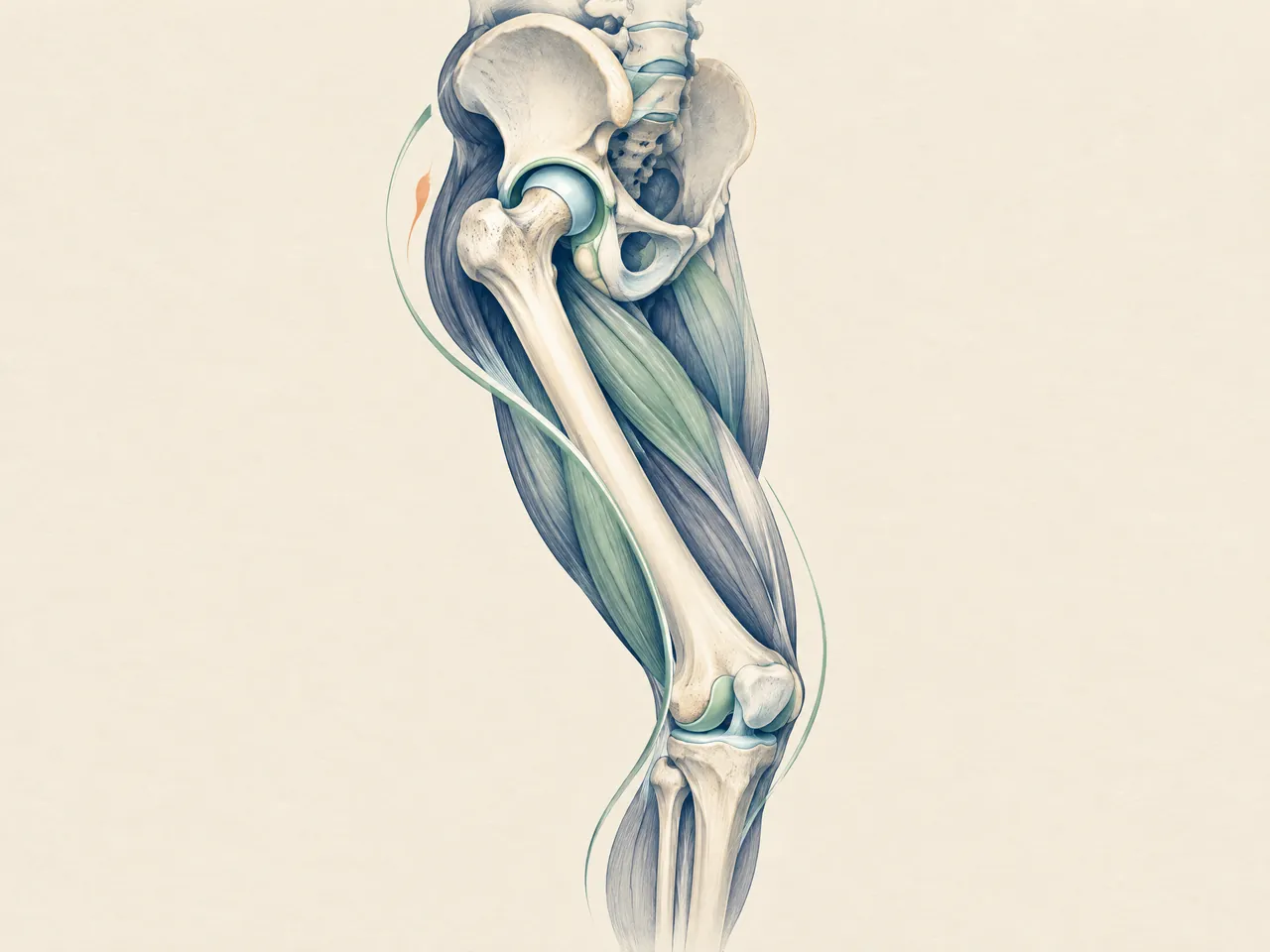
The short answer
For walking with hip pain, start with a route and pace you can complete without a marked flare, then note what changes symptoms: distance, hills, stairs, uneven ground, carrying, or getting up after sitting. Hip pain activity modification means changing those loads rather than automatically staying in bed. Severe pain after an injury, inability to walk or bear weight, persistent numbness, deformity, or a hot swollen hip with fever needs prompt medical assessment [1].
Transparent pricing
See the fees.
Choose your care.
Explore our complete official price list, including first-trial prices, regular prices, packages and branch-specific options.
Opening WhatsApp prepares an enquiry; it does not send a message, take payment or confirm an appointment. Suitability and individual arrangements are confirmed during consultation.
Pain care
All prices in HKDExtracorporeal shockwave treatment
Shockwave treatment for deep-tissue and fascial care. The Kwun Tong clinic offers the multi-area options shown below.
Priced by branch
Branch-specific pricing
Prince Edward: HK$250 per area
Kwun Tong: HK$250 for 1 area / HK$450 for 2 areas / HK$600 for 3 areas
Pain care (manual therapy)
Includes Chinese medicine musculoskeletal assessment, manual joint techniques and tui na.
HK$580 (single session)
Chinese medicine musculoskeletal assessment
Pain care (acupuncture and manual therapy)
Combines acupuncture and manual therapy.
HK$680 (single session)
Combined care
Hair and scalp
All prices in HKDScalp health and hair-loss management
Includes AI scalp analysis, deep scalp and follicle cleansing, and scalp oil-control care.
HK$380 (first trial)
Regular price: HK$680
- 6 sessions: HK$3,480 (HK$580 per session)
- 12 sessions: HK$5,760 (HK$480 per session)
- 20 sessions: HK$8,600 (HK$430 per session)
- 30 sessions: HK$11,400 (HK$380 per session)
Hair acupuncture and Chinese herbal medicine package
Includes scalp acupuncture and 3 days of Chinese herbal medicine that does not require decoction.
HK$580 (single session)
Registered Chinese Medicine Practitioner consultation
- 6 sessions: HK$3,180 (HK$530 per session)
- 12 sessions: HK$5,760 (HK$480 per session)
- 20 sessions: HK$8,600 (HK$430 per session)
- 30 sessions: HK$11,400 (HK$380 per session)
Combined hair and scalp treatment
Combines acupuncture and Chinese herbal medicine with salon-level scalp and follicle care. Packages include complimentary hair-care shampoo and serum.
HK$1,260 (single session)
Combined treatment
- 8 sessions: HK$8,640 (HK$1,080 per session)
- 16 sessions: HK$15,680 (HK$980 per session)
- 20 sessions: HK$18,600 (HK$930 per session)
- 30 sessions: HK$26,400 (HK$880 per session)
Weight management
All prices in HKDFull-body acupoint embedding for weight management
Includes full-body acupoint embedding. Packages include complimentary Chinese herbal medicine for weight management, with the number of included days scaled to the package. Embedding material and the individual treatment arrangement are confirmed during consultation; this is not a cosmetic thread lift.
HK$980 (single session)
No trial session
- 10 sessions: HK$7,800 (HK$780 per session)
- 20 sessions: HK$14,600 (HK$730 per session)
- 30 sessions: HK$20,400 (HK$680 per session)
Facial acupuncture
All prices in HKDFacial acupuncture (basic)
Includes facial acupuncture and meridian-based facial care, including care for facial puffiness.
HK$480 (first trial)
Regular price: HK$680
- 10 sessions: HK$5,200 (HK$520 per session)
- 20 sessions: HK$9,600 (HK$480 per session)
- 30 sessions: HK$13,500 (HK$450 per session)
Facial acupuncture (advanced)
Includes enhanced facial acupuncture with a specially formulated moisturising mask and serum.
HK$780 (first trial)
Regular price: HK$1,180
- 10 sessions: HK$9,000 (HK$900 per session)
- 20 sessions: HK$16,600 (HK$830 per session)
- 30 sessions: HK$23,400 (HK$780 per session)
Chinese medicine
All prices in HKDAcupuncture and Chinese herbal medicine package
Includes a Chinese medicine consultation with pulse assessment, body acupuncture and 3 days of Chinese herbal granules that do not require decoction.
HK$580 (single session)
Chinese medicine consultation with pulse assessment
Walking with Hip Pain and Hip Pain Activity Modification: Start by Tracking Function
Begin with an ordinary day rather than a perfect one. Notice whether discomfort is present when you first stand from a chair, only after several blocks, while turning to cross a road, or later that evening. Record the route, pace, surface, footwear, whether you carried a bag, and what happened by the next morning. This turns a vague report of walking with hip pain into a pattern that can be discussed during assessment. A single difficult day does not identify a cause, but repeated observations can show which load is most relevant.
Pain around the hip has more than one possible source. Symptoms can come from the joint, tendons, a bursa, muscles, the lower back, or an injury, among other possibilities. Hip osteoarthritis, for example, may be felt in the hip, groin, inner thigh, or buttock, and can make walking, stepping up, or getting out of a chair difficult [2]. That does not mean every symptom in those places is osteoarthritis. It means that a location map is useful when paired with history, function, and examination rather than used for self-diagnosis.

Use function as the main marker for hip pain activity modification. Can you take your usual first steps without a sharp catch? Does a limp begin after a certain point? Can you turn, sit down, and get up with control? Can you reach the toilet at night safely? These questions help separate a manageable but limited walk from a situation in which the walking plan needs to pause for assessment. If a knee also hurts, do not assume it is a separate issue: the pattern may be worth discussing in the context of knee pain as well.
Walking with Hip Pain and Hip Pain Activity Modification: Note Location and Timing
Map the most noticeable area with a hand: groin or front of the hip, outer hip, buttock, upper thigh, or more than one area. Then describe the timing. Pain when taking the first steps after getting out of a car differs from pain that grows only on a long downhill route. Pain when lying on one side, pain on stairs, and pain after a sudden pivot each add context. Avoid repeatedly pressing the area to ‘test’ it; the useful information is how symptoms behave during normal movement and recovery.
Timing also guides small experiments. If the first few minutes are uncomfortable but the rest of a short level walk is stable, an unhurried warm-up near home may be more sensible than rushing for transport. If symptoms build with every additional block, use the last tolerable distance as a temporary ceiling instead of trying to finish the previous route. The wider guide to hip pain exercises can help frame activity choices, but an online routine cannot determine why a particular hip hurts.
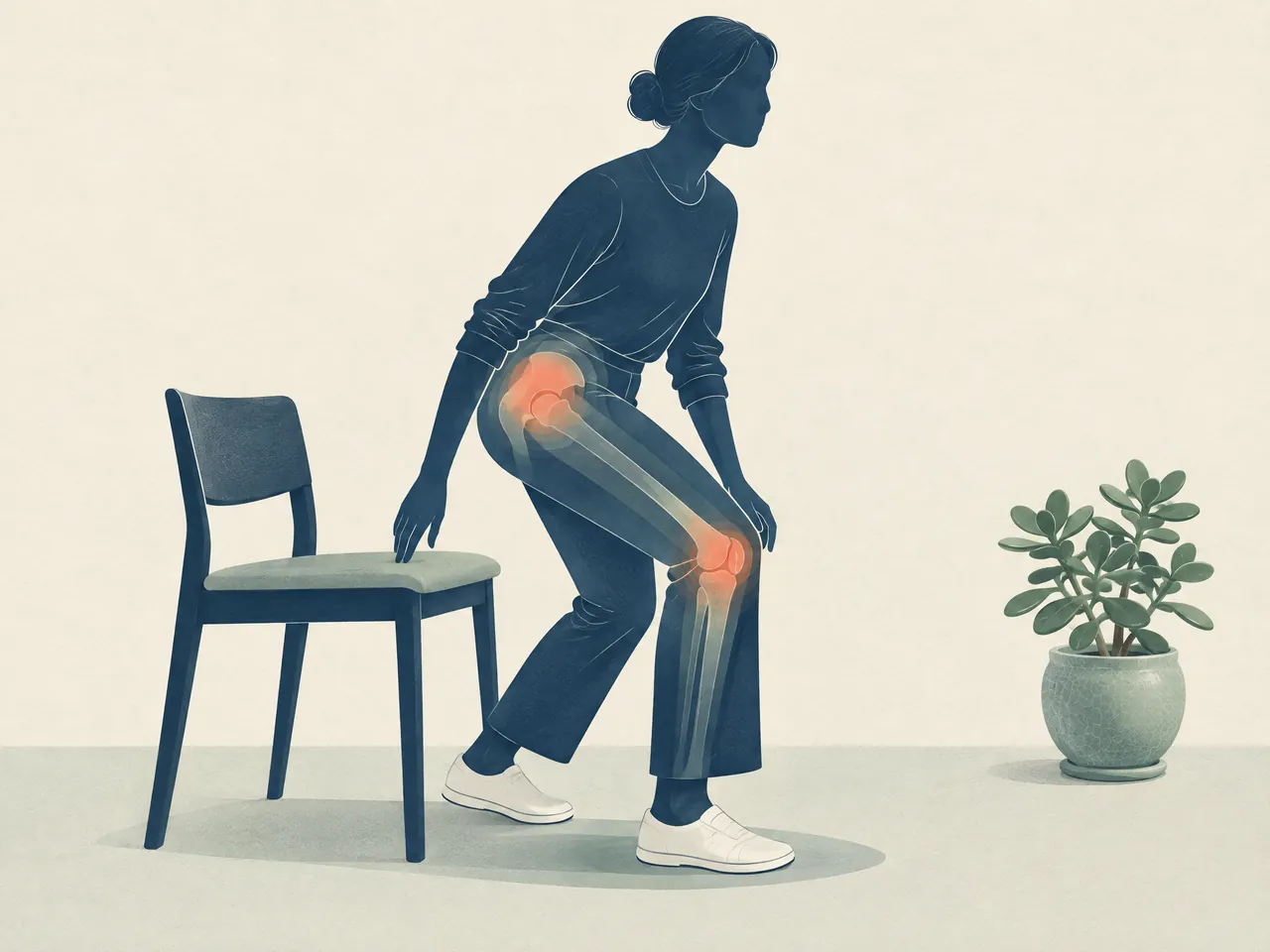
Walking with Hip Pain and Hip Pain Activity Modification: Check Weight-Bearing Ability
Weight-bearing is a safety question, not a fitness challenge. Compare what happens when you stand through the affected leg, take a few ordinary steps indoors, and turn carefully. A new limp, a feeling that the leg may give way, or a sudden need to hold furniture are details to report. Do not deliberately force a single-leg balance test or a deep squat to prove that you can cope. Those tests can add load without clarifying the cause.
After a fall, collision, or twisting incident, severe pain, an inability to walk or put weight on the leg, or tingling or loss of feeling warrants emergency assessment according to NHS guidance [1]. A visibly changed hip or leg also should not be managed with stretching or massage while waiting to ‘see if it settles’. See the page on severe hip pain after a fall for the related triage discussion. In this setting, changing a walking route is not an adequate substitute for care.
Compare your options
| Situation | A lower-load adjustment to try | What to note afterwards | When not to rely on self-adjustment |
|---|---|---|---|
| Pain builds during a usual long route | Use a shorter, familiar level route and split errands across the day. | Distance to symptom change, limp, and how the hip feels later that day and next morning. | Stop self-testing and seek assessment if you cannot bear weight or pain is suddenly severe. |
| Stairs trigger pain or insecurity | Use a handrail, go slowly, take one step at a time, or choose a lift where possible. | Whether the problem is going up, down, turning on a landing, or after several flights. | Seek assessment promptly after a fall, new numbness, or a visibly changed leg or hip. |
| Getting up from sitting is difficult | Choose a higher, firmer seat and avoid repeated low-chair transfers for now. | First-step pain, stiffness after sitting, and whether a limp settles or persists. | Arrange review if ordinary activities or sleep are affected, pain worsens, or it keeps returning. |
| A walk includes shopping or a work bag | Reduce the carried load, use smaller trips, delivery, or ask for assistance temporarily. | Whether carrying changes the side, location, or timing of symptoms. | Do not treat a hot swollen hip, fever, or feeling unwell as a carrying-related strain. |
On smaller screens, scroll the table sideways to compare all columns.
Walking with Hip Pain and Hip Pain Activity Modification: Adjust Daily Loads
When there are no urgent signs, the aim is usually not to win or lose a walking challenge. It is to keep daily life moving within a range that does not clearly worsen symptoms. Start by changing one demand: shorten the route, slow the pace, choose level ground, take fewer stairs, or split one errand into two trips. The NHS advises people with hip pain to avoid putting too much strain on the hip while keeping moving if possible [1]. That practical balance is more useful than either complete rest or forcing the normal routine unchanged.
Use symptom behaviour to judge the adjustment. A tolerable outing may leave you tired or aware of the hip but still able to walk normally afterwards and return to usual activities. A less tolerable outing may produce an obvious limp, force repeated unplanned stops, or leave the hip distinctly worse into the next day. If that pattern repeats, step back to the last manageable version and seek assessment if progress stalls. Persistent or recurrent pain, pain affecting normal activities or sleep, and symptoms that have not improved after home care are reasons to arrange non-urgent review [1].
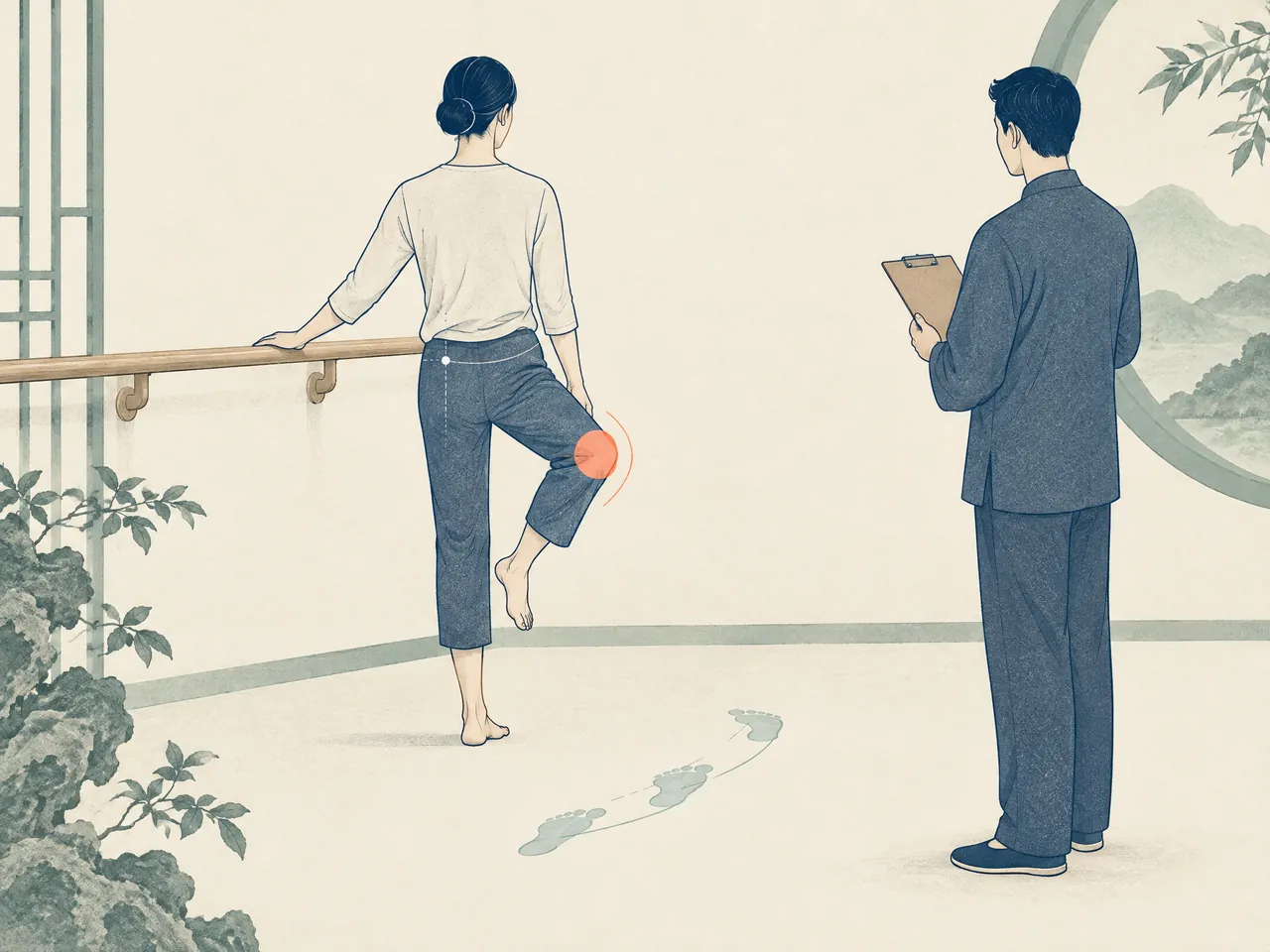
Walking with Hip Pain and Hip Pain Activity Modification: Keep Movement Tolerable
Make the first walk deliberately easy to judge. Choose a familiar, level route close to home, wear footwear that feels stable, and avoid adding a new hill, long stride, or shopping load on the same day. The NHS specifically suggests comfortable, shock-absorbing shoes with a soft sole for hip pain [1]. That is general self-care guidance, not a promise that one type of shoe will solve pain. What matters is whether the footwear and route allow steadier walking without a clear worsening pattern.
Alternate activity with a pause before you are forced to stop. A pause can mean sitting on a higher seat, standing supported, or doing a different low-demand task; it need not mean lying in bed for the afternoon. Keep a realistic baseline for several days before increasing distance. When you do increase, alter only one feature and observe the response over the same day and the following morning. This method reduces guesswork and gives an assessor a clearer account of what has been tried.
Walking with Hip Pain and Hip Pain Activity Modification: Change Stairs, Sitting, and Footwear Tasks
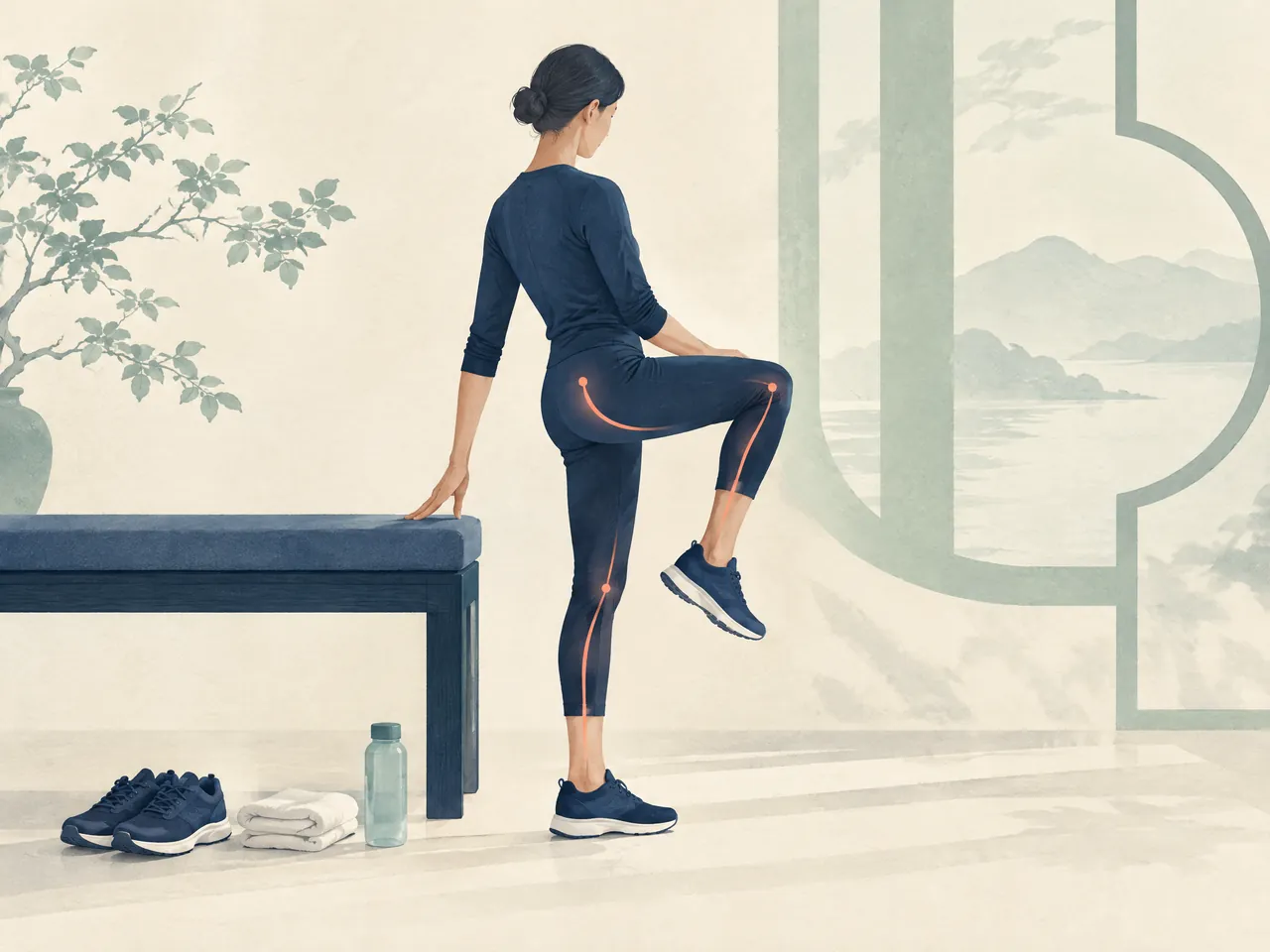
Stairs deserve their own plan because they combine hip motion, balance, and load. Use a handrail where available, take one step at a time if needed, and avoid rushing to keep up with others. If a flight of stairs repeatedly brings on pain or instability, use a lift or change the route until you have been assessed. The same principle applies to low chairs, deep sofas, and low toilets: getting down and up may aggravate the hip even when level walking is reasonably manageable. NHS advice also says not to sit in low chairs, which can put extra pressure on the hips [1].
Footwear tasks can be surprisingly demanding. Instead of bending and twisting quickly to reach socks or laces, sit on a stable higher chair and bring the foot within reach if comfortable, or ask for help temporarily. Avoid trying to stretch into pain simply because a motion feels restricted. Carrying a heavy backpack, suitcase, or grocery bags adds another load; the NHS advises avoiding heavy carrying with hip pain [1]. A smaller shop, lighter bags, delivery, or a companion can be a more meaningful activity modification than skipping all walking.
Walking with Hip Pain and Hip Pain Activity Modification: Know When to Seek Care
Activity modification has limits. It is reasonable only when you can move safely and symptoms are not signalling a time-sensitive problem. A sudden change from ordinary walking to severe pain deserves attention, especially if there was an accident, a fall, or a turn that immediately changed your ability to bear weight. Do not wait for a particular number of painful days before acting when the pattern is alarming. The key question is whether you can safely walk and whether there are associated signs that need medical assessment.
Some symptoms call for urgent rather than routine care even without a fall. NHS guidance lists sudden severe hip pain, a hip that is swollen and hot, changed skin colour around the hip, or hip pain accompanied by fever or feeling generally unwell as reasons for urgent advice [1]. These features can point to problems that should not be handled with a self-directed walking programme, heat, or stretching. If in doubt about the urgency, local emergency and healthcare services can direct you to the appropriate assessment route.
For non-emergency symptoms, make an appointment when hip pain is stopping normal activities, affecting sleep, getting worse, returning repeatedly, or not improving after home measures [1]. Bring the walking notes described above. Include recent injury, medication, any numbness or weakness, and what you have already changed. An assessment can consider the hip and nearby areas, decide whether tests are needed, and discuss an appropriate management plan. It is more useful than trying to match one online description to yourself.

Walking with Hip Pain and Hip Pain Activity Modification: Recognise Urgent Warning Signs
Seek emergency assessment after an injury if hip pain is severe, you cannot walk or bear weight, or you have tingling or loss of feeling in the hip or leg [1]. Treat a deformity or an obviously unusual leg position as urgent too. Do not test the leg repeatedly, drive yourself if you cannot control the pedals safely, or rely on a temporary improvement after resting. Those details change the decision from ‘how far should I walk?’ to ‘how quickly should I be assessed?’
A hot, swollen hip with fever or feeling unwell is a different warning pattern that also deserves urgent care [1]. A new red, hot, swollen, painful area should not be treated as routine muscle tightness. Equally, a sudden severe pain without a fall is not something to solve by increasing stretches or taking a longer walk. List the onset time and associated symptoms for the clinician, but do not delay seeking advice in order to complete a symptom diary.
Walking with Hip Pain and Hip Pain Activity Modification: Discuss Next Steps After Assessment
At a non-urgent appointment, describe the practical goal you want back: walking to the bus stop, standing through a work shift, taking stairs at home, or putting on shoes independently. Share what makes the task worse and what changes have helped. This lets the clinician discuss options in relation to your life rather than offering a generic rule about rest. Ask when to increase walking, what change would mean you should call back, and whether a rehabilitation referral or other assessment is appropriate.
TCM Lab Hong Kong can receive an enquiry about a non-urgent Chinese medicine consultation at the Kwun Tong Chinese medicine clinic or Chinese medicine clinic Prince Edward. Explain that the concern is walking with hip pain, describe any recent injury and current weight-bearing ability, and state any language needs so arrangements can be confirmed. Before enquiring, you may also review the Chinese medicine clinic price list Hong Kong. Urgent warning signs still require medical care first.
Care and health guide
Pain-care information
This directory brings together services, reading, and visit information related to pain care, to help you prepare questions for a consultation.
When pain care affects your day, noting when it occurs, its relation to activity, and what you have already tried can help prepare a consultation; Chinese medicine pain management Hong Kong is a relevant service or reading entry point.
Individual circumstances differ, and acupuncture Hong Kong offers related information to help you understand options and prepare questions.


Your questions, answered
Frequently asked questions
How far should I walk with hip pain?
There is no single safe distance for everyone. Begin below the distance that reliably brings on a marked limp or clear worsening, preferably on a level familiar route. Track the response during the walk and later that day. If function is deteriorating, pain keeps returning, or normal activity and sleep are affected, arrange assessment instead of continually testing a longer distance [1].
Should I rest completely when walking with hip pain hurts?
Not automatically. In the absence of warning signs, general NHS advice is to keep moving if you can while avoiding too much strain [1]. A useful middle path is to temporarily reduce distance, hills, stairs, carrying, or pace and keep other comfortable movement. Complete bed rest can make ordinary tasks harder, but an injury with severe pain or inability to bear weight needs medical care rather than a walking plan.
Is groin pain different from outer-hip or buttock pain?
The location can offer a useful clue, but it cannot identify the cause by itself. Hip osteoarthritis may be felt in the hip, groin, inner thigh, or buttocks, while pain in the hip area may also relate to nearby tissues or the lower back [2]. Note the precise location, timing, and movements that change it, then discuss the pattern with a clinician if it persists or limits walking.
When is hip pain an emergency?
After an injury, severe hip pain, being unable to walk or bear weight, or tingling or loss of feeling in the hip or leg are emergency warning signs [1]. Urgent advice is also appropriate for sudden severe pain without an injury, or a hip that is hot, swollen, associated with skin colour change, fever, or feeling generally unwell [1]. Do not wait to see whether a modified walk fixes these symptoms.
Sources and further information
- [1] [1] NHS — Hip pain in adults
Referenced for: General adult hip-pain self-care, routine review triggers, urgent warning signs, and injury-related emergency signs.
- [2] [2] National Institute of Arthritis and Musculoskeletal and Skin Diseases — Osteoarthritis
Referenced for: Hip osteoarthritis symptom locations and examples of affected everyday function; used to explain why location is a clue rather than a diagnosis.