
TCM Lab · Explore a health topic
Elbow pain, elbow pain TCM and inner elbow pain: understand the pattern
Published Updated
Elbow pain rarely becomes clearer by giving it a quick label. A sore point on the outside after carrying a laptop, an ache on the inside while twisting a jar, or a tender back of the elbow after leaning at a desk may all feel like ‘elbow pain’, yet they call for different questions. This guide helps you map elbow pain, elbow pain TCM questions and inner elbow pain by location, movement and change over time. It is not a way to diagnose yourself. Instead, use the pattern to describe what is happening accurately, reduce an obvious aggravating load, and decide whether an assessment or urgent medical help should come first.
Appointments are confirmed through WhatsApp. If you have language requirements, please mention them in your enquiry.
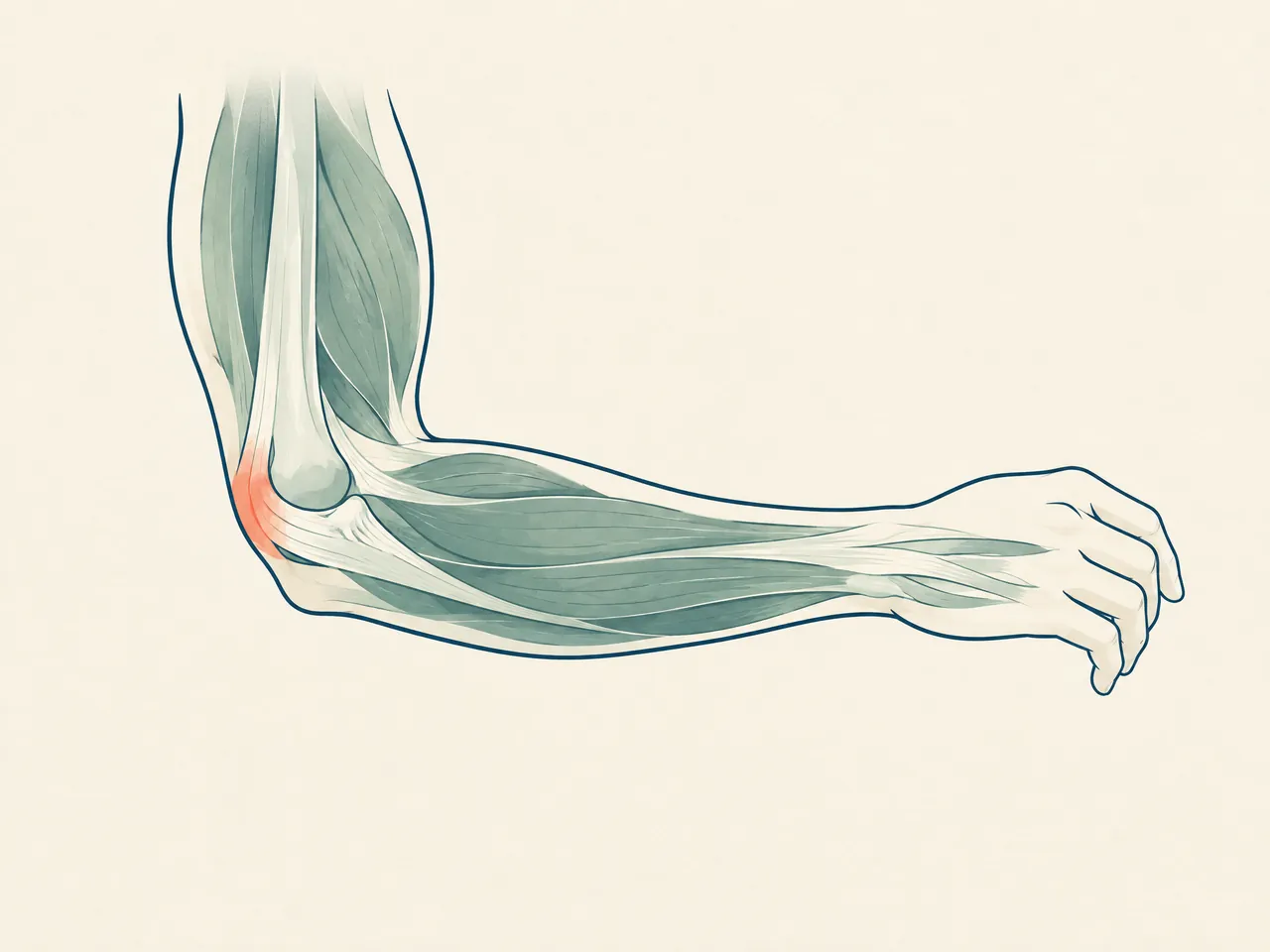
The short answer
Elbow pain is not automatically tennis elbow, and inner elbow pain is not automatically golfer’s elbow. First note the exact painful area, the movement or load that brings it on, and any swelling, loss of movement, tingling or weaker grip. A TCM consultation may discuss symptoms and supportive options after suitable assessment, but trauma, deformity, persistent numbness, a hot swollen joint with fever, or chest pressure with arm pain needs medical attention first.
Transparent pricing
See the fees.
Choose your care.
Explore our complete official price list, including first-trial prices, regular prices, packages and branch-specific options.
Opening WhatsApp prepares an enquiry; it does not send a message, take payment or confirm an appointment. Suitability and individual arrangements are confirmed during consultation.
Pain care
All prices in HKDExtracorporeal shockwave treatment
Shockwave treatment for deep-tissue and fascial care. The Kwun Tong clinic offers the multi-area options shown below.
Priced by branch
Branch-specific pricing
Prince Edward: HK$250 per area
Kwun Tong: HK$250 for 1 area / HK$450 for 2 areas / HK$600 for 3 areas
Pain care (manual therapy)
Includes Chinese medicine musculoskeletal assessment, manual joint techniques and tui na.
HK$580 (single session)
Chinese medicine musculoskeletal assessment
Pain care (acupuncture and manual therapy)
Combines acupuncture and manual therapy.
HK$680 (single session)
Combined care
Hair and scalp
All prices in HKDScalp health and hair-loss management
Includes AI scalp analysis, deep scalp and follicle cleansing, and scalp oil-control care.
HK$380 (first trial)
Regular price: HK$680
- 6 sessions: HK$3,480 (HK$580 per session)
- 12 sessions: HK$5,760 (HK$480 per session)
- 20 sessions: HK$8,600 (HK$430 per session)
- 30 sessions: HK$11,400 (HK$380 per session)
Hair acupuncture and Chinese herbal medicine package
Includes scalp acupuncture and 3 days of Chinese herbal medicine that does not require decoction.
HK$580 (single session)
Registered Chinese Medicine Practitioner consultation
- 6 sessions: HK$3,180 (HK$530 per session)
- 12 sessions: HK$5,760 (HK$480 per session)
- 20 sessions: HK$8,600 (HK$430 per session)
- 30 sessions: HK$11,400 (HK$380 per session)
Combined hair and scalp treatment
Combines acupuncture and Chinese herbal medicine with salon-level scalp and follicle care. Packages include complimentary hair-care shampoo and serum.
HK$1,260 (single session)
Combined treatment
- 8 sessions: HK$8,640 (HK$1,080 per session)
- 16 sessions: HK$15,680 (HK$980 per session)
- 20 sessions: HK$18,600 (HK$930 per session)
- 30 sessions: HK$26,400 (HK$880 per session)
Weight management
All prices in HKDFull-body acupoint embedding for weight management
Includes full-body acupoint embedding. Packages include complimentary Chinese herbal medicine for weight management, with the number of included days scaled to the package. Embedding material and the individual treatment arrangement are confirmed during consultation; this is not a cosmetic thread lift.
HK$980 (single session)
No trial session
- 10 sessions: HK$7,800 (HK$780 per session)
- 20 sessions: HK$14,600 (HK$730 per session)
- 30 sessions: HK$20,400 (HK$680 per session)
Facial acupuncture
All prices in HKDFacial acupuncture (basic)
Includes facial acupuncture and meridian-based facial care, including care for facial puffiness.
HK$480 (first trial)
Regular price: HK$680
- 10 sessions: HK$5,200 (HK$520 per session)
- 20 sessions: HK$9,600 (HK$480 per session)
- 30 sessions: HK$13,500 (HK$450 per session)
Facial acupuncture (advanced)
Includes enhanced facial acupuncture with a specially formulated moisturising mask and serum.
HK$780 (first trial)
Regular price: HK$1,180
- 10 sessions: HK$9,000 (HK$900 per session)
- 20 sessions: HK$16,600 (HK$830 per session)
- 30 sessions: HK$23,400 (HK$780 per session)
Chinese medicine
All prices in HKDAcupuncture and Chinese herbal medicine package
Includes a Chinese medicine consultation with pulse assessment, body acupuncture and 3 days of Chinese herbal granules that do not require decoction.
HK$580 (single session)
Chinese medicine consultation with pulse assessment
Explore this topic
Elbow pain, elbow pain TCM and inner elbow pain: start with location
A useful elbow-pain record begins with one finger: where is the most sensitive point? Describe whether it is on the bony outer side, the inner side facing your body, the crease at the front, or the point at the back. Then say whether the discomfort stays local, travels into the forearm or hand, or seems to come down from the neck or shoulder. Clinical assessment of elbow symptoms considers tendons, bursae, bones and nerves, so a location helps narrow the conversation without proving a cause [2].
Also record the story around the pain. Did it arrive after a fall, an unfamiliar gym session, a week of repetitive mouse use, or gradually during normal work? Was there a snap, bruise, visible swelling, warmth, locking, or trouble fully bending or straightening? These details make a later discussion more useful than simply reporting a pain score. For a fuller symptom-by-symptom explainer, read elbow pain causes alongside your own notes.
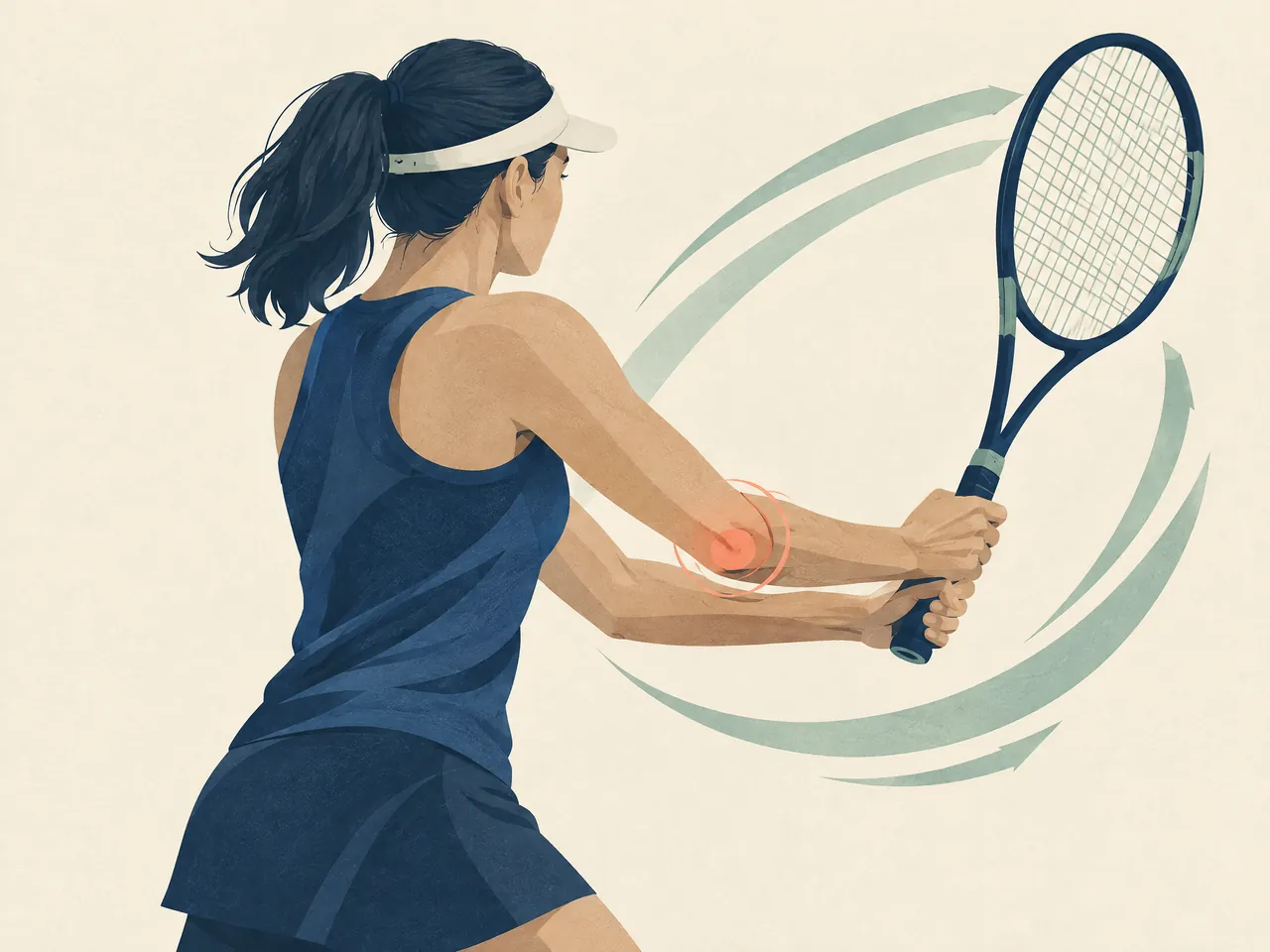
Elbow pain, elbow pain TCM and inner elbow pain: compare the painful areas
Outer elbow pain is often noticed during gripping, lifting a kettle, using a screwdriver, or lifting the wrist against resistance. It is commonly called tennis elbow in everyday language, but an online label cannot rule out other local structures, an injury, or a nerve-related problem. Inner elbow pain may be more obvious when forcefully gripping, turning a key, carrying a bag with the palm up, or using a racquet or club. A primary-care review notes that activity-related medial pain and repeated stress are relevant history points, while numbness and tingling deserve specific attention [2].
Pain at the front of the elbow can be felt when bending the arm or turning the palm; pain at the back can be more noticeable when pushing up from a chair or resting the point of the elbow on a hard surface. Treat these as descriptions rather than a home test. Compare both arms, note whether the painful spot is tender to a light touch, and distinguish an ache after activity from pain that begins at rest. If the pain moves from the neck or shoulder towards the elbow, include that in the picture because referred pain can present as elbow pain [2].
Elbow pain, elbow pain TCM and inner elbow pain: note movements and daily load
Write down the particular action, not just ‘exercise’. For example: holding a phone with the elbow bent on the MTR; moving stock from a low shelf; prolonged keyboard and mouse work; lifting a child; opening jars; serving in badminton; or repeated drilling. Note whether the same action hurts at the start, only after repetition, or the next morning. Grip, wrist position, elbow bend, shoulder posture and total repetition can all change the load a person feels around the joint. This is practical information for an assessment, not a reason to blame one task alone.
Daily load includes recovery as well as the obvious trigger. Consider changes in sleep, a new job rotation, extra household lifting, a new training routine, or continuing the same activity despite rising symptoms. It may help to temporarily change the grip, share a lifting task, use the other hand where safe, or break a long repetitive activity into smaller periods. The guide to tennis elbow pain relief can help you frame questions about everyday modifications, while pain that follows an accident should not be managed as a routine overuse problem.
Compare your options
| What to compare | Useful detail to record | Why it matters for the conversation |
|---|---|---|
| Pain location | Outer, inner, front or back; one spot or a wider area | Separates the main symptom area from pain that spreads. |
| Trigger | Grip, twist, lift, push, keyboard use, sport, or leaning on the elbow | Links symptoms to a real task rather than a general label. |
| Timing | Sudden after injury, gradual, during activity, after activity, or at rest | Helps distinguish the onset and trajectory that need assessment. |
| Associated change | Swelling, warmth, bruising, clicking, locking, numbness or weaker grip | Highlights changes that can alter the urgency or direction of care. |
| What changed the load | New training, job task, lifting, workstation habit, or a fall | Gives context for a plan to modify activity safely. |
On smaller screens, scroll the table sideways to compare all columns.
Elbow pain, elbow pain TCM and inner elbow pain: possible causes and assessment
The same movement can be uncomfortable for different reasons. That is why an elbow-pain assessment commonly asks about onset, duration, injury mechanism, provoking activity, range of movement and associated symptoms rather than relying on a single self-test [2]. The point is not to make a person worry through a long list of diagnoses. It is to distinguish a gradually developing load-related pattern from a sudden injury, a joint that is hot or swollen, a nerve-type sensation, or a problem that needs a different route of care.
Bring a simple timeline: when symptoms first appeared, what has changed since, what you stopped or continued, and what helped or aggravated it. Mention whether you can fully open the elbow, whether it catches or locks, and whether hand strength feels altered in a meaningful daily task. A clinician may look beyond the elbow, including the neck, shoulder, wrist and hand, because the apparent site of pain is not always the source. This broader view matters particularly when neck movement or shoulder symptoms change the elbow complaint [2].
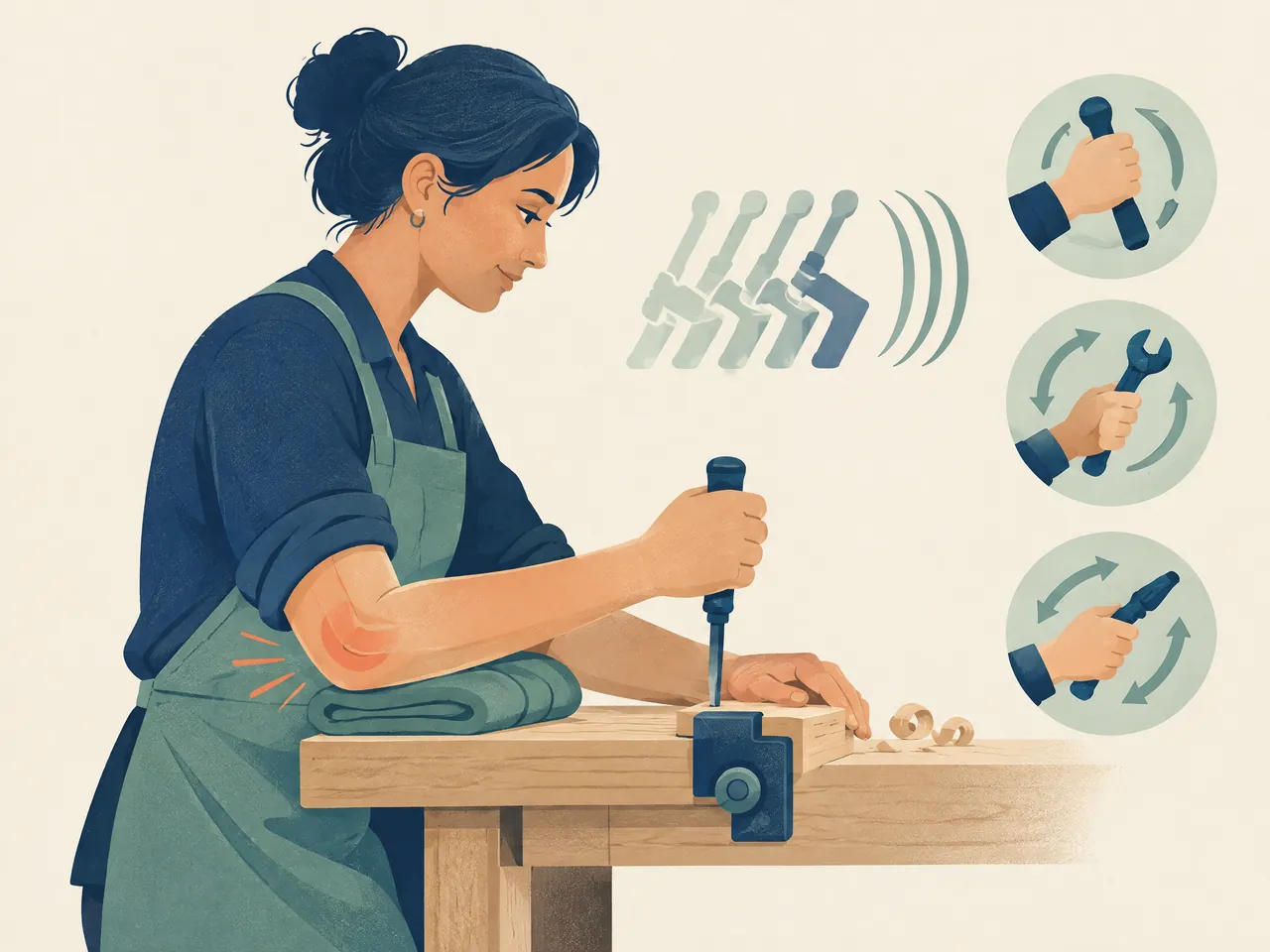
Elbow pain, elbow pain TCM and inner elbow pain: why it is not always tennis elbow
‘Tennis elbow’ is a familiar name for outer elbow symptoms, but familiarity can hide important differences. Local tendon-related symptoms are one possibility; problems involving a bursa, bone, joint, ligament or nerve can also be part of the assessment picture [2]. Inner elbow pain should not be treated as merely the mirror image of outer pain. Tingling into the ring or little finger, for example, makes it especially important to report the nerve-type symptom rather than concentrating only on tenderness. A previous fall, a sudden pull, or a change in the arm’s shape likewise shifts the priority away from self-management.
Stiffness, clicking, catching or locking add useful context. So do redness, heat, a growing lump, symptoms in other joints, and pain that is becoming more constant rather than simply tied to a task. None of these observations can name the cause at home, but they can determine how promptly you should seek assessment. If your question is specifically about a possible outer-elbow pain option, lateral elbow pain acupuncture explains why an assessment should precede assumptions about treatment.
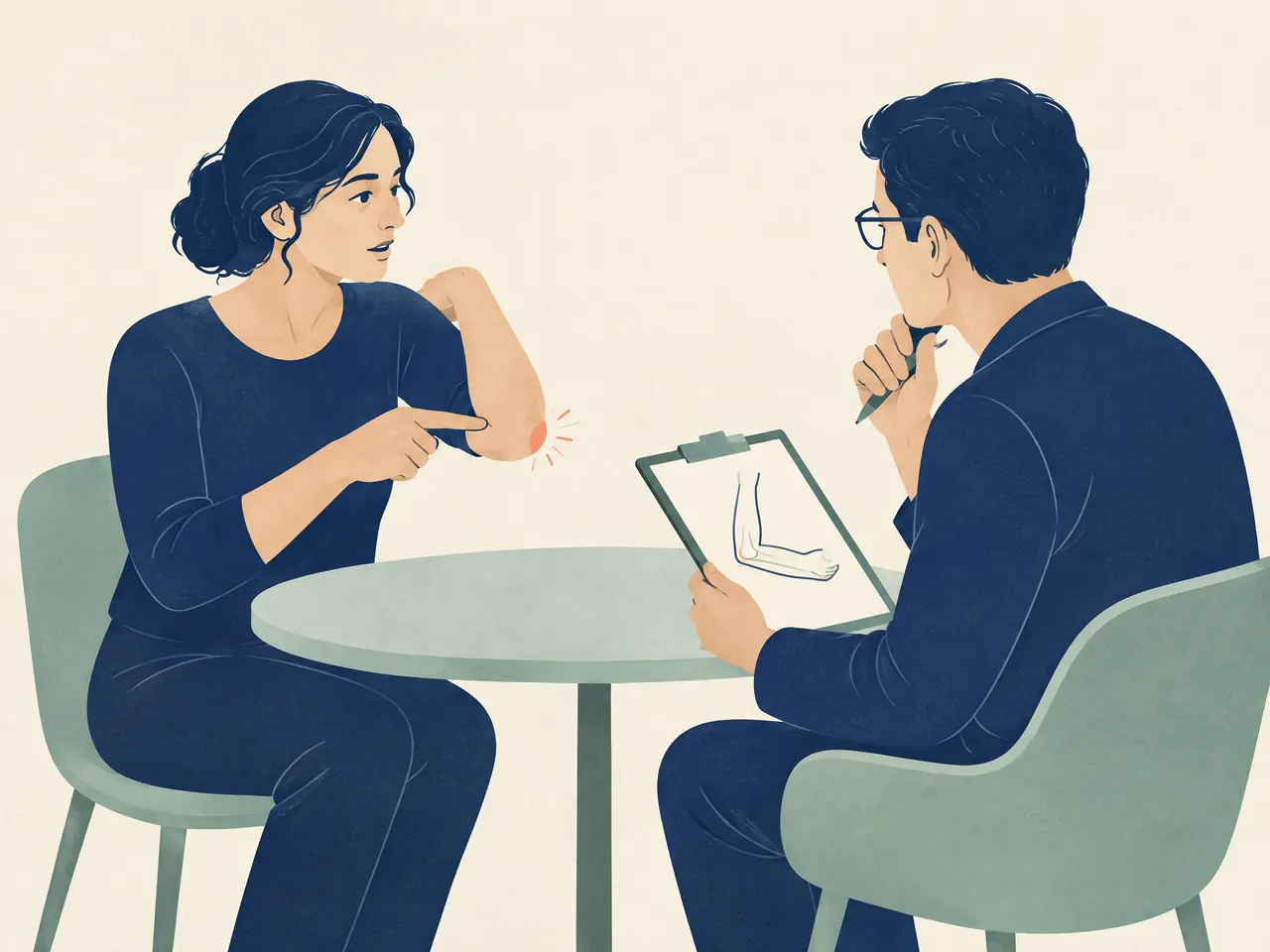
Elbow pain, elbow pain TCM and inner elbow pain: what a consultation can clarify
A focused consultation can turn a vague complaint into a usable account. Expect questions about exact location, timing, work and sport demands, previous injuries, dominant hand, and changes in sensation or function. An examination may compare the two sides and look at movement, tenderness and symptoms extending towards the wrist, hand, shoulder or neck. If the history suggests a traumatic injury, infection, nerve problem, or another medical issue, that concern should be assessed through the appropriate medical route rather than masked by repeated treatment attempts.
In a TCM context, the discussion can include your symptom map, daily routine and goals such as returning to cooking, computer work or training with more confidence. Acupuncture may be discussed as a supportive option only after the relevant safety questions and priorities are clear. The U.S. National Center for Complementary and Integrative Health describes research on acupuncture for several pain conditions, but this does not establish it as a diagnosis or a universal answer for every elbow condition [3]. Ask what the proposed approach is intended to support, how your response will be reviewed, and what changes should prompt medical reassessment.
Elbow pain, elbow pain TCM and inner elbow pain: sensible care and safety
For a mild, clearly load-related elbow complaint without warning signs, the first aim is often to stop repeatedly provoking it, not to stop all movement indefinitely. Relative rest means reducing or adapting the action that repeatedly brings on symptoms while preserving comfortable daily movement. The primary-care review similarly describes avoiding aggravating activities while restoring strength as part of tendinopathy management [2]. What is appropriate depends on the suspected problem, so progress should be guided by the pattern of symptoms rather than a fixed online timetable.

Choose a small change you can observe. A shopper might use two lighter bags instead of one heavy bag. A desk worker may avoid holding the elbow sharply bent against the desk edge for a long period. Someone returning to exercise may lower one demanding element rather than add a painful stretch to an unchanged session. Keep a short record of the next-day response. If pain escalates, movement becomes harder, or new tingling appears, step back and obtain advice rather than pushing through it.

Elbow pain, elbow pain TCM and inner elbow pain: manage load before stretching
Stretching is not a test of determination. Stop if it causes sharp pain, numbness, tingling, a sudden loss of grip or symptoms that remain distinctly worse afterwards. A gentler approach is to identify the most irritating position and make it less demanding first: reduce a heavy grip, shorten the task, change the wrist position, or pause between sets. Once the pattern is stable, an individual assessment can help decide whether mobility, gradual strengthening, technique or another element deserves attention. Trying to ‘stretch out’ a painful elbow after a fall, with marked swelling, or when it is difficult to move is not sensible.
Do not assume a passive treatment replaces changes in daily loading. If acupuncture is being considered, explain your exact pattern and any medical diagnoses, medicines, bleeding concerns, skin problems, pregnancy, implanted devices or prior reactions so the practitioner can judge suitability. The purpose is a shared, cautious discussion, not a promise of a set number of sessions or a guaranteed result. For practical local service questions, see elbow pain treatment Hong Kong and use an assessment to decide whether an adjunctive TCM approach fits your situation.

Elbow pain, elbow pain TCM and inner elbow pain: recognise when to seek medical help
Seek urgent medical help after an injury if there is severe pain with difficulty moving the arm, a snapping sound, a visible change of shape, or tingling or numbness. A swollen arm or joint together with a very high temperature or feeling hot, cold or shivery also needs urgent assessment. These are specific NHS triage warnings, not symptoms to monitor while continuing stretches or massage [1]. A tender, swollen joint after trauma and a rapidly increasing mass are also red flags in primary-care assessment [2].
Call emergency services immediately if arm pain begins suddenly with pressure, heaviness or squeezing across the chest; the NHS notes this may signal a heart attack [1]. Arrange non-emergency medical assessment when elbow or arm pain does not settle after a few weeks, is recurring, meaningfully limits work or daily living, or comes with ongoing weakness, altered sensation, locking or unexplained swelling. Once urgent problems have been excluded, you can contact TCM Lab on WhatsApp at +852 6940 5663 to discuss an elbow-pain consultation. Location pages for the Kwun Tong Chinese medicine clinic and Chinese medicine clinic Prince Edward can help you ask about the two clinics; confirm your language needs and appointment arrangement directly.
Care and health guide
Pain-care information
This directory brings together services, reading, and visit information related to pain care, to help you prepare questions for a consultation.
When pain care affects your day, noting when it occurs, its relation to activity, and what you have already tried can help prepare a consultation; Chinese medicine pain management Hong Kong is a relevant service or reading entry point.
Individual circumstances differ, and acupuncture Hong Kong offers related information to help you understand options and prepare questions.


Your questions, answered
Frequently asked questions
Does inner elbow pain always mean golfer’s elbow?
No. Inner elbow pain can be linked with repeated gripping or wrist loading, but it can also occur with nerve symptoms, joint problems, injury or pain referred from the neck or shoulder. The location and trigger provide clues only. Persistent symptoms, tingling or weakness should be assessed rather than self-labelled.
What should I write down before an elbow pain consultation?
Note the exact site, when it started, whether there was an injury, the movements that provoke it, your work or sport load, and any swelling, loss of movement, clicking, numbness or altered grip. A short timeline is more helpful than trying to perform a self-diagnosis test.
Can I keep exercising with elbow pain?
It depends on the pattern and the activity. Do not push through sharp pain, numbness, a new loss of strength or a clear worsening afterwards. Reducing or changing the provoking load while retaining comfortable movement can be a reasonable starting point for a mild load-related pattern, but trauma or warning signs require medical assessment.
When is elbow pain an emergency?
Seek emergency help for sudden arm pain with pressure, heaviness or squeezing across the chest. Urgent assessment is also needed after serious injury with severe pain or difficulty moving, a changed arm shape, snapping, tingling or numbness, or when swelling occurs with a very high temperature or feeling feverish or shivery [1].
Sources and further information
- [1] NHS: Elbow and arm pain
Referenced for: Triage warnings for trauma, numbness, fever with swelling, persistent symptoms, and chest-pressure symptoms.
- [2] British Journal of General Practice: Elbow pain assessment and management
Referenced for: Assessment considerations for location, triggering activity, movement, nerve symptoms, referred pain, and relative activity modification.
- [3] NCCIH: Acupuncture effectiveness and safety
Referenced for: General evidence and safety context for discussing acupuncture as an adjunct, not a universal elbow-pain diagnosis or outcome claim.