
TCM Lab · Health reading
Functional Dyspepsia Symptoms: Is bloating a symptom of indigestion? When should I see a doctor for persistent bloating?
Published Updated
Bloating is a common part of indigestion for some people, particularly when it arrives with uncomfortable upper-abdominal fullness, early fullness while eating, belching or nausea. It is not, however, a diagnosis by itself. Functional dyspepsia symptoms can overlap with reflux, constipation, food-related reactions and other digestive problems, so the pattern matters. Notice whether discomfort begins during a meal or later, whether it eases after a bowel movement, and whether it is occasional or keeps disrupting eating and sleep. That detail helps distinguish a short-lived reaction from a reason to arrange a medical assessment.
Appointments are confirmed through WhatsApp. If you have language requirements, please mention them in your enquiry.

The short answer
Yes. Bloating can be a symptom of indigestion, especially when it occurs with early fullness, uncomfortable post-meal fullness, upper-abdominal discomfort, belching or nausea. Functional dyspepsia is one possible explanation, but similar symptoms have other causes. Try recording meals, timing and bowel changes while making gentle habit changes. See a doctor if symptoms keep returning, interfere with daily life, or occur with warning signs such as severe pain, vomiting, bleeding, weight loss or swallowing difficulty.
Transparent pricing
See the fees.
Choose your care.
Explore our complete official price list, including first-trial prices, regular prices, packages and branch-specific options.
Opening WhatsApp prepares an enquiry; it does not send a message, take payment or confirm an appointment. Suitability and individual arrangements are confirmed during consultation.
Chinese medicine
All prices in HKDAcupuncture and Chinese herbal medicine package
Includes a Chinese medicine consultation with pulse assessment, body acupuncture and 3 days of Chinese herbal granules that do not require decoction.
HK$580 (single session)
Chinese medicine consultation with pulse assessment
Hair and scalp
All prices in HKDScalp health and hair-loss management
Includes AI scalp analysis, deep scalp and follicle cleansing, and scalp oil-control care.
HK$380 (first trial)
Regular price: HK$680
- 6 sessions: HK$3,480 (HK$580 per session)
- 12 sessions: HK$5,760 (HK$480 per session)
- 20 sessions: HK$8,600 (HK$430 per session)
- 30 sessions: HK$11,400 (HK$380 per session)
Hair acupuncture and Chinese herbal medicine package
Includes scalp acupuncture and 3 days of Chinese herbal medicine that does not require decoction.
HK$580 (single session)
Registered Chinese Medicine Practitioner consultation
- 6 sessions: HK$3,180 (HK$530 per session)
- 12 sessions: HK$5,760 (HK$480 per session)
- 20 sessions: HK$8,600 (HK$430 per session)
- 30 sessions: HK$11,400 (HK$380 per session)
Combined hair and scalp treatment
Combines acupuncture and Chinese herbal medicine with salon-level scalp and follicle care. Packages include complimentary hair-care shampoo and serum.
HK$1,260 (single session)
Combined treatment
- 8 sessions: HK$8,640 (HK$1,080 per session)
- 16 sessions: HK$15,680 (HK$980 per session)
- 20 sessions: HK$18,600 (HK$930 per session)
- 30 sessions: HK$26,400 (HK$880 per session)
Weight management
All prices in HKDFull-body acupoint embedding for weight management
Includes full-body acupoint embedding. Packages include complimentary Chinese herbal medicine for weight management, with the number of included days scaled to the package. Embedding material and the individual treatment arrangement are confirmed during consultation; this is not a cosmetic thread lift.
HK$980 (single session)
No trial session
- 10 sessions: HK$7,800 (HK$780 per session)
- 20 sessions: HK$14,600 (HK$730 per session)
- 30 sessions: HK$20,400 (HK$680 per session)
Facial acupuncture
All prices in HKDFacial acupuncture (basic)
Includes facial acupuncture and meridian-based facial care, including care for facial puffiness.
HK$480 (first trial)
Regular price: HK$680
- 10 sessions: HK$5,200 (HK$520 per session)
- 20 sessions: HK$9,600 (HK$480 per session)
- 30 sessions: HK$13,500 (HK$450 per session)
Facial acupuncture (advanced)
Includes enhanced facial acupuncture with a specially formulated moisturising mask and serum.
HK$780 (first trial)
Regular price: HK$1,180
- 10 sessions: HK$9,000 (HK$900 per session)
- 20 sessions: HK$16,600 (HK$830 per session)
- 30 sessions: HK$23,400 (HK$780 per session)
Pain care
All prices in HKDExtracorporeal shockwave treatment
Shockwave treatment for deep-tissue and fascial care. The Kwun Tong clinic offers the multi-area options shown below.
Priced by branch
Branch-specific pricing
Prince Edward: HK$250 per area
Kwun Tong: HK$250 for 1 area / HK$450 for 2 areas / HK$600 for 3 areas
Pain care (manual therapy)
Includes Chinese medicine musculoskeletal assessment, manual joint techniques and tui na.
HK$580 (single session)
Chinese medicine musculoskeletal assessment
Pain care (acupuncture and manual therapy)
Combines acupuncture and manual therapy.
HK$680 (single session)
Combined care
functional dyspepsia symptoms: Is bloating a symptom of indigestion? — When should I see a doctor for persistent bloating? and symptom patterns
Indigestion, also called dyspepsia, is a group of symptoms rather than one single disease. The National Institute of Diabetes and Digestive and Kidney Diseases lists upper-abdominal pain, burning or discomfort, feeling full too soon, uncomfortable fullness after eating, bloating, nausea and belching among its features [1]. That list answers the common question, “Is bloating a symptom of indigestion?”: it can be. Yet the same feeling may be described as pressure, a visibly distended abdomen, trapped air or simply a meal that seems to sit heavily. A useful first step is to describe the sensation in ordinary words and note its location, timing and companions instead of trying to assign a label immediately.
Functional dyspepsia symptoms often centre on the upper abdomen and the experience of eating. Someone may become uncomfortably full after a modest meal, lose interest in finishing food, or feel nausea and belching without a predictable single trigger. Other people mainly notice a swollen, tight feeling after dinner. Symptoms can be intermittent, and a more stressful week, a rushed lunch or a rich meal may make an existing tendency more noticeable. This does not show why the symptom is occurring, nor does it rule out another condition. If upper-abdominal symptoms recur, a healthcare professional can use the history, examination and, where appropriate, tests to consider the cause [1].
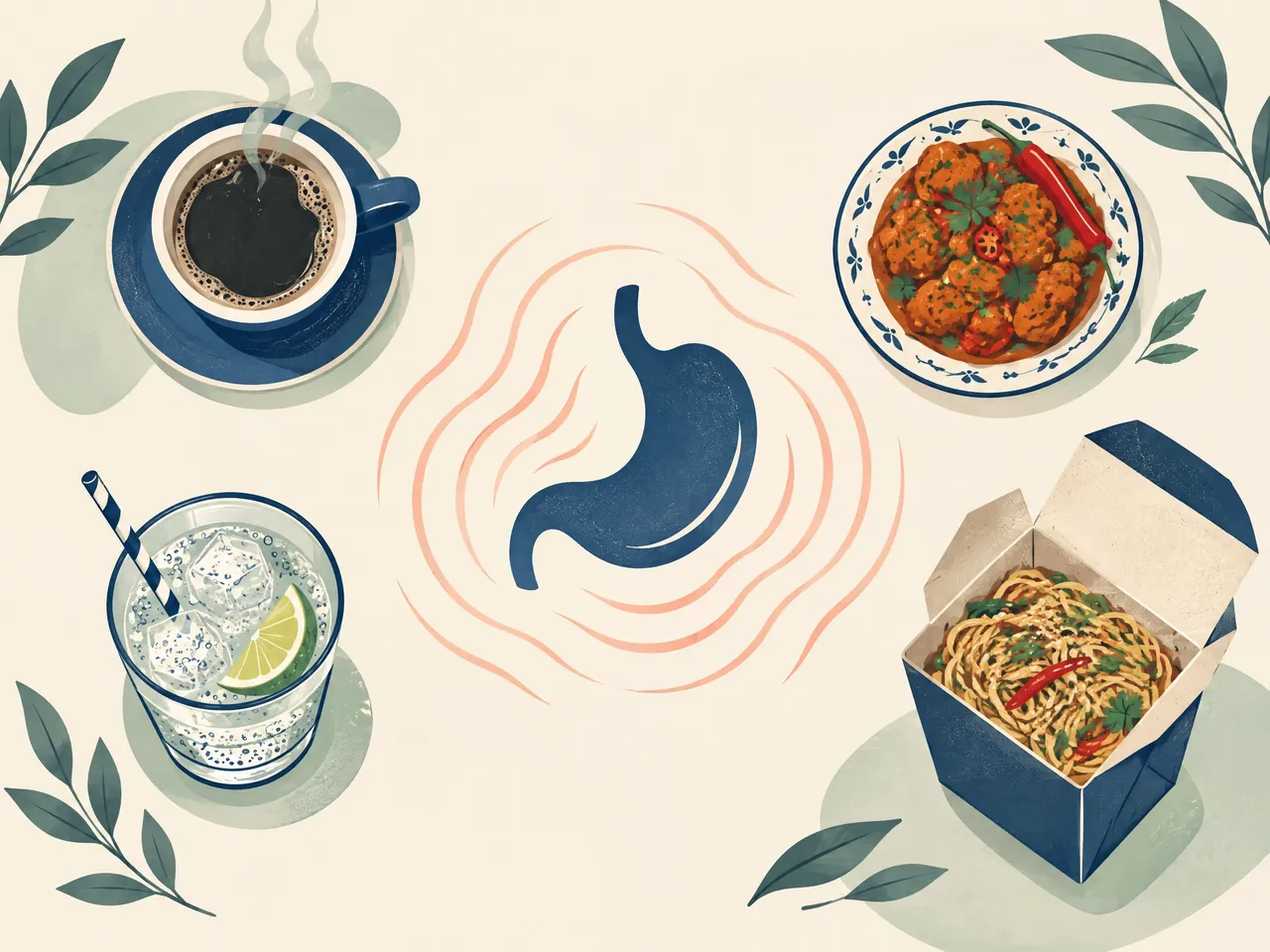
functional dyspepsia symptoms after meals: Is bloating a symptom of indigestion? — When should I see a doctor for persistent bloating? and fullness
Post-meal fullness is different from being comfortably satisfied after eating. It may feel disproportionate to the size of the meal, begin soon after the first few bites, or linger long enough to make a later snack unappealing. Compare it with postprandial fullness to put a name to the timing, but avoid assuming that timing alone identifies a cause. Ask practical questions: Was the meal unusually large or high in fat? Was it eaten very quickly? Was there coffee, alcohol, a fizzy drink or a late bedtime afterwards? Answers across several ordinary days are more informative than one difficult meal.
A diary can also show whether fullness is confined to the upper abdomen or comes with lower-abdominal pressure and changed bowel habits. Bloating that improves after passing stool or gas may point the conversation in a different direction from early fullness after small amounts of food. Heartburn and bringing up sour fluid are also not identical to dyspepsia, even though they may coexist. This distinction matters because it prevents a reader from treating every sensation after eating as the same problem. It also makes a consultation more efficient: state what you feel, where you feel it, what precedes it and what, if anything, relieves it.

Is bloating a symptom of indigestion?: functional dyspepsia symptoms — When should I see a doctor for persistent bloating? when bloating follows eating
Bloating after eating can accompany indigestion, but swallowed air and the mechanics of a meal can contribute too. Eating while rushing, talking continuously, chewing gum, drinking through a straw or choosing carbonated drinks may leave some people with more belching and pressure. Rich, fatty or spicy foods, coffee and alcohol can aggravate indigestion for some people; the NHS also notes that certain anti-inflammatory pain medicines can make it worse [2]. These are possibilities to test carefully, not a universal forbidden-food list. Keep foods that are tolerated and change only one or two habits at a time, so that the result is readable.
It is tempting to remove many foods after a bad episode. A narrower approach is usually more useful: choose one repeatable circumstance, such as a large late supper or fizzy drinks at lunch, and observe whether reducing it changes the pattern. If a particular food seems relevant, note the portion, preparation and what else was eaten; one meal does not prove intolerance. For more focused reading on the meal connection, see bloating after eating. Ongoing symptoms deserve assessment rather than increasingly restrictive eating, especially if appetite, weight or energy are changing.
Compare your options
| Pattern to notice | Useful diary details | Reasonable next step |
|---|---|---|
| Fullness or pressure soon after a meal | Meal size, eating speed, early fullness, belching or nausea | Try slower, less rushed meals and discuss recurrent upper-abdominal symptoms |
| Bloating with constipation or relief after a bowel movement | Bowel frequency, stool change, straining, foods and fluids | Discuss the bowel pattern with a clinician rather than assuming it is indigestion |
| Symptoms after late, rich, spicy, fatty or fizzy choices | Timing, portion, drinks, lying down after eating and repeatability | Change one possible trigger at a time and keep the record |
| Persistent bloating with warning signs | Severe pain, vomiting, bleeding, weight loss, swallowing difficulty or worsening course | Seek prompt medical assessment; do not rely on a food diary alone |
On smaller screens, scroll the table sideways to compare all columns.
functional dyspepsia symptoms and food habits: Is bloating a symptom of indigestion? — When should I see a doctor for persistent bloating? for tracking triggers
A food-and-symptom record is not a test and it does not diagnose functional dyspepsia. Its value is practical: it turns a vague memory of “I am bloated all the time” into a sequence a clinician can review. Include the clock time, meal or drink, approximate portion, speed of eating, symptoms and their intensity in your own words, bowel movement, sleep and notable stress. Record medicines and supplements as well, because changes in these can be relevant. A short record that includes both comfortable and uncomfortable days is more useful than documenting only the worst episodes. This approach is also useful for people trying to understand recurring stomach bloating without jumping to conclusions.
Look for patterns that can be acted on safely. For example, someone who eats a very large lunch after skipping breakfast may choose a steadier meal rhythm; another person may discover that rushing through a meal brings more belching than the food itself. Eat seated when possible, chew thoroughly and leave enough time before lying down after a meal. The NHS suggests avoiding meals in the three to four hours before bed for indigestion and reducing rich, spicy or fatty foods if they are troublesome [2]. These are low-risk experiments, not a promise that a particular change will resolve persistent symptoms.

functional dyspepsia symptoms with meal timing: Is bloating a symptom of indigestion? — When should I see a doctor for persistent bloating? and practical changes
Meal timing helps separate a post-meal pattern from discomfort that is present regardless of food. Write down whether symptoms appear during eating, within the next few hours, at night or on waking. Also note whether the sensation is worse after a large portion than after a smaller, comparable meal. Rather than making drastic changes, select one simple experiment for several days: slow the meal, reduce a clearly oversized portion, substitute still water for a carbonated drink, or avoid a late heavy supper. Keep the rest of the day as ordinary as possible. If symptoms do not shift, that observation is still useful information to take to a doctor.
Regular movement can be another gentle part of the experiment. A short walk after a meal may feel more comfortable than sitting bent over a desk immediately afterwards, while strenuous activity directly after eating may not suit everyone. Stress and worry can also heighten awareness of digestive sensations or change eating speed, so add a brief note about the context without assuming symptoms are “all in the mind.” The purpose is not to blame the person or the meal; it is to identify modifiable habits while staying alert to symptoms that need medical review.

Is bloating a symptom of indigestion? and a food diary: functional dyspepsia symptoms — When should I see a doctor for persistent bloating? if patterns continue
Use the diary to prepare clear questions, not to postpone care indefinitely. After a reasonable observation period, review whether the same symptom appears after similar meals, whether constipation or diarrhoea is involved, and whether practical changes made any difference. Bring the notes to a GP or other qualified clinician if bloating keeps returning or is affecting work, meals or sleep. NIDDK notes that a doctor may consider symptoms, medical history, examination and tests when investigating indigestion [1]. Your record cannot replace that assessment, but it can help avoid relying only on a stressful memory during the appointment.
If you choose to discuss Chinese medicine as an adjunct after appropriate assessment, take the same record and a current medication list. The discussion should cover the meal pattern, bowel pattern, past diagnoses and any red flags, not simply ask for a generic remedy for gas. Can Chinese medicine help with bloating? explores that supportive conversation. In Hong Kong, the Chinese Medicine Council is the statutory body responsible for regulatory measures for Chinese medicine practice [3]. A Registered Chinese Medicine Practitioner can discuss a traditional assessment, but persistent or concerning symptoms still require conventional medical evaluation when indicated.
functional dyspepsia symptoms and care decisions: Is bloating a symptom of indigestion? — When should I see a doctor for persistent bloating? explained clearly
When should I see a doctor for persistent bloating? Arrange an assessment when it keeps returning despite sensible adjustments, has no clear pattern, is getting worse, or changes how much you can eat and how you live. The question is not whether a symptom is dramatic enough to “deserve” care; persistence itself is information. A doctor may ask about the exact location of discomfort, relation to meals and bowel movements, heartburn, medicines, menstrual or pregnancy context where relevant, family history and changes in appetite or weight. This broader history helps separate indigestion-type symptoms from conditions that call for a different route of assessment.
Bring a concise account rather than trying to diagnose yourself. Mention any over-the-counter remedies, pain medicines, supplements and prescribed medicine, and do not stop prescribed treatment on your own. If you are looking for a local supportive consultation after medical advice, the practical location pages for a Kwun Tong Chinese medicine clinic and a Chinese medicine clinic Prince Edward explain where to enquire. It is reasonable to ask what a visit involves, how your existing medicines will be considered and whether the practitioner recommends coordinating with your doctor. It is not reasonable for any consultation to promise a cure or a fixed response time for chronic bloating.

When should I see a doctor for persistent bloating?: functional dyspepsia symptoms — Is bloating a symptom of indigestion? and warning signs
Seek prompt medical care for severe abdominal pain, vomiting blood, black or bloody stool, repeated vomiting, unexplained weight loss, difficulty swallowing, iron-deficiency anaemia, or a lump in the abdomen. These are among the reasons the NHS advises seeing a GP for indigestion rather than relying on self-care [2]. If you feel acutely unwell, symptoms are escalating quickly or you are unsure how urgent the situation is, use appropriate urgent medical services rather than waiting for a dietary experiment. The same principle applies if a new symptom appears alongside a known digestive pattern: do not assume it is automatically more of the same.
For non-urgent but recurring symptoms, make the appointment sooner if meals are becoming smaller because you feel full too early, sleep is repeatedly disturbed, or you are avoiding social eating out of fear of symptoms. Describe the change plainly: “I have bloating after most evening meals for several weeks,” is more helpful than “my stomach is bad.” Include the diary, photos only if a clinician has advised them, and a medication list. This helps the clinician decide whether monitoring, treatment or further investigation is appropriate without asking you to reconstruct every detail from memory.

functional dyspepsia symptoms assessment: Is bloating a symptom of indigestion? — When should I see a doctor for persistent bloating? and supportive discussions
A useful assessment conversation has room for both medical questions and your lived routine. Explain which symptom is most disruptive: early fullness, upper-abdominal discomfort, nausea, belching, visible bloating or fear of eating. Say what you have already tried and what happened. If you are interested in Chinese medicine, frame it as a possible supportive option to discuss after an individual consultation, not a substitute for investigating warning signs. Traditional Chinese medicine uses its own pattern-based assessment; this is different from a modern medical diagnosis. Sharing your test results and medicines allows the practitioner and your usual clinician to make safer, more coherent decisions.
Before arranging a non-urgent visit, you can check the Chinese medicine clinic price list Hong Kong and message TCM Lab with the symptoms and any language or scheduling needs. Ask whether the appointment is suitable for your situation, particularly if you have recently developed red flags or are taking regular medicines. The most useful goal is a clear plan: what to observe, what changes are sensible, which symptoms should trigger medical review and when to follow up. That plan respects both the uncertainty around persistent bloating and the practical impact it can have on daily meals.
Care and health guide
Health service information
This directory brings together services, reading, and visit information related to health services, to help you prepare questions for a consultation.
If you are organising health questions, Chinese medicine clinic Hong Kong is a starting point for learning about related services and preparing for a consultation.
People have different needs; acupuncture Hong Kong provides further reading to help you understand options in your own context.


Your questions, answered
Frequently asked questions
How can I recognise functional dyspepsia symptoms?
Possible features include upper-abdominal discomfort, burning or pain, getting full too soon, uncomfortable fullness after eating, bloating, nausea and belching. These symptoms overlap with other digestive conditions, so they cannot confirm functional dyspepsia on their own. A clinician can assess the history and decide whether any investigation is needed.
Is bloating a symptom of indigestion?
Yes. Bloating can occur as part of indigestion, especially alongside post-meal fullness, early fullness, upper-abdominal discomfort, nausea or belching. It can also occur with swallowed air, bowel changes and other conditions. Record the timing and associated symptoms instead of assuming that every bloating episode has the same cause.
When should I see a doctor for persistent bloating?
Arrange medical assessment when bloating keeps returning, persists despite simple adjustments, is worsening or interferes with eating, sleep or daily life. Seek prompt care for severe pain, ongoing vomiting, vomit or stool with blood, black stool, unexplained weight loss, difficulty swallowing, anaemia or an abdominal lump.
Can I keep taking my usual medicine while seeking Chinese medicine advice?
Tell every practitioner about all prescribed medicines, over-the-counter products and supplements. Do not stop or alter prescribed medicine by yourself. A Registered Chinese Medicine Practitioner can consider this information in a consultation, while your prescribing doctor remains the right person to direct changes to conventional medication.
Sources and further information
- [1] [1] National Institute of Diabetes and Digestive and Kidney Diseases — Indigestion (Dyspepsia)
Referenced for: Symptoms of indigestion, functional dyspepsia as a possible cause, and medical assessment context.
- [2] [2] NHS — Indigestion
Referenced for: Self-care context, potential aggravating factors, and symptoms that warrant medical assessment.
- [3] [3] Chinese Medicine Council of Hong Kong — Main Page
Referenced for: Hong Kong statutory regulatory context for Chinese medicine practice.