
TCM Lab · Health reading
Acid reflux red flags, acid reflux and GERD symptoms: What are the symptoms of acid reflux and GERD?
Published Updated
A burning feeling behind the breastbone or sour fluid reaching the mouth can be acid reflux, especially when it follows a meal, lying down, or bending forward. Repeated symptoms may be called gastro-oesophageal reflux disease (GERD), but the pattern still deserves a careful look rather than a self-diagnosis. This guide explains the common symptoms, the acid reflux red flags that change the next step, and what to record before seeking care. It also sets Chinese medicine in a supportive, safety-first context: urgent assessment, investigations, and prescribed treatment should never be delayed for reflux warning signs.
Appointments are confirmed through WhatsApp. If you have language requirements, please mention them in your enquiry.

The short answer
Acid reflux and GERD symptoms commonly include heartburn and sour or bitter regurgitation, often worse after eating, lying down, or bending over. Recurrent cough, hoarseness, nausea, or throat discomfort can occur too. Get urgent medical help for severe or sudden chest pain, particularly with breathing difficulty, or for vomiting blood or black stools. Difficulty swallowing, food sticking, unexplained weight loss, or persistent vomiting needs prompt medical assessment rather than self-treatment.
Transparent pricing
See the fees.
Choose your care.
Explore our complete official price list, including first-trial prices, regular prices, packages and branch-specific options.
Opening WhatsApp prepares an enquiry; it does not send a message, take payment or confirm an appointment. Suitability and individual arrangements are confirmed during consultation.
Chinese medicine
All prices in HKDAcupuncture and Chinese herbal medicine package
Includes a Chinese medicine consultation with pulse assessment, body acupuncture and 3 days of Chinese herbal granules that do not require decoction.
HK$580 (single session)
Chinese medicine consultation with pulse assessment
Hair and scalp
All prices in HKDScalp health and hair-loss management
Includes AI scalp analysis, deep scalp and follicle cleansing, and scalp oil-control care.
HK$380 (first trial)
Regular price: HK$680
- 6 sessions: HK$3,480 (HK$580 per session)
- 12 sessions: HK$5,760 (HK$480 per session)
- 20 sessions: HK$8,600 (HK$430 per session)
- 30 sessions: HK$11,400 (HK$380 per session)
Hair acupuncture and Chinese herbal medicine package
Includes scalp acupuncture and 3 days of Chinese herbal medicine that does not require decoction.
HK$580 (single session)
Registered Chinese Medicine Practitioner consultation
- 6 sessions: HK$3,180 (HK$530 per session)
- 12 sessions: HK$5,760 (HK$480 per session)
- 20 sessions: HK$8,600 (HK$430 per session)
- 30 sessions: HK$11,400 (HK$380 per session)
Combined hair and scalp treatment
Combines acupuncture and Chinese herbal medicine with salon-level scalp and follicle care. Packages include complimentary hair-care shampoo and serum.
HK$1,260 (single session)
Combined treatment
- 8 sessions: HK$8,640 (HK$1,080 per session)
- 16 sessions: HK$15,680 (HK$980 per session)
- 20 sessions: HK$18,600 (HK$930 per session)
- 30 sessions: HK$26,400 (HK$880 per session)
Weight management
All prices in HKDFull-body acupoint embedding for weight management
Includes full-body acupoint embedding. Packages include complimentary Chinese herbal medicine for weight management, with the number of included days scaled to the package. Embedding material and the individual treatment arrangement are confirmed during consultation; this is not a cosmetic thread lift.
HK$980 (single session)
No trial session
- 10 sessions: HK$7,800 (HK$780 per session)
- 20 sessions: HK$14,600 (HK$730 per session)
- 30 sessions: HK$20,400 (HK$680 per session)
Facial acupuncture
All prices in HKDFacial acupuncture (basic)
Includes facial acupuncture and meridian-based facial care, including care for facial puffiness.
HK$480 (first trial)
Regular price: HK$680
- 10 sessions: HK$5,200 (HK$520 per session)
- 20 sessions: HK$9,600 (HK$480 per session)
- 30 sessions: HK$13,500 (HK$450 per session)
Facial acupuncture (advanced)
Includes enhanced facial acupuncture with a specially formulated moisturising mask and serum.
HK$780 (first trial)
Regular price: HK$1,180
- 10 sessions: HK$9,000 (HK$900 per session)
- 20 sessions: HK$16,600 (HK$830 per session)
- 30 sessions: HK$23,400 (HK$780 per session)
Pain care
All prices in HKDExtracorporeal shockwave treatment
Shockwave treatment for deep-tissue and fascial care. The Kwun Tong clinic offers the multi-area options shown below.
Priced by branch
Branch-specific pricing
Prince Edward: HK$250 per area
Kwun Tong: HK$250 for 1 area / HK$450 for 2 areas / HK$600 for 3 areas
Pain care (manual therapy)
Includes Chinese medicine musculoskeletal assessment, manual joint techniques and tui na.
HK$580 (single session)
Chinese medicine musculoskeletal assessment
Pain care (acupuncture and manual therapy)
Combines acupuncture and manual therapy.
HK$680 (single session)
Combined care
Acid reflux red flags and acid reflux and GERD symptoms: What are the symptoms of acid reflux and GERD?
Acid reflux describes stomach contents moving back towards the oesophagus. The familiar result is heartburn: a hot, burning sensation in the centre of the chest. Regurgitation is another common experience, where acidic material reaches the throat or mouth and leaves a sour or bitter taste. The NHS notes that these symptoms are often worse after eating, when lying down, and when bending over. When this happens repeatedly, a clinician may consider GERD or another explanation, rather than assuming every episode has the same cause. [1]
The phrase acid reflux and GERD symptoms covers more than burning alone. Some people notice nausea, bloating, bad breath, a recurring cough, hiccups, a hoarse voice, or a throat sensation. Hong Kong Adventist Hospital also lists chest pain, coughing, laryngitis, hoarseness, and asthma among symptoms seen with reflux. These signs are not specific to reflux, so a cough, hoarse voice, or chest symptom should be considered alongside its timing, duration, and other possible causes. [2]
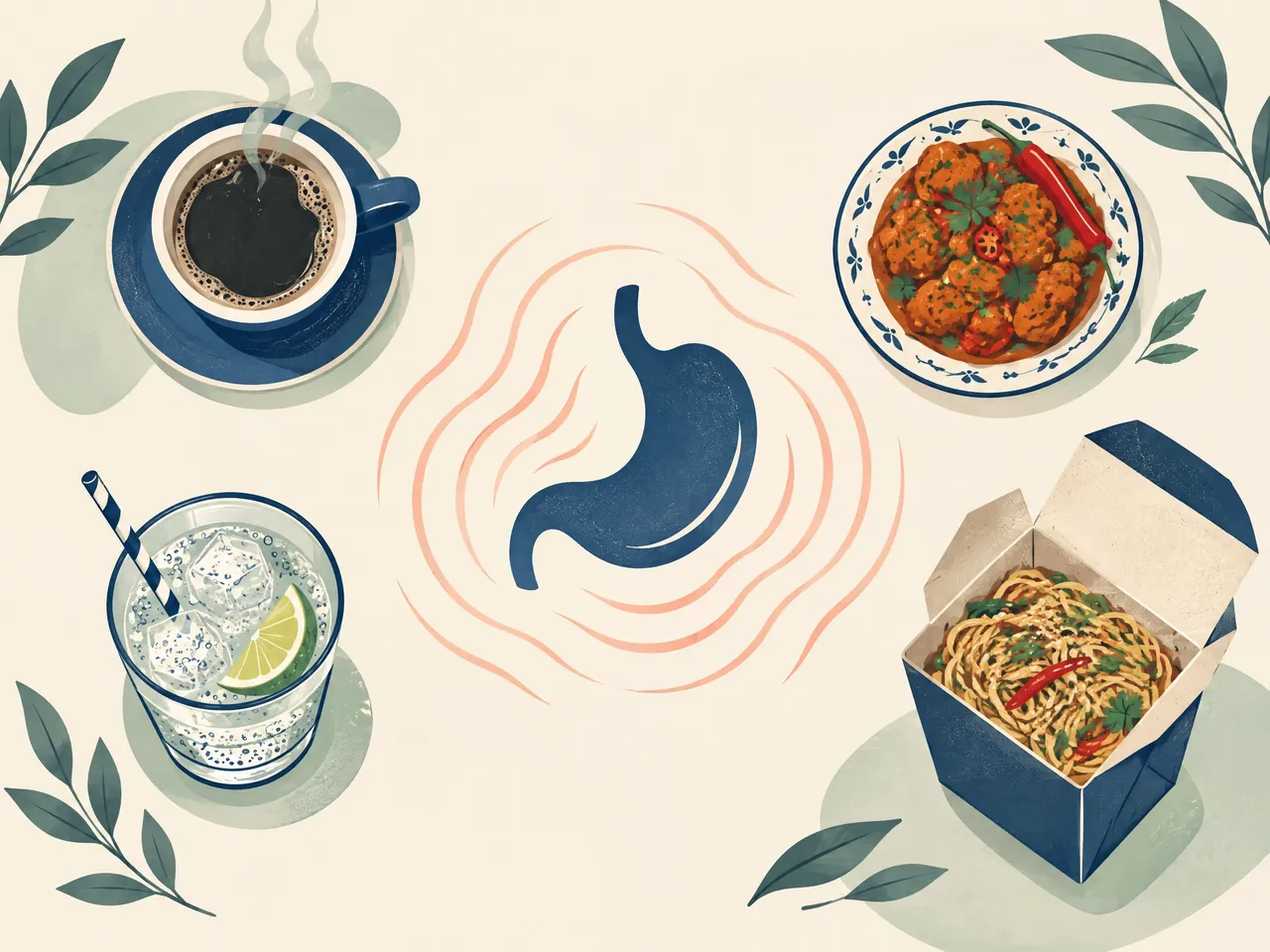
A practical starting point is to separate a familiar, brief meal-related symptom from a new, escalating, or unexplained one. A person who gets a sour taste after a late, rich dinner may have a different immediate question from someone whose food feels stuck or whose chest pain begins suddenly. For a broader explanation of everyday symptoms and triggers, see heartburn and acid reflux. The aim is not to label yourself, but to recognise when the pattern deserves professional assessment.
Common acid reflux red flags with acid reflux and GERD symptoms: What are the symptoms of acid reflux and GERD?
Acid reflux red flags are features that should move the decision beyond diet changes or over-the-counter remedies. Vomiting blood or passing black stools can indicate bleeding and needs urgent medical attention. Severe or sudden chest pain, particularly if it comes with breathing difficulty, should be treated as an emergency because chest pain can have causes other than reflux. Do not wait to see whether an antacid changes a severe chest symptom before seeking urgent help.
Other warning signs call for prompt medical assessment: painful swallowing, trouble swallowing, food seeming to stick in the throat, repeated or uncontrollable vomiting, or weight loss without trying. The NHS specifically advises review when food gets stuck, vomiting is frequent, or weight falls without a clear reason. [1] Symptoms that are becoming more frequent, wake you repeatedly, or interfere with eating and daily life also merit a medical conversation, even if there is no dramatic emergency sign. For a focused next-step guide, read When should I see a doctor for acid reflux?.

Tracking acid reflux and GERD symptoms alongside acid reflux red flags: What are the symptoms of acid reflux and GERD?
A short symptom diary can turn a vague complaint into useful information. Record when the episode began, what and how much you ate or drank, whether you lay down or bent over, and how long the symptom lasted. Include coffee, alcohol, fatty or spicy food only if they were actually part of that day; they are possible triggers for some people, not a universal list to avoid forever. Add a note on cough, hoarseness, sleep interruption, nausea, bowel changes, and any symptom that feels new.
Bring the diary and an up-to-date list of medicines, supplements, and remedies to your appointment. It helps to record whether an acid-suppressing medicine, antacid, meal timing change, or upright posture changed the symptom, without treating that response as a diagnosis. Note red flags separately and date them. This makes it easier to describe whether swallowing changed over days, whether vomiting recurred, or whether weight loss was noticed, and it prevents a serious detail being lost in a general account of indigestion.
Compare your options
| What you notice | Useful details to record | Appropriate next step |
|---|---|---|
| Burning after a meal or when lying down | Meal time, food and drink, body position, duration, and whether it disrupts sleep | Try individually relevant routine changes and arrange review if it persists or becomes frequent |
| Sour or bitter fluid in the throat or mouth | Timing, regurgitation, cough or hoarseness, and any medicine used | Discuss recurrent symptoms with a clinician or pharmacist; do not self-diagnose the cause |
| Food sticking, painful swallowing, repeated vomiting, or unexplained weight loss | When it began, how often it occurs, impact on eating and weight, and all medicines | Seek prompt medical assessment |
| Severe or sudden chest pain, breathing difficulty, vomiting blood, or black stools | Do not delay care to complete a diary or try another remedy | Seek emergency or urgent medical care immediately |
On smaller screens, scroll the table sideways to compare all columns.
Acid reflux red flags, acid reflux and GERD symptoms, and What are the symptoms of acid reflux and GERD? for care decisions
Care decisions begin with urgency, not with choosing a preferred treatment. Emergency symptoms need emergency services. Warning signs that are not immediately life-threatening still need timely medical evaluation. For persistent but uncomplicated symptoms, a doctor may ask about timing, foods, body weight, smoking, alcohol, pregnancy, current medicines, and whether symptoms disturb sleep or meals. This history helps decide whether lifestyle measures, a medication review, testing, or referral is appropriate.
Not every person with heartburn needs the same test, and a normal-looking day does not rule out a recurring issue. Hong Kong Adventist Hospital describes evaluation that may include a response to a proton-pump inhibitor, endoscopy to look for inflammation or complications, and oesophageal pH monitoring in selected situations. It also notes that some people with GERD have no abnormality visible on endoscopy. [2] Those are clinical choices, not tests to request or interpret on your own; the important point is that persistent or alarming symptoms have routes for assessment.

If you are looking locally for an overview of mainstream options, acid reflux treatment Hong Kong explains the kinds of questions worth taking to a medical consultation. If a clinician has already prescribed medicine, continue it as directed and ask the prescriber before changing the dose, schedule, or duration. A symptom diary can support that conversation, but it cannot safely overrule red flags or a medical assessment.
When acid reflux red flags and acid reflux and GERD symptoms need medical assessment: What are the symptoms of acid reflux and GERD?
Book medical review rather than repeatedly self-managing if heartburn happens most days, pharmacy treatments and sensible routine changes are not helping, or the symptom pattern is worsening. A new difficulty with swallowing, recurrent vomiting, unexplained weight loss, or a sensation of food sticking should be described clearly when arranging care. These details help distinguish a routine reflux discussion from a situation where the clinician may need to rule out a more serious cause. [1]
It is particularly important not to assume that all chest discomfort is reflux. Burning after a meal may fit a reflux pattern, but sudden, severe, or unfamiliar chest pain deserves urgent assessment, especially with breathlessness. Likewise, blood in vomit or black stools should not be watched at home. Tell the receiving clinician about reflux symptoms and medications, but do not let a previous GERD label delay the emergency response. A prior episode of heartburn does not explain every future chest symptom.

Lifestyle and conventional care for acid reflux and GERD symptoms: acid reflux red flags and What are the symptoms of acid reflux and GERD?
For symptoms without red flags, try changes that can be tested against your own diary. The NHS suggests smaller, more frequent meals, avoiding food or drink that triggers symptoms, avoiding eating within three to four hours of bedtime, stopping smoking, and reducing alcohol if relevant. It also describes raising the head of the bed so the chest and head are above the waist; extra pillows are not the same approach and can increase pressure on the abdomen. [1] Keeping upright after a meal can be easier to test than making many restrictive changes at once.
Pharmacists may advise short-term products such as antacids or alginates, while doctors may prescribe acid-reducing medicines such as proton-pump inhibitors or, in some situations, an H2 receptor antagonist. [1] The safest plan depends on your symptoms, other conditions, and medicines. Do not stop a prescribed treatment because symptoms temporarily improve, and do not use persistent symptoms as a reason to keep adding remedies without review. If you want to understand the supportive-care discussion as well, start with Chinese medicine for acid reflux.
Chinese medicine context for acid reflux red flags and acid reflux and GERD symptoms: What are the symptoms of acid reflux and GERD?
Chinese medicine can be discussed as a supportive option for a person who has had appropriate assessment, but it is not an alternative pathway for alarm symptoms. A consultation may explore how reflux-like symptoms relate to meal habits, sleep, stress, appetite, bowel habit, and the broader history. In traditional Chinese medicine, these observations may be organised through a traditional pattern-based approach. That language is not the same as a modern diagnosis of GERD, oesophagitis, ulcer disease, or heart disease.
This distinction matters in Hong Kong because the same complaint can have several possible explanations. A registered Chinese medicine practitioner can listen to the symptom history, but swallowing difficulty, bleeding, severe chest pain, unexplained weight loss, or persistent vomiting still require the appropriate conventional medical route first. CUHK's digestive-disease programme similarly presents acid reflux and heartburn among symptoms for which its practitioners discuss individual plans; it does not make them a substitute for urgent investigation. [3]

A useful supportive-care conversation is therefore specific: what has already been assessed, what medicines are being taken, what the diary shows, and what outcome matters most to the person. It may be relief from a recurring after-dinner burning sensation, less sleep disruption, or help sustaining agreed meal routines. It should not be framed as a guarantee to cure reflux or as a reason to postpone an endoscopy, medication review, or emergency evaluation recommended by a doctor.
What a Chinese medicine consultation considers with acid reflux red flags: acid reflux and GERD symptoms and What are the symptoms of acid reflux and GERD?
At a Chinese medicine consultation, the practitioner may ask when burning and regurgitation happen, whether the taste is sour or bitter, how meals and sleep relate to symptoms, and whether there is nausea, poor appetite, bloating, cough, or bowel change. They may also ask about stress, smoking, alcohol, pregnancy, past diagnoses, and all current treatments. These questions can help build a full account of the symptom burden, but they do not convert a red flag into a routine consultation issue.
Traditional assessment may include observation, listening, questioning, and pulse or tongue examination. The resulting traditional description is used within Chinese medicine and should not be read as proof of a structural cause in the oesophagus or stomach. Be direct about any medical diagnosis, test result, and medication, including over-the-counter antacids and supplements. Clear information lets the practitioner keep the discussion grounded in your existing care rather than duplicating or contradicting it.

Discussing supportive options after acid reflux red flags: acid reflux and GERD symptoms and What are the symptoms of acid reflux and GERD?
Once a clinician has addressed any red flags, a Chinese medicine practitioner may discuss whether acupuncture or Chinese herbal medicine is appropriate as supportive care for the individual. CUHK's programme lists consultations, acupuncture, and Chinese herbal medicine in a digestive-care setting, with plans subject to clinical judgement. [3] That supports a discussion of options, not a promise that an intervention will cure acid reflux, heal the oesophagus, or replace standard treatment. For a closer look at the question, see Can acupuncture help acid reflux?.
Bring medicine packaging or a complete list to the appointment and keep the prescribing doctor informed. Do not independently stop a proton-pump inhibitor, H2 blocker, or any other prescribed medicine when starting supportive care. If symptoms escalate, swallowing changes, bleeding occurs, or chest pain becomes severe, return to urgent medical assessment rather than waiting for the next complementary-care visit. You can contact TCM Lab to discuss a digestive-symptom consultation at the Chinese medicine clinic Prince Edward or the Kwun Tong Chinese medicine clinic; the team can confirm an appointment arrangement and language needs.
Care and health guide
Health service information
This directory brings together services, reading, and visit information related to health services, to help you prepare questions for a consultation.
If you are organising health questions, Chinese medicine clinic Hong Kong is a starting point for learning about related services and preparing for a consultation.
People have different needs; acupuncture Hong Kong provides further reading to help you understand options in your own context.


Your questions, answered
Frequently asked questions
Which acid reflux red flags need urgent medical care?
Seek urgent medical care for vomiting blood or black stools, and for severe or sudden chest pain, especially with breathing difficulty. Difficulty or pain when swallowing, food sticking, repeated vomiting, and unexplained weight loss also need prompt medical assessment. Do not assume that a familiar history of heartburn explains a new severe chest symptom.
What are the symptoms of acid reflux and GERD?
The common symptoms are heartburn and sour or bitter regurgitation. They often worsen after food, lying down, or bending over. Some people also have nausea, bloating, recurring cough, hiccups, hoarseness, bad breath, or throat discomfort. Because these symptoms can have other causes, recurrent or changing symptoms deserve professional assessment.
Should I stop acid-reducing medicine if symptoms get better?
No. Do not stop or change prescribed medicines without speaking to the prescribing doctor. A clinician can advise whether a medicine should continue, change, or be reviewed, and can decide whether persistent symptoms need further investigation. This applies even if you also choose to discuss supportive Chinese medicine care.
Can Chinese medicine be used alongside conventional reflux care?
It may be discussed as supportive care after appropriate medical assessment. Tell the practitioner about all diagnoses, tests, prescription medicines, over-the-counter remedies, and supplements. Chinese medicine should not delay emergency care, endoscopy or other investigations when indicated, and it should not be presented as a guaranteed cure for acid reflux.
Sources and further information
- [1] [1] NHS — Heartburn and acid reflux
Referenced for: Symptoms, common triggers, self-care, when to seek review, and conventional treatment overview.
- [2] [2] Hong Kong Adventist Hospital — Acid Reflux
Referenced for: Hong Kong clinical information on reflux symptoms, diagnosis, and treatment pathways.
- [3] [3] The Chinese University of Hong Kong — Chinese Medicine Treatment Program for Digestive Diseases
Referenced for: Hong Kong Chinese medicine digestive-care setting, symptom terminology, and individual clinical discussion; not evidence of efficacy.