

Prince Edward & Kwun Tong clinics · Home-visit enquiries elsewhere

TCM Lab

TCM Lab · Beauty & lifestyle / Colour booking

Plan a bigger colour change around your Sheung Wan visit

Content updated

A major colour change needs more than a free afternoon. Plan the assessment, the first wearable result and possible later visits before tying the work to a Sheung Wan outing or an important event.

Illustrative colour swatches and tonal planning
Illustrative hair-lifestyle concept; not a client record or a Vit So portfolio photograph.

The short answer

Separate your eventual colour goal from the result you could accept after the first visit. Share the history of the hair you still have, then confirm whether you are booking an assessment or actual colour work. Agree on the complete service scope and estimated departure time, with room to postpone or stage the change. Product-specific preparation and later upkeep belong in the calendar too.

Vit So is an external hair and beauty website under the same ownership as TCM Lab. Its beauty services are separate from Chinese medicine care. This section is for beauty and lifestyle education, not diagnosis or treatment.

Give the final colour and the first visit different goals

Start with two descriptions: the colour you eventually want, and the appearance you would be comfortable wearing home after the first visit. They need not be identical. Someone aiming for very light lengths might accept a darker first result, but not an obvious colour boundary. Another person might prefer to leave unchanged rather than begin a transition they cannot maintain. Saying this early makes a staged proposal easier to evaluate.

Rank the things you would protect if the entire wish list cannot fit together. Keeping your current length, avoiding a highly visible change at work and reaching a particular brightness can pull the decision in different directions. Choose which matters most. Reference photographs can illustrate these preferences, but the real booking question is whether the proposed first stage fits your priorities and the dates you can actually attend.

If an event is involved, ask yourself whether you would accept an intermediate shade in its photographs. Do not make the event date an instruction to force the whole transformation into one appointment. If only the final look would feel acceptable, an assessment may lead to starting earlier, changing the target or waiting until afterwards. These are practical choices, not a guarantee that extra calendar time makes every colour achievable.

Record the history of the lengths, not only your last dye date

Make a short timeline for the hair you still have. Include home colour as well as salon work, noting where each application went. For example, new growth may be untouched while the ends contain older dark dye and lightening. If a trim removed some processed hair, mention that too. Approximate dates are useful; an honest 'product unknown' is better than guessing a formula to make the record look complete.

Pair the timeline with current photographs showing the front, back and lengths in ordinary light. Take one with your usual parting and one showing the underneath if its colour differs. Keep inspiration images separate. Describe observations such as ends catching during detangling or short broken pieces you have noticed, without diagnosing their cause. Tell the stylist about any planned perm or straightening as another scheduling consideration.

The American Academy of Dermatology explains that cosmetic treatments can leave hair dry and brittle, and identifies greater lightening as a damage trade-off. [2] This supports discussing condition before adding work, not judging suitability from photographs alone. A slower plan is not a promise of damage-free processing or repaired hair. If retaining length matters more than reaching the lightest reference, make that your explicit decision rule.

Find out what the appointment actually reserves

An assessment and a colour session solve different calendar problems. An assessment may clarify feasibility while leaving the actual work for another day. When enquiring about a hair colour consultation, ask whether a separate visit can be arranged, what its format and fee would be, and what decisions it can establish. Vit So's booking resource leaves these arrangements for confirmation rather than promising a free consultation or a particular spoken language. [3]

Once you are ready to book a hair appointment, obtain confirmation that names the agreed work, rather than retaining only a date in your calendar. Vit So describes messaging as an enquiry, not an instantly reserved slot. [3] Keep the service agreement with the appointment time and quote. If the colour goal changes during the discussion, ask whether the original time allocation and estimate still apply.

Also establish what happens if the in-person assessment changes the proposal. Could the visit remain an assessment only, or would a different scope need your agreement? Ask about any applicable payment or rescheduling conditions before committing. Vit So is an external hair and beauty website under the same ownership as TCM Lab; its salon services are not Chinese medicine or medical care.

Match the service scope to the whole Sheung Wan visit

For an overall shade change, the hair colour sheung wan resource is a starting point for identifying coverage, not a timetable for a major transformation. [4] Ask what is proposed for roots and previously coloured lengths, whether additional work is involved, and how the hair will be finished. A menu label cannot tell you whether the result in your reference belongs within the quoted appointment.

For lighter areas within a retained darker base, use the balayage sheung wan resource to open a placement discussion. [5] Identify where you want brightness visible when your hair is straight or tied up. Then ask which areas and finishing steps belong to the actual proposal. A named design or an included bleaching session does not guarantee a particular brightness or establish that every desired step fits one visit.

Ask for an estimate covering assessment, colour work, washing and the agreed finish, rather than product contact time alone. Explain your firm departure limit before confirmation. The booking page gives the location as 252 Hollywood Road, Sheung Wan. [3] Check your route to that address from your own starting point and allow for the final walk. Avoid placing a flight transfer, childcare collection or another immovable commitment directly against an estimated finish.

Make postponement a usable option, not a last-minute crisis

Leave space before colour day for any required product-specific preparation. The FDA advises following dye instructions and doing a skin test before each use; previous trouble-free colouring does not rule out a later reaction, and a negative test does not eliminate that possibility. [1] Ask the salon about the proposed products and required arrangements early. Do not invent your own test procedure or assume the same timing applies to every product.

Tell the salon about previous dye reactions before arranging work. The FDA also advises against dyeing an irritated, sunburned or damaged scalp. [1] If a current concern arises, contact the salon before travelling; a past reaction warrants healthcare advice, not experimenting with another dye to meet a deadline. Keep preparation questions separate from shade preferences so an attractive reference does not obscure information that could change whether the service proceeds.

Before the visit, decide what you would do if the full plan is postponed: leave the hair as it is, request a revised proposal, or return on another confirmed date. None is automatically available or included. If you are visiting Hong Kong briefly, state when you leave and whether returning is realistic. Do not agree to a first stage whose next step depends on a visit you cannot make.

Keep later maintenance flexible but financially visible

A staged transformation and routine upkeep are different calendar entries. Before committing, ask what the next planned stage would aim to change and what could require reassessment. Separately discuss how you would report later concerns: unwanted warmth, a more visible root boundary or a change in the placement of brightness. Describing the observation is more useful than automatically booking the entire original service again.

Choose a maintenance plan around real availability, not an ideal diary. If you travel often or cannot return regularly, say so before choosing the first scope. Request an estimate for later work when enough details are known, without treating it as a fixed future quote. After the visit, keep the agreed result and home-care instructions together. For outdoor days, the Academy recommends a wide-brimmed hat and notes sun-related fading and dryness, especially after colouring or bleaching. [2]

Take it into everyday life

A practical checklist

  • Write both your eventual target and the first-visit result you could accept; identify the preference you will not trade away.
  • Prepare a timeline of colouring, lightening and other chemical work by area, with current photographs and any product information you have.
  • Share previous product reactions and current scalp concerns early; ask about the proposed products' preparation requirements.
  • Confirm whether the visit is an assessment or colour work, and retain the agreed scope, quote and appointment details together.
  • Ask for the complete visit estimate and explain your departure limit before arranging other Sheung Wan commitments.
  • Clarify rescheduling conditions and your fallback if work cannot proceed; do not assume an alternative service is included.
  • Check that possible later stages fit your travel dates, budget and willingness to wear an intermediate result.

Questions & answers

Should I book a bigger colour change immediately before a wedding or flight?

Avoid making the appointment depend on an immovable departure or an unassessed final colour. Ask about feasibility first and discuss the result you could accept if the work needs staging. If only the complete transformation would suit the event, postponing the change may be the more practical choice.

I cannot remember the box dye I used. Is my history still useful?

Yes. Describe roughly when you used it, the shade it appeared to be and whether it covered the roots or the lengths. Share packaging photographs if available, but label unknown details honestly. Do not assume a faded appearance means earlier colouring is irrelevant to the assessment.

Does a confirmed consultation mean colour will happen that day?

Not unless actual colour work has also been agreed. Ask what the reserved visit covers and whether further appointments could be needed. If you have limited time in Hong Kong, confirm this before travelling rather than relying on a consultation date as a transformation date.

Is one included bleaching session a promise of the reference shade?

No. A stated inclusion describes service scope, not a guaranteed colour outcome. Ask what first-stage finish is being proposed for your starting hair, what would remain different from the reference, and whether further work needs a separate assessment and quote.

Should I reserve another full colour appointment for maintenance straight away?

First distinguish a planned next stage from upkeep. Ask what changes to observe and how to contact the salon for reassessment. A later concern about tone may call for a different discussion from changing brightness or coverage; do not assume the original scope must be repeated.

Sources & further context

Numbered references follow the order in which the sources are listed below. Service websites provide beauty-service context, not medical evidence.

  1. [1] U.S. Food and Drug Administration — Hair Dyes
  2. [2] American Academy of Dermatology — Coloring and perming tips for healthier-looking hair
  3. [3] Vit So — Appointment enquiry resource
  4. [4] Vit So — Hair colour service resource
  5. [5] Vit So — Highlights and balayage service resource

Make the length you want to keep visible

If keeping length is your first priority, show what that means before approving the colour plan. Use a current photograph to identify the shortest finish you would accept, rather than saying only that you want to keep it long. Ask whether any cutting is proposed within the visit and whether it changes the agreed scope. The practice tresses illustrate different length boundaries, not a recommended haircut. If the proposal depends on removing more hair than you want, return to the first-stage colour goal rather than agreeing to a cut you had not considered.

Three practice hair tresses of different lengths beside a blank consultation card and a comb
Use a visible length boundary to explain what you want to retain; these practice tresses are an illustration, not a client's hair.Generated illustrative image

Explain which part of the colour reference matters

Give each reference one clear purpose. One may show the darkness you prefer at the crown, while another shows the warmth you like through the ends. Compare pictures in similar lighting where possible, as the colour service resource recommends. [4] If your favourite image is taken beside a bright window, include a second view that makes the darker areas easier to see. The sample board shown in two lighting settings is a prompt for that comparison, not a prediction of your result. Tell the stylist which preference would still matter if the first visit cannot reproduce the whole image.
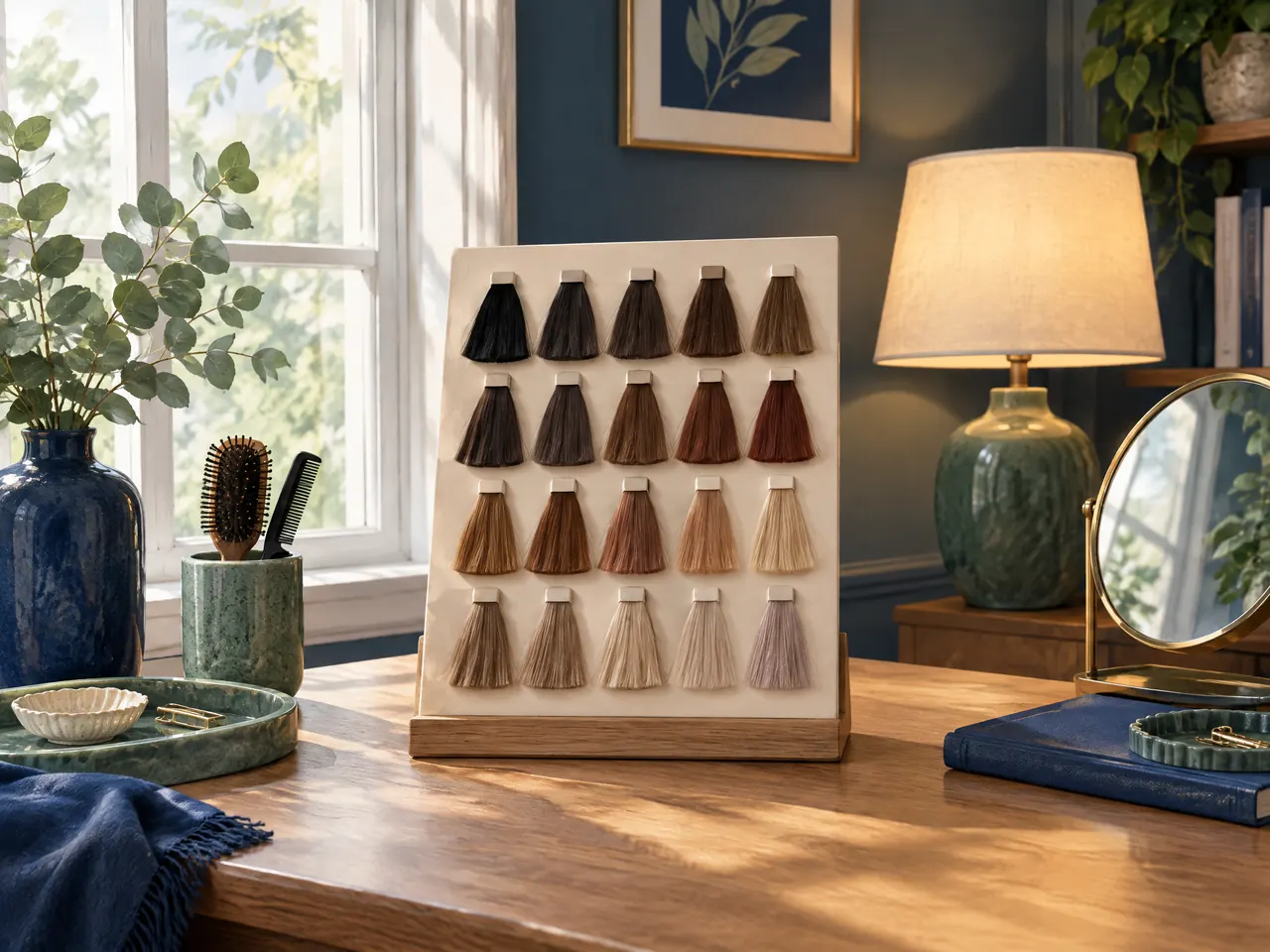
A neutral hair sample board between window daylight and a shaded interior lamp, with a mirror
Compare references in similar lighting and identify the feature you like; the hair samples do not establish an achievable salon shade.Generated illustrative image

Ask for a first-stage plan by area

Alongside the service name, keep a short written description of what the first stage would change at the roots, middle lengths and ends. Add any areas intended to remain as they are. The sectioned practice head illustrates how a broad wish can be divided into areas for discussion; it is not an application guide. Vit So's colour resource asks readers to confirm the proposed work across roots and lengths rather than assuming an overall finish means identical handling throughout. [4] If a later proposal changes those areas, ask for the scope and estimate to be reconfirmed before work proceeds.

A featureless practice head viewed from above with hair divided by jade clips and a tail comb beside it
A sectioned practice head helps explain area-by-area questions; it does not prescribe a colouring technique or show a customer appointment.Generated illustrative image

Include the finish in your departure-time discussion

When requesting the complete visit estimate, describe how you normally wear your hair and ask what drying or styling is included. The booking resource distinguishes the whole appointment from product contact time. [3] If your references show a round-brush finish but you usually let the hair dry naturally, ask to discuss the placement in the context of that everyday routine too. The dryer and attachments illustrate finishing questions, not equipment promised by the salon. Keep the agreed finish with the service confirmation so an appointment estimate is not mistaken for colour-processing time alone.

An unplugged unbranded hair dryer with a diffuser and nozzle beside a round brush and a practice hair tress
Confirm the drying and styling included in the visit; these illustrative tools are not a statement of salon equipment or a home-care prescription.Generated illustrative image

Clinic enquiries

Contact and appointment arrangements

Clinics
Prince Edward and Kwun Tong
Opening hours
11:00–21:00
WhatsApp and telephone
+852 6940 5663

Appointments, practitioner availability and service arrangements are confirmed via WhatsApp.

Please mention any consultation language needs in your WhatsApp enquiry so that arrangements can be confirmed.

Enquire via WhatsApp
Food, gifts and floral lifeWhatsApp enquiry