
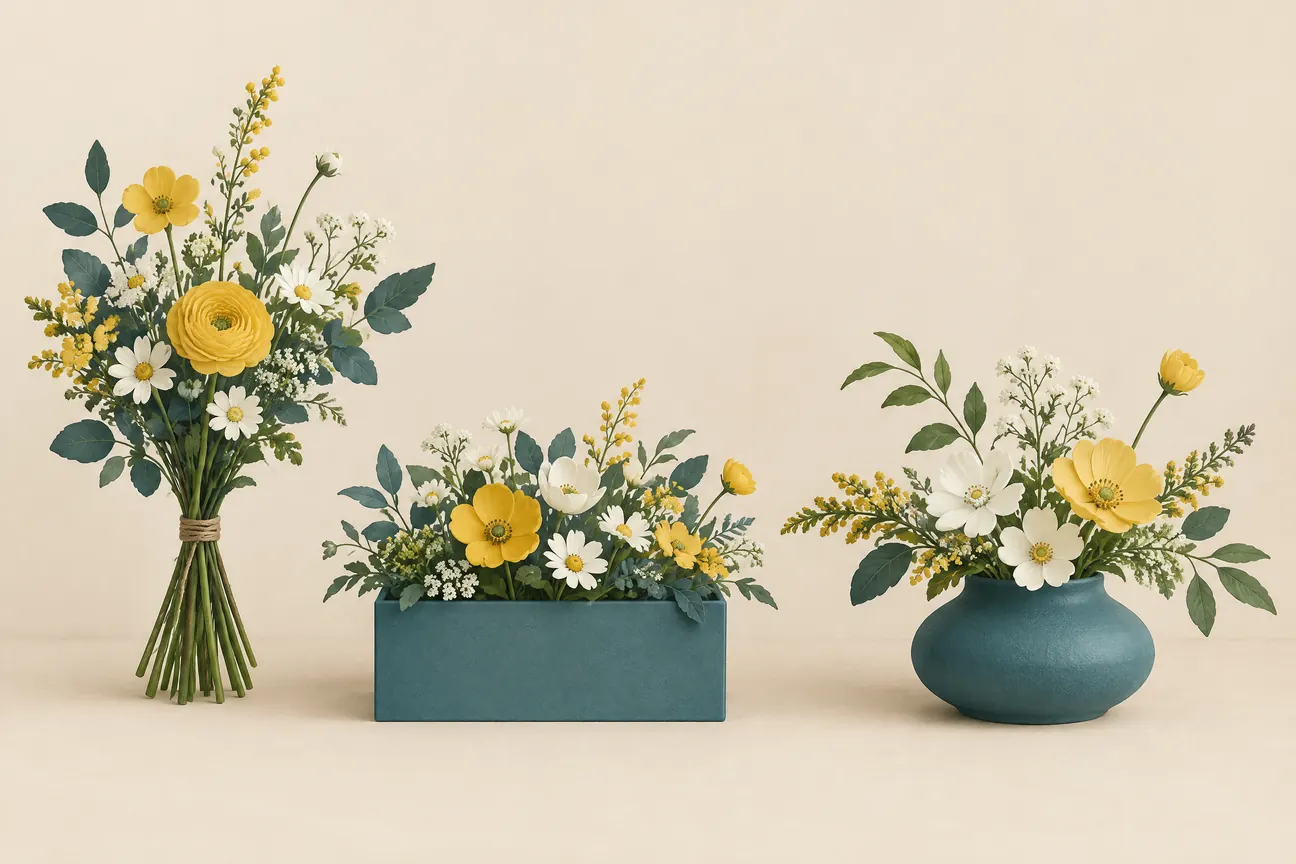
Choose flower workshop materials by the work you want to do
Imagine the part of the afternoon you would most enjoy: balancing a raised flower head, gathering textured stems, moving petals across a flat surface, or positioning small pieces inside glass. Those are different tasks, even when their finished colours look similar. Start with the action rather than a reference photograph. Someone who enjoys paper collage may prefer a pressed design; someone who wants to practise volume and spacing may find a small three-dimensional arrangement more relevant.
There is also a distinction between preparing a material and designing with it. University of Florida guidance describes air drying, drying agents and pressing as different processes. Removing moisture takes time that varies with the material and method. [1] A session that uses already-dried flowers can focus on arranging, whereas one that starts with fresh stems may leave you with a drying project to continue at home. Neither is inherently the fuller experience; they teach different things.
For a weekend outing in Hong Kong, decide whether your priority is a finished object, a technique you can repeat, or time to experiment. A finished-object brief could be a compact shelf arrangement. A technique brief could be learning how to select and position thin flowers for pressing. Ask for the actual lesson sequence, not just the name of the medium, so the session matches the kind of participation you want.
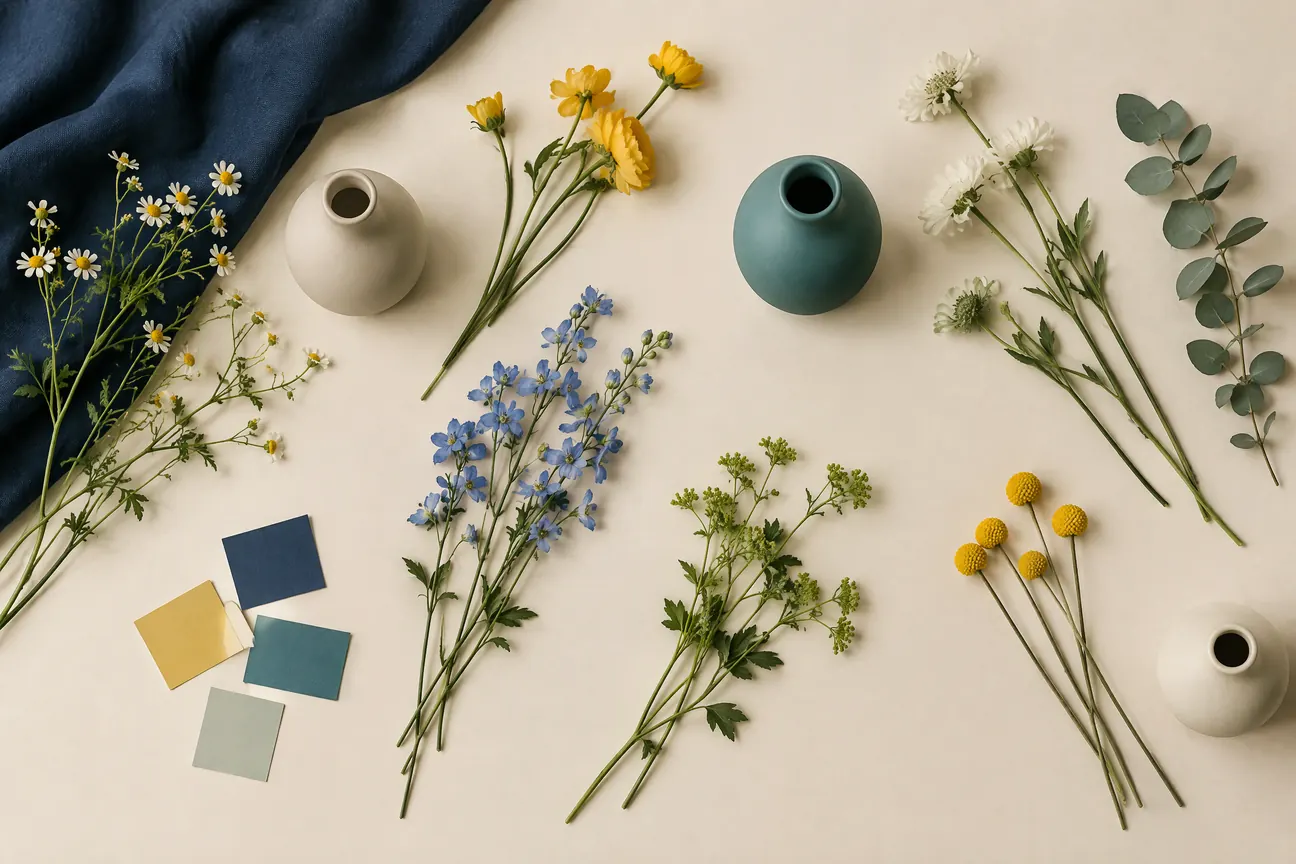
Preserved flowers: build depth without assuming you will do the treatment
Treat 'preserved' as a starting point for a material enquiry, not a complete explanation of how the botanicals were processed. Mississippi State Extension describes glycerin treatment for foliage, noting that it suits mature leaves better than soft flower petals and changes their texture and colour. [2] That does not establish how a supplied preserved rose was made. Ask which parts are preserved, whether dried fillers are mixed in, and whether the session teaches treatment or uses prepared components.
When comparing a Preserved flower workshop, a useful project question is how you will build and support depth. Will you practise attaching flower heads, positioning them in a base, or simply selecting colours for a supplied structure? Find out whether wire, tape, adhesive or a display container is involved and who completes each stage. A small raised arrangement can still offer worthwhile practice if you make the spacing decisions yourself rather than copying fixed positions.
Look beyond the front view. A flower that appears balanced from one angle may hide another when seen from the side, so ask whether you can rotate the work as you arrange it. Also request care guidance for the actual materials. Some glycerin-treated foliage can release oily droplets under humid conditions and stain nearby surfaces. [2] This is a reason to ask about the supplied foliage and its placement, not to assume that every preserved flower behaves the same way.
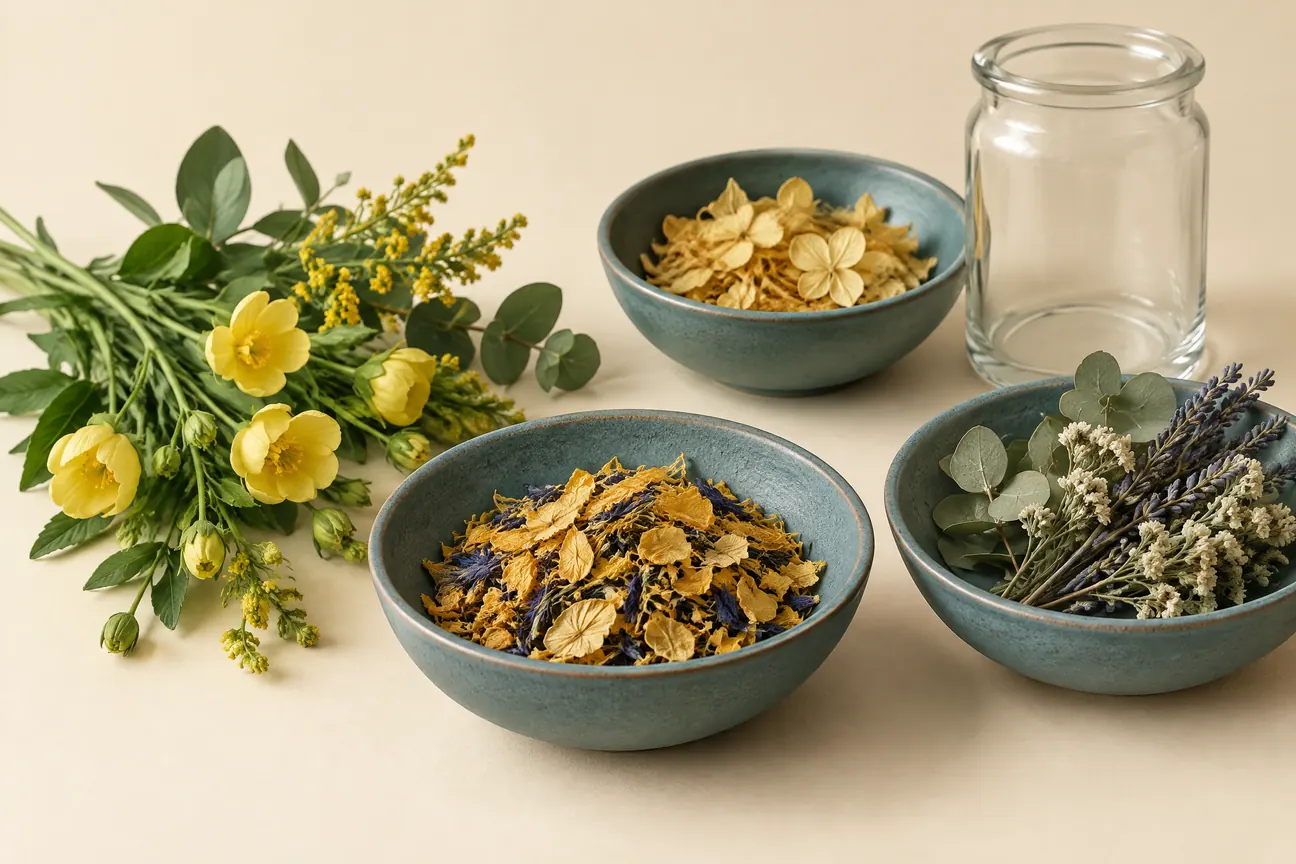
Dried flowers: explore texture through stems and small bundles
Dried stems offer an opportunity to work with outlines and contrasting textures rather than a dense mass of flower heads. You might prefer a loose group with visible gaps, or a compact bundle that emphasises a few shapes. Before choosing, ask whether the project retains long stems or cuts material into small pieces. The first centres on arranging and tying; the second may centre on surface decoration. Both use dried botanicals, but the movements and finished footprint differ.
The Dried flower workshop page is a commercial enquiry starting point for this direction. Ask whether you will learn a binding technique, make a supported arrangement, or work with pre-cut pieces. If tying is the attraction, find out whether there is time to loosen a first attempt and try again. Practising the grip and the point where stems gather may matter more to you than adding more decorative material to a single finished bundle.
Dried does not mean indestructible. University of Florida guidance calls for careful handling of dried materials and describes gentle brushing when appropriate. [1] Give fragile pieces room on the work surface instead of stacking them beneath heavier stems. A tray for loose fragments and a separate spot for selected stems make the process easier to manage. Ask how breakages are handled during the lesson; spare material can support experimentation, but its inclusion should not be assumed.
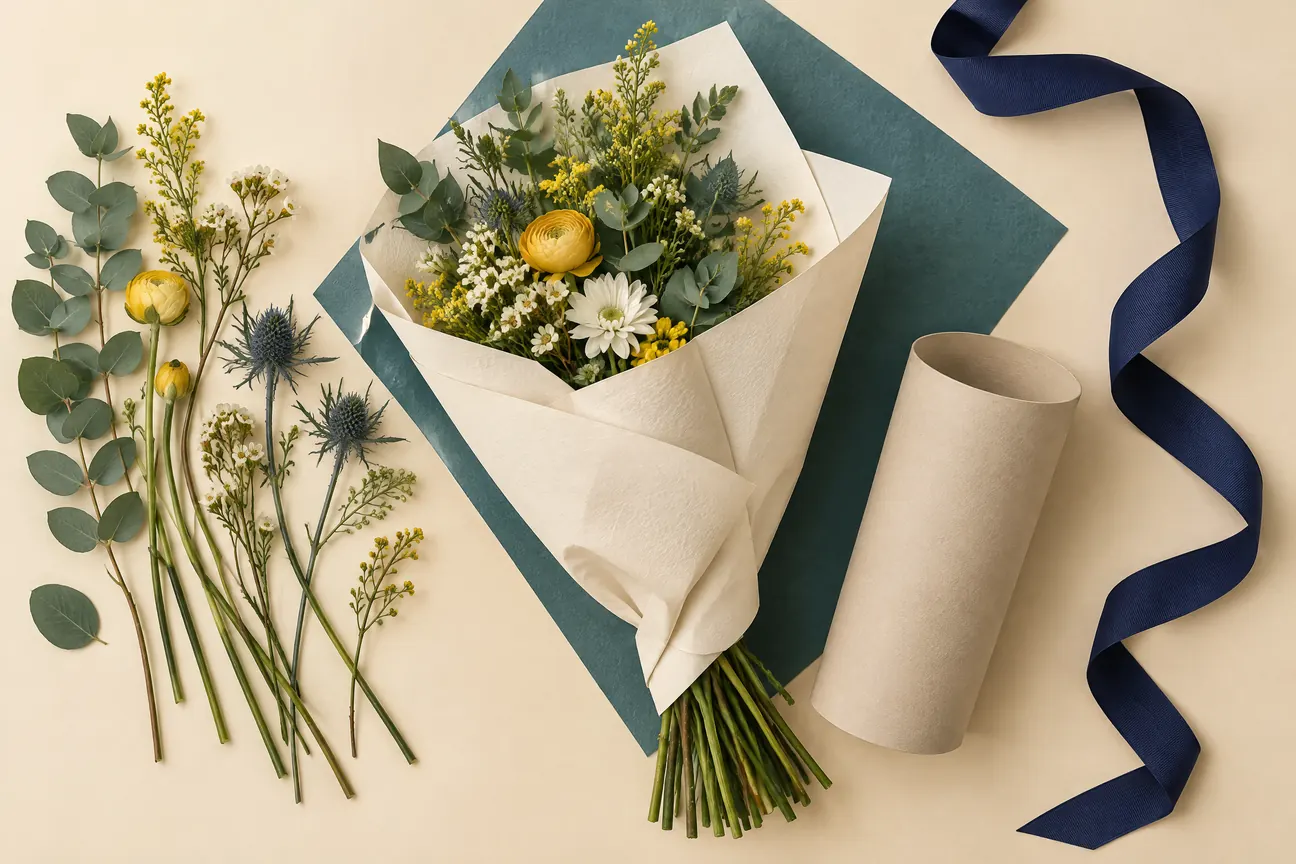
Pressed flowers: trade volume for careful flat composition
Pressing changes the design problem: instead of supporting height, you decide how outlines, overlaps and empty space work on a surface. University of Florida guidance favours flat or single flowers for pressing; thick or double flowers can develop mould before drying. [1] If you want to prepare your own specimens, learning which shapes suit the method is valuable. If you want an afternoon of composition, a selection of already-pressed material may give you more time to arrange.
For a Pressed flower workshop, establish whether the lesson starts with fresh flowers, prepared pressed pieces, or both. A fresh specimen placed in a press is not the same take-home result as an assembled flat artwork. Ask what support is supplied and whether mounting or framing is included. A card, a loose design and a framed piece require different finishing decisions, even if all three begin with the same petal shapes.
Try a dry layout before any permanent attachment: set out the larger shapes, leave room around them, and then consider smaller details. Photograph the arrangement if that helps you remember it while mounting. Ask the tutor how to lift the particular specimens without damaging them, and which attachment method suits the backing. A sparse design is a legitimate choice, not an unfinished one; it can make delicate edges easier to see and reduce the temptation to cover every gap.
Bottled flowers: design within a vessel, not a scientific collection
A decorative botanical bottle project is best understood as arranging within a container. The word 'herbarium' needs context: Kew uses it for a collection of dried plant specimens catalogued and organised for scientific study. [3] A decorative bottle session should not be assumed to teach plant identification or scientific specimen preparation. If botany is your main interest, ask whether observation, plant names or specimen records are actually part of the lesson rather than inferring them from the title.
When exploring a Herbarium workshop, ask whether the vessel holds dry botanicals alone or includes a liquid. Establish the exact supplied materials and the provider's handling instructions before choosing. Do not substitute a household liquid because it looks similar, or assume that a sealed bottle makes any contents suitable. If filling or sealing is involved, ask which steps participants perform and whether the work is ready to carry when those steps are finished.
Bottle shape affects the task before decoration begins. A narrow opening limits access, so ask whether suitable long tools are provided and whether you can reposition pieces during the process. Choose a clear focal area rather than packing every part of the vessel. View the planned arrangement from the side as well as the front, and leave room for the closure. Request the vessel dimensions: a small-looking photograph does not tell you how easily the finished work fits on a shelf or in a carrier.
Compare the tools and the freedom to change your design
Compare the actual sequence of tools rather than assuming one medium is easier. A three-dimensional project may involve cutting stems and making supports; a pressed design may involve repeated lifting and precise attachment; a bottle may demand reaching through a restricted opening. Ask which tools are used, which are shared, and whether an alternative is available if you find a particular grip awkward. The important match is between the lesson's movements and your comfort, not a blanket beginner label.
The freedom to revise is another useful difference. Moving loose pieces around a backing is different from changing a glued layout. Retrying a tied bundle is different from rearranging botanicals after a bottle has been closed. Ask where the reversible practice stage ends and whether feedback comes before the permanent step. For a first session, a modest design with a chance to make a second attempt can be more useful than a complicated object completed mostly by someone else.
Compare quoted inclusions against that sequence. You need to know whether the base, backing, vessel, finishing materials and packaging belong to the project, while reusable tools may remain with the provider. Ask what is necessary to continue at home if that is your goal. You do not need to buy a full kit in advance: first understand the technique and its materials, then decide whether it is something you want to repeat.
Plan the journey home and the place your work will occupy
Match packing to the object rather than the flower label. A raised arrangement needs space around projecting parts; a stem bundle needs support that does not crush the heads; a flat artwork needs its surface protected. A glass vessel needs a carrier suited to its shape, plus any closure instructions for its contents. Ask about finished dimensions and included packing before booking, particularly if you plan to take the MTR and continue to dinner rather than go straight home.
At the end of the session, distinguish 'assembled' from 'ready to display'. Fresh material begun in a press may need continued drying, while attachment or finishing steps may have their own waiting instructions. University of Florida guidance shows why drying time cannot be inferred from a short class duration. [1] Ask the provider to identify any unfinished stage and explain what you should do next. If you need to hand the object to someone that evening, make that requirement part of the initial project choice.
Decide on a display space with enough clearance to place and remove the work without brushing against it. Follow care instructions for the actual backing, container and botanicals, rather than treating all four formats alike. Keep dried material away from candles and other ignition sources; the University of Florida publication identifies its flammability. [1] Enjoy the object as a craft outcome without assigning a fixed lifespan. Material preparation, finishing and its surroundings matter more than a promise attached to the workshop name.
| Format | Making focus | Tools to ask about | Take-home question |
|---|---|---|---|
| Preserved arrangement | Raised shapes, spacing and supports | Wire, tape, cutting tools and attachment method | Is the container included, and are projecting parts protected? |
| Dried-stem project | Texture, outlines and binding or supported placement | Stem cutters, binding material and a sorting tray | Will packing support the stems without crushing the heads? |
| Pressed-flower design | Flat outlines, overlaps and mounting | Press if starting fresh, lifting tools and backing-specific adhesive | Is this drying material, loose artwork or a finished mounted piece? |
| Decorative bottle | Placement through the opening and views within glass | Suitable long tools and any filling or closure equipment | What are the contents, closure instructions and carrier requirements? |
On a small screen, scroll the table sideways to compare.
Take it into everyday life
A practical checklist
- Choose the action you want to practise: building depth, tying stems, composing flat pieces or arranging inside glass.
- Ask whether you prepare fresh botanicals or use materials supplied ready for arranging.
- Request the project dimensions and the exact base, backing or vessel.
- Identify participant steps, tutor-completed stages and any tools you need help using.
- Find out when you can revise the design before attachment, filling or closure.
- Check whether finishing, mounting and the take-home carrier are included in the quote.
- Ask what remains to dry or finish at home and obtain material-specific instructions.
- Choose a display space and a journey home that suit the finished object's shape.
Questions & answers
Which format is a useful starting point if I enjoy paper crafts?
A pressed-flower design is worth exploring because it centres on flat placement and empty space. Ask for prepared pressed material if your main aim is composition rather than drying. Confirm the backing and mounting method; paper-craft experience does not automatically make every floral attachment technique familiar.
Does a preserved-flower session teach me how to preserve fresh roses?
Not necessarily. It may teach arranging with supplied treated components. Request the lesson sequence and distinguish treatment from assembly. Glycerin guidance for mature foliage cannot be treated as a verified method for the merchant's flower heads. [2]
Can I press a thick flower and finish its artwork during one session?
Do not assume so. Flat or single flowers are better suited to pressing, and thick flowers may develop mould before drying. [1] Ask whether fresh specimens are a separate practice exercise and whether ready-pressed pieces are supplied for the artwork. Let the actual drying method determine the next step.
Is a decorative herbarium bottle a living terrarium?
Do not infer that from the name. Establish whether the project uses dried or preserved botanicals and whether it contains liquid. Ask for its specific care instructions rather than adding water or treating it as a planted container. Kew's scientific herbarium is a catalogued specimen collection, which is another distinct use of the term. [3]
Can I take the work straight to a dinner as a gift?
Tell the provider this before selecting the project. Confirm that drying, attachment, filling or closure stages allow that plan, and ask about the carrier. A finished-looking object may still require a waiting stage. Choose a format that fits the whole evening rather than relying on the class end time.
Can I bring flowers from a sentimental bouquet?
Ask before bringing them, with details of their condition and the result you hope for. The provider may not accept personal materials, and a chosen technique may not suit their thickness or shape. If the bouquet is irreplaceable, discuss practising on supplied material before committing it to a permanent process.
Do I need to buy tools before booking?
Usually the useful first step is to ask what the quote includes, not to shop from a generic equipment list. Separate tools loaned during the session from materials that leave with the work. If you want to repeat the technique, request a focused list for that specific project after you understand it.
Which of the four formats lasts longest?
There is no defensible universal ranking from these format names. Preparation, botanical type, backing, contents, finish and display conditions differ. Ask for care guidance for the actual work, and choose the making experience and footprint you prefer rather than treating a general preservation label as a durability guarantee.
Sources & further context
Numbered references follow the source order below. Merchant pages provide context for their own products or services; independent sources support relevant general reading, not merchant quality or medical suitability.