
Prince Edward & Kwun Tong clinics · Home-visit enquiries elsewhere

TCM Lab

TCM Lab · Hair choices & preparation / Hair assessment

Acupuncture, herbs and hair regrowth services: compare roles and review plans

Content updated

Before choosing a hair-loss programme, separate its proposed role from its promised result. A useful consultation should leave you with a clear assessment, understandable risks and a plan for reviewing change.

Illustrative hair care and observation objects
AI-generated illustrative concept; not a DT Hub location, product photograph or case record.

The short answer

Start by finding out what is causing the hair change. Acupuncture research for alopecia remains limited and cannot establish that a particular service will help you. Herbal treatment needs an ingredient and safety review, while scalp care and styling have different aims from medical treatment. Agree what will be measured, when you will review it and what would trigger referral or a change of plan before committing. Wigs can support appearance but do not regrow hair. [1] [2] [3]

DT Hub is an external website under the same ownership as TCM Lab, with salon and Academy, hair assessment and Chinese medicine hair-growth information, and wig sections. Salon services and scalp spas concern styling and beauty care; Academy concerns skills learning. Chinese medicine and medical options require individual assessment and do not guarantee hair growth; wigs are appearance products, not treatment. Business sources support service information, not evidence of medical effectiveness.

Describe the hair change before choosing an option

A widening part, short broken hairs and a sudden increase in shedding are different observations, not interchangeable diagnoses. Start with a simple account: when you first noticed the change, whether it appeared quickly and which areas are affected. Bring dated photographs if you have them, along with a medication list and details of recent illness or other health changes. Avoid deciding that stress or an oily scalp explains everything before an assessment. A dermatologist may find more than one cause, and the American Academy of Dermatology emphasises that effective treatment begins with identifying the cause. [1]

Ask the assessing clinician what is known, what is still uncertain and whether further examination or testing is indicated. Blood tests or a scalp biopsy are sometimes appropriate when a disease, deficiency, hormonal problem or infection is suspected; they are not automatically required for every person. Likewise, a scalp-camera image can document appearance but does not answer every medical question. If loss is sudden, patches are expanding or the scalp is painful, prioritise a healthcare assessment over shopping for a package. The point is to understand which decisions need attention before considering optional services. [1]

Separate a TCM assessment from a medical diagnosis

A traditional Chinese medicine consultation may use its own assessment framework to discuss symptoms and propose care. That framework should not be treated as a laboratory result or assumed to rule out a dermatological condition. DT Hub's page on tcm hair loss treatment describes its traditional assessment approach. Use it to prepare questions about what the consultation covers, who will assess you and when medical referral would be recommended. Reading a service description is not the same as confirming the cause of your hair loss or verifying a practitioner's current registration. [5]

You can ask both practitioners to explain their working assessment in plain language and how it affects the next decision. For example, would the proposed treatment still make sense if a dermatologist identified hereditary loss, alopecia areata or an infection? What findings would change the recommendation? Keep existing prescriptions on your medication list and share proposed complementary treatments with the prescribing clinician. NCCIH advises people not to use TCM to replace or delay conventional care. Coordination means making information available to everyone involved, not assuming that combining approaches is automatically better. [1] [3]

Match acupuncture evidence to the actual diagnosis and technique

Evidence for one type of hair loss does not apply automatically to another. A 2026 systematic review examined acupuncture-related treatments for alopecia areata, an immune-related condition. It found a possible benefit in a comparison involving plum-blossom needling added to conventional medicine, but rated that evidence as low certainty. The included studies also had important reporting and bias limitations. This is not proof that ordinary scalp acupuncture works for every cause of thinning, and it does not establish results for any particular provider. Ask whether the cited research matches your diagnosis, the proposed technique and the outcome you care about. [2]

DT Hub lists acupuncture for hair growth as a service, which provides a starting point for discussing the proposed procedure rather than a personal efficacy forecast. Before agreeing, ask who will perform it, how sterile single-use needles are handled and how discomfort or other adverse effects are managed. Discuss relevant medical conditions and medicines rather than assuming that a non-drug procedure has no risks. NCCIH reports that improper delivery or nonsterile needles can cause serious complications. A clear explanation of safety and uncertainty should come before a commitment to repeated appointments. [3] [5]

Review the actual herbal formula, not the word natural

Herbal treatment is not one standard product. If you are exploring DT Hub's chinese herbal medicine for hair service, ask for a written ingredient list and instructions for the specific preparation being proposed. Clarify whether it is taken by mouth, applied to the scalp or both, and who to contact if problems develop. Bring prescription medicines, supplements and other herbal products into the discussion so that a healthcare professional can review compatibility. Pregnancy, breastfeeding and existing health conditions need explicit consideration; a general service page cannot establish individual safety. [3] [5]

One ingredient deserves particular attention if it appears in a proposed formula: He Shou Wu, also called Polygonum multiflorum. LiverTox documents cases of acute liver injury associated with this herb, including serious cases. That does not tell you the risk of a particular preparation, but it makes an unqualified safety promise inappropriate. Ask whether the ingredient is necessary and whether monitoring or an alternative is appropriate for you. If dark urine or yellowing of the skin or eyes develops while taking it, stop the product and seek prompt medical assessment. Do not restart it after suspected liver injury without medical advice. [4]

Unpack what a regrowth programme actually includes

The label on a package tells you less than its component list. DT Hub's hair regrowth treatment page describes a programme involving scalp care and other techniques. Ask for the exact current components, the person responsible for each and the separate purpose of each step. Cleansing or massage should not be assumed to treat the cause of hair loss. If a light-based device is offered, ask for its identity and evidence relevant to your condition; research on one device or protocol cannot validate every machine sold under a similar name. [1] [5]

Keep appearance services separate in your decision. A haircut or colour service changes presentation; a scalp spa is cosmetic care, not a diagnosis. Academy courses teach skills rather than treat a scalp condition. A wig or concealer can make thinning less visible, but the AAD states that these do not slow hair loss or help hair regrow. None of these choices needs to be dismissed simply because it is not a growth treatment. You may value appearance support while a medical assessment or treatment proceeds, provided the role is clear and the fitting or cosmetic service does not replace needed care. [1]

Agree a review plan before the first treatment

Put the review plan into writing, even if it is only a page. Record the working diagnosis, each intervention and its intended outcome. Separate less scalp discomfort, less observed shedding and increased visible density; improvement in one does not demonstrate improvement in all three. Choose a manageable way to document change, such as photographs taken with the same parting, lighting and distance. Note haircuts, colour, concealers and styling changes because they can alter how full the hair looks. Keep a brief record of treatment dates and adverse effects rather than relying on memory at the next consultation.

Agree two kinds of review: an earlier check on tolerability and understanding, and a later assessment of the intended hair outcome. The clinician should explain why the timing suits your diagnosis and proposed treatment. Some established hair-loss treatments take months to show results, and no treatment works for everyone; a provider's timetable is not a guarantee. Ask what would count as meaningful change and what would prompt reassessment instead of another identical course. If several interventions start together, any improvement may be difficult to attribute to one component, so avoid treating a combined result as proof that every part worked. [1]

Include a route for getting help between visits and a decision point about cost. Discuss which symptoms require medical attention, who reviews worsening loss and what happens if no meaningful change is seen. Set a spending limit you can sustain and request the full expected cost, including consultation, products and follow-up. Do not stop prescribed treatment merely to make an informal comparison cleaner; changes need the prescribing clinician's advice. A worthwhile review may lead to a revised diagnosis, a different treatment or a decision not to continue an optional service. More appointments are not the only possible next step. [3]

Use a Kwun Tong visit to compare explanations, not promises

For someone researching tcm acupuncture kwun tong, the useful comparison is how clearly a provider explains assessment, evidence, safety and review decisions. DT Hub lists its actual location at Unit 03, 21/F, 50 Hoi Yuen Road, Kwun Tong, Kowloon. Confirm the building details, appointment availability and which professional you will meet before travelling. A geographical service page does not establish another branch. Ask for current fees and appointment duration directly rather than assuming that promotional information describes what your own visit will involve. [5]

Leave with an answer to a practical question: what will happen next, and why? You should be able to describe the proposed role of each service without using a cure promise. If the diagnosis remains uncertain, further assessment may be the most useful next step. If you choose complementary care, keep the agreed review date and share the plan with other clinicians involved. Appearance support can remain a separate choice. You do not need to accept every available option at once, and you should have enough information to decide whether the time, risks and cost are acceptable to you.

Take it into everyday life

A practical checklist

  • Write down the onset, pattern and affected areas, and bring dated photographs if available.
  • Bring a complete list of prescriptions, supplements and herbal products, including packaging or ingredient lists.
  • Ask what the working diagnosis is, what remains uncertain and whether medical tests or referral are indicated.
  • Request the actual procedure or formula details, safety precautions and a contact for adverse effects.
  • Separate the intended hair outcome from scalp comfort and changes caused by styling or concealment.
  • Agree a tolerability check, an outcome-review date and the conditions for reassessment or stopping optional care.
  • Confirm the Kwun Tong appointment, the professional you will meet and the full expected cost before committing.

Questions & answers

Does research show that acupuncture will regrow my hair?

It cannot establish that outcome for you. A 2026 review reported possible benefit for a specific add-on needling approach in alopecia areata, but the evidence was low certainty. That cannot be extended to every diagnosis, acupuncture technique or commercial service. Ask how closely the research matches your condition and proposed treatment. [2]

Can I try TCM care while seeing a dermatologist?

Discuss the proposed care with both practitioners first and give each a full medication and treatment list. The aim is to check suitability and coordinate decisions, not assume that more treatments produce a better result. Do not use complementary care to delay assessment or independently replace prescribed treatment. [3]

Are herbs safer because they are natural?

Natural origin does not remove safety concerns. NCCIH describes serious adverse effects and quality problems in some herbal products. He Shou Wu is specifically associated with documented liver injury. Safety needs a review of the exact preparation, your health and other medicines, with particular caution during pregnancy or breastfeeding. [3] [4]

Should everyone have blood tests before starting?

No. Tests should follow the clinical assessment rather than be an automatic package requirement. The AAD explains that blood tests or scalp biopsy may be needed when a clinician suspects a disease, deficiency, hormonal problem or infection. Ask which question a proposed test would answer and how its result would affect care. [1]

How can I tell whether a programme is helping?

Agree the outcome and review timing before starting. Keep photographs comparable and record treatment dates, tolerability and styling changes. Discuss scalp comfort separately from visible density. Improvement after a combined programme cannot identify which component caused it, and the assessment may lead to a change rather than automatic renewal.

Can I use a wig while waiting for treatment results?

A wig is an appearance option, not a regrowth treatment. The AAD describes wigs and concealers as ways to make loss less visible without slowing loss or growing hair. If you also have scalp symptoms or are receiving treatment, discuss fitting and comfort needs with the clinician and fitter. [1]

Sources & further context

Numbered references follow the source order below. Business websites provide relevant service or product information, not evidence of medical effectiveness.

  1. [1] American Academy of Dermatology — Hair loss: Diagnosis and treatment
  2. [2] Jun et al., Medicine, 2026 — Acupuncture for treating alopecia areata: A systematic review and meta-analysis
  3. [3] NCCIH — Traditional Chinese Medicine: What You Need To Know
  4. [4] LiverTox — Polygonum Multiflorum
  5. [5] DT Hub — Hair-growth service overview and Kwun Tong location

Keep a decision note beside the treatment record

A treatment diary records what happened; a decision note records what the next appointment needs to resolve. Alongside the dates, make three short entries: the outcome you are trying to assess, the question that remains unanswered and the agreed next decision. For example, a discussion about scalp comfort should not silently become a claim about increased density. If a review ends with a revised assessment, write down why the plan changed and which earlier assumptions no longer apply. The notebook illustration represents this preparation, not a diagnostic tool or a record of a treatment result.

A blank notebook, unmarked clock, water glass and wooden body-outline token arranged as observation-note prompts
Illustrative objects for preparing observations and review questions; not a patient record or diagnostic assessment.Generated illustrative image

Make the medicine and product list usable

Use the product's actual name on your list rather than a description such as hair supplement or herbal tonic. Keep a photograph of the packaging or a written ingredient list with the entry, and distinguish products taken by mouth from those applied to the scalp. Include products you use occasionally, not only those you use every day. When a new preparation is proposed, add its details to the same list so the practitioners can discuss the complete picture. The generic containers in the illustration do not identify any formula, confirm its ingredients or establish that products can be used together.

Closed unbranded medicine containers and a sealed plain pouch beside a blank note card and empty consultation folder
Illustrative containers prompt a complete medicine and product list; they do not depict a prescribed formula or verify safety.Generated illustrative image

Record routine-care changes separately

Give ordinary washing and grooming changes their own line in the review record. Note when you introduce a different wash product, change how often you wash or add a salon scalp-care visit. This makes the next conversation more specific than saying that everything was changed at once. Ask which part of the proposed programme is routine care and which part is intended to address the assessed hair problem. Keep both descriptions beside the provider's review plan rather than using a pleasant wash experience as the measure of a hair-growth outcome. The basin and bottle illustrate routine-care objects, not a particular service or effective product.
A plain wash basin, unbranded pump bottle, folded towel and wide-tooth comb on a cream shelf
Illustrative washing and grooming objects help separate routine care from the intended treatment outcome; not a clinic scene or product endorsement.Generated illustrative image

Give appearance support a separate brief

If you also want appearance support, describe the area you want covered and how you expect to use the piece in daily life. The illustration places a small removable hairpiece beside an empty full wig cap to prompt questions about coverage, fitting and removal; it does not show which option would suit you. Ask the fitter to explain those choices separately from the clinician's hair-treatment plan. Keep fitting notes and cosmetic adjustments distinct from any photographs used to review visible density, and record when you wore added hair or concealment. This lets you pursue an appearance preference without turning it into evidence that a growth treatment worked.
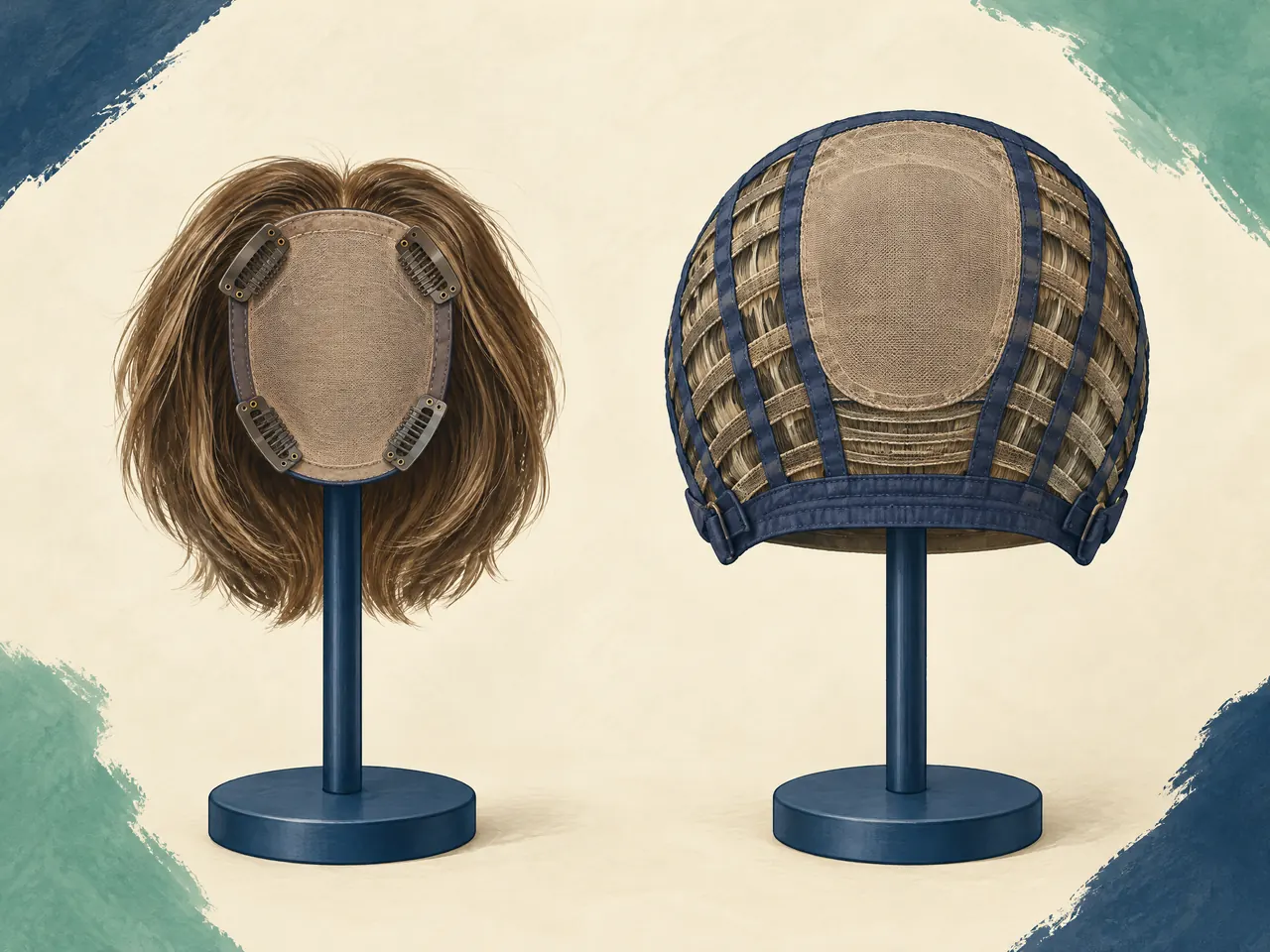
A generic removable topper and an empty full wig cap on separate plain stands with underside construction visible
Illustrative partial and full-cap hairpiece objects support questions about appearance coverage; not actual products, fitting advice or a regrowth result.Generated illustrative image

Clinic enquiries

Contact and appointment arrangements

Clinics
Prince Edward and Kwun Tong
Opening hours
11:00–21:00
WhatsApp and telephone
+852 6940 5663

Appointments, practitioner availability and service arrangements are confirmed via WhatsApp.

Please mention any consultation language needs in your WhatsApp enquiry so that arrangements can be confirmed.

Enquire via WhatsApp
Food, gifts and floral lifeWhatsApp enquiry